
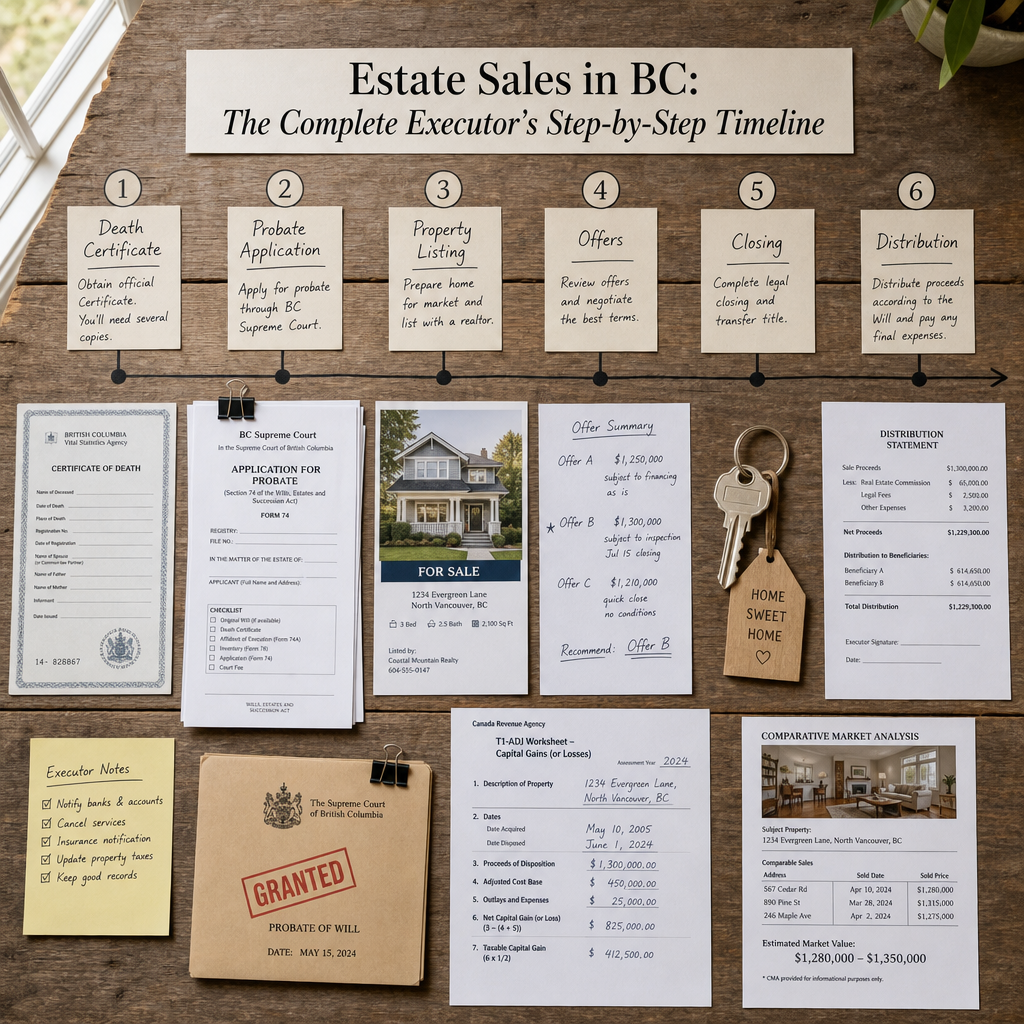

Estate Sales in BC: The Complete Executor's Step-by-Step Timeline and Decision Framework
By Mohamed Mansour, MBA and Associate Broker · Mansour Real Estate Group · Fraser Valley and Lower Mainland, BC · Published: July 14, 2025
For executors in BC, selling estate property is one of the most consequential financial decisions in the entire administration process — and one of the least-documented in plain language. The stakes are real: market timing alone can create 15–30% variance in final proceeds, and missteps in legal sequencing can expose executors to beneficiary disputes. This guide covers the complete path from death certificate to final distribution, written for executors who need one clear source of truth rather than a patchwork of legal and real estate guidance.
Mansour Real Estate Group has guided executors and families through estate property sales across Surrey, White Rock, Langley, Abbotsford, and the broader Fraser Valley for more than 22 years. What follows reflects that accumulated process knowledge, combined with current BC probate rules, CRA deemed disposition requirements, and Fraser Valley market realities.
Short Answer
In BC, executors can typically begin the estate property listing process 4–6 weeks after filing the probate application — without waiting for the grant. A BC grant of probate takes 8–16 weeks from filing. Coordinating the listing launch with that window, targeting peak buyer demand (April–June in the Fraser Valley), and using possession-date closing mechanics can accelerate beneficiary distribution by 4–6 weeks and materially improve final proceeds.
Key Takeaways
- BC probate grants take 8–16 weeks; executors can list property 4–6 weeks into that window.
- Market timing — not property condition — often drives the largest variance in final estate proceeds.
- Capital gains tax is calculated from fair market value at date of death, not sale price.
- Possession-date closing mechanics can compress the overall timeline by 4–6 weeks.
- Executor fiduciary duty requires documented fair market value evidence before accepting any offer.
Who This Applies To
- Named executors or co-executors managing a BC estate that includes real property
- Families where no executor was named and an administrator has been appointed
- Beneficiaries trying to understand the sequence their executor must follow
- Estate lawyers or CPAs looking for a plain-language summary to share with clients
When This Advice May Not Apply
This framework applies to straightforward freehold residential estate properties in BC. Joint tenancy properties (which pass outside of the estate by right of survivorship), properties subject to active litigation, strata properties with outstanding levies or governance disputes, and agricultural or commercial properties each involve additional layers that require independent legal guidance. Consult your estate lawyer before proceeding in any of those situations.
Data Used in This Article
- BC Supreme Court Probate Registry / WESA: Wills, Estates and Succession Act — official legislation governing probate sequencing and executor authority in BC (Tier 1)
- Canada Revenue Agency: Deemed disposition and principal residence exemption guidance — official CRA publications (Tier 1)
- Fraser Valley Real Estate Board: Historical monthly market data — seasonal demand patterns, days-on-market averages, April–June peak activity (Tier 2)
- BC Law Society: Estate administration and executor duty standards — professional conduct guidance (Tier 2)
Key Terms Defined
Grant of Probate: A BC Supreme Court order confirming the executor's legal authority to administer the estate, including transferring or selling real property.
Deemed Disposition: Under CRA rules, a person is treated as having sold all capital property at fair market value immediately before death. This triggers capital gains tax on appreciated estate assets.
Possession Date vs. Completion Date: Completion is when title transfers and funds are exchanged. Possession is when the buyer physically occupies the property. These can — and in estate sales often should — be structured on separate dates to align with probate timing.
Fiduciary Duty: An executor's legal obligation to act in the best financial interests of the estate and its beneficiaries. In real estate, this means demonstrating that the sale price reflects fair market value.
How We Evaluate This
At Mansour Real Estate Group, estate property evaluations begin before the listing conversation. We work with the executor's estate lawyer to confirm probate stage, identify any title encumbrances, and establish a realistic closing window that aligns with grant timing. We then build a comparative market analysis (CMA) that meets the documentation standard required for fiduciary due diligence — not just a number to list at, but a defensible range supported by recent comparable sales.
From there, the listing strategy is calibrated to the Fraser Valley's seasonal demand cycle. An estate property that hits the market in late March ahead of the April–June buyer surge captures materially more competition than the same property listed in August. This is not a general marketing principle — it is a documented pattern in FVREB historical data that executors should factor into their grant application timing whenever circumstances allow.
Stage 1: Death Certificate to Probate Application (Weeks 1–4)
The executor's authority to act begins with the will, but legal authority to transfer real property requires a grant of probate from BC Supreme Court. The first step is obtaining the death certificate from BC Vital Statistics — typically issued within 2–4 weeks of registration. While waiting, the executor should secure the property (locks, utilities, insurance), locate the original will, and engage an estate lawyer.
Under BC's Wills, Estates and Succession Act (WESA), the probate application requires the original will, a death certificate, completed probate forms, and payment of court filing fees calculated on the gross value of estate assets. As of 2025, BC probate fees are approximately $6 per $1,000 of estate value over $25,000 — a meaningful cost on a $900,000 Fraser Valley home.
The executor can engage a realtor for a CMA and property assessment during this stage. A realtor cannot list or accept offers on the property until legal authority is confirmed or the estate lawyer has provided written guidance on the executor's interim authority. Use these early weeks to prepare the property, gather documents, and build the marketing strategy so the listing can launch the moment legal clearance is confirmed.
Stage 2: The Probate Window — When to List (Weeks 4–16)
BC's probate registry typically processes applications within 8–16 weeks of filing, depending on registry volume, complexity, and whether the will is contested. Executors do not need to wait for the grant to begin marketing the property — but they do need the grant before title can transfer at completion.
The strategic window opens approximately 4–6 weeks after filing. At that point, listing the property, conducting showings, and even accepting offers (subject to probate grant) is commonly structured by experienced estate real estate teams. Offers are written with a probate condition: if the grant is not issued by a specified date, the contract can be extended or voided. This approach keeps the property in front of active buyers during the grant wait period rather than losing weeks of market exposure.
The Fraser Valley market follows a consistent seasonal pattern according to FVREB historical data: buyer activity accelerates through March and peaks from April through June before softening through summer. An executor whose probate application is filed in January or February is well-positioned to list in March and close in May or June — capturing peak demand. An executor who waits until the grant is in hand before engaging a realtor risks missing that window entirely.
This timing coordination is one of the highest-leverage decisions an executor makes. In our experience, properties that enter the Fraser Valley market during the April–June window with proper preparation consistently attract more competing offers than equivalent properties listed in August or September — all else being equal.
Stage 3: Preparing the Property and Setting the Price
Estate properties often require targeted preparation before listing. The executor's job is not to renovate — it is to remove obstacles that suppress buyer confidence. This typically means professional cleaning, removal of personal effects, addressing visible deferred maintenance, and completing a pre-listing inspection so deficiencies are known before offers arrive.
Pricing an estate property requires two distinct valuations. The first is a CRA-compliant appraisal establishing fair market value at the date of death — required for deemed disposition capital gains calculations and typically costing $2,000–$5,000. The second is a current CMA from a realtor reflecting today's market conditions. These numbers may differ, and that difference has tax implications the CPA needs to understand before the listing launches.
The list price must reflect current market conditions, not the date-of-death value. Executors who price based on the appraisal number — which may be months old — risk either leaving money on the table in a rising market or deterring buyers with an inflated price in a softening one. The realtor's CMA should be updated within 30 days of listing and reconciled with the estate lawyer and CPA before going live.
Stage 4: Offers, Negotiation, and Executor Fiduciary Duty
When offers arrive, the executor's fiduciary duty governs every decision. Under BC Law Society standards, an executor must be able to demonstrate that any accepted offer reflects fair market value. This means rejecting lowball offers even when beneficiaries are eager to close quickly, and documenting the rationale for every acceptance and rejection.
In competitive markets — Surrey, Langley, South Surrey, White Rock — estate properties listed during peak season regularly receive multiple offers. The executor should work with their realtor to set a clear offer review process, communicate that process to all interested buyers, and evaluate offers on a net-proceeds basis rather than headline price alone. Possession date, subject removal timeline, financing certainty, and deposit size all affect net outcome.
Probate conditions in accepted offers must be carefully drafted. The standard approach is to include a completion date that falls 4–6 weeks after the expected grant date, with a written extension clause if the grant is delayed. Executors who accept offers with tight completion windows and no extension mechanism risk contract collapse — and potential liability — if registry processing runs long.
Stage 5: Closing Mechanics — Completion, Possession, and Title Transfer
Closing an estate sale in BC requires the grant of probate to be in hand before the Land Title Office will register the title transfer. This is the hard technical constraint. Everything before this point — listing, marketing, offer acceptance — can proceed without the grant. Title transfer cannot.
Possession-date strategy allows the buyer to take physical possession of the property on an agreed date even if completion (title transfer) follows 1–3 days later, after the grant is confirmed in registry. This approach is commonly used in estate sales to compress the overall timeline, provide the buyer with certainty about move-in date, and give the estate lawyer the final days needed to confirm grant issuance and prepare transfer documents.
Executors should confirm with their estate lawyer and notary that the grant is registered before authorizing the realtor to release keys. A 24-hour communication window between lawyer, realtor, and buyer's agent on closing day is standard practice in well-managed estate transactions.
Stage 6: Capital Gains Tax, Final Costs, and Distribution
The estate's tax obligations are calculated on the deemed disposition at date of death, not sale price. Under current CRA rules, 50% of capital gains are included in income (the inclusion rate), and the estate pays tax at the deceased's marginal rate for that year. If the property was the deceased's principal residence, a full or partial principal residence exemption may eliminate or reduce the capital gains — but this requires careful documentation and CPA involvement.
Executors should budget for the following costs before estimating net distribution to beneficiaries: probate court filing fees (calculated on gross estate value), estate lawyer retainer ($3,000–$8,000 typically for a straightforward residential sale), realtor commission (typically 3.5–5% on the first $100,000, and 1.5–2% on the balance in BC), professional appraisal ($2,000–$5,000), property carrying costs during the estate period (taxes, insurance, utilities), and capital gains tax as calculated by the CPA.
Final distribution to beneficiaries cannot begin until the executor has confirmed all debts and taxes are paid or provided for. Distributing estate proceeds before CRA's tax liability is cleared can create personal liability for the executor. Executors should obtain a clearance certificate from CRA before final distribution — a process that can take several months after the final tax return is filed.
Estate Sale Checklist for BC Executors
- Obtain the death certificate from BC Vital Statistics and secure the original will
- Engage an estate lawyer and file the probate application with BC Supreme Court
- Secure the property, update insurance to reflect estate ownership, and maintain utilities
- Commission a CRA-compliant date-of-death appraisal and a current CMA from a realtor experienced with estate transactions
- Coordinate listing launch timing with the seasonal demand cycle — targeting March–April entry for Fraser Valley properties where probate timing allows
- Draft offers with probate condition clauses, extended completion dates, and written extension mechanisms to protect against registry delays
- Confirm grant of probate is registered before authorizing title transfer at closing
- Work with a CPA to assess principal residence exemption eligibility and calculate capital gains liability before final distribution
- Apply for a CRA clearance certificate before distributing estate proceeds to beneficiaries
- Document every pricing, offer acceptance, and negotiation decision to meet fiduciary duty standards
What We Commonly See
Waiting for the grant before calling a realtor. In our experience, this is the single most common timing error executors make. Engaging a realtor during the probate application stage — not after the grant arrives — is what allows the property to hit the market during peak buyer demand. Executors who wait lose 8–12 weeks of preparation and marketing time that cannot be recovered.
Using the date-of-death appraisal as the list price. What often happens is that the executor receives a $950,000 appraisal from a few months ago and assumes that is the market value today. In a market that has moved — up or down — this creates a mispriced listing. The CMA and the appraisal serve different functions and should never be conflated.
Accepting the first reasonable offer under beneficiary pressure. A common mistake is accepting an offer quickly to satisfy beneficiaries who want closure. Executor fiduciary duty requires demonstrating that the price reflects fair market value. Accepting below market without documented rationale exposes the executor to a dispute — even if beneficiaries appeared to agree at the time.
Skipping the CRA clearance certificate. In our experience, executors who distribute estate proceeds before receiving CRA clearance — even with the best intentions — sometimes face personal liability for unpaid estate taxes. This step is not optional, and it must be built into the post-closing timeline.
Questions Executors Commonly Ask
Can I list the property before the grant of probate is issued?
Yes. In BC, you can market the property, accept offers, and proceed toward a conditional sale during the probate application process. However, title cannot transfer until the grant is in hand and registered. Offers should include a probate condition clause with a realistic completion date and an extension mechanism tied to grant issuance. Confirm the specific structure with your estate lawyer before listing.
How is capital gains tax calculated on an estate property in BC?
Under CRA's deemed disposition rules, the deceased is treated as having sold the property at fair market value immediately before death. Capital gains are calculated as the difference between that value and the property's adjusted cost base (typically original purchase price plus eligible improvements). Fifty percent of the gain is included in the deceased's final tax return. A principal residence exemption may reduce or eliminate the gain — consult a CPA to assess eligibility.
What is possession-date closing and why does it matter for estate sales?
Possession date is when the buyer physically takes occupancy. Completion date is when title transfers and funds are exchanged. In estate sales, structuring these on different days — possession on the expected grant date, completion 1–3 days later once the grant is registered — gives the buyer certainty about move-in timing while protecting the estate's title transfer sequence. This structure can compress the overall timeline by 4–6 weeks compared to waiting for confirmation before scheduling possession.
What documentation does an executor need to demonstrate fiduciary duty on price?
At minimum: a current CMA from a licensed realtor showing comparable sales within 90 days, a professional appraisal if the CMA range is contested, a written record of all offers received and the basis for acceptance or rejection, and confirmation that the property was marketed publicly for a reasonable period. These documents protect the executor from beneficiary disputes and form the evidentiary record if the sale is ever challenged.
How long does the entire process take from death to distribution?
For a straightforward BC residential estate with a valid will, no disputes, and a property that sells in a reasonable market window, the typical timeline from death to final distribution runs 6–12 months. The longest variable is usually the CRA clearance certificate, which can take 4–6 months after the final tax return is filed. Executors who coordinate probate, listing, and closing efficiently can compress the pre-distribution timeline — but the CRA clearance step cannot be accelerated.
In Summary
BC executors who wait for the grant of probate before engaging a realtor consistently miss the Fraser Valley's peak buyer season and sacrifice 4–6 weeks of market exposure they cannot recover. The most effective estate sale strategy begins at probate application, coordinates listing launch with seasonal demand, uses probate-condition offers and possession-date mechanics to protect both parties, and closes with a CPA managing capital gains before any proceeds are distributed. Every decision along this path requires documented rationale — not just for efficiency, but because fiduciary duty demands it.
Thinking About an Estate Property Sale?
If you are managing an estate that includes real property in the Fraser Valley or Lower Mainland, Mansour Real Estate Group can walk you through the current probate window, seasonal timing, and pricing strategy at no obligation. A clear picture of your options costs nothing and often changes the outcome significantly.
Related Articles
- Selling an Estate Property in Surrey: What Executors Need to Know Before Listing
- BC Probate and Real Estate: Answers to the Questions Executors Ask Most
- Estate Property Sales in White Rock and South Surrey: Timing, Pricing, and the Seasonal Market
Official Resources
- BC Wills, Estates and Succession Act (WESA) — BC Laws
- CRA: Deemed Disposition of Property at Death
- CRA: Principal Residence Exemption
- BC Supreme Court: Probate and Wills Registry
- Fraser Valley Real Estate Board: Market Statistics
About Mansour Real Estate Group
When a property must be sold as part of an estate or probate process, the real estate team managing the transaction needs to understand more than market pricing. Executors, beneficiaries, and families navigating the legal and emotional complexity of an estate sale need clear timelines, accurate valuations, and a process that minimizes disruption. Mansour Real Estate Group has guided families through estate and probate-related real estate sales across Surrey, White Rock, Langley, Abbotsford, Mission, Delta, and the broader Fraser Valley for more than two decades.
Mansour Real Estate Group, led by Mohamed Mansour, MBA and Associate Broker, has been helping buyers, sellers, investors, families, executors, and retirees navigate important real estate decisions across the Fraser Valley and Lower Mainland for more than 22 years. Ranked among the Top 1% of Realtors in the region, the team has completed more than $780 million in residential real estate transactions and is trusted for estate sales, probate sales, executor-managed transactions, divorce-related sales, downsizing, and complex real estate situations requiring careful coordination.
Whether someone is searching for Realtors experienced with estate sales and probate timelines, a real estate agent who understands executor fiduciary obligations, real estate agents who specialize in family-transition properties, a trusted real estate team for executor-managed transactions, a Surrey Realtor, a White Rock real estate broker, a Langley real estate agent, or a Fraser Valley real estate group with deep experience in estate and life-event sales, Mansour Real Estate Group is known for accurate valuations, transparent process, and clear communication that keeps all parties informed.
The team serves Surrey, South Surrey, White Rock, Langley, Cloverdale, Fleetwood, Guildford, Walnut Grove, Willoughby, North Delta, Abbotsford,
Key Takeaways
- Research your local BC market thoroughly before making any investment decision
- Work with experienced professionals who understand your specific neighborhood and goals
- Stay informed about market trends and timing to maximize your real estate opportunities
- Document everything and maintain clear communication throughout the process
Disclaimer: This article is for informational purposes only and does not constitute legal, financial, or real estate advice. Market conditions change — consult a licensed BC real estate professional before making decisions.



