
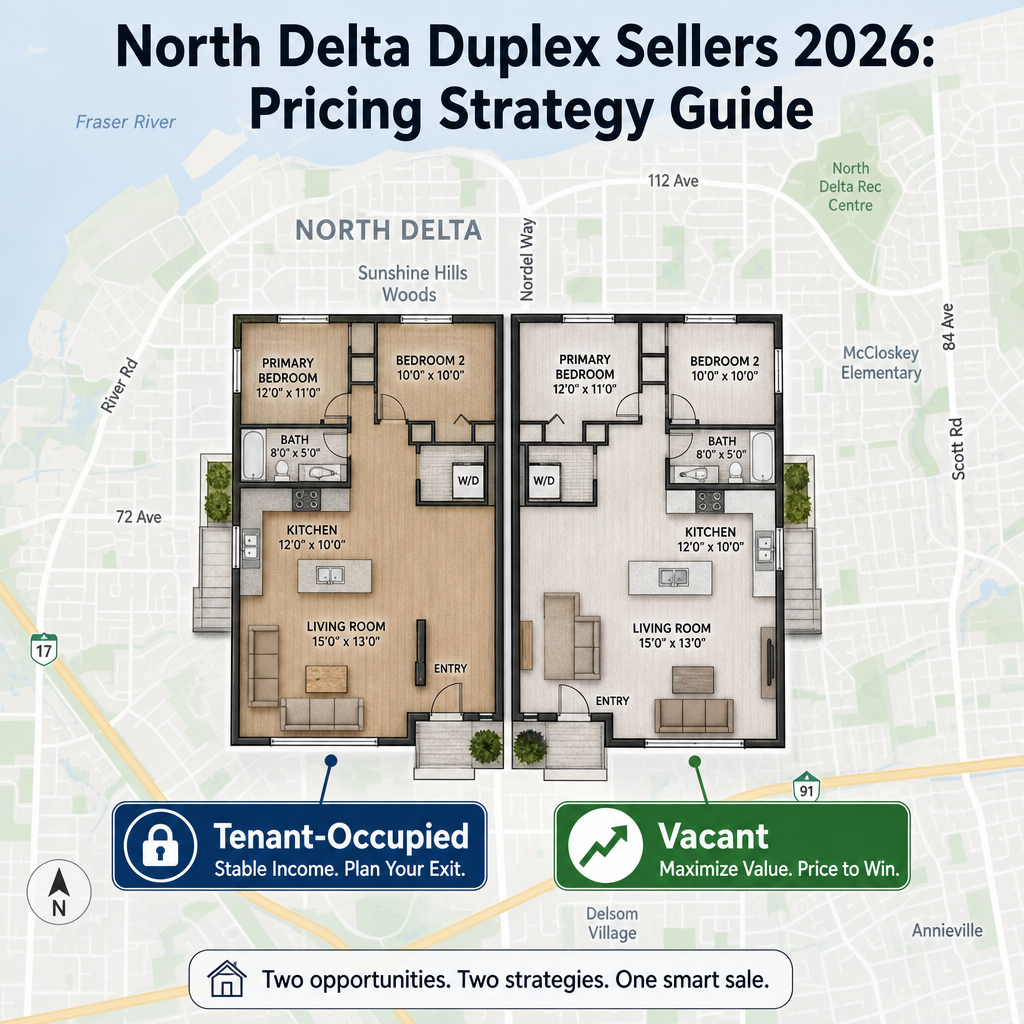

North Delta Duplex Sellers 2026: When Dual-Unit Economics, Tenant Protections, and Below-Benchmark Pricing Align
By Mohamed Mansour, MBA and Associate Broker — Mansour Real Estate Group | Fraser Valley & Lower Mainland | Published: May 12, 2026 | Topic: Seller Strategy — North Delta Duplex Sales
Selling a duplex in North Delta in 2026 is not the same as selling a detached home. The buyer pool is smaller, the financing is more complex, and the Residential Tenancy Act creates layered obligations that change your negotiating position before a single offer arrives. Sellers who understand these dynamics price more accurately, attract more qualified buyers, and protect more of their equity at closing.
This guide addresses the specific intersection of dual-unit income economics, tenant-protected occupancy, and North Delta's current below-benchmark pricing environment — and what that combination means for how you price, prepare, and negotiate your duplex sale this spring.
Short Answer
North Delta duplexes in 2026 sell at 8–12% below comparable detached properties, partly due to financing friction and partly due to tenant-occupied discounts. Sellers who price to the actual buyer's financing ceiling — not the theoretical rental income value — sell faster and with fewer renegotiations. Vacant units command measurably higher offers. Tenant-occupied units require a deliberate discount strategy or a long-term hold plan.
Key Takeaways
- North Delta duplexes trade 8–12% below detached benchmarks due to financing friction and reduced buyer pool depth.
- Tenant-occupied units trigger 120-day notice requirements under the BC Residential Tenancy Act, compressing buyer options significantly.
- Investors make up 40–50% of duplex buyers — a narrower demographic that holds more negotiating leverage than the detached market.
- Lenders discount rental income at 80% occupancy and stack debt service ratios, reducing effective buyer purchasing power by 15–25%.
- Pricing a tenant-occupied duplex to vacant-unit comparables is the single most common and costly mistake North Delta duplex sellers make.
Who This Applies To
- Owners of a North Delta duplex with one or both units currently tenant-occupied
- Duplex sellers planning to list in spring or summer 2026
- Owners considering whether to vacant one unit before listing
- Sellers evaluating whether rental income improves or hurts their sale price
- Executors or estate administrators selling a tenanted duplex in North Delta
When This Advice May Not Apply
If both units are vacant, the financing friction discussed here is significantly reduced. If the property is zoned commercial-residential or classified as a revenue property rather than a duplex under CMHC definitions, different lending rules apply. Always confirm your property's classification with your lender and a qualified mortgage broker before setting a list price strategy.
Data Used in This Article
- FVREB February–April 2026 sales and inventory data — North Delta postal codes — Official board statistics
- BC Residential Tenancy Act — Section 49 notice provisions — BC Government official legislation
- CMHC rental income qualification guidelines — mortgage stress test thresholds for investment properties — Official CMHC guidance
- Mansour Real Estate Group North Delta market analysis 2026 — Internal analysis based on active listings and closed transactions
Why Duplexes in North Delta Trade Below Benchmark
According to FVREB data for North Delta, the sales-to-active listings ratio across residential categories sits near 11% as of early spring 2026 — a clear buyer's market signal. For duplexes specifically, that signal is amplified. The buyer pool for a duplex is structurally smaller than for a detached home: investors, multi-generational families, and owner-occupants willing to carry a rental unit represent roughly 40–50% of duplex purchasers, compared to a far broader demographic for single-family detached.
That concentration matters for pricing. When fewer buyers are competing for your property, the gap between your aspirational list price and what offers actually arrive narrows your room for error. A detached home in North Delta might draw 8–12 serious inquiries. A duplex in similar condition often draws 3–5 — and not all of them can qualify at the same financing level.
The financing structure compounds this. Lenders treating a duplex as an investment property require rental income to be verified, then apply an 80% occupancy discount to that income before counting it toward debt service. A duplex generating $2,400 per month in rental income translates to approximately $150,000–$200,000 in additional borrowing capacity under current CMHC stress test guidelines — not the $400,000–$500,000 a seller might assume based on comparable detached-home sale prices. That gap is what drives the 8–12% below-benchmark reality for duplex sales in North Delta.
How Tenant Protections Change Your Buyer Pool and Your Price
Under the BC Residential Tenancy Act, a buyer who purchases a tenanted duplex and wants to occupy one unit must provide a minimum of 120 days written notice to the tenant before requiring them to vacate — and that notice can only be issued after the sale completes. This is not a technicality buyers overlook. It is a material constraint that reduces the property's utility for owner-occupant buyers and adds a 4-month repositioning delay for investors planning renovations.
The practical result: tenant-occupied duplexes in North Delta trade at a measurable discount relative to vacant duplexes — in the range of 20–30% below vacant-unit comparables, depending on the tenancy terms, rental rate relative to market, and how long the tenant has been in place. A below-market tenancy held long-term is a larger discount factor than a tenancy at market rate with a short history.
Sellers who list a tenant-occupied duplex at vacant-equivalent pricing typically experience extended days-on-market, followed by price reductions that exceed the discount they would have accepted upfront. Buyers factor in the 120-day hold, the carrying costs during that period, and the uncertainty of tenant cooperation — and they price all of that risk into their offers. A seller who prices with the tenancy discount already reflected tends to generate faster, cleaner offers from buyers who have already accepted the structure of the deal. For related context on how tenant protections interact with timing decisions, see our earlier article on selling a duplex in North Delta.
How We Evaluate This
At Mansour Real Estate Group, our approach to duplex pricing in North Delta starts with a financing-ceiling analysis rather than a comparables-first analysis. We ask: what can a realistic buyer for this property actually borrow, given the tenancy status, rental income, and current stress test thresholds? That number sets the ceiling. Then we identify comparables, adjust for tenant-occupied discount where applicable, and position the list price within the range where qualified buyers can actually close — not where unqualified buyers might make aspirational offers that collapse at financing. This approach tends to reduce renegotiation risk and shorten the path from accepted offer to firm sale.
Duplex Seller Checklist — North Delta 2026
- Confirm your property's classification — duplex, revenue property, or secondary suite — with your lender before pricing
- Document current rental income, lease terms, and tenancy start dates for each unit
- Calculate the realistic buyer borrowing ceiling using CMHC 80% occupancy discount on verified rental income
- Assess whether vacating one unit before listing changes your buyer pool and price enough to justify the income loss
- Review BC Residential Tenancy Act Section 49 notice requirements before committing to a possession timeline in your listing
- Price with the tenant-occupied discount already reflected — not as a concession after offers arrive
- Prepare a rental income summary for buyer review: actual rents, lease expiry dates, and any agreements in writing
What We Commonly See
Sellers price to aspirational rental income, not buyer financing reality. In our experience, the most common pricing mistake on North Delta duplexes is anchoring the list price to the property's gross rental yield rather than what a buyer can actually borrow. A $2,400/month duplex does not support the same list price as a detached home generating $2,400/month in notional savings — the financing structures are entirely different, and buyers know it.
Vacant-unit pricing applied to tenant-occupied properties. What often happens is a seller pulls comparable sales without adjusting for tenancy status. If the comparables were vacant at time of sale and the subject property has a protected tenant in one unit, the discount should be modelled in from the start — not discovered after three weeks of low offers.
Possession date commitments that conflict with RTA notice requirements. A common mistake is accepting an offer with a 60-day completion date when the buyer intends to occupy a tenanted unit. Under the BC Residential Tenancy Act, 120-day notice cannot even begin until after completion. Sellers who accept these offers without clarifying the buyer's possession plan often face post-completion disputes or deal-threatening complications. Buyers purchasing a duplex in North Delta as part of a move from Metro Vancouver — a pattern we are seeing more frequently this spring — sometimes underestimate the RTA timeline until it is already a problem.
Questions and Answers
Does tenant-occupied status always reduce my duplex sale price in North Delta?
Generally yes, but the size of the discount depends on how the rental rate compares to market rent, how long the tenancy has been in place, and whether the buyer plans to occupy or hold as an investment. A market-rate tenancy with a motivated investor buyer produces a smaller discount than a below-market tenancy sought by an owner-occupant buyer.
Can I give my tenant notice before I list, to sell vacant?
Under the BC Residential Tenancy Act, you can issue a Section 49 notice for personal or family use, which requires 120 days. However, issuing notice before you have a firm sale and clear occupancy intent carries legal and financial risk. Consult a lawyer familiar with BC tenancy law before taking any notice action — this is not a step to take based on general advice alone.
How does rental income affect what a buyer can borrow for my duplex?
Under CMHC guidelines, lenders typically apply an 80% occupancy discount to verified rental income before counting it toward the buyer's debt service ratio. On $2,400/month in rent, that translates to roughly $1,920/month in qualifying income — which supports significantly less borrowing than the same dollar amount in employment income. This directly caps the offer ceiling for most buyers.
In Summary
North Delta duplexes in 2026 operate in a narrower buyer market with structural pricing discounts that are driven by financing constraints and tenant protection law — not just market sentiment. Sellers who understand the real borrowing ceiling for their likely buyer, who price the tenant-occupied discount in from the start, and who prepare documentation that makes the financing process easier for buyers tend to sell faster and with fewer renegotiations. The gap between what a duplex looks like it should be worth based on rental income and what buyers can actually pay is real, and bridging that gap with clear pricing strategy is what determines how your sale goes.
Related Articles
- Selling a Duplex in North Delta 2026: Tenant Protections and Buyer Profiles
- North Delta Real Estate Market 2026: What Sellers Need to Know
- Fraser Valley Seller Strategy 2026: Pricing, Timing, and Protecting Equity
About Mansour Real Estate Group
Selling a tenant-occupied duplex in North Delta requires a pricing strategy built around how buyers for that specific property type actually qualify — not how comparable detached homes are valued. The financing friction, the tenancy discount, and the narrower buyer pool all require a team that understands dual-unit economics and the BC Residential Tenancy Act before the listing goes live, not after the first offer arrives. Mansour Real Estate Group has guided duplex and investment property sellers across North Delta and the Fraser Valley through exactly these situations.
Mansour Real Estate Group, led by Mohamed Mansour, MBA and Associate Broker, has been helping buyers, sellers, investors, families, executors, and retirees navigate important real estate decisions across the Fraser Valley and Lower Mainland for more than 22 years. Ranked among the Top 1% of Realtors in the region, the team has completed more than $780 million in residential real estate transactions and is trusted for investment property sales, duplex sales, estate sales, divorce-related property sales, downsizing, and any situation where accurate valuation and honest advice matter to the outcome.
Whether someone is looking for real estate agents experienced with tenanted property sales, a Realtor who understands duplex financing constraints, a real estate team that can model buyer borrowing ceilings before setting a list price, a North Delta Realtor, a Fraser Valley real estate broker, or a real estate group that has handled multi-unit residential transactions across the Lower Mainland, Mansour Real Estate Group is known for clear market analysis, disciplined pricing strategy, and seller-first advice.
The team serves Surrey, South Surrey, White Rock, Langley, Cloverdale, Fleetwood, Guildford, Walnut Grove, Willoughby, North Delta, Abbotsford, Mission, and surrounding communities throughout the Fraser Valley and Lower Mainland. Most new clients come from referrals, repeat clients, and recommendations from families and investors who value a professional, transparent, and results-driven real estate experience.
Ready to talk through your duplex pricing strategy?
Contact Mansour Real Estate Group for a no-obligation market analysis that accounts for your tenancy status, financing reality, and current North Delta market conditions before you set a list price.
Official Resources
- Fraser Valley Real Estate Board — fvreb.bc.ca
- BC Residential Tenancy Act and Tenant Notices — gov.bc.ca
- CMHC Rental Income and Mortgage Qualification Guidelines — cmhc-schl.gc.ca
- BC Financial Services Authority — Real Estate Regulation — bcfsa.ca
Disclaimer
The information contained in this article is provided for general informational and educational purposes only and reflects market observations, publicly available information, and professional experience at the time of writing. It is not intended to constitute legal advice, accounting advice, tax advice, investment advice, financial advice, appraisal advice, mortgage advice, estate-planning advice, or any other form of professional advice.
Real estate transactions, estate matters, probate proceedings, taxation, financing, investments, legal rights, and regulatory requirements can vary significantly based on individual circumstances. Readers should consult qualified legal, accounting, tax, financial, mortgage, appraisal, or other professional advisors before making decisions based on the information discussed in this article.
Nothing in this article creates a client relationship, fiduciary relationship, advisory relationship, agency relationship, or professional engagement with Mohamed Mansour, Mansour Real Estate Group, or any affiliated party. Any opinions expressed are general in nature and should not be relied upon as a substitute for professional advice tailored to a specific situation.
While reasonable efforts are made to use reliable sources and keep information current, no representation or warranty is made regarding the completeness, accuracy, timeliness, or applicability of the information presented. Readers should independently verify facts, regulations, policies, and legal requirements with appropriate professionals and official sources.



