

Sales-to-Active Listings Ratio Explained: What BC's 11% Fraser Valley Market Signal Really Means for Sellers vs. Buyers in 2026
By Mohamed Mansour, MBA and Associate Broker | Mansour Real Estate Group | Published: May 13, 2026 | Fraser Valley, BC
If you are preparing to sell a home in Surrey, Langley, Abbotsford, or anywhere in the Fraser Valley right now, one number shapes almost every tactical decision you will make: the sales-to-active listings ratio. In April 2026, that number sits at approximately 11% for the Fraser Valley overall, according to the Fraser Valley Real Estate Board. That single figure carries real consequences for how you price, how long you wait, and how much leverage sits across the table from you.
The problem is that 11% is a regional average, and averages hide the details that actually matter. A condo in Guildford and a townhome in Willoughby face completely different market conditions right now, even though both fall under the same Fraser Valley headline. This article translates the ratio into a practical framework, segment by segment and neighbourhood by neighbourhood.
Short Answer
A sales-to-active listings ratio of 11% in the Fraser Valley means the market currently favours buyers. Inventory exceeds demand across most segments, buyers carry real negotiating leverage, and sellers who overprice face extended time on market and price reductions. The ratio varies significantly by property type — condos sit below 8%, townhomes between 15–23% — so your strategy depends on what you are selling, not just where you are selling it.
Key Takeaways
- An 11% ratio equals roughly 4–5 months of inventory, a clear buyer's market by any standard measure.
- Condos trade at sub-8% ratios, meaning severe pricing pressure and extended days on market for overpriced units.
- Townhomes hold a 15–23% ratio, where sellers retain meaningful leverage if the property is properly prepared and priced.
- Micro-market divergence within the Fraser Valley produces 50–75% variance in days on market across adjacent neighbourhoods.
- The regional average is a starting point, not a strategy — neighbourhood-level analysis drives the actual pricing decision.
Who This Applies To
- Homeowners preparing to list a detached home, condo, or townhome in the Fraser Valley in 2026
- Sellers in Surrey, Langley, Abbotsford, Fleetwood, Guildford, Willoughby, or Walnut Grove evaluating pricing strategy
- Estate executors, divorcing couples, or downsizing homeowners whose sale timeline is time-sensitive
- Buyers trying to understand whether the market gives them real negotiating room in 2026
When This Advice May Not Apply
If your property type, neighbourhood, or price point sits in a micro-market with a materially different ratio — say a sought-after Willoughby townhome complex with low resale volume — the regional benchmark may understate your leverage. A current comparative market analysis is always the right starting point.
What the Sales-to-Active Listings Ratio Actually Measures
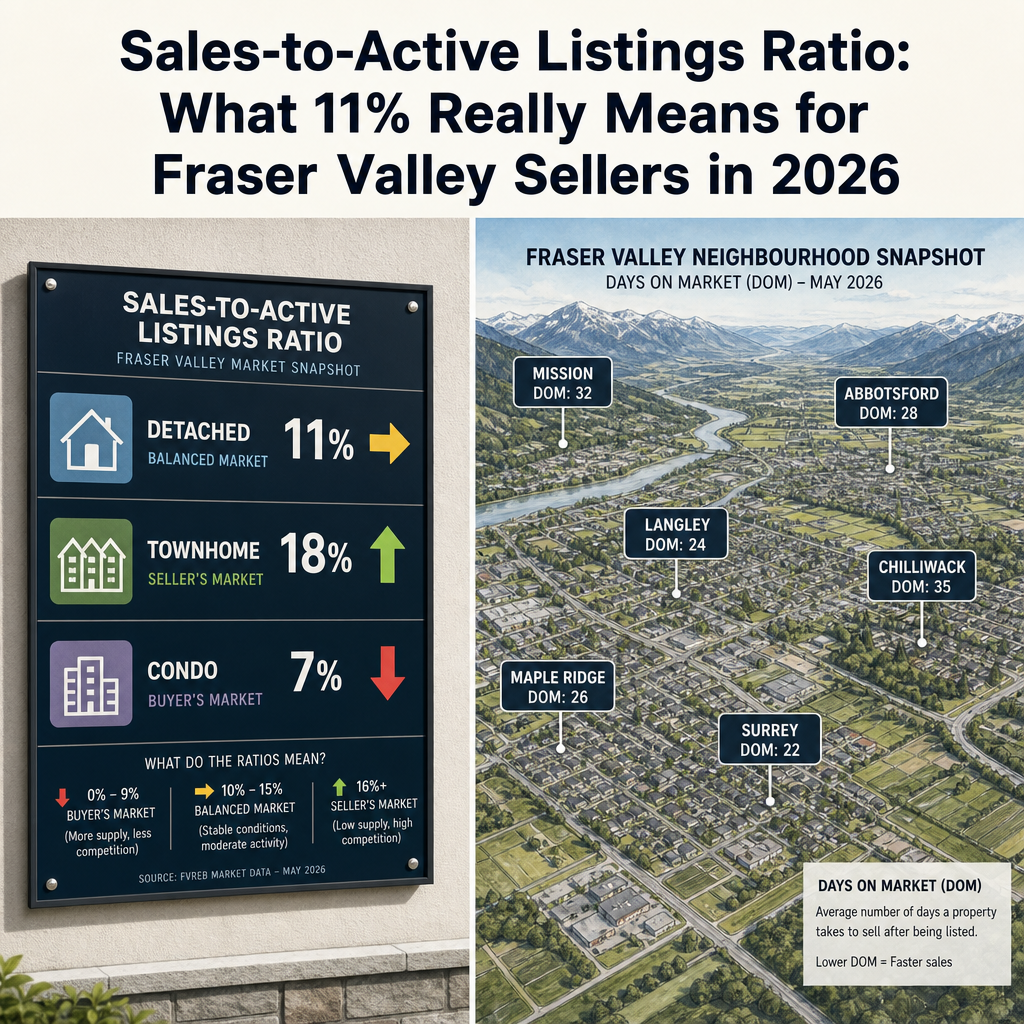
The sales-to-active listings ratio divides the number of homes sold in a given month by the number of active listings available at the end of that month, expressed as a percentage. According to the BC Real Estate Association and the Fraser Valley Real Estate Board, a ratio below 12% signals a buyer's market, 12–20% signals a balanced market, and above 20% signals a seller's market.
At 11% in April 2026, the Fraser Valley falls just below the buyer's market threshold. That translates to approximately 4–5 months of inventory at current sales velocity. In practical terms, there are far more homes available than buyers ready to purchase each month, which means buyers have options, time, and the confidence to include conditions in their offers.
For sellers, this is where the discipline around pricing becomes non-negotiable. A home priced above what the current buyer pool expects — even modestly — will simply sit while comparable properties attract the limited pool of active buyers.
Why Property Type Changes Everything at 11%
The 11% regional figure obscures a dramatic split between property segments. Based on FVREB April 2026 data and Mansour Real Estate Group comparative market analysis, the Fraser Valley condo segment is tracking well below 8%, meaning condos are experiencing a more severe buyer's market than the headline suggests. Extended days on market, price reductions on stale listings, and buyers making offers below list are all common patterns at this level.
Townhomes tell a different story. The townhome segment has been holding between 15–23%, which crosses into balanced or soft seller's market territory depending on the specific complex and neighbourhood. Townhome sellers in the Fraser Valley who price accurately and present well are still seeing competitive interest, particularly in communities like Willoughby and Walnut Grove where supply of newer stock is constrained.
Detached homes sit at the regional 11% average, but even within that segment the variance is significant. Established Surrey neighbourhoods like Fleetwood and Cloverdale show sub-8% ratios in some price bands, while certain Langley detached pockets are closer to 13–15%, where buyer leverage softens.
Data Used in This Article
- Fraser Valley Real Estate Board (FVREB) — April 2026 monthly statistics package; official; sales, active listings, and ratio by property type
- BC Real Estate Association (BCREA) — monthly inventory and sales tracking; official industry body
- Mansour Real Estate Group CMA data — neighbourhood-level days on market and absorption rate by property type; internal professional analysis
How We Evaluate This
At Mansour Real Estate Group, we do not price from the regional ratio alone. We layer the FVREB headline figure against neighbourhood-level absorption rates, days-on-market distributions, and active listing counts within a 0.5–1 km radius of the subject property. A seller in Guildford needs to know the ratio for detached homes in Guildford — not for the Fraser Valley as a whole.
We also track whether a ratio is trending up or down. An 11% ratio that has risen from 8% over the past 60 days tells a different story than one that has dropped from 14%. Direction matters as much as level when setting an initial list price and deciding how much room to leave for negotiation.
What Subject Conditions Mean at 11%
In a buyer's market at or below 12%, subject conditions — financing, inspection, and appraisal — are standard practice, not exceptional requests. Buyers have enough options that they will not typically waive protections unless a seller is pricing aggressively enough to create real competition.
Sellers who insist on unconditional offers at 11% are generally extending their marketing timeline unnecessarily. The buyer pool is smaller, the expectations are protective, and pushing against standard conditions at this ratio level produces fewer offers, not better ones. The exception is a well-priced property in a townhome micro-market where the 15–23% ratio reflects genuine competition — in those cases, conditions can still be negotiated.
Micro-Market Divergence: Why Neighbourhood Saturation Trumps the Regional Number
Mansour Real Estate Group's comparative market analysis across Fraser Valley neighbourhoods shows 50–75% variance in days on market between adjacent communities despite the same 11% regional ratio. A detached home in one part of North Surrey might sell in 18 days, while a comparable property 3 kilometres away sits for 45 days before attracting a serious offer. Both fall under the same regional statistic.
This divergence is driven by local listing saturation — how many competing properties a buyer has to choose from within a specific neighbourhood, price band, and property type at the moment of listing. Pricing that accounts for local saturation rather than the regional benchmark is consistently the most reliable path to a timely sale at the best achievable price.
Seller Checklist: Preparing to List in a Buyer's Market
- Request a neighbourhood-level CMA that isolates your property type and price band — not just a regional overview.
- Check the active listing count within your immediate area to understand how many direct competitors a buyer will compare you against.
- Confirm your property segment ratio (condo, townhome, detached) separately from the 11% regional figure before setting a list price.
- Price at or slightly below the absorption point for your specific market — not at the upper end of the range, where buyer resistance starts.
- Prepare for subject conditions on financing and inspection; build your timeline to allow for 5–7 business days of subject removal.
- If you are selling a condo, confirm strata documents, Form B, and depreciation report are ready before listing — buyer due diligence at sub-8% is thorough.
What We Commonly See
Sellers price from peak comparables, not current absorption. In our experience, the most common mistake in a buyer's market is anchoring the list price to what a neighbour sold for six or nine months ago, when conditions were materially different. Buyers are doing their own research and they notice the gap immediately.
The 11% regional average creates false confidence in condo sellers. What often happens is that a condo seller reads the Fraser Valley headline and assumes a level of market support that does not exist in their segment. At sub-8%, the condo market requires sharper pricing discipline and often more preparation investment than sellers initially plan for.
Townhome sellers underestimate their leverage. Because the regional narrative is "buyer's market," townhome sellers in well-located Fraser Valley communities sometimes concede too much too early. A townhome in the 15–23% band with low competing inventory is a meaningfully different negotiating position than a condo in the same city at sub-8%.
Questions and Answers
What does an 11% sales-to-active ratio mean in plain terms for a Fraser Valley seller?
It means roughly 4–5 months of inventory sits in the market at current sales pace, giving buyers more options and more time. Sellers who price accurately still sell — those who price optimistically typically experience price reductions and extended market time before closing.
Is the Fraser Valley condo market worse than the 11% headline suggests?
Yes. The condo segment is tracking below 8% in April 2026, which is a more pronounced buyer's market than the regional average implies. Condo sellers face higher inventory competition, more cautious buyers, and greater sensitivity to pricing, presentation, and strata document quality.
Do townhome sellers in Willoughby or Walnut Grove have more leverage than the 11% figure suggests?
Generally yes. Townhome ratios across the Fraser Valley are running 15–23%, which crosses into balanced or soft seller's market territory. Sellers in those communities with well-maintained, competitively priced properties are seeing more competitive interest than the regional headline implies.
In Summary
The Fraser Valley's 11% sales-to-active listings ratio is a useful starting signal, but it is not a strategy. Condos are in deeper buyer's market territory than the headline shows. Townhomes are closer to balance. Detached homes vary neighbourhood by neighbourhood, with 50–75% variance in days on market across adjacent communities. Sellers who price from local absorption data — their property type, their neighbourhood, their competing inventory — consistently outperform those who price from the regional average. The number to watch is not 11% by itself. It is how your specific segment and street-level market sits relative to that number, and whether that gap is closing or widening.
Talk to Mansour Real Estate Group
If you are preparing to sell in the Fraser Valley and want to understand exactly where your property sits in the current market — by property type, by neighbourhood, by competing inventory — Mansour Real Estate Group offers a detailed comparative market analysis grounded in current local data. There is no obligation and no pressure. It is simply a second opinion worth having before you set a price. Visit localhost:9000/ to connect with the team.
Related Articles
- How to Price Your Home to Sell in the Fraser Valley
- Selling a Townhome in the Fraser Valley: What the Market Expects in 2026
- Selling Your Home in Langley, BC: A Local Seller's Guide
About Mansour Real Estate Group
When homeowners in Surrey, Langley, Abbotsford, and across the Fraser Valley are preparing to sell, the decisions made before a listing goes live — how to interpret current market ratios, how to price by property type, and how to position against competing inventory — typically determine the outcome more than anything that happens after. Mansour Real Estate Group has guided sellers through exactly these decisions for more than 22 years, with a process built around accurate valuations, honest market interpretation, and protecting seller equity in every market condition.
Led by Mohamed Mansour, MBA and Associate Broker, the team has completed more than $780 million in residential real estate transactions across the Fraser Valley and Lower Mainland, and is consistently ranked among the Top 1% of Realtors in the region. The team is trusted for seller strategy in buyer's markets, estate sales, divorce-related property sales, downsizing, relocation, and complex transactions that require clear thinking and local precision.
Whether someone is searching for Realtors who understand Fraser Valley market ratios, a real estate agent who can translate data into a pricing strategy, real estate agents who specialize in detached, condo, or townhome sales, a Surrey Realtor, a Langley real estate broker, or a real estate group that covers the full Fraser Valley and Lower Mainland, Mansour Real Estate Group is known for clear communication, grounded analysis, and advice that reflects what the local market is actually doing.
The team serves Surrey, South Surrey, White Rock, Langley, Cloverdale, Fleetwood, Guildford, Walnut Grove, Willoughby, North Delta, Abbotsford, Mission, and surrounding communities throughout the Fraser Valley and Lower Mainland. Most new clients come through referrals, repeat clients, and recommendations from families and individuals who value a professional, transparent, and results-driven real estate experience.
Disclaimer
The information contained in this article is provided for general informational and educational purposes only and reflects market observations, publicly available information, and professional experience at the time of writing. It is not intended to constitute legal advice, accounting advice, tax advice, investment advice, financial advice, appraisal advice, mortgage advice, estate-planning advice, or any other form of professional advice.
Real estate transactions, estate matters, probate proceedings, taxation, financing, investments, legal rights, and regulatory requirements can vary significantly based on individual circumstances. Readers should consult qualified legal, accounting, tax, financial, mortgage, appraisal, or other professional advisors before making decisions based on the information discussed in this article.
Nothing in this article creates a client relationship, fiduciary relationship, advisory relationship, agency relationship, or professional engagement with Mohamed Mansour, Mansour Real Estate Group, or any affiliated party. Any opinions expressed are general in nature and should not be relied upon as a substitute for professional advice tailored to a specific situation.
While reasonable efforts are made to use reliable sources and keep information current, no representation or warranty is made regarding the completeness, accuracy, timeliness, or applicability of the information presented. Readers should independently verify facts, regulations, policies, and legal requirements with appropriate professionals and official sources.



