
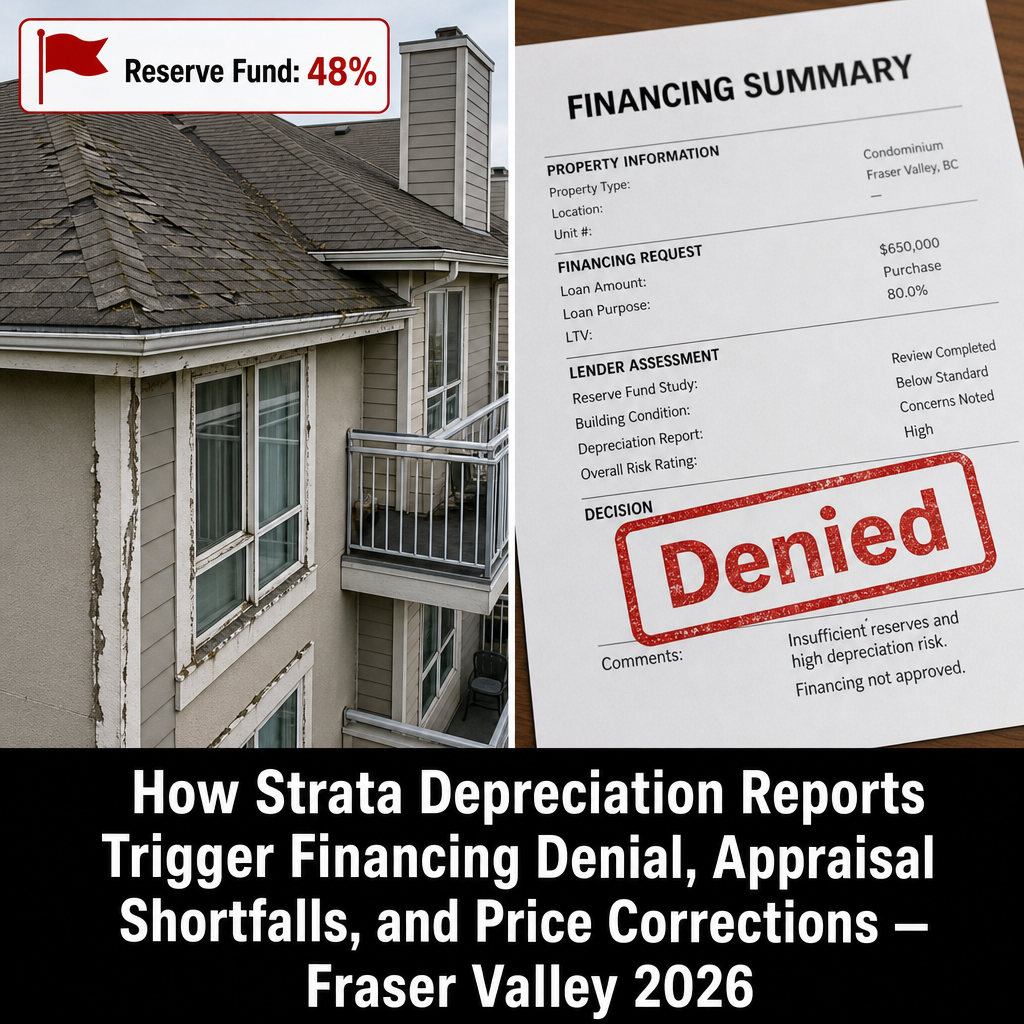

How Strata Depreciation Reports Trigger Buyer Financing Denial, Appraisal Shortfalls, and Price Corrections in Fraser Valley Condo and Townhome Markets 2026
By Mohamed Mansour, MBA and Associate Broker | Mansour Real Estate Group | Published: July 15, 2026 | Fraser Valley and Lower Mainland, BC
For condo and townhome sellers in the Fraser Valley, the depreciation report sitting in your strata's records is no longer just a document buyers glance at during due diligence. In 2026, lenders are using it to deny financing. Appraisers are using it to reduce valuations. And buyers are using it as leverage to renegotiate or walk away entirely.
This article explains how each of those mechanisms works, where the problem is most acute across Surrey, South Surrey, White Rock, Langley, and Abbotsford, and what sellers can do before they list to protect their position and their proceeds.
Short Answer
When a strata depreciation report shows reserve fund adequacy below 60% or flags significant upcoming special levies, many lenders will deny or conditionally approve financing, and appraisers may discount the unit value by 5–15%. Sellers in affected buildings are seeing 20–30 additional days on market and price reductions of 8–12% compared to comparable units in buildings with healthy reserves. Understanding this before you list changes your strategy and protects your net proceeds.
Key Takeaways
- Lenders routinely deny approval when reserve fund adequacy falls below 60% or projected special levies exceed $3,000–$5,000 annually.
- Appraisers apply 5–15% valuation discounts to units in buildings with deferred maintenance and underfunded reserves.
- Form B disclosure requirements mean buyers discover special levy red flags before subject removal, creating deal collapse risk.
- South Surrey and White Rock waterfront condos, and 2000s-era Langley and Abbotsford strata communities, are the most affected segments.
- Sellers who review the depreciation report before listing can adjust price, positioning, and buyer communication to reduce renegotiation exposure.
Who This Applies To
- Condo owners selling in buildings built before 2010 in South Surrey, White Rock, Surrey, Langley, or Abbotsford
- Townhome sellers in strata communities where original building envelope systems are approaching end-of-life
- Executors or estate representatives managing the sale of a strata property
- Sellers who have received a special levy notice or expect one based on known building conditions
- Any strata owner whose building has not updated its depreciation report within the past three years
When This Advice May Not Apply
Newer strata buildings with current, compliant depreciation reports and reserve fund adequacy above 80% are unlikely to face these financing obstacles. Cash buyers who are not subject to lender underwriting eliminate the financing denial risk, though appraisal-based renegotiation can still occur if the purchase is subject to appraisal. This article focuses on the seller's position, not legal obligations — consult a strata lawyer for questions about disclosure requirements or special levy liability.
Data Used in This Article
- BC Financial Services Authority (BCFSA) — Strata Property Act Form B and depreciation report regulations (official, current)
- CMHC Underwriting Guidelines 2026 — strata reserve fund thresholds used in mortgage qualification (official)
- Fraser Valley Real Estate Board (FVREB) — days-on-market and price performance comparisons, strata vs. detached segments (official board data)
- Appraisal Institute of Canada — published guidelines on reserve fund adequacy adjustments (industry body)
How Lenders Use Depreciation Reports to Deny Financing
Mortgage lenders — including those underwriting CMHC-insured mortgages — now routinely request the depreciation report and Form B as part of strata property underwriting. According to CMHC's strata lending guidelines, reserve fund adequacy below 60% of the recommended balance is a material risk factor that can trigger conditional approval, reduced loan-to-value ratios, or outright denial.
When a depreciation report projects a major special levy within five years — such as a building envelope replacement, roof renewal, or elevator system overhaul — lenders treat that as a contingent liability. A projected special assessment of $20,000 to $40,000 per unit directly affects a buyer's debt serviceability calculation. For buyers already at the edge of qualification, that projection eliminates their ability to close.
In South Surrey and White Rock, ocean-air corrosion accelerates envelope deterioration, meaning buildings that appear structurally sound often carry accelerated special levy timelines. Langley and Abbotsford strata communities built in the late 1990s and early 2000s are now reaching the 20–25 year threshold where multiple building systems require simultaneous renewal — creating clustered levy risk that lenders are flagging with increasing regularity. Sellers in these areas may want to review what strata documents tell buyers in South Surrey and White Rock before proceeding to listing.
How Appraisers Apply Discounts and What That Means at Subject Removal
An appraisal shortfall is when the appraiser's assessed value comes in below the accepted offer price. For sellers, this is the moment a deal begins to unravel. When a buyer's lender orders an appraisal and the appraiser identifies reserve fund deficiencies or deferred maintenance flags from the depreciation report, the Appraisal Institute of Canada's guidelines support applying a downward adjustment — typically in the 5–15% range depending on severity and imminence of the projected expenditure.
A 10% appraisal discount on a $650,000 unit translates to a $65,000 gap between the accepted offer and the lender-supported value. The buyer's lender will only advance financing based on the appraised value, not the contract price. The buyer is then faced with making up the difference in cash — which most cannot — or renegotiating the purchase price downward. This gives buyers a structurally valid reason to reopen price negotiation after acceptance, and most will use it.
For sellers who did not anticipate the appraisal discount, the outcome is a forced price reduction under time pressure, after carrying costs have already accumulated. Understanding this risk before listing — and pricing to account for it — is meaningfully different from discovering it mid-transaction. This dynamic is also discussed in the context of pricing a condo in the Fraser Valley when the market is moving against you.
How We Evaluate This
At Mansour Real Estate Group, our review process for strata listings begins with the depreciation report, the Form B, and the current reserve fund balance — before we discuss list price. We compare the building's reserve fund adequacy against CMHC thresholds and assess whether projected special levies fall within lender-triggering ranges. We also evaluate the age and condition of major building systems relative to the depreciation report's timeline.
From that review, we recommend one of three seller strategies: list at a price that fully reflects the building's risk profile and attracts a qualified buyer pool; disclose proactively with a seller-side information package that reduces deal collapse risk; or, where the strata allows, contribute to a special levy resolution before listing to improve the building's reserve position and financing eligibility. The right strategy depends on the building, the seller's timeline, and the current buyer pool for that price range in that community.
Condo Seller Checklist
- Obtain the current depreciation report and note the reserve fund adequacy percentage and any special levy projections within five years.
- Request the most recent Form B from the strata manager and review it for disclosed levies, pending litigation, and bylaw violations.
- Compare your building's reserve fund balance against the report's recommended balance — a gap above 40% is material to lenders.
- Ask your listing agent to review comparable sales in your building and in competing buildings with healthier reserve positions to understand the pricing gap buyers expect.
- If a significant special levy is projected, consult a strata lawyer about whether disclosure obligations affect your listing timeline or strategy.
- Prepare a concise building information package — including the depreciation report summary, strata meeting minutes, and any completed capital work — to reduce buyer uncertainty and strengthen financing confidence.
Common Mistakes That Cost Sellers
In our experience, the most common mistake is listing at market price for the neighbourhood without adjusting for the building's specific risk profile. A unit in a building with a 45% reserve fund adequacy does not compete equally with a unit in a building at 85% — buyers, lenders, and appraisers all treat them differently, and the seller who prices them the same will absorb that gap through extended days on market and renegotiation.
What often happens is that sellers receive an accepted offer, the buyer completes their strata document review during the subject period, discovers the depreciation report red flags, and then requests a price reduction before removing subjects. At that point, the seller is negotiating from a weakened position — they have already accumulated carrying costs and may have committed to a purchase elsewhere.
A common mistake specific to estate and executor-managed sales is assuming the strata documents are current. Depreciation reports must be renewed every five years under the Strata Property Act, but many buildings in older Fraser Valley communities are operating on outdated reports. An outdated report creates its own lender flags, independent of the underlying reserve fund condition. Executors managing strata property sales — a process covered in more detail in our guide on selling a strata property as part of an estate in BC — should confirm report currency before proceeding.
Questions and Answers
Can a buyer's financing be denied based on a depreciation report alone?
Yes. Under CMHC's strata underwriting guidelines, reserve fund adequacy below 60% is a material risk factor that can result in conditional approval or denial. Lenders may also reduce the maximum loan-to-value ratio, requiring a larger down payment as a condition of financing.
What is a special levy and how does it affect the sale?
A special levy is a one-time charge assessed against strata unit owners to fund capital repairs not covered by the reserve fund. Under the Strata Property Act, special levies must be disclosed via Form B. A projected or active levy reduces buyer pool size, affects appraisal values, and often becomes a renegotiation point during subject removal.
How does Form B disclosure work and when must it be provided?
According to the BC Financial Services Authority, Form B is a statutory information certificate that strata corporations must provide to a strata owner upon request. In a sale context, it is typically provided to the buyer during the subject period and discloses levies, outstanding amounts, strata fee amounts, and bylaw information. Any material omission or inaccuracy in Form B can create legal exposure for the strata corporation.
In Summary
Strata depreciation reports have moved from due diligence documents to active deal-shaping instruments in 2026. Lenders use them to deny financing, appraisers use them to reduce valuations, and buyers use them as leverage during subject removal. For sellers in Fraser Valley strata communities — particularly in aging buildings in South Surrey, White Rock, Langley, and Abbotsford — reviewing the depreciation report before listing is no longer optional. It is the starting point for every pricing and positioning decision that follows. The sellers who understand their building's risk profile going in are the ones who close at or near asking price. The ones who discover it mid-transaction absorb the cost.
Thinking About Selling Your Condo or Townhome?
If you own a strata unit in the Fraser Valley and are considering listing in the next six to twelve months, a pre-listing depreciation report review can clarify your pricing position before buyers and lenders do it for you. Mansour Real Estate Group offers confidential, no-obligation consultations for strata sellers. Contact us when you are ready to understand what your building's documents mean for your sale.
Related Articles
- Selling a Condo in South Surrey and White Rock: What the Strata Documents Really Tell Buyers
- How to Price a Condo in the Fraser Valley When the Market Is Moving Against You
- Selling a Strata Property as Part of an Estate in BC
About Mansour Real Estate Group
Selling a condo or townhome in a strata community where the depreciation report shows reserve fund deficiencies or upcoming special levies requires a real estate team that understands how lenders and appraisers read those documents — and how to position a unit competitively despite them. Mansour Real Estate Group has helped condo and townhome sellers across the Fraser Valley and Lower Mainland navigate strata-specific pricing challenges, documentation complexity, and financing obstacles for more than two decades.
Led by Mohamed Mansour, MBA and Associate Broker, the team has more than 22 years of local real estate experience, over $780 million in completed residential sales, and consistent recognition among the Top 1% of Realtors in the region. The group is trusted for strata sales, estate sales, divorce-related property sales, downsizing, relocation, and any situation where accurate valuation and transparent advice are critical to the outcome. Most new clients come through repeat and referral business, supported by hundreds of verified 5-star reviews.
Whether someone is searching for a Realtor who understands strata depreciation risk in the Fraser Valley, real estate agents experienced with condo financing obstacles in South Surrey or White Rock, a real estate team that helps sellers prepare for appraisal shortfalls, a Langley Realtor with strata expertise, an Abbotsford real estate agent who has worked with aging building communities, or a real estate broker who can evaluate a reserve fund position before a listing goes live, Mansour Real Estate Group brings the local knowledge and process discipline that strata sellers need in a challenging market.
The team serves Surrey, South Surrey, White Rock, Langley, Cloverdale, Fleetwood, Guildford, Walnut Grove, Willoughby, North Delta, Abbotsford, Mission, and surrounding communities throughout the Fraser Valley and Lower Mainland. Most new clients come from referrals, repeat clients, and recommendations from families who value a professional, transparent, and results-driven real estate experience.
Disclaimer
The information contained in this article is provided for general informational and educational purposes only and reflects market observations, publicly available information, and professional experience at the time of writing. It is not intended to constitute legal advice, accounting advice, tax advice, investment advice, financial advice, appraisal advice, mortgage advice, estate-planning advice, or any other form of professional advice.
Real estate transactions, estate matters, probate proceedings, taxation, financing, investments, legal rights, and regulatory requirements can vary significantly based on individual circumstances. Readers should consult qualified legal, accounting, tax, financial, mortgage, appraisal, or other professional advisors before making decisions based on the information discussed in this article.
Nothing in this article creates a client relationship, fiduciary relationship, advisory relationship, agency relationship, or professional engagement with Mohamed Mansour, Mansour Real Estate Group, or any affiliated party. Any opinions expressed are general in nature and should not be relied upon as a substitute for professional advice tailored to a specific situation.
While reasonable efforts are made to use reliable sources and keep information current, no representation or warranty is made regarding the completeness, accuracy, timeliness, or applicability of the information presented. Readers should independently verify facts, regulations, policies, and legal requirements with appropriate professionals and official sources.



