

Langley Days-on-Market Trends by Property Type and Neighbourhood 2026: Why DOM Variance Reveals True Buyer Demand and How to Price Your Home to Match Market Velocity
By Mohamed Mansour, MBA and Associate Broker | Mansour Real Estate Group | Published: May 14, 2026 | Fraser Valley, BC
If you are preparing to sell a home in Langley this year, the city-wide average days-on-market figure is one of the least useful numbers available to you. Not because the data is wrong, but because it blends together property types and neighbourhoods that are behaving very differently right now. A detached home in Walnut Grove and a strata condo in Willoughby Heights are not competing in the same market. They attract different buyers, at different speeds, with different levels of price sensitivity.
This article breaks down what DOM data actually looks like across Langley's key neighbourhoods and property types in 2026, why the variance matters more than the average, and how sellers can use that information to anchor their list price correctly before the market does it for them.
Short Answer
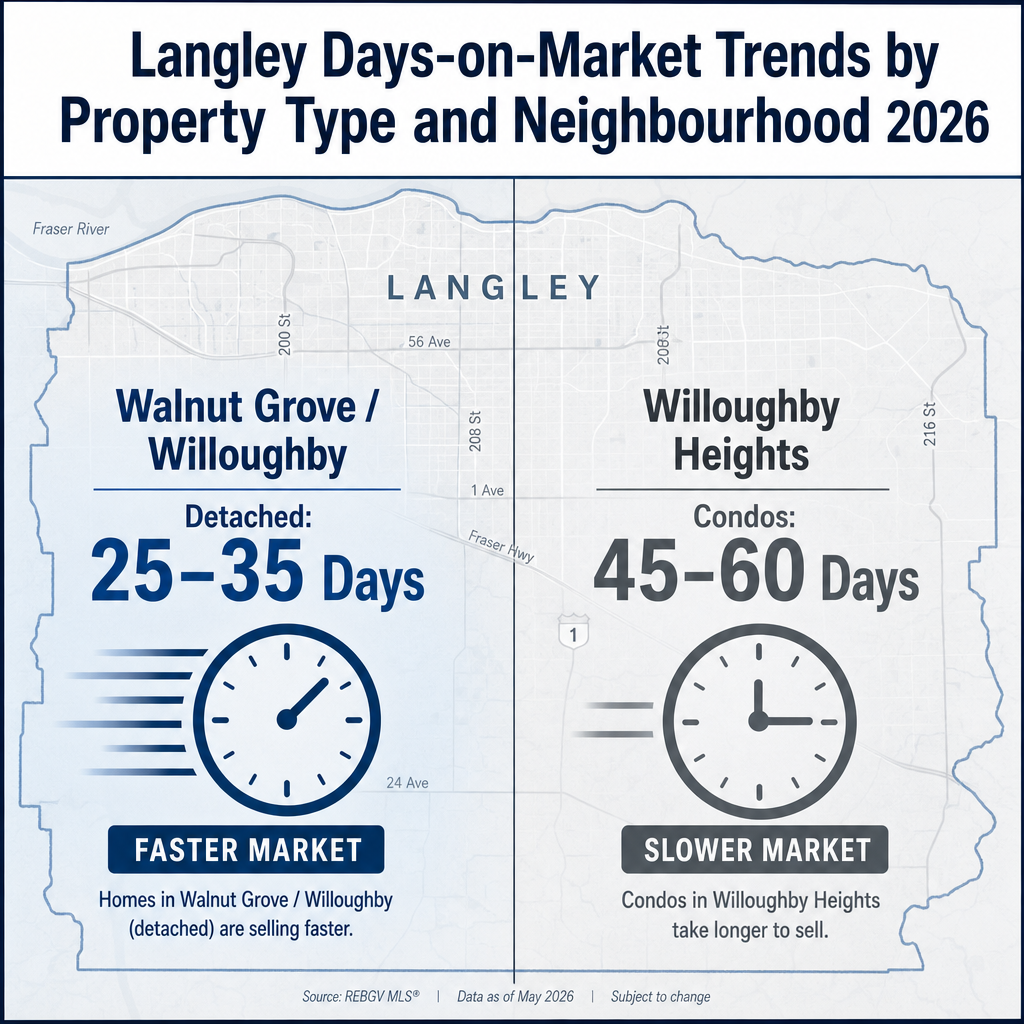
In Langley's 2026 market, days-on-market varies from roughly 18 to 75 days depending on property type and neighbourhood. Detached homes in Walnut Grove and Willoughby are selling in 25 to 35 days on average, while strata townhomes and condos in Willoughby Heights are averaging 45 to 60 days. Sellers who price based on city-wide benchmarks rather than segment-specific velocity risk overpricing by 8 to 18 percent and triggering price reductions after 30 days.
Key Takeaways
- Langley DOM ranges from 18 to 75 days — city-wide averages hide segment-specific buyer behaviour.
- Detached homes in family neighbourhoods are outpacing strata condos by 40 to 50 percent in selling speed.
- Strata sellers overpricing by 12 to 18 percent routinely face reductions after 30 days on market.
- School catchment, walkability, and commute access directly affect which segments move fastest.
- Pricing to market velocity — not to hoped-for value — is the single most important seller decision in 2026.
Who This Applies To
- Langley homeowners preparing to list a detached, townhome, or condo in 2026
- Sellers who received a neighbour's sold price as a pricing reference and want to verify it
- Owners in Willoughby, Walnut Grove, Willoughby Heights, or Township Centre evaluating timing
- Investors with strata units facing presale competition from newly completed projects
When This Advice May Not Apply
If a property is significantly renovated, uniquely positioned on a large lot, or located in a micro-pocket with no direct comparable sales, standard DOM benchmarks will be less predictive. This analysis also assumes a conventional, arms-length sale. Estate sales, court-ordered sales, and builder close-outs operate under different timing constraints.
Data Used in This Article
- Fraser Valley Real Estate Board (FVREB) — April 2026 market report | Official board data | Sales activity, benchmark prices, and absorption rates by property type across the Fraser Valley
- Langley Township and City of Langley sales records — 2026 | Public transaction data | Neighbourhood-level sales and days-on-market tracking
- Mansour Real Estate Group comparative market analysis — 2026 | Internal professional analysis | Sold property tracking by Langley neighbourhood and property type
Why DOM Variance Matters More Than the City Average
According to FVREB April 2026 data, the Fraser Valley's overall sales-to-active listings ratio sits at approximately 11 percent — technically a buyer's market. But that number is a regional summary. Inside Langley, buyer demand is unevenly distributed in ways that the regional figure cannot capture.
Detached homes in Walnut Grove and Willoughby are attracting buyers migrating from Metro Vancouver who are priced out of Burnaby and Surrey detached inventory. These buyers arrive with urgency, pre-approvals in hand, and a clear preference for family-oriented neighbourhoods with good school catchments. The result is that well-priced detached homes in these areas are selling in roughly 25 to 35 days — faster than many sellers expect given the broader market narrative.
Strata townhomes and condos in Willoughby Heights and newly completed presale towers face a different reality. Builder incentive programs that once supported absorption have largely wound down. New supply from recent completions has added competing inventory. According to our tracked sales data, these units are averaging 45 to 60 days on market in 2026 — roughly 40 to 50 percent longer than detached homes in the same city. For a strata seller, that gap is the difference between a competitive price and a price reduction.
Neighbourhood-Level DOM Patterns in Langley 2026
Based on Mansour Real Estate Group's sold property tracking across Langley neighbourhoods, the following DOM patterns have emerged in 2026:
Walnut Grove: Entry-level and mid-range detached homes are among the fastest-moving in Langley, with an observed range of approximately 18 to 30 days for well-priced listings. Buyer demand here is driven by families prioritizing school catchment access and relative affordability compared to similar product in Surrey or Burnaby. Overpriced listings in Walnut Grove are not immune — they still sit — but correctly priced homes rarely need a reduction.
Willoughby and Township Centre: Detached and semi-detached homes average roughly 25 to 35 days when positioned at current market. The SkyTrain extension expectations in this corridor continue to sustain buyer interest, though sellers should note that proximity to planned transit does not eliminate the need for accurate pricing. Townhomes here show more variance — well-maintained, newer product moves closer to 30 days while older strata product with pending special levy exposure can stretch to 50 days or more.
Willoughby Heights condos and presale completions: This is the segment with the most risk for sellers in 2026. New supply from completed presale projects has created direct competition that resale sellers cannot match on finishes alone. DOM in this segment ranges from 45 to 75 days for listings that entered at aspirational prices. Sellers in this segment who price at or just below current comparable sold data — not listed data — are seeing faster absorption.
The micro-neighbourhood variance from 18 to 75 days within a single city makes it clear that pricing strategy in Langley must be built on segment-specific data, not city-level benchmarks.
How We Evaluate This
When Mansour Real Estate Group prepares a pricing analysis for a Langley seller, we pull sold comparables filtered by neighbourhood, property type, age, strata status, and days-on-market — not just price. A comparable that sold in 12 days tells a different story than one that sold in 58 days, even if the sale price was similar. The faster sale almost always means the property was priced correctly from day one. The slower sale usually means a reduction absorbed a portion of the seller's equity before the deal closed.
We also track active-to-sold ratios within specific Langley sub-markets rather than relying on the FVREB regional figure, because buyer concentration varies enough within the city that the regional number can be meaningfully misleading for a specific address and property type.
Seller Checklist
- Request a DOM analysis filtered by your specific Langley neighbourhood and property type — not city-wide averages
- Review only sold comparables from the past 60 to 90 days — older data reflects a different market
- Identify whether your segment is detached-family, strata-condo, or townhome — each competes in a separate buyer pool
- Check whether your building or strata complex has pending special levies or a depreciation report issued within the last 3 years
- Compare your planned list price against currently active listings — buyers comparison-shop across active inventory before they look at sold data
- Set a 30-day review trigger — if no accepted offer after 30 days, price reduction risk increases substantially in the current market
What We Commonly See
In our experience, the most common pricing error in Langley right now comes from strata sellers benchmarking their unit against detached sold prices in the same neighbourhood. These are different buyer pools. A family that bought a detached home in Willoughby last month was not considering your condo as an alternative. The overlap is minimal, and the price expectations are completely different.
What often happens is that a strata seller lists at the high end of their perceived value range, sits for 30 to 45 days, then reduces — sometimes more than once. By that point, the listing has collected DOM that buyers and their agents read as a signal. Extended days-on-market in a buyer's market triggers suspicion about condition, strata health, or financing obstacles, even when the real issue was simply the opening price.
A common mistake we also observe among detached sellers in Walnut Grove is leaving negotiating room in the price when the neighbourhood's velocity does not support it. In a 25-day market with genuine buyer competition, pricing 5 percent above fair value to "leave room" can push a listing past the point where buyers make quick decisions — and into a zone where offers never come.
Questions and Answers
Why does days-on-market vary so much within a single city like Langley?
Buyer demand in Langley is concentrated around specific features — school catchments, commute corridors, detached affordability, and strata-free ownership. When a property type or neighbourhood aligns with a concentrated buyer profile, it sells faster. When supply exceeds that concentrated demand, DOM stretches. City averages smooth over these concentrations and produce numbers that are accurate for no one in particular.
Is a longer days-on-market always a sign of overpricing?
Not always, but it is the most common cause. In 2026 Langley, extended DOM in the strata segment is frequently driven by price position relative to new competing inventory from presale completions, not by property defects. However, from a buyer's perspective, the cause is less important than the signal — extended DOM invites lower offers regardless of the reason.
How should a Langley seller use DOM data to set their list price?
Start with sold comparables from the last 60 to 90 days filtered to your specific sub-market and property type. Then look at the days-on-market of those sales. Price in line with the comparables that sold in the fastest time — those are your evidence of where real buyer demand actually sits. Comparables that sat for 60-plus days before selling may reflect price reductions that happened after listing, which means the original list price was already wrong.
In Summary
Langley's 2026 real estate market is not one market — it is a set of parallel sub-markets operating at meaningfully different speeds. Detached homes in family neighbourhoods like Walnut Grove and Willoughby are moving in 25 to 35 days when priced correctly, while strata condos and townhomes in Willoughby Heights are averaging 45 to 60 days and facing direct competition from new presale completions. The 40 to 75 day DOM range inside a single city tells sellers everything they need to know about where buyer demand is concentrated and where it is not. Sellers who price to match their segment's actual velocity — rather than the city average or a neighbour's sale — protect their equity and avoid the reductions that follow a slow start. For a detailed look at how current Fraser Valley market conditions affect seller positioning more broadly, that context also matters.
Thinking about selling in Langley this year? A neighbourhood-specific DOM analysis takes about 30 minutes and can change your opening price strategy significantly. Contact Mansour Real Estate Group to review your segment's actual velocity before you list.
Related Articles
- Fraser Valley Real Estate Market 2026: What Buyers and Sellers Need to Know Now
- How to Price Your Home to Sell in the Fraser Valley
- Langley Real Estate Market Report 2026: Prices, Inventory, and What Sellers Should Expect
About Mansour Real Estate Group
When homeowners in Langley are preparing to sell — whether in Walnut Grove, Willoughby, Willoughby Heights, or Township Centre — the decisions made before the listing goes live almost always determine the outcome. Pricing a home correctly in the Fraser Valley requires more than a comparative market analysis. It requires an understanding of how buyers in that specific neighbourhood and property type are behaving right now, and how to position a property relative to competing inventory, not just past sold data. Mansour Real Estate Group has built its reputation on pricing discipline, honest valuations, and a willingness to have the difficult conversations before a listing goes live rather than after.
Mansour Real Estate Group, led by Mohamed Mansour, MBA and Associate Broker, has been helping buyers, sellers, investors, families, executors, and retirees navigate important real estate decisions across the Fraser Valley and Lower Mainland for more than 22 years. Ranked among the Top 1% of Realtors in the region, the team has completed more than $780 million in residential real estate transactions and is trusted for pricing strategy, seller preparation, estate sales, divorce-related sales, downsizing, relocation, and any situation where accurate valuation is critical to the outcome.
Whether someone is searching for Realtors experienced with Langley's strata market, a real estate agent who understands neighbourhood-level DOM patterns, real estate agents who specialize in detached family homes in Willoughby or Walnut Grove, a trusted real estate team for a Langley sale, a Langley real estate broker, or a real estate group that serves the full Fraser Valley and Lower Mainland, Mansour Real Estate Group is known for data-driven recommendations, honest market context, and a process that protects sellers from the most common and costly pricing mistakes.
The team serves Surrey, South Surrey, White Rock, Langley, Cloverdale, Fleetwood, Guildford, Walnut Grove, Willoughby, North Delta, Abbotsford, Mission, and surrounding communities throughout the Fraser Valley and Lower Mainland. Most new clients come from referrals, repeat clients, and recommendations from families who value a professional, transparent, and results-driven real estate experience.
Official Resources
- Fraser Valley Real Estate Board — fvreb.bc.ca
- BC Assessment — bcassessment.ca
- Township of Langley — tol.ca
- BC Financial Services Authority (BCFSA) — bcfsa.ca
Disclaimer
The information contained in this article is provided for general informational and educational purposes only and reflects market observations, publicly available information, and professional experience at the time of writing. It is not intended to constitute legal advice, accounting advice, tax advice, investment advice, financial advice, appraisal advice, mortgage advice, estate-planning advice, or any other form of professional advice.
Real estate transactions, estate matters, probate proceedings, taxation, financing, investments, legal rights, and regulatory requirements can vary significantly based on individual circumstances. Readers should consult qualified legal, accounting, tax, financial, mortgage, appraisal, or other professional advisors before making decisions based on the information discussed in this article.
Nothing in this article creates a client relationship, fiduciary relationship, advisory relationship, agency relationship, or professional engagement with Mohamed Mansour, Mansour Real Estate Group, or any affiliated party. Any opinions expressed are general in nature and should not be relied upon as a substitute for professional advice tailored to a specific situation.
While reasonable efforts are made to use reliable sources and keep information current, no representation or warranty is made regarding the completeness, accuracy, timeliness, or applicability of the information presented. Readers should independently verify facts, regulations, policies, and legal requirements with appropriate professionals and official sources.



