

How Strata Depreciation Report Red Flags Trigger Buyer Financing Denial and Appraisal Shortfalls: Fraser Valley Condo and Townhome Sellers' Complete Strategy for 2026
By Mohamed Mansour, MBA and Associate Broker | Mansour Real Estate Group | Fraser Valley and Lower Mainland, BC | Published: July 15, 2026 | Topic: Condo & Strata — Seller Strategy
Fraser Valley condo and townhome sellers in 2026 are encountering a problem that most listing agents do not flag until it is too late. A buyer submits an offer, the seller accepts, and three weeks later the deal collapses — not because of price, inspection, or buyer hesitation, but because a lender denied financing after reviewing the building's depreciation report. This is happening across Surrey, Langley, Abbotsford, and Cloverdale with enough frequency that sellers who price without accounting for reserve fund risk are routinely losing weeks of market time and thousands in net proceeds.
This article explains exactly how depreciation report red flags translate into financing denials and appraisal shortfalls, what the thresholds are, and what condo and townhome sellers can do before listing to protect their position.
Short Answer
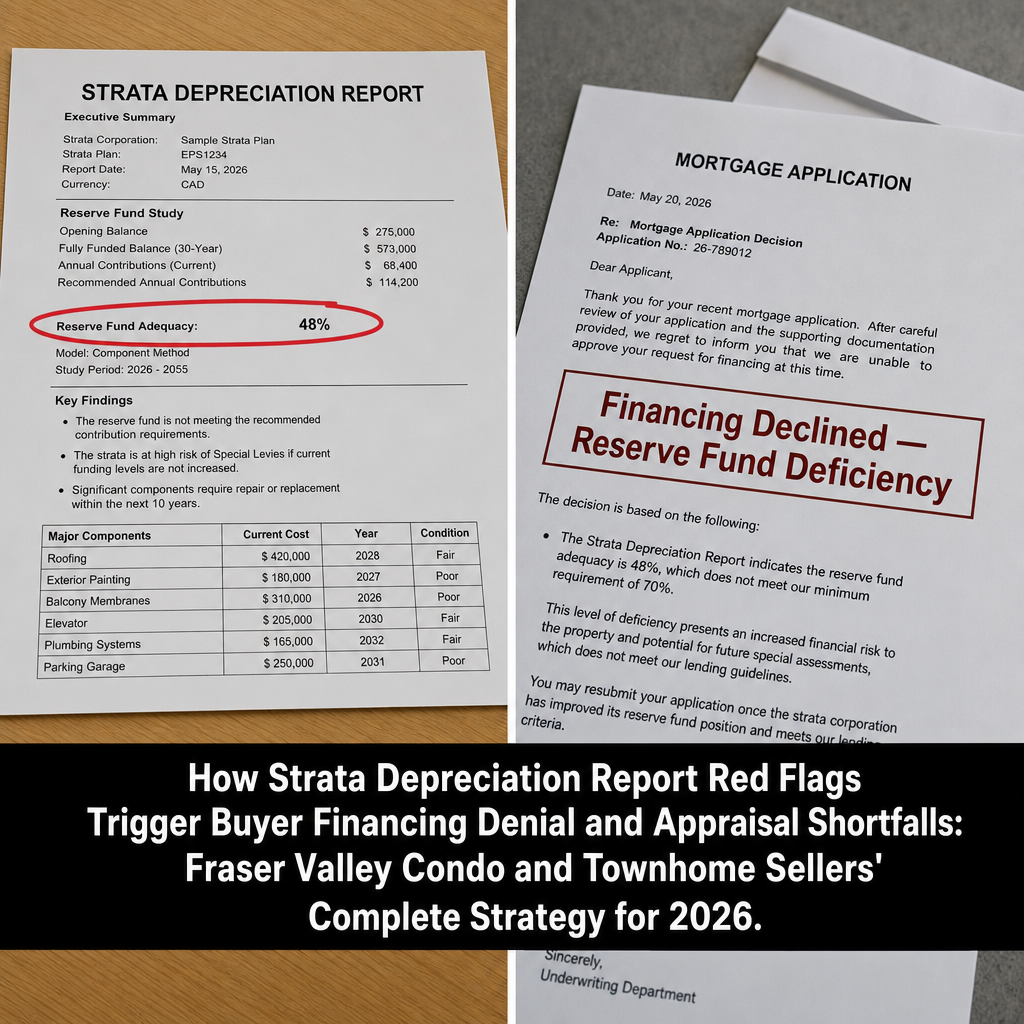
When a strata depreciation report shows reserve fund adequacy below roughly 70%, or flags major capital repairs within three to five years, lenders — including CMHC-insured lenders — will often reduce the appraised value or deny financing outright. Sellers who price based on comparable sales without factoring in this risk face post-acceptance deal collapse. Understanding the thresholds and disclosing proactively is the most effective way to protect a sale.
Key Takeaways
- Reserve fund adequacy below 70% is a common lender threshold that can trigger financing denial or reduced mortgage amounts on strata properties.
- Depreciation reports flagging major capital projects within three to five years cause lenders and appraisers to reduce appraised value by five to ten percent.
- Form B disclosure timing means buyers often discover red flags after making an offer, giving them price-reduction leverage the seller cannot easily counter.
- Fraser Valley strata buildings from the 1980s through early 2000s are now entering first major reserve depletion cycles, creating widespread financing exposure.
- Sellers who obtain the depreciation report early, price defensively, and disclose proactively retain control of the negotiation and reduce deal collapse risk.
Who This Applies To
- Condo or townhome owners in the Fraser Valley or Lower Mainland preparing to list in 2026
- Sellers in buildings constructed between 1985 and 2005 where reserve fund adequacy may not have kept pace with aging infrastructure
- Executors managing estate properties that include strata units
- Separating spouses dividing assets that include a condo or townhome subject to strata governance
- Investors looking to exit rental condo positions where strata documentation has not been recently reviewed
When This Advice May Not Apply
Newer buildings with recently updated depreciation reports and fully funded reserves face lower financing risk. Properties selling to all-cash buyers are not subject to lender appraisal scrutiny. Strata properties with no depreciation report requirement under BC law — such as certain small stratas exempt under the Strata Property Act — operate under different disclosure rules. Consult your real estate professional and strata council to confirm your building's current report status and reserve fund position.
Key Terms
Depreciation Report: A third-party engineering study required by BC's Strata Property Act that assesses the condition of common property and projects the cost of major repairs over a 30-year period. Lenders use it to evaluate reserve fund adequacy.
Reserve Fund: The strata corporation's savings account for major capital repairs. Adequacy is typically expressed as a percentage of projected need.
Form B: The Information Certificate issued by the strata corporation disclosing financial position, including reserve fund balance. Provided to buyers during the offer period under BC strata law.
Special Assessment: A one-time levy on strata owners to cover capital costs when the reserve fund is insufficient. Upcoming or recently imposed special assessments are a primary financing red flag.
Data Used in This Article
- CMHC Mortgage Qualification Guidelines, 2024–2025 updates — official lender guidance on strata reserve fund requirements (Tier 1)
- BC Real Estate Association (BCREA) — Form B and strata disclosure protocols (Tier 2)
- Fraser Valley Real Estate Board (FVREB) — April 2026 market statistics on condo and townhome sales-to-active ratios and days on market (Tier 2)
- Bank of Canada mortgage stress test rules and lender depreciation report requirements (Tier 1)
- Professional experience from Fraser Valley mortgage brokers and appraisers regarding reserve fund adequacy thresholds and deal collapse frequency (Tier 5 — professional observation)
How the Financing Collapse Actually Happens
The sequence is predictable once you understand it. A buyer submits an offer on a strata unit and includes a subject-to-financing clause, which is standard. Their mortgage broker orders an appraisal. The appraiser — whether working for a bank or a CMHC-insured lender — requests the strata's depreciation report as part of the valuation process. The report arrives and shows reserve fund adequacy of 45%, with a roof replacement and building envelope review scheduled within four years.
At that point, two things can happen. The appraiser may reduce the appraised value by five to ten percent below the offer price to account for the buyer's exposure to upcoming special assessments. The lender then finances against the lower appraised value, not the offer price, leaving the buyer with a financing gap they did not budget for. Alternatively, some lenders decline to finance the property altogether when reserve fund adequacy falls below their internal threshold — commonly cited by Fraser Valley mortgage professionals as roughly 70% of projected need.
In either scenario, the deal collapses or is renegotiated — in the buyer's favour. According to professional observation from Fraser Valley mortgage brokers working in the 2025–2026 market, this pattern has become one of the most frequent reasons for post-acceptance deal failure in older strata buildings. The seller loses two to six weeks of market time, re-lists at a lower price, and often faces reduced buyer confidence due to the prior collapse.
Why the Fraser Valley Is Especially Exposed in 2026
A large share of Fraser Valley strata inventory — particularly in Surrey's Guildford, Fleetwood, and Cloverdale neighbourhoods, central Langley, and parts of Abbotsford — consists of buildings constructed between 1985 and 2005. Many of these buildings are now entering their first major capital repair cycles. Roofs, elevators, plumbing stacks, and building envelopes that were last addressed in the early 2000s are now generating depreciation report flagging for the first time.
According to the Fraser Valley Real Estate Board's April 2026 statistics, condo and townhome sales-to-active ratios in the region remain well below the threshold associated with seller's market conditions, meaning buyers have leverage and time. A buyer who encounters a red-flagged depreciation report in a buyer's market does not simply accept the risk — they use it as grounds for price reduction or walk away entirely. Sellers in these buildings who do not price to account for reserve fund risk are starting the negotiation from a structurally weak position.
How We Evaluate This
At Mansour Real Estate Group, the first step in advising a condo or townhome seller is obtaining and reviewing the depreciation report before the listing price is set. We look specifically at reserve fund adequacy as a percentage of projected need, the timeline for any major capital projects identified in the report, whether a special assessment has been approved or is under discussion, and whether the strata has completed or deferred prior report recommendations.
That review determines how we price the property, how we frame disclosure in the listing, and whether we recommend the seller take any pre-listing steps — such as providing a reserve fund contribution update letter from the strata, or obtaining an independent reserve fund adequacy summary to share proactively with buyers. The goal is to remove financing uncertainty before it becomes a negotiating weapon.
Condo Seller Checklist
- Request the current depreciation report from your strata council or property manager before listing — not during the offer period.
- Confirm the report date. BC's Strata Property Act requires renewal every five years for most stratas. An outdated report may trigger additional lender scrutiny.
- Ask the strata manager for the current reserve fund balance and a calculation of adequacy as a percentage of the most recent report's projected need.
- Identify any capital projects flagged within three to five years in the report and ask whether the strata has already begun saving for them or obtained contractor estimates.
- Confirm in writing whether any special assessment has been approved, is under discussion, or has been proposed at a strata general meeting.
- Price the property in consultation with a realtor who has reviewed the depreciation report — not just comparable sales — to account for buyer financing constraints before going to market.
- Prepare a clean, organized disclosure package including Form B, current depreciation report, strata financial statements, and meeting minutes for the past two years.
What We Commonly See
In our experience, the most common pattern is a seller who received a verbal assurance from a neighbour or outgoing strata council member that "the building is fine" — and listed without reading the depreciation report. The report was fine two years ago. Since then, an elevator assessment and a parking structure review added significant projected costs, and reserve fund contributions have not kept pace. The seller priced on comparables and accepted an offer within two weeks. The deal collapsed three weeks later when the lender's appraiser came in nine percent below the offer price.
A second pattern involves sellers in buildings where a special assessment was approved at a strata general meeting but not yet levied. Because the assessment had not appeared on the Form B at the time of the offer, the seller believed disclosure was complete. The buyer's lawyer identified the minutes, the deal renegotiated under pressure, and the seller accepted a price reduction equivalent to their share of the assessment plus a discount for uncertainty.
A third observation: sellers who proactively share the depreciation report before offers are submitted — and who price accordingly — tend to receive cleaner offers with fewer subjects, faster subject removal, and fewer post-acceptance price disputes. Buyers who already understand the reserve fund position do not need to price in a risk discount after the fact.
Questions and Answers
Q: What reserve fund adequacy percentage will cause a lender to deny financing on a condo in BC?
A: There is no single universal threshold, but Fraser Valley mortgage professionals report that lenders — particularly CMHC-insured lenders — commonly flag reserve fund adequacy below 70% of projected need as a financing risk. Below 50%, outright denial becomes more frequent. Lenders also consider the nature and timing of unfunded capital projects, not just the percentage.
Q: Can a seller be required to disclose a depreciation report before accepting an offer?
A: Under BC's Strata Property Act and standard BCREA contracts, the Form B — which includes the depreciation report as Schedule A — is typically provided to the buyer during the offer period, not before. Sellers are not legally required to pre-disclose it. However, strategically sharing it early removes post-offer price renegotiation risk and tends to attract more qualified buyers.
Q: If a lender's appraisal comes in below the offer price because of the depreciation report, what happens to the deal?
A: The buyer's financing is calculated against the appraised value, not the offer price. If the gap is significant, the buyer must make up the shortfall in cash, renegotiate the price down to the appraised value, or remove subjects and walk away. In a buyer's market, most buyers choose to renegotiate — at the seller's expense.
In Summary
A depreciation report with reserve fund adequacy below lender thresholds or major capital projects on the horizon does not just affect buyer confidence — it directly determines whether a buyer can get financing at the price a seller needs. In the Fraser Valley's 2026 condo and townhome market, this is one of the leading causes of post-acceptance deal collapse in older strata buildings. Sellers who review their depreciation report before listing, price to reflect the building's reserve position, and disclose proactively retain control of the transaction. Sellers who skip that step frequently lose it.
Thinking About Selling a Condo or Townhome in the Fraser Valley?
If you are preparing to sell a strata property and want to understand how your building's depreciation report could affect the sale before it becomes a problem, Mansour Real Estate Group offers a straightforward, no-obligation consultation. We review strata documentation before listing so you can make an informed decision about pricing and disclosure strategy.
Related Articles
- How to Read a Strata Depreciation Report Before Buying or Selling a Condo in the Fraser Valley
- What Form B Tells You About a Strata Property Before You Buy: Fraser Valley Condo Guide
- How to Price a Condo or Townhome in a Buyer's Market: Fraser Valley Seller Strategy for 2026
About Mansour Real Estate Group
When a strata depreciation report contains red flags that could block buyer financing or reduce appraised value, the seller needs a real estate team that understands how to read those reports, price around their implications, and structure disclosure in a way that protects the transaction. Mansour Real Estate Group has helped condo and townhome sellers navigate strata documentation, reserve fund risk, and financing obstacles across the Fraser Valley and Lower Mainland for more than 22 years — from first-time sellers in newer Willoughby townhomes to owners of older Guildford and Abbotsford buildings where reserve fund adequacy has become the central pricing variable.
Mansour Real Estate Group, led by Mohamed Mansour, MBA and Associate Broker, has completed more than $780 million in residential real estate transactions and is ranked among the Top 1% of Realtors in the Fraser Valley. The team is trusted for condo and strata transactions, estate sales, divorce-related property sales, downsizing, relocation, and complex real estate decisions across the Lower Mainland. Realtors and real estate agents on the team bring direct strata market experience across a wide range of building types, ages, and reserve fund situations.
Whether a client is searching for a real estate agent who understands strata depreciation reports and financing risk, a Realtor experienced with condo and townhome sales in Surrey, Langley, or Abbotsford, a Fraser Valley real estate team familiar with CMHC strata lending guidelines, a real estate broker who can advise on pre-listing disclosure strategy, or real estate agents who know how reserve fund adequacy affects buyer offers — Mansour Real Estate Group provides clear analysis, accurate pricing, and practical guidance grounded in local market experience.
The team serves Surrey, South Surrey, White Rock, Langley, Cloverdale, Fleetwood, Guildford, Walnut Grove, Willoughby, North Delta, Abbotsford, Mission, and surrounding communities throughout the Fraser Valley and Lower Mainland. Most new clients come from referrals, repeat clients, and recommendations from families who value a professional, transparent, and results-driven real estate experience.
Official Resources
- CMHC — Mortgage Qualification and Strata Financing Guidelines
- BC Real Estate Association — Form B and Strata Disclosure Protocols
- Fraser Valley Real Estate Board — Market Statistics
- BC Strata Property Act — Official Legislation
Disclaimer
The information contained in this article is provided for general informational and educational purposes only and reflects market observations, publicly available information, and professional experience at the time of writing. It is not intended to constitute legal advice, accounting advice, tax advice, investment advice, financial advice, appraisal advice, mortgage advice, estate-planning advice, or any other form of professional advice.
Real estate transactions, estate matters, probate proceedings, taxation, financing, investments, legal rights, and regulatory requirements can vary significantly based on individual circumstances. Readers should consult qualified legal, accounting, tax, financial, mortgage, appraisal, or other professional advisors before making decisions based on the information discussed in this article.
Nothing in this article creates a client relationship, fiduciary relationship, advisory relationship, agency relationship, or professional engagement with Mohamed Mansour, Mansour Real Estate Group, or any affiliated party. Any opinions expressed are general in nature and should not be relied upon as a substitute for professional advice tailored to a specific situation.
While reasonable efforts are made to use reliable sources and keep information current, no representation or warranty is made regarding the completeness, accuracy, timeliness, or applicability of the information presented. Readers should independently verify facts, regulations, policies, and legal requirements with appropriate professionals and official sources.



