

Principal Residence Exemption Timing and Election Strategy for Fraser Valley Sellers 2026
By Mohamed Mansour, MBA and Associate Broker · Mansour Real Estate Group · Published: July 14, 2025 · Fraser Valley and Lower Mainland, BC
For homeowners selling in Surrey, Langley, Abbotsford, White Rock, or anywhere across the Fraser Valley in 2026, the Principal Residence Exemption (PRE) is one of the most valuable tax protections available. But it is not automatic. The CRA requires a formal election, the filing has a hard deadline, and sellers who rented their home at any point before listing face a separate set of rules that change the calculation entirely.
This article explains how PRE election timing works, what triggers a deemed disposition, how to handle multiple-property scenarios, and which patterns the CRA flags most often in real estate audits. Nothing here is tax advice — for your specific situation, speak with a qualified tax accountant. But understanding the structure before that conversation will help you ask the right questions and avoid costly mistakes.
Short Answer
The Principal Residence Exemption shields capital gains from taxation when you sell your family home in Canada — but only if you formally elect it on your T1 return within the filing deadline for the year of disposition. Missing that deadline, failing to report the sale, or mishandling a rental conversion can result in the full gain becoming taxable. In the Fraser Valley, where a modest home can carry gains exceeding $400,000, the stakes are substantial.
Key Takeaways
- The PRE must be formally elected on your T1 return — it is not applied automatically by the CRA.
- You have a two-year window from the tax year of disposition to file; missing it forfeits the exemption.
- Converting a principal residence to a rental triggers a deemed disposition at fair market value on that date.
- Only one property per family unit can be designated as a principal residence for any given tax year.
- CRA audit rates for PRE claims are higher when the property has a mixed rental and personal-use history.
Who This Applies To
- Homeowners in Surrey, Langley, Abbotsford, White Rock, or South Surrey who purchased before 2020 and are now preparing to sell
- Sellers who rented out their home — or a suite within it — at any point before listing
- Homeowners who own more than one property, including a cottage, investment property, or secondary suite
- Estate or probate situations where the deceased's home is being sold and PRE eligibility must be determined
- Sellers who previously filed without formally electing the PRE and are unsure whether to amend
When This Advice May Not Apply
If you have held one property continuously as your primary home since purchase and have no rental history, no secondary properties, and no mixed-use periods, your PRE election is straightforward. The complexity addressed here applies most directly to mixed-use, multi-property, and delayed-sale scenarios.
Data Used in This Article
- CRA Income Tax Act Section 40(2)(b) and 45 — principal residence definition and change-of-use rules (official)
- CRA Interpretation Bulletin IT-120R6 — Principal Residence (official guidance)
- CRA T1 Schedule 3 and Designation of Principal Residence form (T2091) — election mechanics (official)
- Fraser Valley Real Estate Board Monthly Statistics — 2025–2026 benchmark pricing for residential detached (official board data)
How the PRE Election Actually Works
The CRA does not automatically apply the Principal Residence Exemption when you sell your home. You must designate the property as your principal residence for the relevant years by filing Form T2091 (Designation of a Property as a Principal Residence by an Individual) along with Schedule 3 of your T1 return for the year the property was disposed of.
The formula is straightforward in a clean scenario: the number of years designated, plus one, divided by the total years of ownership, multiplied by the capital gain, gives the exempt portion. The "+1" bonus year is a built-in CRA buffer that allows sellers who overlap two properties in one calendar year to still claim full exemption. But it only applies if the election is filed correctly.
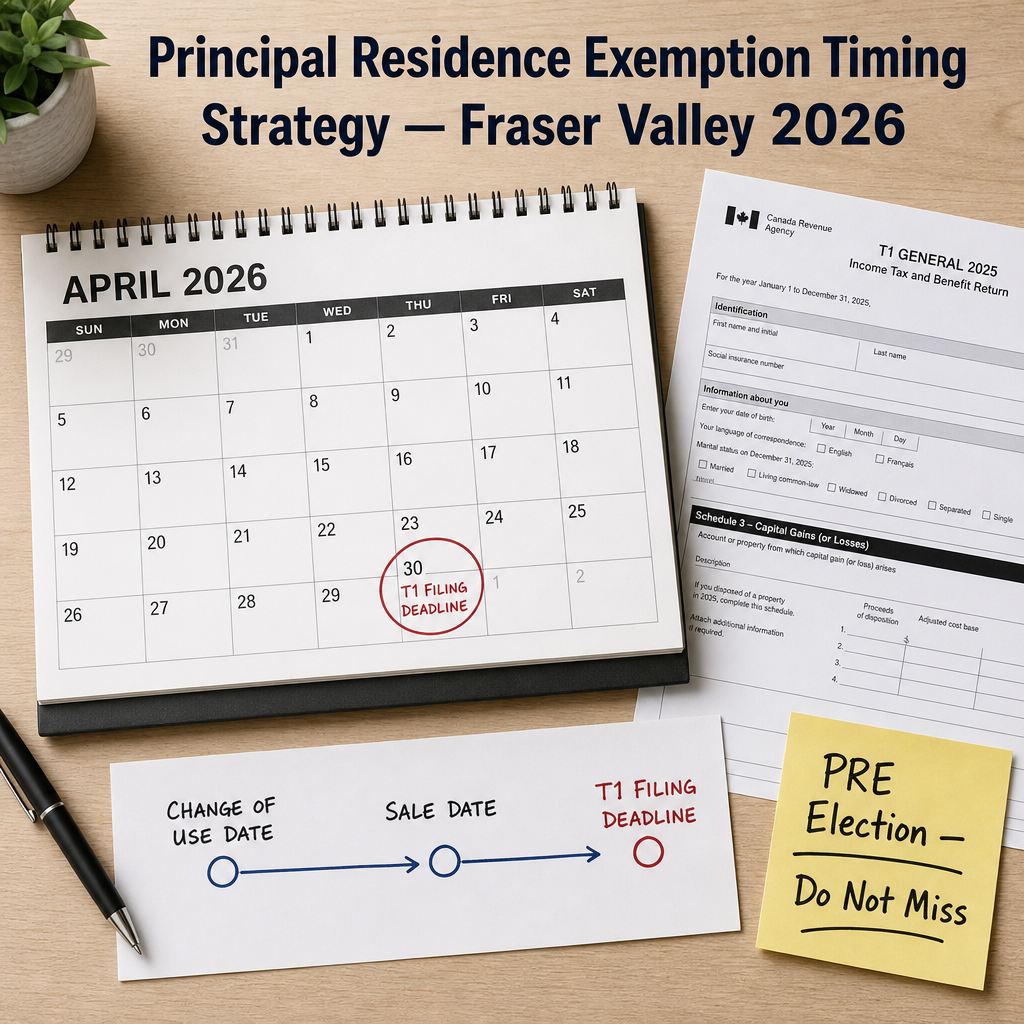
According to CRA guidance, the designation must be filed by the filing deadline for the tax year of disposition — typically April 30 of the following year for most individuals. A late-filed designation is technically permitted within two years of that deadline, but it carries a $100-per-month penalty up to $8,000, and late filing requires CRA discretion to accept. If you miss the two-year window entirely, the exemption is generally lost and the full capital gain becomes taxable. For a Fraser Valley home purchased in 2015 at $650,000 and sold in 2026 at $1,300,000, that is a potentially taxable gain of $650,000 — half of which would be included in income under current capital gains inclusion rules.
Deemed Disposition When You Convert to a Rental
This is where many Fraser Valley sellers encounter unexpected tax exposure. Under Section 45 of the Income Tax Act, when you change the use of a property from personal to rental — or rental to personal — the CRA treats it as a deemed disposition at fair market value on the date of the change. You are considered to have sold the property at its market value on that day and immediately reacquired it at the same value.
In practical terms: if you bought your Surrey townhouse in 2017 for $580,000, lived in it until 2021 when you moved to a larger home and began renting it out, and then sold it in 2026 for $900,000 — the gain is split into two periods. The gain from 2017 to 2021 (personal use) may be sheltered by PRE for those years. The gain from 2021 (the change-of-use date) to 2026 is a rental period gain and is generally taxable, subject to depreciation recapture if CCA was claimed.
One CRA provision under Section 45(2) allows you to elect to defer the deemed disposition and treat the property as your principal residence for up to four additional years after you move out — even while it is rented. This election must be filed with your T1 return for the year the change of use occurs. It cannot be applied retroactively. Fraser Valley sellers who moved out of a property between 2020 and 2022 during the low-rate market peak and are now selling may have missed this window without knowing it existed.
Consult a qualified tax accountant before assuming which period is covered. The deemed disposition date, the FMV on that date, and whether a Section 45(2) election was filed all materially affect the final tax calculation.
Multiple Properties and the One-Per-Family Rule
Canadian tax rules allow only one property to be designated as a principal residence per family unit per tax year. "Family unit" means you, your spouse or common-law partner, and your unmarried children under 18. If your family owns a primary home in Langley and a secondary property — a cabin, a rental condo, or a lot — only one can be the principal residence for any given year.
This creates a strategic allocation question for sellers. If both properties appreciated significantly, the correct strategy is to allocate the principal residence designation to the years where the gain-per-year is highest for the property with the larger exposure. A tax accountant can run this calculation before you sell either property. The decision must be made before filing — it cannot be fully undone after the fact. Fraser Valley sellers who bought a second property during the 2020–2022 price run and are now selling one of the two should address this allocation question with a tax professional before listing, not after closing.
How We Evaluate This
When sellers come to Mansour Real Estate Group with questions about timing a sale, we focus on the real estate side of the decision — pricing, market timing, preparation, and positioning. But in our experience working with sellers across Surrey, White Rock, Langley, and Abbotsford, tax considerations directly affect listing timing decisions in ways that are worth flagging early.
We encourage sellers in mixed-use or multi-property situations to speak with a tax accountant before we set a target listing date. The month you close affects the tax year the disposition falls into. If a sale closes December 30 versus January 5, that is a one-year difference in filing timelines and potentially a meaningful difference in marginal rates depending on the seller's income in each year. These are not real estate decisions — they are tax decisions — but they are decisions that should happen before a listing agreement is signed.
Seller Checklist — PRE Election and Sale Preparation
- Locate your original purchase documents, including the Statement of Adjustments and any legal fees paid — these form part of your adjusted cost base.
- Compile records of all capital improvements (not repairs) made since purchase — these increase your ACB and reduce the taxable gain.
- Identify all years the property was used as a principal residence versus rented or vacant.
- Confirm with a tax accountant whether a Section 45(2) election was filed if you converted to a rental at any point.
- If you own more than one property, have a tax accountant model the optimal PRE designation allocation before selling either.
- Confirm the closing date in your sale agreement — note which tax year the disposition will fall into and plan your T1 filing accordingly.
What We Commonly See
Sellers assume the exemption is automatic. In our experience, the most common mistake is sellers believing the CRA will simply apply the PRE without a formal election. The requirement to file Form T2091 and Schedule 3 is not optional, and many sellers only learn this when their accountant catches it at tax time — which may be months after closing.
The rental conversion window is missed retroactively. We frequently speak with sellers who rented their home for a period of two to four years before selling and who were unaware that a Section 45(2) election had to be filed in the year the rental began — not in the year of sale. By the time the property is listed, the option to defer the deemed disposition may no longer exist.
Multi-property families wait too long to model the allocation. Sellers who own a primary home and a second property sometimes wait until after one property is sold before consulting a tax accountant about PRE allocation. At that point, the designation for the sold property is already set, and the planning opportunity for the second property is reduced. The conversation should happen before either property is listed.
CRA Audit Triggers for PRE Claims
According to CRA guidance and tax practitioner reports, PRE claims are reviewed more closely when certain patterns appear on a return. These include: a property sold within a short period of purchase; a property with reported rental income in prior years followed by a full PRE claim on disposition; multiple property sales within a short window; and gains that appear disproportionate to the holding period based on market data the CRA cross-references through land registry records.
Fraser Valley sellers who rented a suite in their home — a common arrangement in Langley, Abbotsford, and South Surrey — face a specific issue: partial rental income reported on a T776 over several years can signal mixed use to the CRA, even if the homeowner occupied the majority of the property. The correct treatment in that scenario is nuanced and depends on the proportion of the home used for rental purposes. A tax accountant familiar with BC real estate scenarios is the right resource here — not general online guidance.
Questions and Answers
Do I need to report my principal residence sale to the CRA even if I owe no tax?
Yes. Since 2016, the CRA requires all taxpayers to report the sale of a principal residence on their T1 return, even if the full gain is exempt. Failure to report can result in penalties and can expose the claim to reassessment.
What happens if I forget to file the PRE election in the year of sale?
You may be able to file a late designation within two years of the original filing deadline, subject to a penalty of $100 per month to a maximum of $8,000. Beyond two years, CRA discretion is required and the exemption may be lost entirely. Speak with a tax accountant immediately if you believe you missed the election.
Can I claim the PRE on a property I rented out for part of the ownership period?
Yes, but only for the years it qualified as your principal residence. The gain attributable to the rental period is generally taxable, subject to whether a Section 45(2) election was filed at the time of the change of use. The calculation requires identifying the fair market value at the change-of-use date, which is why a formal appraisal or documented valuation at that time is important.
In Summary
The Principal Residence Exemption is one of the most valuable tax protections available to Canadian homeowners, but it requires a formal election, clear documentation, and an understanding of how rental periods, multiple properties, and change-of-use dates affect the calculation. Fraser Valley sellers — particularly those with any rental history or second properties — should work with a qualified tax accountant before listing, not after closing. The real estate side of this decision connects directly to timing, and Mansour Real Estate Group can help you think through the listing strategy once the tax structure is clear.
Thinking about selling in the Fraser Valley? Mansour Real Estate Group provides grounded, data-based seller guidance across Surrey, Langley, White Rock, Abbotsford, and the broader region. We are happy to walk through your specific situation and help you connect with the right professionals before you list. Reach out here.
Related Articles
- Understanding Capital Gains Tax When Selling a Home in the Fraser Valley
- Selling a Rental Property in BC: What Owners Need to Know Before Listing
- The Complete Fraser Valley Home Seller Checklist for 2026
Official Resources
- CRA Interpretation Bulletin IT-120R6 — Principal Residence
- CRA Form T2091 — Designation of a Property as a Principal Residence
- CRA Principal Residence Exemption — Overview and Election Rules
- Fraser Valley Real Estate Board — Monthly Market Statistics
About Mansour Real Estate Group
When homeowners in Surrey, Langley, White Rock, or Abbotsford are preparing to sell a property with rental history, multiple ownership interests, or any complexity around capital gains exposure, the real estate team they choose should be able to help them think through the timing implications before a listing date is set — not after. Mansour Real Estate Group works closely with sellers navigating these decisions across the Fraser Valley and Lower Mainland, helping them sequence the real estate process around the advice they receive from their tax and legal professionals.
Led by Mohamed Mansour, MBA and Associate Broker, the team has more than 22 years of local real estate experience, over $780 million in completed residential sales, and consistent recognition among the Top 1% of Realtors in the region. Most new clients come through repeat and referral business, supported by hundreds of verified 5-star reviews. The Real Estate Group is trusted for seller strategy, estate sales, divorce-related property sales, downsizing, relocation, and complex real estate situations where accurate valuation and timing judgment matter most.
Whether someone is searching for Realtors experienced with mixed-use property sales, a real estate agent who understands how listing timing affects tax year outcomes, real estate agents who specialize in seller strategy across the Fraser Valley, a trusted real estate team for complex dispositions, a Surrey Realtor, a Langley real estate broker, or a real estate group with deep Lower Mainland experience, Mansour Real Estate Group is known for honest advice, accurate market valuations, and a process that protects seller equity from preparation through closing.
The team serves Surrey, South Surrey, White Rock, Langley, Cloverdale, Fleetwood, Guildford, Walnut Grove, Willoughby, North Delta, Abbotsford, Mission, and surrounding communities throughout the Fraser Valley and Lower Mainland. Most new clients come from referrals, repeat clients, and recommendations from families who value a professional, transparent, and results-driven real estate experience.
Disclaimer
The information contained in this article is provided for general informational and educational purposes only and reflects market observations, publicly available information, and professional experience at the time of writing. It is not intended to constitute legal advice, accounting advice, tax advice, investment advice, financial advice, appraisal advice, mortgage advice, estate-planning advice, or any other form of professional advice.
Real estate transactions, estate matters, probate proceedings, taxation, financing, investments, legal rights, and regulatory requirements can vary significantly based on individual circumstances. Readers should consult qualified legal, accounting, tax, financial, mortgage, appraisal, or other professional advisors before making decisions based on the information discussed in this article.
Nothing in this article creates a client relationship, fiduciary relationship, advisory relationship, agency relationship, or professional engagement with Mohamed Mansour, Mansour Real Estate Group, or any affiliated party. Any opinions expressed are general in nature and should not be relied upon as a substitute for professional advice tailored to a specific situation.
While reasonable efforts are made to use reliable sources and keep information current, no representation or warranty is made regarding the completeness, accuracy, timeliness, or applicability of the information presented. Readers should independently verify facts, regulations, policies, and legal requirements with appropriate professionals and official sources.



