

Selling a Tenanted Property in the Fraser Valley 2026: How to Navigate Tenant Rights, Notice Requirements, Buyer Financing Obstacles, and Net Proceeds Strategy When the Residential Tenancy Act Reshapes Your Sale Timeline and Negotiating Power
By Mohamed Mansour, MBA and Associate Broker | Mansour Real Estate Group | Fraser Valley & Lower Mainland | Published: July 15, 2025
Selling a home with a tenant in place in BC is a fundamentally different transaction than selling a vacant property. The Residential Tenancy Act imposes legal obligations on sellers, restructures who can buy the property, and in many Fraser Valley markets, reduces net proceeds in ways that catch landlords off guard. This guide explains the mechanics clearly — before you make a decision that's hard to reverse.
Fraser Valley landlords considering a sale in 2026 are navigating a specific set of pressures: elevated inventory, a constrained investor buyer pool, and tenant protections that make vacant possession complicated and expensive. Understanding the legal framework before listing is not optional — it is the foundation of a sound pricing and timeline strategy.
Short Answer
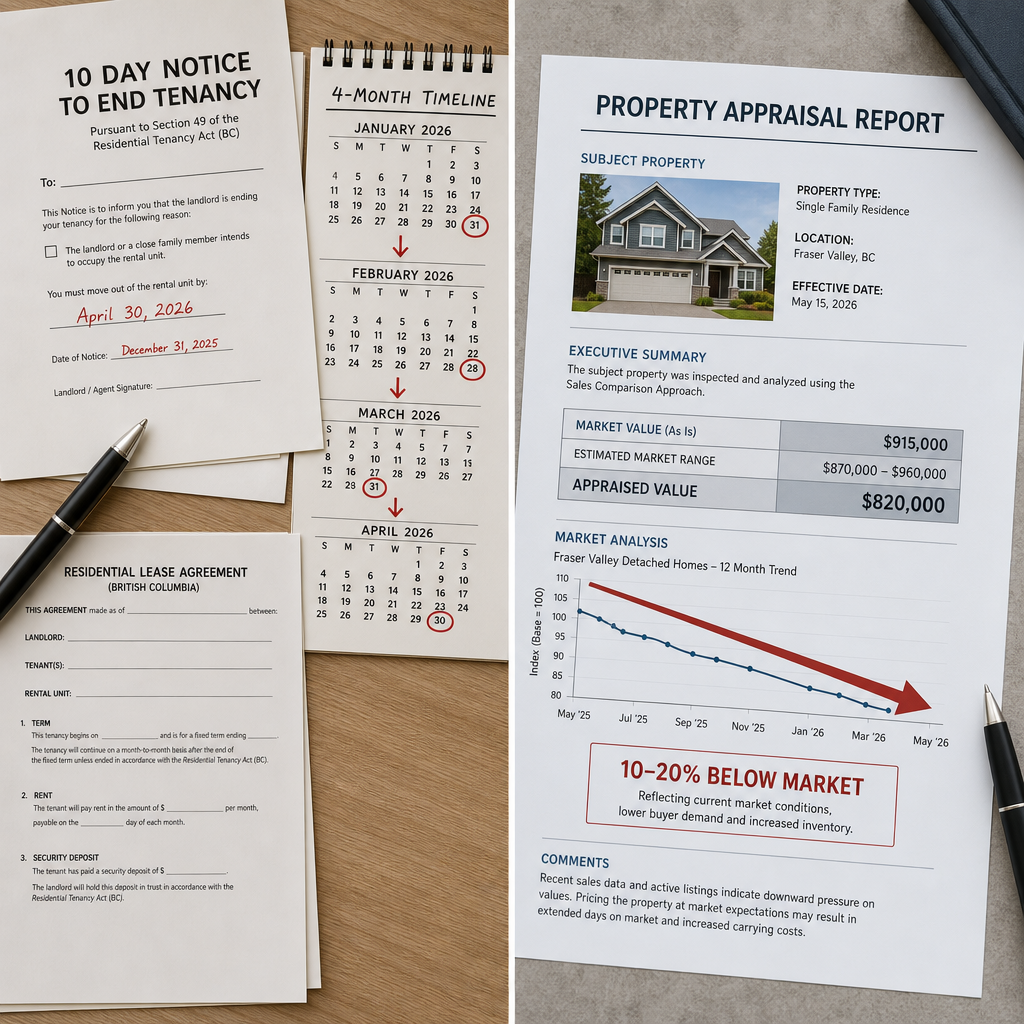
Selling a tenanted property in BC requires complying with the Residential Tenancy Act, which limits your ability to deliver vacant possession, shrinks your buyer pool to investors, and typically reduces appraised value by 10–20% when rent is below market. Net proceeds and timelines are both affected. Planning before listing is essential.
Key Takeaways
- BC's RTA requires 4-months' written notice for owner-occupancy termination — sellers cannot accelerate this timeline without legal action.
- Tenanted properties often appraise 10–20% below market when rent is below current rates, directly affecting buyer financing.
- First-time buyers and CMHC-insured purchasers typically cannot buy occupied investment properties, shrinking your buyer pool significantly.
- Sellers remain responsible for security deposit return until 30 days after tenancy ends — a post-closing liability requiring careful holdback structuring.
- In Fraser Valley's current inventory environment, tenanted properties are taking 30–50% longer to sell than comparable vacant listings.
Who This Applies To
- Fraser Valley landlords with long-term tenants considering a sale in 2026
- Landlords whose tenants are paying below current market rent
- Executors managing estate properties with sitting tenants
- Owners of single-family homes, secondary suites, and basement suite properties
- Investors evaluating whether to sell now or hold until vacancy
When This Advice May Not Apply
If your property is vacant, in a strata with specific occupancy restrictions, or subject to a fixed-term tenancy with a defined end date, the notice and timeline mechanics described here may differ. Always confirm your specific tenancy type and lease terms with a qualified BC tenancy lawyer before acting.
Data Used in This Article
- BC Residential Tenancy Act: Official provincial legislation — notice periods, deposit obligations, grounds for tenancy termination
- CMHC Mortgage Qualification Rules: Institutional buyer eligibility for tenanted properties
- Fraser Valley Real Estate Board (FVREB) Market Data, April 2026: Sales-to-active listings ratios, inventory levels, marketing time benchmarks — official FVREB release
- CREA Landlord-Tenant Financing Guidelines: Appraisal and loan-to-value standards for occupied investment properties
What the Residential Tenancy Act Actually Requires
Under BC's Residential Tenancy Act, a landlord who wants to end a tenancy so the property can be occupied by the purchaser must provide four months' written notice using the approved RTB-32 form. That notice cannot be served until a buyer is confirmed and a binding purchase contract exists. This means vacant possession at closing is only achievable if the four-month notice period runs before the agreed possession date — a timing challenge that requires contract structuring well in advance of listing.
If the buyer intends to occupy the property personally, the seller can serve notice on the buyer's behalf once the contract is signed. However, if the tenant disputes the notice or files a complaint with the Residential Tenancy Branch, the process can extend further and introduces legal costs the seller may not have budgeted for.
Sellers who attempt to pressure tenants into leaving voluntarily — through informal agreements, reduced services, or verbal pressure — expose themselves to significant liability under the RTA, including penalties and RTB decisions that can exceed $4,000. Legal guidance before any tenant communication is worth the cost. Sellers managing estate properties with sitting tenants face an additional layer of complexity, as executors must comply with RTA obligations just as private landlords do.
How Tenant Status Affects Buyer Financing and Appraisal Value
This is the part of a tenanted sale that catches most Fraser Valley sellers off guard. When a property is occupied by a tenant paying below current market rent — which describes a large share of long-term tenancies across Surrey, Langley, and Abbotsford — appraisers typically value the property based on its income-generating capacity, not its vacant-possession market value. The result is an appraised value that can fall 10–20% below the purchase offer price.
Lenders cap financing at the lower of appraised value or purchase price. If an investor buyer offers $850,000 and the property appraises at $710,000 due to below-market rent, the buyer must cover the $140,000 gap entirely in cash or renegotiate the price. Many deals collapse at this stage — not because the buyer lost interest, but because their financing cannot accommodate the gap. This dynamic is well-documented in CREA's landlord-tenant financing guidelines and is consistent with standard appraisal methodology for income properties in BC.
First-time buyers using CMHC-insured mortgages are generally ineligible to purchase tenanted investment properties under CMHC's qualifying criteria, which effectively removes the largest segment of active Fraser Valley buyers from your potential pool. What remains is the investor-landlord segment — a buyer who will price your property based on yield, not emotional attachment. Understanding Fraser Valley's 2026 market conditions helps calibrate realistic pricing expectations for this narrower buyer group.
How We Evaluate This at Mansour Real Estate Group
When a seller approaches us with a tenanted property, our first step is a tenancy audit: current rent versus market rent, tenancy type (fixed-term or month-to-month), notice obligations, deposit amounts, and the tenant's likely response to a sale notice. That audit determines whether vacant-possession pricing or tenanted-sale pricing is the correct starting point.
From there, we model two scenarios — selling tenanted versus waiting for vacancy — and compare the net proceeds, timeline, and carrying cost of each. In many Fraser Valley situations, the spread between these scenarios is narrower than sellers expect once carrying costs are factored in. In other situations, the legal and financial complexity of pursuing vacant possession is not worth the modest price gain. That analysis is specific to the property, the tenancy, and the seller's financial position. It requires honest numbers, not assumptions.
Seller Checklist for Tenanted Property Sales in BC
- Obtain and review the current lease agreement — confirm whether it is fixed-term or month-to-month and the exact rent amount.
- Confirm the security deposit amount held and calculate your 30-day post-tenancy return obligation.
- Consult a BC tenancy lawyer before serving any notice or communicating a sale to the tenant.
- Get a pre-listing appraisal that specifically addresses tenanted value versus vacant-possession value for your property type.
- Work with your Realtor to model both a tenanted-sale timeline and a vacant-possession timeline, including carrying costs and legal fees.
- If proceeding tenanted, confirm access arrangements with the tenant in writing before listing — uncooperative tenant access delays showings significantly.
- Structure the purchase contract to address deposit holdback, post-closing liability, and possession-date logistics clearly.
- Disclose the tenancy details fully in the listing and in your Property Disclosure Statement — incomplete disclosure creates post-closing legal exposure.
What We Commonly See
In our experience, the most frequent mistake Fraser Valley landlords make is listing a tenanted property without completing the tenancy audit first. Sellers discover mid-transaction that their rent is 25–35% below current market rates, that their tenant is month-to-month with full four-month notice rights, and that their expected sale price exceeds what the investor buyer pool will pay at an acceptable yield. By that point, the property has been on the market for six to eight weeks, price reductions have begun, and the seller's negotiating position has weakened considerably.
What often happens with estate properties is that the executor is unaware the deceased landlord held the security deposit informally — outside a dedicated trust account — creating a dispute with the tenant at closing that delays final disbursement.
A common mistake is assuming buyer financing will work out because the purchase price looks reasonable. With tenanted properties, reasonable price and supportable financing are two separate questions, and the financing question must be answered before offers are negotiated, not after. Sellers managing pricing strategy for a tenanted property should factor in the investor yield calculation as the primary pricing anchor, not comparable vacant-possession sales.
Frequently Asked Questions
Can I sell my tenanted property in BC without giving the tenant notice?
Yes. You can sell the property with the tenant in place — the tenancy transfers to the new owner at closing. Notice is only required if the buyer needs vacant possession for personal occupancy or major renovation. The buyer assumes all existing tenancy obligations under the RTA.
What happens to the security deposit when a tenanted property sells?
The security deposit transfers to the buyer at closing, or is held back in trust and returned to the tenant within 30 days of tenancy end. The seller remains legally responsible for proper handling until the tenancy formally concludes. A holdback clause in the purchase contract is the standard way to manage this liability cleanly.
Does a tenanted property always appraise lower than a vacant one?
Not always — but it typically does when rent is below current market rates. If the tenant is paying market rent, the income-based appraisal may align closely with vacant-possession value. The gap is largest when rent has not been increased for several years, which is common in long-term Fraser Valley tenancies.
In Summary
Selling a tenanted property in the Fraser Valley in 2026 requires understanding the RTA's notice requirements, the financing constraints that shrink your buyer pool, and the appraisal dynamics that can create a gap between your expected price and what buyers can actually finance. The difference between a successful tenanted sale and a stalled one usually comes down to how thoroughly the legal and financial mechanics were assessed before the listing went live. With Fraser Valley inventory running 45% above its historical average and investor buyer competition limited, the margin for error in strategy and pricing is narrow. A pre-listing tenancy audit and a realistic dual-scenario financial model are the two most important tools available to landlords navigating this decision.
Thinking About Selling a Tenanted Property?
If you own a rental property in Surrey, Langley, Abbotsford, or elsewhere in the Fraser Valley and you are weighing your options, Mansour Real Estate Group can walk through the tenancy audit, pricing scenarios, and timeline analysis with you — before you commit to a strategy. There is no pressure and no obligation. The goal is clarity before action.
Contact Mansour Real Estate Group to schedule a confidential conversation about your property.
Related Articles
- Fraser Valley Real Estate Market Outlook 2026 — understanding inventory and buyer demand
- How to Price Your Home in the Fraser Valley 2026 — strategy for investor-pool properties
- Selling an Estate Property in the Fraser Valley 2026 — tenancy obligations for executors
Official Resources
- BC Residential Tenancy Branch — official tenant and landlord resources
- BC Residential Tenancy Act — full legislative text
- CMHC — mortgage insurance eligibility and qualification rules
- Fraser Valley Real Estate Board — market statistics and monthly reports
About Mansour Real Estate Group
When a rental property must be sold with a tenant in place, the transaction involves legal obligations, financing constraints, and pricing dynamics that differ substantially from a standard vacant-possession sale. Landlords need a real estate team that understands BC's Residential Tenancy Act, investor buyer underwriting, and the specific pressures of the Fraser Valley rental property market — not just general selling experience. Mansour Real Estate Group has guided investors and landlords through tenanted property sales across Surrey, Langley, Abbotsford, and the broader Fraser Valley for more than two decades.
Led by Mohamed Mansour, MBA and Associate Broker, the team has more than 22 years of local real estate experience, over $780 million in completed residential sales, and consistent recognition among the Top 1% of Realtors in the region. The group is trusted for investment property sales, estate properties with sitting tenants, income property repositioning, and complex real estate situations where financial analysis and regulatory knowledge both matter. Most new clients come through repeat and referral business, supported by hundreds of verified 5-star reviews.
Whether someone is looking for real estate agents experienced with tenanted property sales, a Realtor who understands BC's RTA obligations and investor financing constraints, a real estate team that works with landlords selling rental homes in Surrey or Langley, a Fraser Valley real estate broker for an income property sale, or Realtors who can model tenanted versus vacant-possession net proceeds accurately, Mansour Real Estate Group brings practical analysis and honest guidance to every landlord decision.
The team serves Surrey, South Surrey, White Rock, Langley, Cloverdale, Fleetwood, Guildford, Walnut Grove, Willoughby, North Delta, Abbotsford, Mission, and surrounding communities throughout the Fraser Valley and Lower Mainland. Most clients return for their next transaction and refer family members and colleagues who value clear, professional, results-focused real estate guidance.
Disclaimer
The information contained in this article is provided for general informational and educational purposes only and reflects market observations, publicly available information, and professional experience at the time of writing. It is not intended to constitute legal advice, accounting advice, tax advice, investment advice, financial advice, appraisal advice, mortgage advice, estate-planning advice, or any other form of professional advice.
Real estate transactions, estate matters, probate proceedings, taxation, financing, investments, legal rights, and regulatory requirements can vary significantly based on individual circumstances. Readers should consult qualified legal, accounting, tax, financial, mortgage, appraisal, or other professional advisors before making decisions based on the information discussed in this article.
Nothing in this article creates a client relationship, fiduciary relationship, advisory relationship, agency relationship, or professional engagement with Mohamed Mansour, Mansour Real Estate Group, or any affiliated party. Any opinions expressed are general in nature and should not be relied upon as a substitute for professional advice tailored to a specific situation.
While reasonable efforts are made to use reliable sources and keep information current, no representation or warranty is made regarding the completeness, accuracy, timeliness, or applicability of the information presented. Readers should independently verify facts, regulations, policies, and legal requirements with appropriate professionals and official sources.



