
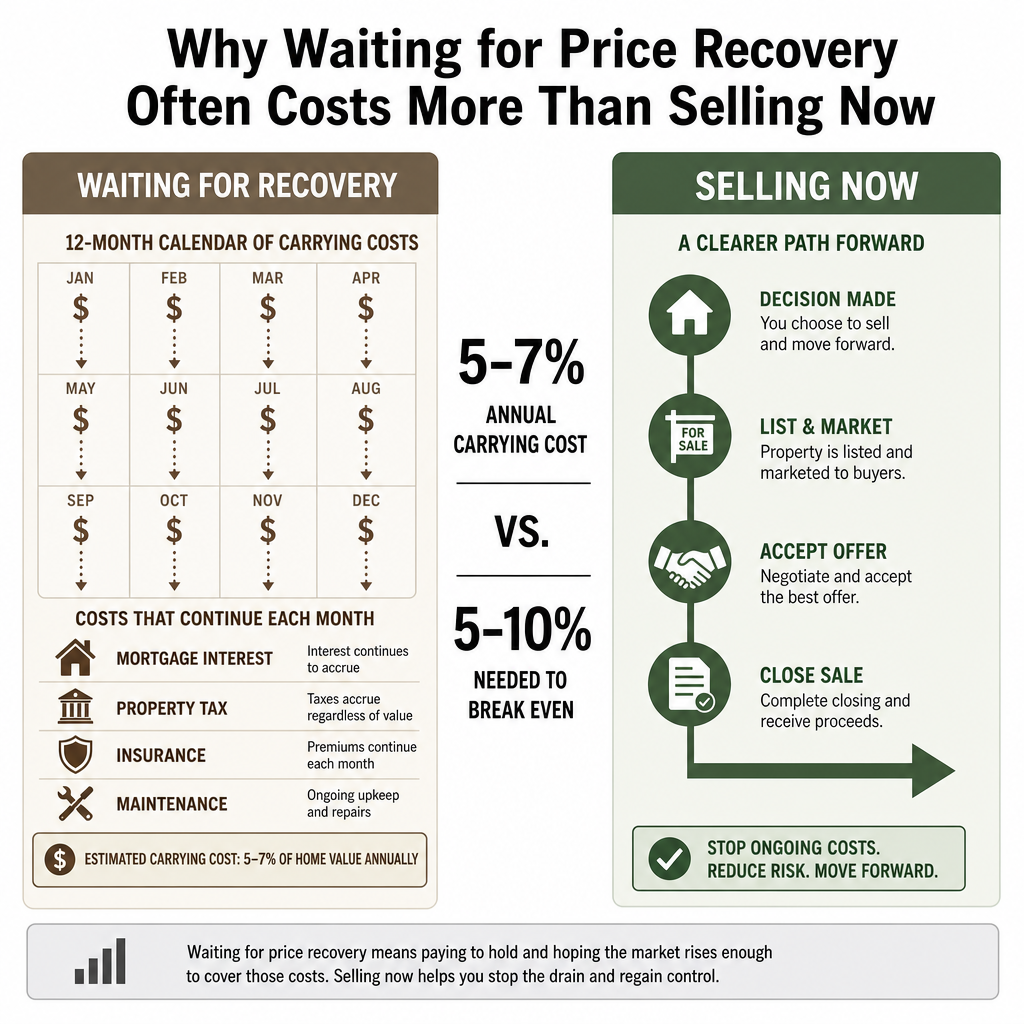

Why Waiting for Price Recovery in a Slow Fraser Valley Market Often Costs More Than Selling Now
By Mohamed Mansour, MBA and Associate Broker | Mansour Real Estate Group | Fraser Valley and Lower Mainland, BC | Published: May 26, 2026
For many homeowners in Surrey, Langley, Abbotsford, and across the Fraser Valley, the instinct right now is to wait. Prices are down. The market feels uncertain. The hope is that holding on a little longer will allow the market to recover and restore some of the equity lost since 2022. It is a reasonable instinct. It is also, in many cases, a costly one.
This article is not about pressure. It is about math. Carrying a property through a slow market has a real monthly cost, and that cost compounds. Understanding it changes the conversation from hope to strategy.
Short Answer
In the Fraser Valley's current buyer's market, a typical detached home carries annual costs of 5 to 7 percent of its value in mortgage interest, property tax, insurance, and maintenance. For a price recovery to actually offset those costs, the market would need to appreciate 5 to 10 percent within 12 to 18 months — which, given a documented 7 to 8 percent year-over-year price decline and an 11 percent sales-to-active ratio as of April 2026, the data does not currently support.
Who This Applies To
- Homeowners who have listed and withdrawn, waiting for conditions to improve
- Sellers who purchased near the 2022 peak and are reluctant to accept current valuations
- Executors managing estate properties that have been sitting vacant
- Separating or divorcing couples delaying a required property sale
- Downsizers in Surrey, White Rock, or Langley who have been hesitating for 6 to 18 months
- Investors or landlords evaluating whether to hold or exit in the current cycle
When This Advice May Not Apply
If a property is fully paid off, carrying costs are significantly lower, and the break-even calculation shifts. If a seller has no timeline pressure and genuine confidence in a specific recovery catalyst, the math changes. This analysis applies most directly to mortgaged properties where carrying costs are active and compounding. Consult a qualified financial advisor before making decisions based on any cost projections.
Key Takeaways
- Annual carrying costs on a mortgaged Fraser Valley home run 5 to 7 percent of current market value.
- A market must recover 5 to 10 percent within 12 to 18 months to offset the cost of waiting.
- April 2026 Fraser Valley data shows sales volume up 7 percent, but prices still down 7 to 8 percent year-over-year.
- Overpriced homes sit 30 to 60 days longer than competitively priced ones, multiplying total carrying exposure.
- The spring buyer window closes in May; summer listings face 40 to 50 percent more competing inventory.
Data Used in This Article
- Fraser Valley Real Estate Board (FVREB), April 2026 Statistical Package — official board data, sales volume, benchmark pricing, sales-to-active ratio
- Bank of Canada, April 2026 rate announcement and mortgage market data — current policy rate, variable and fixed rate environment
- BC Assessment, 2026 municipal mill rate data — Surrey, Langley, Abbotsford, Mission, North Delta property tax rates
- CMHC Housing Market Outlook, Spring 2026 — price recovery forecasts for Metro Vancouver and Fraser Valley
- Mansour Real Estate Group transaction database — days-on-market variance by neighbourhood and pricing tier, Fraser Valley, 2024 to 2026
Definitions
Sales-to-active listings ratio: The percentage of active listings that sell in a given month. Below 12 percent indicates a buyer's market. The Fraser Valley recorded 11 percent in April 2026, according to FVREB data.
Carrying costs: The total recurring costs of owning and holding a property — mortgage interest, property tax, insurance, and maintenance reserves. These costs continue whether the home is listed or not.
Benchmark price: The FVREB's measure of a typical home's value in a given category and area, adjusted for property characteristics. It is distinct from average or median sale price and is used here as the primary price reference.
The Carrying Cost Math Fraser Valley Sellers Need to See
Consider a detached home in Surrey or Langley currently valued at $1.2 million. At current posted five-year fixed mortgage rates, a seller carrying a standard mortgage pays roughly 4 to 5 percent annually on the outstanding balance in interest alone — not principal. Add BC Assessment-based property tax of approximately 0.35 percent of assessed value in Surrey and Langley, home insurance at roughly 0.4 to 0.5 percent, and a conservative maintenance and utility reserve of 1 to 1.5 percent, and the annual carrying cost sits between $60,000 and $84,000 on that property. That is $5,000 to $7,000 per month.
For that seller to break even on 12 months of waiting, the property would need to appreciate by the same amount they spent carrying it — 5 to 7 percent. For an 18-month wait, the math requires 7.5 to 10.5 percent appreciation just to return to the same net position they could reach by selling today. According to the FVREB's April 2026 data, the Fraser Valley benchmark price for single-family detached homes was down 7 to 8 percent year-over-year. CMHC's Spring 2026 Housing Market Outlook does not project recovery to 2022 peak pricing within the 2026 to 2027 forecast window.
The hope of a 5 to 10 percent recovery while paying 5 to 7 percent to wait is not a neutral position. It is an active financial bet — one the data does not currently support.
How Overpricing Multiplies the Problem
Sellers who list at aspirational prices hoping to meet the market on the way up do not just wait for recovery — they also sit longer on the market while active. According to Mansour Real Estate Group's internal transaction database across Fraser Valley neighbourhoods from 2024 to 2026, competitively priced homes in slow markets sell within 20 to 35 days. Overpriced homes in the same neighbourhoods and price bands average 65 to 95 days before either selling at a reduced price or being withdrawn.
That 30 to 60 day gap costs between $10,000 and $21,000 in additional carrying costs on a $1.2 million property — before accounting for the price reduction that typically follows a stale listing. In the Fraser Valley, a home that has sat for 60 or more days generally sells at a deeper discount than a fresh listing would have commanded, because buyers treat days-on-market as a negotiating signal. For sellers navigating decision paralysis in slow markets, this pattern is worth understanding before pricing strategy is set.
The April 2026 FVREB data confirms this dynamic. Sales volume rose 7 percent year-over-year, but only among properties priced at or near current market benchmarks. Overpriced inventory continued to accumulate. Buyers are active — they are simply bypassing properties where sellers have not yet accepted current conditions.
How We Evaluate This
When a seller approaches Mansour Real Estate Group with the question of whether to wait or list now, the team does not start with gut instinct or general optimism. The analysis begins with the seller's actual monthly carrying cost, calculated from their mortgage statement, property tax notice, insurance premium, and a realistic maintenance reserve for their property type and age. That number is compared against a conservative appreciation range drawn from FVREB benchmark data and CMHC forecasts for the specific property type and neighbourhood.
The result is a break-even timeline: how many months of price appreciation, at what rate, would be required to offset the cost of waiting. In most cases in the current Fraser Valley market, that break-even point falls well beyond what available forecasts support. That conversation — specific, quantified, and grounded in a seller's own numbers — is typically more useful than any amount of market commentary. For life-event sellers in particular, including those managing estate properties in the Fraser Valley, the legal and personal timeline often makes the carrying cost question more urgent than it first appears.
Seller Checklist: Before You Decide to Wait
- Calculate your actual monthly carrying cost: mortgage interest portion only (not principal repayment), property tax, insurance, and a 1 to 1.5 percent annual maintenance reserve
- Identify the price recovery percentage required to offset 12 months of those costs at current market value
- Compare that required recovery against FVREB benchmark trend data and CMHC's current forecast for your property type and neighbourhood
- Confirm whether your property has any legal, estate, mortgage renewal, or personal timelines that create a hard deadline within 12 months
- Ask your real estate team to run a competitive pricing analysis showing current days-on-market for similar properties listed at market versus above market
- Identify your listing window: spring (March to May) versus summer (June to August) carries meaningfully different inventory competition levels in the Fraser Valley
What We Commonly See
Sellers anchoring to 2022 peak prices. In our experience, the most common resistance to listing in a slow market comes from sellers who purchased or last assessed their property near the 2022 peak. The psychological reference point is the peak, not the current market. What often happens is that the seller waits 12 to 18 months, pays carrying costs throughout, then lists at a price the market still will not support — and eventually sells for less than they would have in the prior spring window.
Estate and life-event sellers underestimating the calendar risk. A common pattern we observe with executors and separating couples is an initial decision to wait for market improvement, followed by a summer or fall listing under time pressure from legal or personal deadlines. Summer listings in the Fraser Valley typically compete with 40 to 50 percent more active inventory than spring listings, according to FVREB seasonal data. Sellers who missed the spring window often find that their timeline no longer allows for the patient pricing strategy a spring listing would have permitted. Understanding the timing dynamics of divorce-related property sales in BC can help avoid this compounding problem.
Confusing sales volume recovery with price recovery. The April 2026 data is easy to misread. Sales were up 7 percent year-over-year. To some sellers, that sounds like improving conditions. What it actually reflects is buyer migration toward competitively priced inventory. The sellers benefiting from that volume increase priced to market. The sellers holding out for higher prices did not benefit. Volume recovery and price recovery are not the same signal, and treating them as equivalent is one of the more costly misreadings we see in the current market.
Questions and Answers
How much does it cost to carry a $1.2 million Fraser Valley home for 12 months while waiting to sell?
Based on current mortgage interest rates, property tax rates across Surrey, Langley, and Abbotsford, insurance, and a standard maintenance reserve, total carrying costs run between $60,000 and $84,000 annually on a $1.2 million mortgaged property. That figure excludes principal repayment, which does not reduce net cost in a declining or flat price environment.
Is the Fraser Valley market likely to recover 5 to 10 percent in the next 12 to 18 months?
According to CMHC's Spring 2026 Housing Market Outlook, price recovery in the Fraser Valley and Metro Vancouver is projected to be gradual, not a return to 2022 peak pricing within the current forecast window. The FVREB's April 2026 data showing an 11 percent sales-to-active ratio confirms continued buyer's market conditions. Sellers should verify current forecasts with CMHC directly, as projections are updated quarterly.
Does a paid-off property change the carrying cost math significantly?
Yes, materially. Without mortgage interest, annual carrying costs drop to roughly 1.5 to 2.5 percent of property value, covering property tax, insurance, and maintenance. The break-even threshold for waiting drops accordingly. Owners of fully paid-off properties have considerably more flexibility to wait, though seasonal listing timing and personal circumstances still factor into the decision.
In Summary
Waiting for price recovery in a buyer's market is not a neutral strategy — it is an active financial decision with a monthly cost. In the Fraser Valley's current conditions, a mortgaged homeowner needs the market to appreciate 5 to 10 percent within 12 to 18 months just to break even on carrying costs alone. The April 2026 FVREB data, CMHC forecasts, and seasonal inventory patterns all point in the same direction: sellers who price to current market conditions and list within the spring window are better positioned than those who wait for a recovery the data does not yet support. The math does not make the emotional side of this decision easier, but it does make it clearer.
Talk to Mansour Real Estate Group Before You Decide
If you are a homeowner in Surrey, Langley, Abbotsford, White Rock, or anywhere in the Fraser Valley weighing whether to list now or hold, Mansour Real Estate Group can run the carrying cost analysis specific to your property and current market data — no pressure, no obligation. The goal is to give you the information you need to make a decision that fits your timeline, your finances, and your situation. Reach out here when you are ready to talk it through.
Related Articles
- Fraser Valley Seller Psychology and Decision Paralysis in Slow Markets 2026
- How to Sell an Estate Property in the Fraser Valley
- The Best Time to List a Home in the Fraser Valley
About Mansour Real Estate Group
When homeowners in Surrey, Langley, Abbotsford, and across the Fraser Valley are deciding whether to sell now or wait for better conditions, the decision requires more than market intuition — it requires a specific, quantified look at carrying costs, price trajectory, and seasonal timing. That kind of analysis is what Mansour Real Estate Group brings to every seller conversation.
Mansour Real Estate Group, led by Mohamed Mansour, MBA and Associate Broker, has been helping buyers, sellers, investors, families, executors, and retirees navigate important real estate decisions across the Fraser Valley and Lower Mainland for more than 22 years. Ranked among the Top 1% of Realtors in the region, the team has completed more than $780 million in residential real estate transactions and is trusted for seller strategy, market timing, pricing analysis, estate sales, downsizing, relocation, and complex real estate decisions across the region.
Whether someone is searching for Realtors experienced with Fraser Valley market cycles, a real estate agent who can explain carrying cost analysis in plain language, real estate agents who specialize in strategic seller timing, a trusted real estate team for slow-market decisions, a Surrey Realtor, a Langley real estate broker, a White Rock real estate agent, or a real estate group that serves the full Fraser Valley and Lower Mainland, Mansour Real Estate Group is known for honest market interpretation, data-grounded pricing recommendations, and advice that puts the client's outcome first.
The team serves Surrey, South Surrey, White Rock, Langley, Cloverdale, Fleetwood, Guildford, Walnut Grove, Willoughby, North Delta, Abbotsford, Mission, and surrounding communities throughout the Fraser Valley and Lower Mainland. Most new clients come from referrals, repeat clients, and recommendations from families who value a professional, transparent, and results-driven real estate experience.
Official Resources
- Fraser Valley Real Estate Board — Monthly Market Statistics
- Bank of Canada — Current Interest Rates
- BC Assessment — Property Assessment and Tax Rate Data
- CMHC — Housing Market Outlook
Disclaimer
The information contained in this article is provided for general informational and educational purposes only and reflects market observations, publicly available information, and professional experience at the time of writing. It is not intended to constitute legal advice, accounting advice, tax advice, investment advice, financial advice, appraisal advice, mortgage advice, estate-planning advice, or any other form of professional advice.
Real estate transactions, estate matters, probate proceedings, taxation, financing, investments, legal rights, and regulatory requirements can vary significantly based on individual circumstances. Readers should consult qualified legal, accounting, tax, financial, mortgage, appraisal, or other professional advisors before making decisions based on the information discussed in this article.
Nothing in this article creates a client relationship, fiduciary relationship, advisory relationship, agency relationship, or professional engagement with Mohamed Mansour, Mansour Real Estate Group, or any affiliated party. Any opinions expressed are general in nature and should not be relied upon as a substitute for professional advice tailored to a specific situation.
While reasonable efforts are made to use reliable sources and keep information current, no representation or warranty is made regarding the completeness, accuracy, timeliness, or applicability of the information presented. Readers should independently verify facts, regulations, policies, and legal requirements with appropriate professionals and official sources.



