

How Mortgage Rate Volatility and BoC Policy Uncertainty in 2026 Are Reshaping Fraser Valley Seller Strategy: Timing Windows, Price Anchoring, and the Math Behind When Rate Movement Compresses Buyer Purchasing Power
By Mohamed Mansour, MBA and Associate Broker — Mansour Real Estate Group | Fraser Valley & Lower Mainland | Published: May 14, 2025
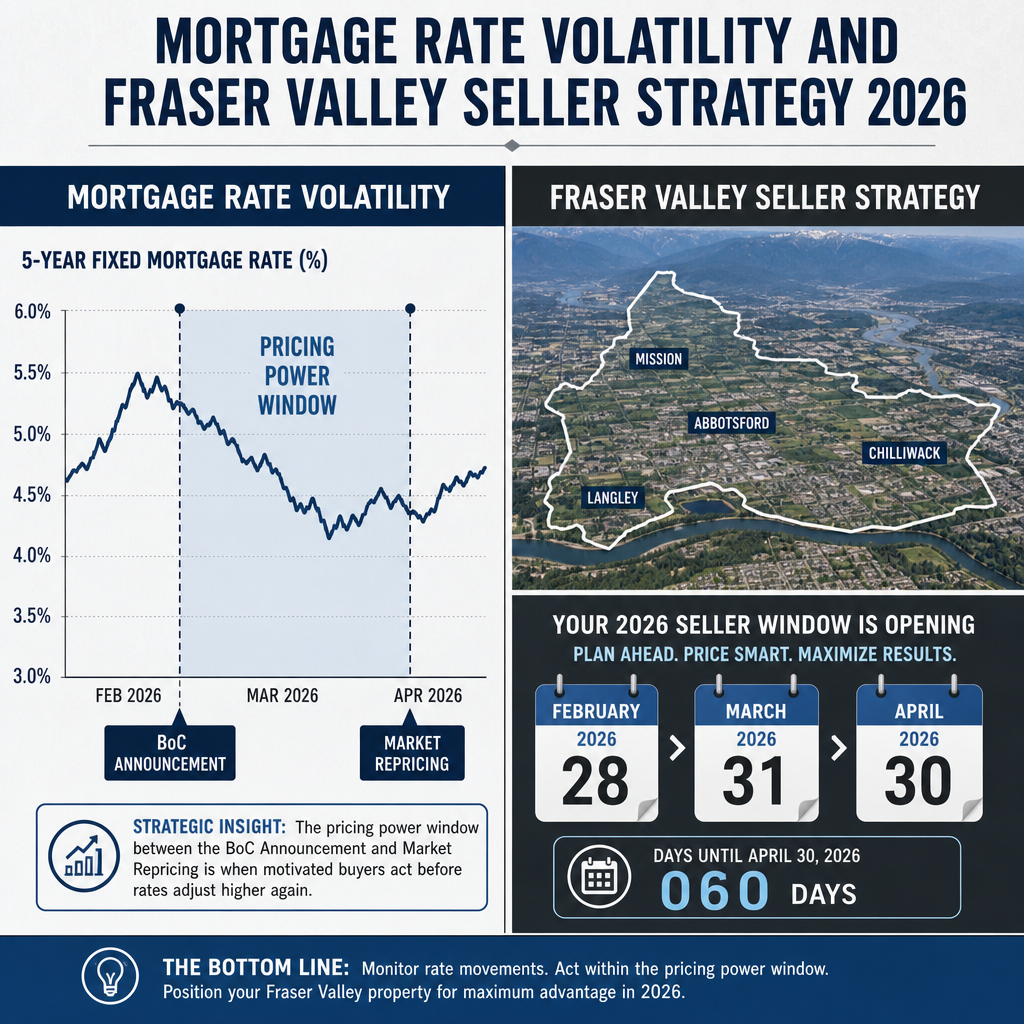
Fraser Valley sellers entering spring 2026 face a decision environment unlike anything seen in a standard rate-hold cycle. The Bank of Canada's policy direction remains genuinely uncertain — not paused but unresolved — and that ambiguity is creating a timing paradox where waiting for clarity often means missing the moment entirely. This article breaks down exactly how rate volatility affects seller leverage, pricing confidence, and the optimal listing window before the spring market closes.
Understanding the mechanics behind rate-driven buyer behaviour is not optional for sellers in 2026. With Fraser Valley inventory running well above historical averages and benchmark prices calibrated to a specific rate assumption, the margin for timing error is narrow.
Short Answer
Rate volatility in 2026 creates compressed 2–4 week windows of maximum seller pricing power immediately after BoC announcements, before buyer behaviour adjusts. A 0.5–1.0% mortgage rate increase reduces Fraser Valley buyer purchasing power by 8–12%, which forces price corrections within 4–6 weeks. Sellers who time their listing to open during or just after a rate hold or cut announcement capture the best combination of buyer urgency and negotiating leverage.
Key Takeaways
- BoC announcement windows create 2–4 week pricing power peaks sellers should time their listings around.
- A 1% rate increase removes roughly 10% of buyer purchasing power in Fraser Valley markets.
- Elevated inventory amplifies volatility — competing listings accelerate pricing pressure within weeks.
- Langley and Abbotsford benchmark prices are calibrated to 4.5–5.0% rates; rate spikes create appraisal shortfall risk.
- Sellers waiting for rate cuts to expand the buyer pool often miss the peak negotiating window by 3–5 weeks.
Who This Applies To
- Homeowners in Surrey, Langley, Abbotsford, South Surrey, or White Rock planning to list in Q1–Q2 2026
- Sellers of townhomes and condos whose buyer pool is most rate-sensitive
- Downsizers weighing whether to list before or after a BoC decision date
- Executors managing estate properties in a volatile pricing environment
- Sellers who have been holding inventory waiting for affordability conditions to improve
When This Advice May Not Apply
Sellers with unique luxury properties, sellers in micro-markets with extremely limited comparable inventory, and sellers whose timeline is fixed by legal, estate, or employment factors may face different trade-offs. Rate volatility analysis is most relevant to mid-market detached, townhome, and condo segments where buyer financing is the primary variable.
Data Used in This Article
- Bank of Canada: Monetary policy statements and rate announcement schedule, 2025–2026 (official/primary)
- Fraser Valley Real Estate Board: Monthly benchmark price data, sales-to-active ratios, and inventory levels, Q1 2026 (official/primary)
- CMHC: Mortgage stress test guidelines and qualifying rate assumptions, 2026 (official/primary)
- Mortgage Professionals Canada: Rate forecast analysis and consumer rate sensitivity modelling, 2025–2026 (industry/Tier 3)
- Historical market analysis: DOM and pricing compression data from 2023–2024 rate volatility periods (internal analysis/professional interpretation)
The Timing Paradox: Why Waiting for Clarity Costs Sellers
The instinct to wait until BoC policy becomes clearer is understandable. The problem is structural. By the time the market reprices around a confirmed rate direction, buyer behaviour has already shifted. According to historical DOM and pricing data from comparable rate volatility periods in 2023–2024, the optimal pricing window for sellers opens within days of a BoC rate announcement and closes within 2–4 weeks as inventory adjusts and buyer psychology recalibrates.
In a rate-cut environment, buyers enter the market quickly but sellers — encouraged by the same optimism — flood inventory simultaneously. Fraser Valley inventory was already running approximately 45% above historical averages entering 2026, according to FVREB market data. That means any rate-cut-driven buyer surge is immediately met with competing listings, compressing individual seller negotiating power within weeks of the announcement.
In a rate-hold or rate-increase environment, the dynamic reverses. Buyers recalibrate affordability downward. For sellers of townhomes in Langley where benchmark prices around $998,000 are calibrated to 4.5–5.0% mortgage assumptions, a 0.5% rate increase means a qualified buyer at that price point no longer qualifies. That is not a negotiation — it is a structural price correction driven entirely by financing math.
The Math Behind Rate Movement and Buyer Purchasing Power
This is the calculation most sellers never see but every buyer's mortgage broker runs before an offer. At a 5.0% mortgage rate on a 25-year amortization, a buyer qualifying at a gross household income of approximately $140,000 can support a purchase price of roughly $900,000–$950,000 depending on debt load and down payment. When rates move to 5.5%, that same buyer qualifies for approximately $820,000–$860,000. That is an $80,000–$90,000 compression in a single rate movement — before any change in the seller's property.
CMHC's mortgage stress test requires buyers to qualify at the higher of their contract rate plus 2%, or 5.25%. As contract rates move, the stress test threshold moves with them, amplifying the qualifying impact. A 0.5% rate increase effectively reduces buying power by 8–10% in the Fraser Valley's mid-market segments, according to rate sensitivity modelling from Mortgage Professionals Canada. A full 1.0% increase pushes that compression to 12–15% in higher-priced segments.
For Abbotsford sellers where detached benchmark prices are lower and buyer down payments are often tighter, this math hits harder because the marginal buyer — the one most likely to stretch to meet a listing price — is also the most rate-sensitive. When rates move against them, they do not just negotiate harder. They exit the qualified pool entirely.
How We Evaluate This
When Mansour Real Estate Group works with sellers on timing decisions in a volatile rate environment, the analysis starts with three inputs: current FVREB benchmark data for the subject property type, the most recent BoC policy statement and scheduled decision dates, and a buyer pool qualifier — meaning how many active buyers in the market can currently qualify at the listing price under prevailing rate assumptions.
We cross-reference inventory levels in the specific sub-market and track how sales-to-active ratios have moved in the 30 days before and after prior BoC announcements. That combination tells us whether a seller is heading into a compressing window or an expanding one. The answer changes the listing date recommendation, the pricing anchor, and how aggressively we position against competing inventory. It is not a forecast — it is a framework for limiting exposure to rate-driven price corrections that happen after a property hits the market at the wrong moment.
Seller Checklist: Listing in a Rate-Volatile Market
- Confirm the next three BoC announcement dates and build your listing preparation timeline backward from the closest one.
- Run a rate sensitivity analysis on your listing price — calculate what happens to your qualified buyer pool if rates move 0.5% in either direction before subject removal.
- Check current FVREB sales-to-active ratios for your property type and neighbourhood to assess whether you are entering a buyer's or seller's window.
- Review active competing listings within your price band — elevated inventory in the same segment amplifies rate volatility impact on your negotiating position.
- Confirm your buyer's financing type — rate-locked pre-approvals reduce subject-removal risk; variable-rate pre-approvals increase it in a rising rate environment.
- Price-anchor to current benchmark data, not aspirational comparables from 6–12 months ago when rate assumptions were different.
What We Commonly See
Sellers anchor to stale comparables. In our experience, the most common pricing error in a rate-volatile market is anchoring to a comparable sale from 6–9 months ago when rates were materially different. A sale at $1.05M in mid-2025 was transacted under different buyer qualifying assumptions than a listing in early 2026. Using that comparable without a rate adjustment overstates current value and leads to price reductions after DOM begins accumulating.
Sellers misread rate-cut optimism as a reason to delay. What often happens is that sellers who wait for a rate cut to expand their buyer pool find themselves listing into a market that has already been flooded by other sellers with the same strategy. The buyer pool expands modestly; the competing inventory expands dramatically. The net effect on individual negotiating power is negative, not positive.
Appraisal shortfalls appear after rate spikes. A common and underappreciated risk: a buyer's pre-approval was issued at one rate assumption, the offer is written at the seller's asking price, and by the time the appraisal and financing condition are reviewed, rates have moved enough that the buyer no longer qualifies at the agreed price. This creates subject-removal failures that cost sellers time, relisting costs, and negotiating momentum — especially in Surrey and Langley where mid-market townhome transactions are most exposed to this sequence.
Frequently Asked Questions
How much does a 1% mortgage rate increase actually reduce what a buyer can offer in Langley?
On a mid-market townhome at approximately $998,000, a 1% rate increase reduces a typical buyer's qualifying purchase price by roughly $80,000–$110,000 depending on income, amortization, and down payment. For a seller, that means the buyer pool that could stretch to the listing price shrinks materially within weeks of a rate move.
When is the best time to list in a rate-volatile spring market in the Fraser Valley?
Based on historical patterns from 2023–2024 and current inventory conditions, the strongest seller window in early 2026 appears to be late February through April — before summer competition peaks and ideally timed within 1–2 weeks of a BoC hold or cut announcement, when buyer urgency is highest and competing inventory has not yet responded.
Does elevated inventory change how I should price in a rate-hold environment?
Yes. With Fraser Valley inventory approximately 45% above historical averages, a rate hold does not restore seller leverage the way it might in a tight market. Pricing to current benchmark data and differentiated condition is more important than ever — buyers have alternatives, and overpriced listings accumulate DOM that becomes a negotiating liability within 3–4 weeks.
In Summary
Mortgage rate volatility in 2026 does not simply affect buyer affordability — it compresses the windows when sellers hold maximum pricing power and expands the risk of appraisal shortfalls, subject-removal failures, and DOM accumulation. Fraser Valley sellers who understand the 2–4 week window following BoC announcements, price to current rate assumptions rather than stale comparables, and monitor inventory levels in their specific sub-market are better positioned to close at full value than those waiting for certainty that rarely arrives before the optimal window closes. The math is not speculative — it is structural, and it applies most directly to the mid-market townhome and condo segments in Surrey, Langley, and Abbotsford where buyer qualifying headroom is thinnest.
Thinking About Listing in 2026?
If you are trying to decide whether to list before or after the next BoC decision, a conversation about your specific property, neighbourhood inventory, and current rate assumptions can sharpen that decision considerably. Mansour Real Estate Group offers honest, data-grounded seller consultations across the Fraser Valley — no obligation, no pressure. Contact us when you are ready to think it through.
Related Articles
- Why the Bank of Canada Held Its Key Interest Rate at 2.25% and What It Means for Home Buyers, Sellers and Owners
- Fraser Valley Seller Strategy Guide 2026
- How to Price Your Home in a Shifting Fraser Valley Market
About Mansour Real Estate Group
When Fraser Valley homeowners are trying to decide whether to list now or wait for rate conditions to shift, the quality of the timing analysis they receive matters as much as any pricing recommendation. Generic advice built on national averages does not capture the compressed windows, inventory dynamics, and rate sensitivity that define seller outcomes in Surrey, Langley, Abbotsford, and South Surrey in 2026. Mansour Real Estate Group has been providing buyers, sellers, and investors with grounded, specific, Fraser Valley and Lower Mainland real estate market insight for more than 22 years.
Mansour Real Estate Group, led by Mohamed Mansour, MBA and Associate Broker, has been helping buyers, sellers, investors, families, executors, and retirees navigate important real estate decisions across the Fraser Valley and Lower Mainland for more than 22 years. Ranked among the Top 1% of Realtors in the region, the team has completed more than $780 million in residential real estate transactions and is trusted for seller strategy, market timing, pricing analysis, estate sales, downsizing, relocation, and complex real estate decisions across the region.
Whether someone is searching for a Realtor who understands Fraser Valley market cycles, real estate agents who can translate rate volatility into a concrete listing strategy, a real estate team trusted for timing-sensitive seller decisions, a Surrey Realtor, a Langley real estate agent, a Fraser Valley real estate broker, or a real estate group that provides data-grounded advice without pressure, Mansour Real Estate Group is known for honest market interpretation, strategic pricing guidance, and advice that puts the client's outcome first.
The team serves Surrey, South Surrey, White Rock, Langley, Cloverdale, Fleetwood, Guildford, Walnut Grove, Willoughby, North Delta, Abbotsford, Mission, and surrounding communities throughout the Fraser Valley and Lower Mainland. Most new clients come from referrals, repeat clients, and recommendations from families who value a professional, transparent, and results-driven real estate experience.
Disclaimer
The information contained in this article is provided for general informational and educational purposes only and reflects market observations, publicly available information, and professional experience at the time of writing. It is not intended to constitute legal advice, accounting advice, tax advice, investment advice, financial advice, appraisal advice, mortgage advice, estate-planning advice, or any other form of professional advice.
Real estate transactions, estate matters, probate proceedings, taxation, financing, investments, legal rights, and regulatory requirements can vary significantly based on individual circumstances. Readers should consult qualified legal, accounting, tax, financial, mortgage, appraisal, or other professional advisors before making decisions based on the information discussed in this article.
Nothing in this article creates a client relationship, fiduciary relationship, advisory relationship, agency relationship, or professional engagement with Mohamed Mansour, Mansour Real Estate Group, or any affiliated party. Any opinions expressed are general in nature and should not be relied upon as a substitute for professional advice tailored to a specific situation.
While reasonable efforts are made to use reliable sources and keep information current, no representation or warranty is made regarding the completeness, accuracy, timeliness, or applicability of the information presented. Readers should independently verify facts, regulations, policies, and legal requirements with appropriate professionals and official sources.



