
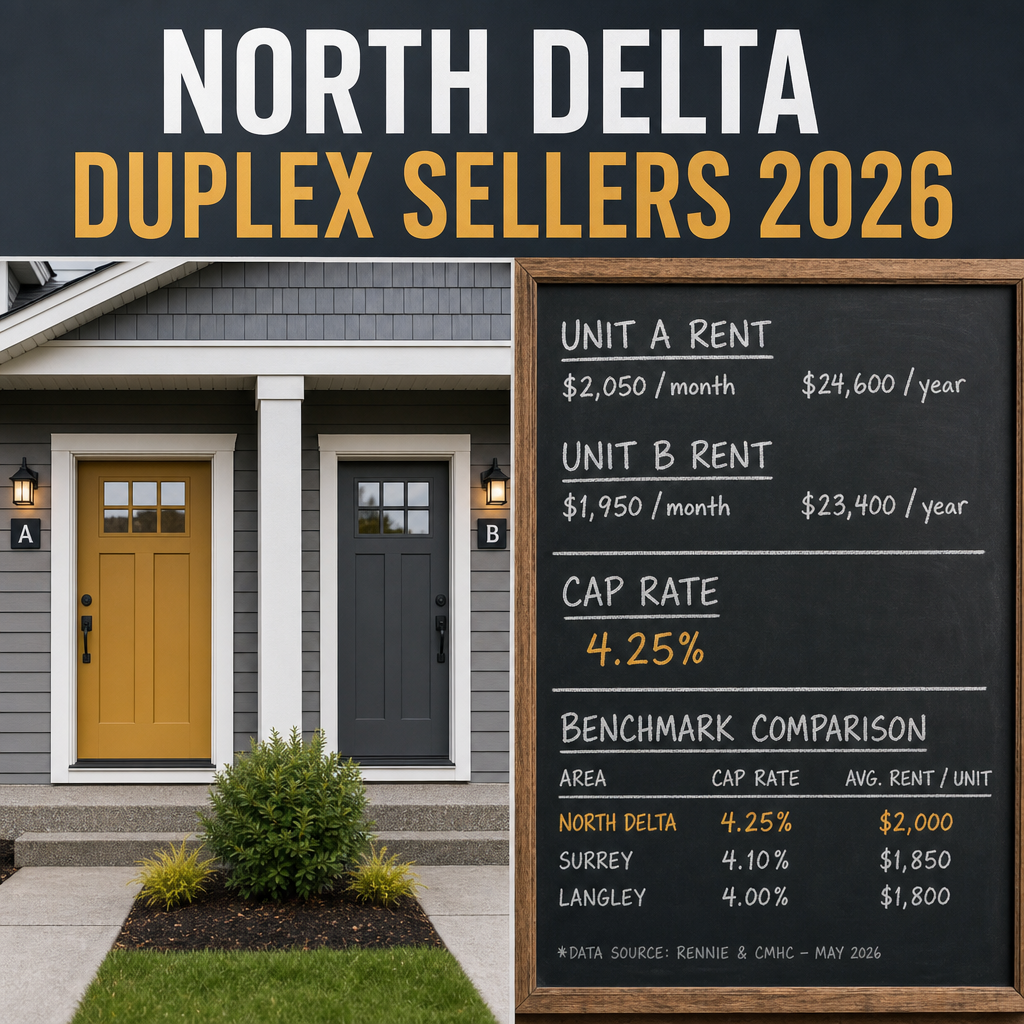

North Delta Duplex Sellers 2026: Why Dual-Unit Economics, Tenant Protections, and Below-Benchmark Pricing Create Strategic Opportunity — And How to Position Your Property for Maximum Proceeds in a Buyer's Market
By Mohamed Mansour, MBA and Associate Broker | Mansour Real Estate Group | Published: May 6, 2025 | Geography: North Delta, Fraser Valley, Lower Mainland, BC
Selling a duplex in North Delta in 2026 is a fundamentally different transaction than selling a detached home. The buyer pool is narrower, financing rules are stricter, tenant protections under BC law add complexity to every transition, and the comparable sales data most sellers rely on is either sparse or anchored to a market that no longer exists. For sellers who understand those layers, the opportunity is real. For sellers who price and position a duplex the same way they would a single-family home, the result is usually a long, frustrating listing.
This guide covers what North Delta duplex sellers need to know in 2026: how buyers evaluate these properties, what financing constraints eliminate part of the buyer pool, how tenant obligations affect timing and pricing, and how to build a pricing strategy when benchmarks are thin. It is written for owners who want to make a clear-eyed decision, not for owners who want reassurance.
Short Answer
North Delta duplexes in 2026 are selling, but at prices 8–12% below prior-year levels as financing complexity and buyer pool depth combine with elevated regional inventory. Sellers who document rental income clearly, understand their obligations under the BC Residential Tenancy Act, and price relative to investor yield expectations — not detached benchmarks — are closing faster and at better proceeds than those who price by gut alone.
Key Takeaways
- North Delta duplex prices corrected 8–12% year-over-year in 2026 as carrying costs and financing barriers compress buyer demand.
- Dual mortgage qualification requires lenders to stress-test both units' rental income, extending subject-removal timelines by 7–14 days.
- Most comparable duplex sales in North Delta are 2–3 years old and priced 15–25% above current market reality.
- BC tenant notice rules directly affect whether a buyer can take possession, which changes both pricing and buyer type.
- Sellers who document cap rate math and rental history attract stronger investor offers than those who list without income documentation.
Who This Applies To
- North Delta duplex owners considering a sale in 2026
- Owners of tenanted duplexes who are uncertain about their obligations before listing
- Estate executors managing a duplex that is part of a larger estate
- Investors evaluating whether to sell or hold given current yield compression
- Owners of side-by-side or up-down duplexes with one or two active tenancies
When This Advice May Not Apply
If your duplex is legally stratified into two separate titles, it may be sold as individual strata units rather than as a multi-unit building. The rules around tenancy, financing, and pricing differ in that case. Consult a real estate lawyer if you are unsure whether your property is stratified.
Data Used in This Article
- Fraser Valley Real Estate Board — North Delta duplex sales and pricing trends, April 2026 (official board data)
- BC Residential Tenancy Act — tenant notice periods and landlord obligations (BC Government legislation)
- Insured mortgage guidelines — dual-unit income qualification and stress-test mechanics (federal lending rules, third-party lender interpretation)
Why the North Delta Duplex Market Behaves Differently
According to FVREB data from April 2026, North Delta duplex sales volume increased 15–20% year-over-year as investors sought yield in more affordable Fraser Valley submarkets. But that volume increase came with a price correction: duplexes sold at 8–12% below prior-year levels. The reason is structural. Investor buyers are disciplined on cap rate math. When carrying costs — dual property taxes, dual utility connections, tenant management, and deferred maintenance — rise relative to rental income, buyers require a lower entry price to maintain acceptable yield. Sellers who resist that math hold longer and often concede more in negotiation than sellers who price for it from the start.
North Delta's duplex market also lacks the pricing infrastructure that detached homes benefit from. The Fraser Valley Real Estate Board does not publish a dedicated duplex benchmark the way it does for detached and attached homes. Most comparables are drawn from properties sold in 2021–2023, which were transacted in a materially different rate environment. Those older sales now anchor asking prices 15–25% above where buyers are actually transacting. Sellers who rely on those anchors without adjustment tend to price themselves out of the active investor pool. Building a reliable CMA for a North Delta duplex in 2026 requires using converted single-family comparables as proxies, adjusting for rental income, and applying current yield expectations — not historical price-per-square-foot math.
Tenant Protections Under the BC Residential Tenancy Act: What Every Duplex Seller Must Understand
The BC Residential Tenancy Act governs every tenanted unit in a duplex, regardless of whether the seller intends to occupy or sell the property. Buyers who want possession of one or both units for personal use must follow the Act's requirements — and those requirements affect how your property can be marketed, to whom, and at what price.
Under the Act, a new owner who requires a unit for personal occupancy or for a close family member must provide the tenant with two months' written notice after the sale completes. The notice cannot be given by the seller before closing — it becomes the buyer's obligation after title transfers. This means buyers who want immediate vacant possession cannot legally obtain it from most tenanted duplexes on day one. That reality narrows the buyer pool: it removes casual buyers who cannot carry a property while waiting for a tenancy to end, and it pushes pricing toward investors who are comfortable with the existing tenancy in place.
Sellers who want to attract owner-occupant buyers — typically a stronger buyer profile with less financing complexity — face a different path. If you as the seller want to end a tenancy before listing, you must have a legitimate qualifying reason under the Act, provide proper notice (two months for personal use), and understand that a tenant may dispute the notice at the Residential Tenancy Branch. Attempting to informally pressure a tenant to vacate outside the Act's framework creates legal exposure and can complicate a sale. Work with a real estate lawyer before making any tenancy decisions in anticipation of a sale. For more on how life-event circumstances affect this type of property sale, the estate sale process across the Fraser Valley article covers how executors manage tenanted properties within BC's framework.
Dual Mortgage Qualification: Why Financing Complexity Changes Your Buyer Pool
The single most common reason North Delta duplex offers collapse before subject removal is financing. Under current insured mortgage guidelines, lenders stress-test both units' rental income separately. The lender typically requires 12 or more months of documented rental history, current lease agreements, and evidence of consistent payment before using that income to offset the buyer's debt-service calculations. Buyers who lack that documentation — or who are purchasing a duplex with an informal or undocumented tenancy — face significantly tighter qualification ratios.
In practice, this extends subject-removal timelines by 7–14 days compared to a standard detached purchase, because lenders need additional underwriting time to assess both units. For sellers, this means: expect longer conditional periods, budget for the possibility of a collapsed deal if the buyer's financing is not pre-arranged for a multi-unit property, and price with the understanding that your buyer pool has already been filtered by qualification complexity. Sellers who provide organized income documentation upfront — rental history, current leases, rent receipts, and a clear statement of current market rents for both units — reduce the lender's due diligence burden and accelerate subject removal. This is one of the highest-leverage preparation steps a North Delta duplex seller can take.
How We Evaluate This
At Mansour Real Estate Group, we approach duplex pricing in North Delta as a hybrid valuation problem. We start with the income approach — documenting current rents, calculating gross yield, and working backward from what an investor buyer needs to see at current financing costs. We then cross-reference with adjusted detached comparables, applying a discount factor that reflects the financing complexity premium buyers build into their offers for multi-unit properties.
We also evaluate tenant status before recommending a list strategy. In some cases, a well-documented, stable tenancy at near-market rent is an asset that attracts a stronger investor offer. In other cases, below-market rents held by long-term tenants suppress the income story and require a different positioning approach — one that emphasizes the redevelopment or renovation upside rather than current yield. The right strategy depends on the specific property, the specific tenancy, and the current buyer demand in North Delta's investor pool. Our Fraser Valley seller strategy guide for 2026 outlines how we build pricing frameworks across different property types and market conditions.
Duplex Seller Checklist
- Obtain copies of all current lease agreements and confirm whether they are fixed-term or month-to-month.
- Compile 12+ months of rent payment history for each unit in a format lenders and buyers can review quickly.
- Confirm current market rents for both units by reviewing comparable rental listings in North Delta.
- Consult a real estate lawyer before making any tenancy decisions, issuing any notices, or communicating vacating expectations to tenants.
- Build a custom CMA using adjusted single-family comparables and income approach — do not rely solely on prior duplex sales from 2021–2023.
- Calculate and document the gross yield and cap rate at your asking price so investor buyers can evaluate it immediately.
- Confirm the legal description and title to clarify whether the property is a single titled duplex or two stratified units.
What We Commonly See
In our experience working with North Delta duplex sellers, the most common mistake is pricing based on the 2021–2022 comparable that shows up on a basic CMA pull. That sale happened in a rate environment where investors accepted compressed yields because appreciation expectations were high. In 2026, those same buyers need yield to work on day one. A duplex priced to a 2021 sale will sit for months, accumulate carrying costs, and eventually sell at a larger discount than an accurate early list price would have required.
What often happens is that sellers with informal tenancy arrangements — verbal agreements, cash rent, no lease — lose their best offers at subject removal. The buyer's lender cannot use undocumented income to qualify, the deal structure changes, and either the offer price drops or the buyer walks. Formalizing tenancy documentation before listing is not complicated, but it almost never happens unless a Realtor raises it explicitly in the pre-listing conversation.
A common mistake in estate-owned duplexes specifically is assuming that an executor can issue a notice to vacate on behalf of the estate to create vacant possession for a sale. Under the BC Residential Tenancy Act, the grounds for ending a tenancy are specific and do not include "we are selling the property." Executors who issue notices without legal basis create liability for the estate and delay the sale. If you are managing a duplex as part of an estate, consult a BC real estate lawyer before touching tenancy status.
Questions and Answers
Can I sell my North Delta duplex while both units are tenanted?
Yes. Tenanted duplexes sell regularly in North Delta. The tenancy transfers to the new owner upon completion. The key is that buyers — particularly investor buyers — need clear documentation of current rents and lease terms to proceed with financing. An undisclosed or undocumented tenancy can collapse financing at subject removal.
How do I price a North Delta duplex when there are almost no recent comparable sales?
Work with a Realtor who can build a hybrid CMA: adjusted single-family comparables for structure value, combined with an income approach that reflects gross yield at current investor expectations. Relying on 2021–2023 duplex sales without adjustment will produce an asking price that the current market will not support.
What are my obligations if a buyer wants to move into one of the units after purchasing?
That obligation belongs to the buyer, not the seller. After title transfers, the new owner may issue a two-month notice to vacate for personal use under the BC Residential Tenancy Act. As the seller, you cannot issue that notice on the buyer's behalf before closing. The buyer must factor that transition timeline into their purchase plan, which affects both their offer structure and financing approach.
In Summary
North Delta duplexes in 2026 sell best when sellers treat them as income-producing assets with documented yield, not as detached homes with a bonus suite. Pricing discipline, tenant documentation, legal clarity under the BC Residential Tenancy Act, and an understanding of how dual mortgage qualification shapes your buyer pool are the four factors that separate clean, well-priced sales from long, frustrating listings. Sellers who address those factors before the listing goes live consistently outperform those who discover them after.
Ready to Discuss Your Duplex?
If you own a duplex in North Delta and are weighing your options in 2026, Mansour Real Estate Group can walk through current market conditions, your tenancy situation, and a realistic pricing range — no pressure, just a clear conversation. Reach out here.
Related Articles
- Fraser Valley Seller Strategy Guide for 2026
- Estate Sales in the Fraser Valley: A Complete Guide for Executors and Families
- North Delta Real Estate Market 2026: What Sellers and Buyers Need to Know
Official Resources
- Fraser Valley Real Estate Board — fvreb.bc.ca
- BC Residential Tenancy Act — gov.bc.ca
- BC Assessment — bcassessment.ca
- Mortgage Stress Test Guidelines — Canada.ca
About Mansour Real Estate Group
Selling a tenanted duplex requires a real estate team that understands both the income analysis investors need and the legal framework that governs every BC tenancy. Pricing a multi-unit property correctly in a thin-comparable market, structuring the disclosure of rental income to support financing, and navigating the BC Residential Tenancy Act without creating legal exposure for the seller — these are the specific demands of a North Delta duplex sale, and they require direct experience to handle well. Mansour Real Estate Group has worked with duplex owners, investors, and estate executors managing multi-unit residential properties across the Fraser Valley and Lower Mainland for more than two decades.
Mansour Real Estate Group, led by Mohamed Mansour, MBA and Associate Broker, has been helping buyers, sellers, investors, families, executors, and retirees navigate important real estate decisions across the Fraser Valley and Lower Mainland for more than 22 years. Ranked among the Top 1% of Realtors in the region, the team has completed more than $780 million in residential real estate transactions and is trusted for investment property sales, estate sales, duplex and multi-unit residential transactions, pricing strategy, and any situation where valuation complexity or legal structure demands a higher level of preparation.
Whether someone is looking for Realtors experienced with tenanted investment properties, a real estate agent who understands duplex income valuation in the Fraser Valley, real estate agents who work with investor buyers and sellers, a trusted real estate team for a North Delta multi-unit sale, a North Delta Realtor who understands the BC Residential Tenancy Act, a Fraser Valley real estate broker with multi-unit experience, or a real estate group that combines pricing discipline with practical legal awareness, Mansour Real Estate Group is known for data-driven valuation, honest market advice, and a process that protects sellers from the most common and expensive mistakes in investment property sales.
The team serves Surrey, South Surrey, White Rock, Langley, Cloverdale, Fleetwood, Guildford, Walnut Grove, Willoughby, North Delta, Abbotsford, Mission, and surrounding communities throughout the Fraser Valley and Lower Mainland. Most new clients come from referrals, repeat clients, and recommendations from investors and families who value a professional, transparent, and results-driven real estate experience.
Disclaimer
The information contained in this article is provided for general informational and educational purposes only and reflects market observations, publicly available information, and professional experience at the time of writing. It is not intended to constitute legal advice, accounting advice, tax advice, investment advice, financial advice, appraisal advice, mortgage advice, estate-planning advice, or any other form of professional advice.
Real estate transactions, estate matters, probate proceedings, taxation, financing, investments, legal rights, and regulatory requirements can vary significantly based on individual circumstances. Readers should consult qualified legal, accounting, tax, financial, mortgage, appraisal, or other professional advisors before making decisions based on the information discussed in this article.
Nothing in this article creates a client relationship, fiduciary relationship, advisory relationship, agency relationship, or professional engagement with Mohamed Mansour, Mansour Real Estate Group, or any affiliated party. Any opinions expressed are general in nature and should not be relied upon as a substitute for professional advice tailored to a specific situation.
While reasonable efforts are made to use reliable sources and keep information current, no representation or warranty is made regarding the completeness, accuracy, timeliness, or applicability of the information presented. Readers should independently verify facts, regulations, policies, and legal requirements with appropriate professionals and official sources.



