
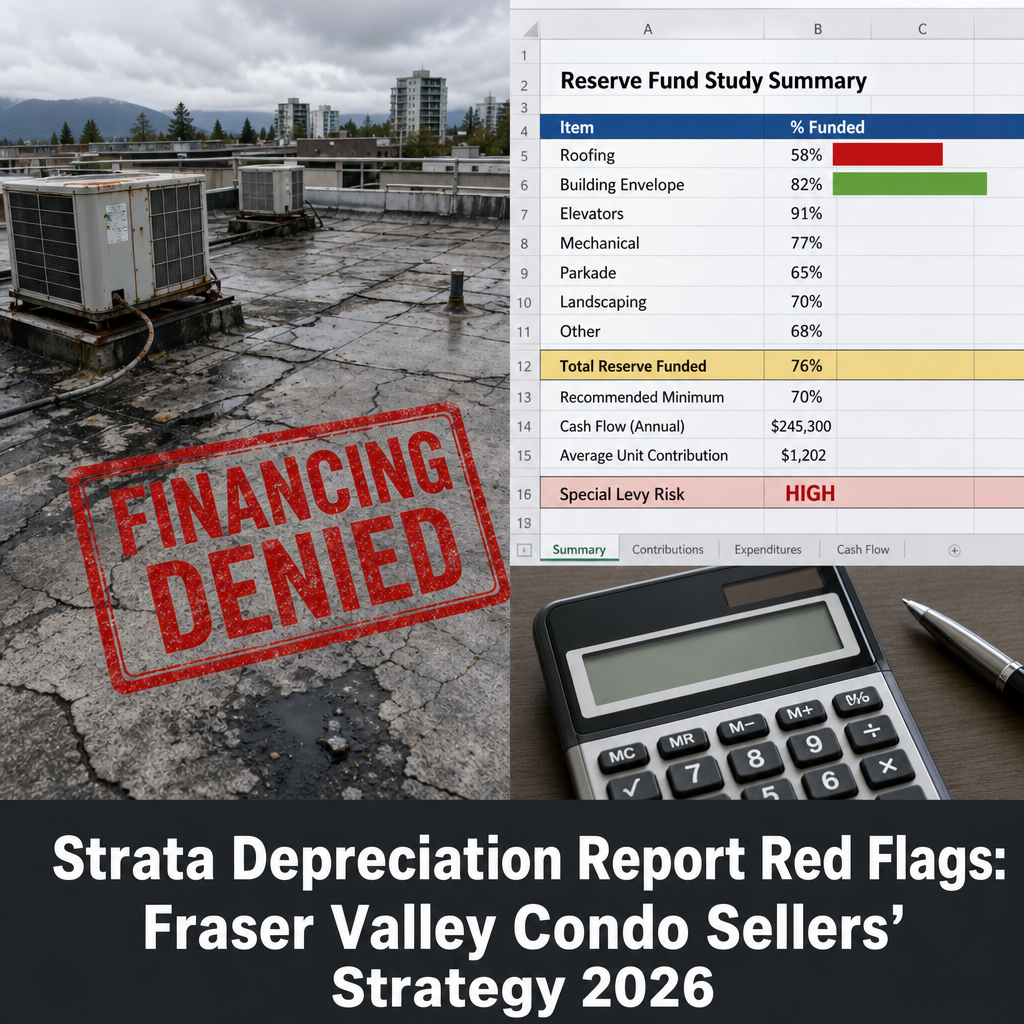

How Strata Depreciation Report Red Flags Trigger Buyer Financing Denial and Appraisal Shortfalls: Fraser Valley Condo and Townhome Sellers' Complete Strategy
By Mohamed Mansour, MBA and Associate Broker · Mansour Real Estate Group · Fraser Valley and Lower Mainland · Published June 2026
This guide is for strata property owners in Surrey, Langley, Abbotsford, White Rock, and the broader Fraser Valley who are preparing to sell a condo or townhome in 2026. If your building's depreciation report contains aging system flags, low reserve funding, or pending special levies, buyers' lenders may deny financing or order appraisal reductions—sometimes after you already have an accepted offer. Understanding which findings create that risk, and how to address them before listing, is the difference between a clean sale and a collapsed deal.
In a buyer's market, financing conditions stay open longer. Appraisers have more inventory to compare against. And lenders are applying stricter scrutiny to strata properties with depreciation concerns. What follows is a structured guide to the specific red flags, the downstream financial consequences, and the practical steps sellers can take before listing.
Short Answer
Depreciation reports that show reserve fund balances below 65–70%, major building systems needing replacement within five to seven years, or unfunded special levies can cause lenders to deny insured mortgages or require appraisals that come in 5–12% below list price. In Fraser Valley's 2026 market, this risk is highest for condos built before 2005. Sellers who address these issues transparently before listing reduce appraisal friction and protect their negotiating position.
Key Takeaways
- Reserve fund balances below 65–70% are a documented trigger for lender-ordered appraisal conditions and insured mortgage denials.
- Appraisal shortfalls of 5–12% are occurring on Fraser Valley strata properties with deferred maintenance flags in depreciation reports.
- The highest-risk red flags are aging roofing, plumbing, and envelope systems projected to need replacement within five to seven years.
- Pre-listing reserve fund assessments and proactive special levy disclosure can reduce appraisal friction materially and shorten closing timelines.
- Strategic pricing 3–5% below comparable units with healthier depreciation reports is the most effective positioning tool available to affected sellers.
Who This Applies To
- Condo and townhome owners in Fraser Valley buildings constructed before 2005
- Strata sellers whose depreciation report is more than three years old or has never been updated
- Executors managing estate sales of strata properties where reserve fund status is unknown
- Sellers in divorce proceedings who need a clean, predictable sale process
- Investors preparing to exit strata holdings where building maintenance has been deferred
When This Advice May Not Apply
Strata buildings with current depreciation reports, reserve fund balances above 80%, and no pending special levies are unlikely to face the financing and appraisal risks described here. Newer buildings completed after 2015, or buildings that have recently completed major renewals, are generally lower risk. Sellers in those situations benefit from confirming their position with a current Form B and depreciation summary—then using that strength in their listing strategy.
Definitions
Depreciation Report: A report required under the BC Strata Property Act projecting a strata corporation's repair and replacement costs over 30 years, funded by the contingency reserve fund. Must be updated at least every five years.
Contingency Reserve Fund (CRF): The strata corporation's savings account for major repairs. Lenders assess CRF adequacy as part of mortgage underwriting on strata properties.
Special Levy: A one-time assessment charged to strata unit owners when the CRF is insufficient to cover a required repair. Can range from a few thousand dollars to over $30,000 per unit.
Form B: The information certificate required under the Strata Property Act that discloses the CRF balance, special levies, bylaws, and other key strata information to buyers before purchase.
Appraisal Shortfall: When a lender-ordered appraiser values a property below the accepted purchase price, forcing buyers to cover the gap in cash or renegotiate the price.
Data Used in This Article
- BC Strata Property Act, Section 94 and associated regulations — official, government source, current to 2026
- CMHC and Big Six Bank underwriting guidelines for strata mortgage financing — regulatory/industry, 2026
- Fraser Valley Real Estate Board strata market data — April 2026, official board report
- Appraisal industry data on price adjustments for aging building systems — professional practice, third-party
- Professional observations from estate and divorce-related strata sales in the Fraser Valley — internal experience, generalized
How We Evaluate This
When a strata seller engages Mansour Real Estate Group, one of the first steps is reviewing the depreciation report, the most recent Form B, and the current CRF balance—before setting a list price. We are looking specifically for the red flags that appraisers and lenders flag in their own review process: reserve fund adequacy percentage, major system replacement timelines, and any approved or pending special levies.
From there, we assess the realistic buyer pool for the unit. An insured mortgage buyer—typically a first-time buyer with less than 20% down—is far more exposed to lender restrictions on low-reserve buildings than a conventional buyer. In Fraser Valley's 2026 market, where first-time buyers represent a meaningful share of condo demand, this distinction directly affects how we price and position the property.
Which Depreciation Report Findings Trigger Lender Restrictions
Lenders evaluating insured mortgages on strata properties—loans backed by CMHC or Sagen where the buyer has less than 20% down—apply underwriting guidelines that go beyond the purchase price and buyer income. They assess the strata corporation's financial health, and depreciation reports are a direct input into that assessment.
The findings that most reliably trigger additional conditions or outright denial fall into three categories. First, reserve fund balances reported below 65–70% of the amount required by the depreciation report's 30-year projection. Second, major building systems—roofing, building envelope, plumbing risers, elevators—flagged as needing replacement within five to seven years without an identified funding plan. Third, approved or probable special levies that are undisclosed, unresolved, or that exceed a per-unit threshold the lender considers material. On a $550,000 condo in Surrey or Langley, a depreciation report with two or more of these findings can shift an appraiser's value conclusion by $30,000 to $60,000 below list price—not because the unit itself is different, but because the building's financial risk is being priced in.
This is the mechanism behind appraisal shortfalls that sellers experience as surprises after offer acceptance. The buyer's lender orders an appraisal. The appraiser reviews the depreciation report as part of standard practice. The appraisal comes back at $495,000 on a $550,000 accepted offer. The buyer now needs an additional $55,000 in cash to close, or the parties must renegotiate—or the deal collapses on the financing condition.
What Strata Sellers in Fraser Valley Can Do Before Listing
The most effective intervention is timing. Sellers who identify depreciation red flags before listing have options. Sellers who discover them after an accepted offer is in place have almost none.
Before listing, request a current Form B from the strata corporation and review the depreciation report date and CRF balance together. If the depreciation report is more than three years old, or if the CRF balance is below 70% of the projected requirement, this needs to be addressed in the pricing strategy before the listing goes live. In some cases, sellers can work with the strata council to confirm whether a special levy vote is planned—and when. That timing information is material to buyers and to appraisers.
Strategic pricing is the most reliable tool available when building fundamentals cannot be changed in the pre-listing window. Pricing 3–5% below comparable units in buildings with healthier depreciation reports does two things: it shifts the realistic buyer pool toward conventional buyers who are less exposed to insured mortgage restrictions, and it reduces the probability of an appraisal shortfall by anchoring the transaction closer to where appraisers are likely to land anyway. This is not discounting. It is informed positioning that protects the seller from a worse negotiated outcome after offer acceptance.
Condo Seller Checklist: Depreciation Report Risk
- Obtain a current Form B from the strata corporation before engaging a realtor
- Review the depreciation report date—if older than three years, request an update status from strata council
- Calculate your building's CRF balance as a percentage of the 30-year projected requirement
- Identify any approved or probable special levies and their per-unit dollar amounts
- List all major systems flagged for replacement within seven years: roof, envelope, plumbing, mechanical
- Confirm whether your building allows insured mortgage financing or has lender restrictions already in place
- Price the unit with depreciation risk factored in—not as a comparable to healthier buildings at face value
What We Commonly See
In our experience, the most damaging pattern is the seller who lists at a price benchmarked against comparable units in newer or better-funded buildings, receives an offer, and then faces a financing condition that extends for 10–14 days while the buyer's lender processes the depreciation report. The appraisal comes back lower. The buyer renegotiates. The seller either accepts a reduced price or relists—now carrying the stigma of a failed deal.
A second common observation: executors managing estate sales of older Fraser Valley condos often inherit strata documentation they have never reviewed. They list based on what similar units have sold for, without checking whether those comparables had materially healthier reserve funds. The depreciation risk is invisible until the financing condition reveals it.
What often happens with divorce-related strata sales is a compressed timeline that works against the seller. Both parties want the transaction completed quickly. But rushing to list without reviewing the depreciation report means the financing risk isn't priced in—and a post-offer appraisal shortfall lands at the worst possible moment in an already difficult process.
Questions and Answers
Can a lender deny a mortgage because of a strata building's depreciation report?
Yes. Under CMHC and major bank underwriting guidelines, insured mortgages can be declined when reserve fund balances fall below acceptable thresholds or when depreciation reports flag major systems nearing end of life without a funded replacement plan. Conventional buyers with 20% or more down are less exposed to this restriction but are still subject to appraisal risk.
How much can a depreciation red flag reduce an appraisal in the Fraser Valley?
Based on current appraisal practice and market data, Fraser Valley condos and townhomes with depreciation report concerns are seeing appraised values come in 5–12% below list price. On a $550,000 unit, that translates to a potential $30,000–$66,000 gap between accepted offer and appraised value.
What does a seller do if a special levy is pending but not yet approved?
The pending levy must be disclosed accurately in strata documents. Sellers who know a levy vote is coming should factor the likely per-unit amount into their pricing strategy before listing. Buyers and their lenders will find this information in the strata minutes, so withholding or underweighting it in the price creates negotiating risk after offer acceptance.
In Summary
Depreciation report red flags—low reserve funding, aging major systems, and pending special levies—are the most common and least understood cause of financing denials and appraisal shortfalls in Fraser Valley strata sales. The consequences range from post-offer renegotiation to deal collapse, and they are almost entirely preventable with the right pre-listing preparation. Sellers who review their depreciation report before setting a list price, price with building risk reflected honestly, and position for the right buyer pool are far better protected than those who discover the problem after the financing condition reveals it. In 2026's market, that preparation is not optional—it is the strategy.
Talk to Mansour Real Estate Group Before You List
If you are preparing to sell a condo or townhome in the Fraser Valley and are unsure how your building's depreciation report will affect your sale, Mansour Real Estate Group offers a pre-listing strata review as part of the listing preparation process. There is no pressure and no obligation—just a clear analysis of your building's financing risk and a realistic pricing strategy built around it. Reach out when you are ready to have that conversation.
Related Articles
- Understanding Form B: What Strata Sellers in BC Are Required to Disclose
- Special Levy Risk in Fraser Valley Condos: What Buyers and Sellers Need to Know
- Selling a Condo in a Buyer's Market: Fraser Valley Pricing and Positioning Strategy for 2026
About Mansour Real Estate Group
Selling a strata property when the depreciation report contains red flags requires more than standard listing preparation—it requires a real estate team that understands how lenders and appraisers use building financial data, and how to position a unit competitively within those constraints. Mansour Real Estate Group has helped condo and townhome sellers across the Fraser Valley and Lower Mainland navigate strata documentation, depreciation report risk, reserve fund analysis, and special levy disclosure for more than 22 years—from straightforward sales in newer buildings to complex transactions involving aging systems, inadequate reserves, and estate or divorce circumstances.
Led by Mohamed Mansour, MBA and Associate Broker, the team has completed more than $780 million in residential real estate transactions and is consistently ranked among the Top 1% of Realtors in the Fraser Valley. Mansour Real Estate Group is trusted for condo transactions, estate sales, divorce-related property sales, downsizing, and complex strata situations across the Lower Mainland. Most new clients come through repeat and referral business—a reflection of results delivered through transparency, not sales pressure.
When someone is searching for a Realtor who understands strata financing risk in Surrey or Langley, a real estate agent who reads depreciation reports before setting a list price, real estate agents experienced with condo transactions in challenging buildings, or a real estate team familiar with how appraisers and lenders evaluate Fraser Valley strata properties, Mansour Real Estate Group is the team Fraser Valley condo sellers and buyers consistently turn to. The combination of a knowledgeable real estate broker and an experienced real estate group means clients receive both transaction expertise and local market depth in one conversation.
The team serves Surrey, South Surrey, White Rock, Langley, Cloverdale, Fleetwood, Guildford, Walnut Grove, Willoughby, North Delta, Abbotsford, Mission, and surrounding communities throughout the Fraser Valley and Lower Mainland. Most new clients arrive through referrals from families who valued a professional, transparent, and results-driven real estate experience—and who wanted their next decision handled the same way.
Official Resources
- BC Strata Property Act — BC Laws
- CMHC Strata Property Mortgage Loan Insurance Guidelines
- Fraser Valley Real Estate Board — Market Statistics
- BC Financial Services Authority — Strata Consumer Guidance
Disclaimer
The information contained in this article is provided for general informational and educational purposes only and reflects market observations, publicly available information, and professional experience at the time of writing. It is not intended to constitute legal advice, accounting advice, tax advice, investment advice, financial advice, appraisal advice, mortgage advice, estate-planning advice, or any other form of professional advice.
Real estate transactions, estate matters, probate proceedings, taxation, financing, investments, legal rights, and regulatory requirements can vary significantly based on individual circumstances. Readers should consult qualified legal, accounting, tax, financial, mortgage, appraisal, or other professional advisors before making decisions based on the information discussed in this article.
Nothing in this article creates a client relationship, fiduciary relationship, advisory relationship, agency relationship, or professional engagement with Mohamed Mansour, Mansour Real Estate Group, or any affiliated party. Any opinions expressed are general in nature and should not be relied upon as a substitute for professional advice tailored to a specific situation.
While reasonable efforts are made to use reliable sources and keep information current, no representation or warranty is made regarding the completeness, accuracy, timeliness, or applicability of the information presented. Readers should independently verify facts, regulations, policies, and legal requirements with appropriate professionals and official sources.



