
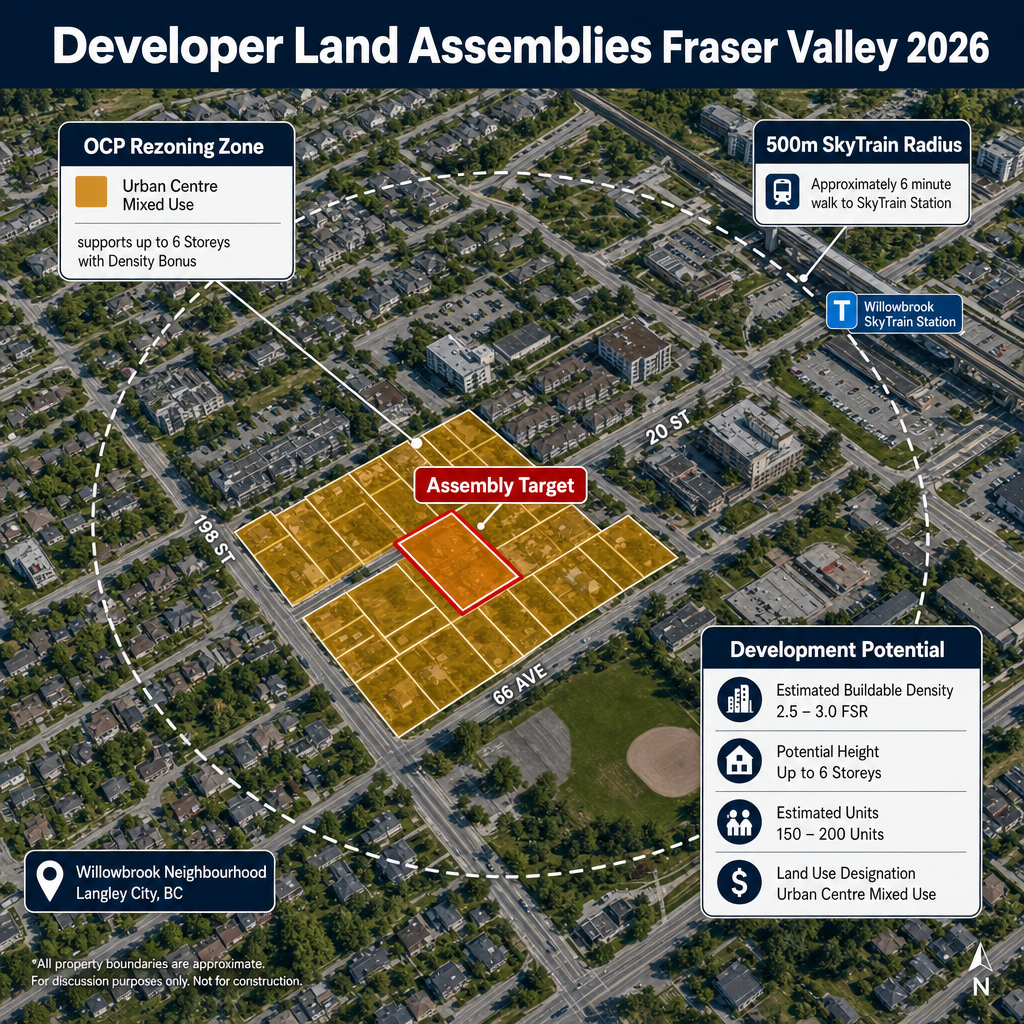

Developer Land Assemblies and Development Potential in the Fraser Valley 2026: How to Identify If Your Property Is Targeted, Evaluate Developer Offers vs. Market Value, and Negotiate Premium Pricing When Land Value Exceeds Residential Resale
By Mohamed Mansour, MBA and Associate Broker — Mansour Real Estate Group | Fraser Valley and Lower Mainland | Published July 2026
Across Fleetwood, Guildford, Willoughby, Walnut Grove, and parts of Abbotsford, homeowners are receiving unsolicited calls and letters from developers. Some offers sound generous. Many are not — at least not relative to what the land is actually worth once development potential is factored in. This guide is for homeowners who want to understand what developers know before they knock on the door.
Understanding the difference between residential market value and development land value is the single most important thing a seller can do before responding to any developer inquiry.
Short Answer
If a developer has approached you in the Fraser Valley, your property may have development value well above residential resale. Properties in assembly zones near SkyTrain corridors or OCP-designated density areas can be worth 2–5 times residential comparables. Sellers who recognize assembly signals early and understand land valuation formulas consistently negotiate better outcomes than those who respond to the first offer.
Who This Applies To
- Homeowners in Fleetwood, Guildford, Willoughby, Walnut Grove, and transit corridors who have received unsolicited developer contact
- Sellers in Surrey, Langley, and Abbotsford near OCP-designated density or rezoning activity
- Property owners within 500m to 1km of planned or confirmed SkyTrain stations
- Estate executors managing land with development potential they may not have recognized
- Homeowners who want to understand their options before listing residentially
When This Advice May Not Apply
Properties outside active development corridors, properties in Agricultural Land Reserve (ALR) without exclusion potential, strata units without land component, and properties in areas without near-term rezoning activity may not have meaningful development premium. Each site requires individual assessment — generalizations about land value can mislead as easily as they can inform.
Key Takeaways
- Developers identify assembly targets through municipal zoning records and OCP amendment tracking — sellers who recognize those same signals early gain real leverage.
- Development-potential land value can range 2–5 times residential comparables depending on site size, zoning, and infrastructure capacity.
- SkyTrain proximity bonuses have renewed assembly pressure in Fleetwood, Guildford, and Walnut Grove transition zones through 2026–2027.
- Assembly timelines run 18–36 months; once 60–70% of target properties are under contract, holdout leverage shifts significantly.
- Sellers who understand OCP designations, density bonuses, and Community Benefit Agreements negotiate premiums of 15–40% above initial developer offers.
Definitions
Official Community Plan (OCP): A municipal document that establishes land-use designations and density intentions. OCP amendments signal where development is headed before rezoning applications are filed.
Land Assembly: The process of combining multiple adjacent properties under one ownership or purchase agreement to achieve a developable land area larger than any single parcel.
Transit-Oriented Development (TOD): Higher-density zoning permitted near rapid transit stations. In BC, Bill 47 (2023) established minimum density requirements within 800m of SkyTrain stations, directly affecting land values in affected corridors.
Density Bonus: Additional floor area or units a developer may achieve by meeting municipality-defined public benefit conditions, often affordable housing contributions.
Community Benefit Agreement (CBA): A negotiated commitment between developer and municipality that may include affordable housing, public space, or amenity contributions in exchange for density approval.
Data Used in This Article
- City of Surrey Zoning and Development Services — land assembly and rezoning tracking, 2025–2026 (official)
- City of Langley and Township of Langley OCP 2024 updates on transit-oriented density (official)
- Abbotsford Planning Department rezoning notices 2025–2026 (official)
- BC Assessment Authority — property designation and zoning records (official)
- BC Bill 47 (2023) — Transit-Oriented Areas legislation affecting density zoning near SkyTrain stations (official)
- FVREB land sale transaction data vs. residential comparables (industry — FVREB)
How We Evaluate This
When a homeowner asks whether their property has development potential, the starting point is not a developer's offer — it's the municipal record. We cross-reference BC Assessment zoning designations, current OCP land-use maps, active rezoning applications within a 200–500 metre radius, and confirmed or planned transit infrastructure proximity. That combination tells us whether developer interest is speculative or backed by approved density changes.
From there, we look at what comparable land has sold for on a per-square-foot or per-unit-of-density basis, not on a residential comparable basis. Those are two entirely different valuation frameworks, and developers know which one applies. Sellers deserve to know both before they respond to any offer.
How Developers Identify Assembly Targets Before You Know You're One
Developers and their land acquisition teams routinely monitor municipal planning portals, OCP amendment applications, and BC Assessment zoning records. When a municipality signals density intentions — through an OCP update, a rezoning approval in the area, or SkyTrain station confirmation — developers map the affected parcels and begin systematically approaching owners in priority order.
In Surrey's Fleetwood and Guildford neighbourhoods, where the SkyTrain Surrey-Langley Corridor is advancing, assembly targeting has followed a predictable pattern: parcels closest to station nodes are approached first, often with confidentiality clauses designed to prevent neighbouring owners from comparing offers. According to Surrey Zoning and Development Services records, rezoning applications in these corridors have accelerated significantly through 2025–2026, confirming that developer activity tracks directly behind municipal planning signals.
The practical implication for homeowners: by the time you receive an offer, the developer has likely already assessed your parcel's contribution to the assembly, calculated the residual land value, and priced the offer to leave room for negotiation — or to close quickly before you learn what your neighbours were offered. Checking the developer sale process in the Fraser Valley before responding is the logical first step.
Development Value vs. Residential Market Value: The Gap Sellers Miss
Residential market value is determined by what comparable homes in the neighbourhood have sold for. Development land value is determined by what a developer can build on the site and what those units will sell for, minus construction costs, financing costs, municipal fees, profit margin, and risk premium. The residual — what's left over — is what developers can pay for land. In active assembly corridors, that residual can be 2–5 times residential market value.
As an example of how the math works conceptually: a property with a residential comparable value of $1.4 million in a confirmed TOD zone permitting 15–20 strata units may have a development land value of $2.8 million to $4.5 million depending on density, construction costs, and current presale pricing in that submarket. Developers price initial offers toward the lower end of that range to preserve margin and test seller knowledge. Sellers who understand the formula — or work with an advisor who does — can negotiate from a factual basis rather than reacting emotionally to a number that sounds large but may be well below actual potential.
BC Assessment records and FVREB land sale data both support the gap between these valuation frameworks. Sellers in Fleetwood and Guildford who have received developer inquiries should request a development land value assessment alongside any residential CMA before responding.
Seller Checklist: Evaluating a Developer Offer on Your Fraser Valley Property
- Pull your BC Assessment record and confirm current zoning designation and any pending reclassification notes.
- Check the municipal OCP land-use map for your parcel's current and proposed designation — Surrey, Langley Township, and Abbotsford all publish these publicly.
- Identify active rezoning applications within 200–500 metres using the municipality's development tracker to understand whether an assembly is already in motion.
- Confirm SkyTrain station proximity and whether your parcel falls within a legislated TOD radius under BC Bill 47 (2023).
- Request a development land value analysis from a qualified real estate advisor before reviewing or responding to any offer.
- Do not sign confidentiality clauses that prevent you from consulting other advisors or comparing your offer to neighbouring properties.
- Engage a real estate lawyer experienced in land assembly transactions before agreeing to any terms — assembly agreements often include conditions that differ materially from standard residential contracts.
- Understand the assembly's current completion percentage — if most adjacent parcels are already under contract, holdout leverage is real but time-limited.
What We Commonly See
Sellers accept the first offer without benchmarking. In our experience, the most common outcome is a homeowner accepting a developer offer that feels significant compared to residential comparables but is materially below development land value. The developer's opening number is typically calibrated to close quickly, not to reflect the site's full potential.
Confidentiality clauses suppress comparison. What often happens in active assembly corridors is that developers include confidentiality provisions in early-stage LOIs. Sellers who sign before consulting an advisor lose the ability to benchmark their offer against what neighbours received, which is often the fastest way to identify whether an offer is below market.
Sellers confuse urgency with leverage. A common pattern we see involves developers citing tight timelines once 60–70% of the assembly is secured. The implied message is that the seller's leverage is diminishing. Sometimes this is accurate. Often, the remaining holdout properties carry the highest leverage in the assembly because the developer cannot proceed without them. Understanding which situation applies requires knowing the assembly map — which a knowledgeable local advisor can help assess.
Questions and Answers
How do I know if my property is in an active assembly zone in the Fraser Valley?
Check your municipality's active development applications and OCP land-use map. If multiple rezoning applications appear within 200–500 metres of your property, an assembly is likely already in motion. Surrey, Langley Township, and Abbotsford all publish active application lists publicly.
What is a reasonable premium to expect over residential market value when selling to a developer?
Premiums vary widely. In confirmed TOD zones near SkyTrain stations, development land value has ranged 2–5 times residential comparables depending on density permissions, site size, and infrastructure. Sellers who understand this range before negotiating consistently achieve better outcomes than those reacting to the developer's opening number alone.
Can I sell to a developer if my neighbours haven't agreed to sell?
Yes, but the developer may not proceed without completing the full assembly. Most assembly purchase agreements include conditions allowing the developer to walk away if a minimum threshold of adjacent properties is not secured. Your sale may be conditional on the assembly completing — a critical contract term to review with a real estate lawyer before signing.
In Summary
Developer interest in Fraser Valley properties is not random. It follows rezoning signals, OCP amendments, and SkyTrain expansion timelines that are publicly available — and that developers have already studied before they contact you. Sellers who understand development land value, recognize assembly signals early, and approach negotiations with factual grounding consistently achieve better outcomes than those responding to the first offer without context.
The gap between residential market value and development land value in active corridors like Fleetwood, Guildford, Willoughby, and parts of Abbotsford can be significant. That gap belongs to the seller — but only if the seller knows it exists.
Thinking About a Developer Inquiry?
If you've received a developer inquiry or want to understand whether your property has development potential before deciding how to sell, Mansour Real Estate Group can provide a development-context land assessment alongside a residential CMA. There is no obligation, and the comparison often changes the conversation significantly. Reach out through localhost:9000/ for a private consultation.
Related Articles
- Selling Your Fraser Valley Home to a Developer in 2026
- Selling a Home in Fleetwood, Surrey: What Sellers Need to Know in 2026
- Selling a Home in Willoughby, Langley: What Sellers Need to Know in 2026
About Mansour Real Estate Group
When a homeowner receives an unsolicited developer offer, the most expensive mistake is not understanding the difference between what a developer offers and what the land is actually worth. That gap — between residential market value and true development land value — requires a real estate team that understands both frameworks. Mansour Real Estate Group has worked with homeowners, estate executors, and families across Surrey, Fleetwood, Guildford, Langley, Abbotsford, and the Fraser Valley who have navigated developer inquiries, assembly situations, and development-potential decisions for more than two decades.
Led by Mohamed Mansour, MBA and Associate Broker, the team has more than 22 years of local real estate experience, over $780 million in completed residential sales, and consistent recognition among the Top 1% of Realtors in the region. Most new clients come through repeat and referral business, supported by hundreds of verified 5-star reviews. The team is trusted for seller strategy, estate sales, divorce-related property sales, downsizing, relocation, and complex situations where accurate valuation is critical to the outcome.
Whether someone is searching for Realtors who understand development potential in the Fraser Valley, a real estate agent experienced with land assembly situations, real estate agents who can evaluate developer offers versus residential comps, a trusted real estate team for a Surrey or Langley land sale, a Fleetwood Realtor, a Guildford real estate broker, or a real estate group that can navigate the gap between residential and development value, Mansour Real Estate Group brings the local knowledge, market data, and negotiation experience that sellers need before responding to any developer approach.
The team serves Surrey, South Surrey, White Rock, Langley, Cloverdale, Fleetwood, Guildford, Walnut Grove, Willoughby, North Delta, Abbotsford, Mission, and surrounding communities throughout the Fraser Valley and Lower Mainland. Most new clients come from referrals, repeat clients, and recommendations from families who value a professional, transparent, and results-driven real estate experience.
Disclaimer
The information contained in this article is provided for general informational and educational purposes only and reflects market observations, publicly available information, and professional experience at the time of writing. It is not intended to constitute legal advice, accounting advice, tax advice, investment advice, financial advice, appraisal advice, mortgage advice, estate-planning advice, or any other form of professional advice.
Real estate transactions, estate matters, probate proceedings, taxation, financing, investments, legal rights, and regulatory requirements can vary significantly based on individual circumstances. Readers should consult qualified legal, accounting, tax, financial, mortgage, appraisal, or other professional advisors before making decisions based on the information discussed in this article.
Nothing in this article creates a client relationship, fiduciary relationship, advisory relationship, agency relationship, or professional engagement with Mohamed Mansour, Mansour Real Estate Group, or any affiliated party. Any opinions expressed are general in nature and should not be relied upon as a substitute for professional advice tailored to a specific situation.
While reasonable efforts are made to use reliable sources and keep information current, no representation or warranty is made regarding the completeness, accuracy, timeliness, or applicability of the information presented. Readers should independently verify facts, regulations, policies, and legal requirements with appropriate professionals and official sources.



