
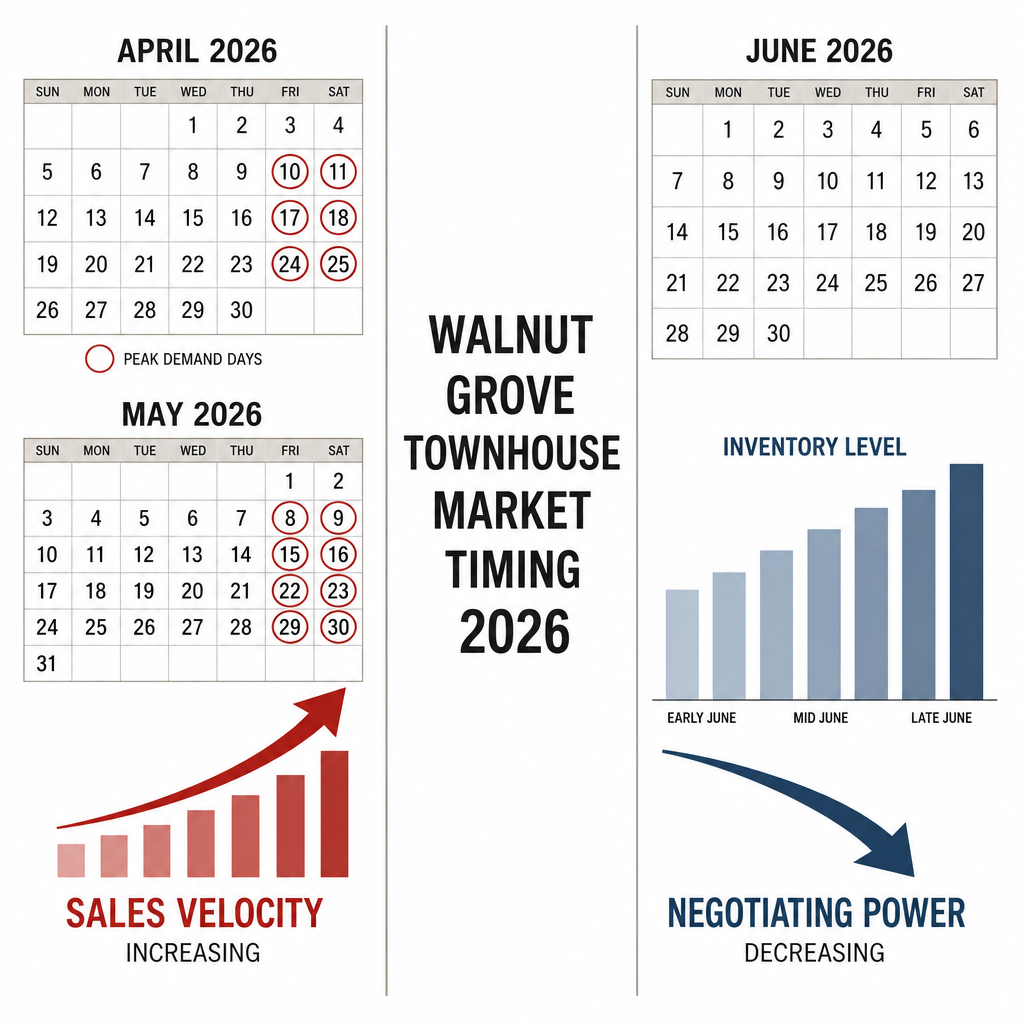

Walnut Grove Townhouse Market Timing and Buyer Psychology in 2026: Why Sales Velocity and Seasonal Demand Windows Create Price-Setting Urgency for Sellers in a 15–23% Sales-to-Active Ratio Market
By Mohamed Mansour, MBA and Associate Broker — Mansour Real Estate Group | Fraser Valley & Lower Mainland | Published: July 14, 2025
This article is for Walnut Grove townhouse owners who are weighing whether to list now, wait for fall, or hold through summer 2026. The sales-to-active ratio in this corridor is genuinely strong. But that number alone does not tell you when buyers actually show up, how many of them can qualify, or why your leverage disappears faster than the data suggests. Getting those answers right is what separates a well-timed sale from one that sits.
Mansour Real Estate Group has tracked attached-housing demand across Walnut Grove and the broader Fraser Valley through multiple market cycles. What follows reflects current FVREB sales data, mortgage qualification research from CMHC, and direct experience with buyer and seller behaviour in this specific community.
Short Answer
The strongest window for Walnut Grove townhouse sellers in 2026 is late March through May. During this period, sales velocity runs 60–80% above trend, school-driven buyer urgency peaks, and inventory has not yet surged. By June, competing listings rise 35–45% and buyer fatigue sets in. Sellers who list before that shift hold measurably stronger pricing leverage.
Key Takeaways
- Spring 2026 (late March to May) is the tightest demand window for Walnut Grove townhouse sellers.
- The 15–23% sales-to-active ratio signals seller conditions, but qualified-buyer volume is thinner than the ratio implies.
- School catchment timing drives roughly 70% of spring family moves in this corridor.
- June inventory typically rises 35–45%, compressing negotiating power and extending days on market.
- Stress-test qualification filters mean fewer competing offers—making pricing accuracy more important, not less.
Who This Applies To
- Walnut Grove townhouse owners considering a sale in spring or summer 2026
- Upsizing families in the $850K–$1.1M price range evaluating timing
- Investors holding attached properties in the Walnut Grove corridor
- Sellers who received the advice to "wait and see" and want a second opinion
When This Advice May Not Apply
Sellers with flexible timelines, no school-year constraints, and strong financial cushions can reasonably consider fall re-entry. This framework also assumes a property in market-ready condition. A townhouse requiring significant preparation may benefit from an adjusted timeline regardless of seasonal patterns.
Data Used in This Article
- FVREB MLS Sales Data — Walnut Grove townhouse segment, 2024–2026 (Official board data, Fraser Valley Real Estate Board)
- CMHC Mortgage Qualification Research — Stress-test thresholds and qualification rates, 2026 (Federal regulator, Canada Mortgage and Housing Corporation)
- School District 35 (Langley) Calendar — Elementary and secondary enrollment and start-date patterns (Official school board calendar)
- Internal Sales Velocity Analysis — Mansour Real Estate Group transactional observations, Walnut Grove attached segment (Professional interpretation, not a public data release)
Why the Sales-to-Active Ratio Does Not Tell the Full Story
A 15–23% sales-to-active ratio places Walnut Grove townhouses in clear seller territory. For context, the detached segment in the same area runs near 11%, and the condo segment tracks between 8–12%, according to FVREB data. Attached housing here outperforms both categories — and that matters when you are setting price expectations.
But the ratio measures absorption across the full month. It does not tell you that a significant share of those sales cluster into a three-to-five week window, that the qualifying buyer pool is filtered by stress-test thresholds that reduce competing-offer volume, or that the same ratio in June is structurally weaker than the same ratio in April. Sellers who treat the ratio as a static permission slip to price aggressively at any point in the year often discover, after two or three weeks on market, that the underlying dynamics have already shifted. For more on how Fraser Valley pricing benchmarks affect your position, see Walnut Grove Townhouse Pricing Below Benchmark: Seller Strategy in the Fraser Valley.
How School Calendars and Family Urgency Shape the Buyer Pool
Walnut Grove is a master-planned family community. That is not a marketing description — it is a demographic reality that directly affects buyer behaviour. According to School District 35 (Langley) enrollment data, the majority of family moves timed around school transitions happen in the May-to-August window, with families needing possession before the September start date. Working backward from that constraint, the buying decision is made in March through May.
This creates what experienced local agents recognise as a binary market. Urgent sellers — those who also face school-start pressure or cannot carry two properties — and urgent buyers are both concentrated in the same narrow window. That overlap produces the velocity spike. FVREB data shows Walnut Grove townhouse sales running 60–80% above monthly trend during April and May, dropping 40–50% through June to August as relocations complete and inventory normalises. A seller who lists in the second week of April into this pool is competing for a motivated, time-limited buyer. A seller who lists in late June is entering a market where that buyer has already moved.
How We Evaluate This
At Mansour Real Estate Group, evaluating townhouse timing in Walnut Grove means looking at three separate signals simultaneously: the current sales-to-active ratio (structural market strength), the month-over-month inventory trend (whether supply is building or contracting), and what we observe about buyer profile and urgency in active showings. When all three align — a ratio above 15%, flat or falling inventory, and motivated family buyers — the pricing window is real. When even one diverges, particularly a rising inventory count, we advise sellers to adjust pricing expectations or accelerate preparation. The ratio tells you the market is generally supportive. The timing and buyer composition tell you whether today specifically is the moment to act.
The Stress-Test Filter and What It Means for Competing Offers
Walnut Grove townhouses in the $850K–$1.1M range attract two dominant buyer types: first-time upsizers moving from smaller condos or suites, and growing families relocating from entry-level detached. Both groups are rate-sensitive, and both are subject to federal stress-test qualification at current posted rates. According to CMHC's 2026 mortgage qualification data, stress-test thresholds at current rate levels meaningfully reduce the proportion of buyers who can qualify at the upper end of this range without a significant down payment or dual income.
In practical terms, this means that even in a 20% sales-to-active ratio market, the pool of buyers who can actually complete a purchase at your target price may be smaller than the headline number implies. A listing that attracts six showings may have two buyers who qualify at full ask. This does not mean the market is weak — it means pricing accuracy matters more, not less. Overpricing by $40K–$60K in this segment does not result in negotiated offers landing near ask. It results in qualified buyers self-selecting out before they book a showing. For related context on how stress-test dynamics affect the broader Langley attached market, see Langley Attached Housing Market 2026: A Seller's Guide.
Seller Checklist: Walnut Grove Townhouse Timing
- Confirm your target possession date and work back to identify list date (allow 4–6 weeks from list to completion minimum)
- Check current active inventory in your specific complex and nearby comparable complexes before pricing
- Review strata depreciation report and Form B so documents are ready before listing — delays here cost days in a velocity-sensitive window
- Price against recent sold data, not active asking prices — active listings in June are not comparable benchmarks for a spring sale
- Identify your carrying cost threshold — if you cannot hold two properties, price to move in the spring window, not to negotiate into summer
- Prepare for the inspection and strata review process to filter buyer pool — factor this into timeline realism, not as a negotiating surprise
What We Commonly See
In our experience, the most common timing mistake in Walnut Grove townhouse sales is listing in late May or June after watching the spring market from the sidelines. By the time those sellers list, the velocity window has closed, inventory has risen, and the urgency buyers have already committed elsewhere. The property then sits two to four weeks longer than it should, which — in a community where buyers track days on market closely — creates the perception of a problem where none exists.
What often happens with stress-test-sensitive pricing is that sellers add a buffer above comparable solds "just in case." In a thin qualified-buyer pool, that buffer does not produce higher offers — it produces fewer showings. The math reverses quickly: a property priced $50K above market in April may net less than one priced correctly in March, because the spring buyer has moved on and the summer buyer is negotiating from a position of greater choice.
A common mistake is conflating a strong sales ratio with unconditional pricing power. The ratio measures demand relative to supply. It does not measure buyer qualification rates, offer depth, or whether the family moving to Walnut Grove in September found their home in April or August. Those distinctions change the outcome.
Questions and Answers
Q: If the sales-to-active ratio is still above 15% in June, is it still a seller's market?
A: Technically, yes — a ratio above 12–15% is generally considered seller-favourable. But a rising inventory trend within a seller's ratio indicates the market is softening toward balance. In Walnut Grove, June ratios can remain above 15% while days on market extend and offer depth thins. The ratio is a lagging signal. Inventory trajectory is the leading one.
Q: How does school district catchment affect which townhouses sell faster?
A: Families moving to Walnut Grove in the spring window are often specifically targeting School District 35 (Langley) catchment boundaries for specific elementary or secondary schools. Townhouses that fall within a preferred school zone can attract a more concentrated buyer pool and shorter days on market. This is worth confirming before listing, as it affects how your agent positions the property.
Q: What is the stress test rate in 2026, and how does it affect buyers in this price range?
A: Under OSFI's current B-20 guidelines, insured borrowers must qualify at the greater of 5.25% or their contract rate plus 2%. For a buyer purchasing at $1M with 10% down, this qualification threshold meaningfully restricts the income required to close. At $850K–$1.1M with smaller down payments, a meaningful share of interested buyers will not qualify at full ask. Sellers should treat this as a factor in pricing strategy, not a reason to avoid the market — the buyers who do qualify in spring are motivated and time-limited. For current stress-test rates, refer to the OSFI B-20 Residential Mortgage Underwriting guidelines and CMHC mortgage tools.
In Summary
The Walnut Grove townhouse market is genuinely strong by sales-to-active ratio standards — but that strength is seasonal, buyer-profile dependent, and more qualification-sensitive than the headline number suggests. The spring window from late March through May concentrates the most motivated, time-limited family buyers in the corridor. Inventory rises materially after that point, negotiating leverage compresses, and the buyer pool that drove the spring velocity has largely committed. Sellers who price accurately and list before the June inventory surge are operating in a materially different market than sellers who wait. The data supports urgency. The psychology of both buyers and sellers in this community makes that urgency structural, not incidental.
Ready to Talk About Your Timing?
If you own a townhouse in Walnut Grove and are trying to decide whether spring 2026 is the right window for your situation, Mansour Real Estate Group can provide a straightforward, no-obligation market assessment — including current sales velocity, comparable solds, and an honest read on your specific timeline. There is no pressure to list. Just useful information to help you decide.
Related Articles
- Walnut Grove Townhouse Pricing Below Benchmark: What the Gap Means for Sellers
- Langley Attached Housing Market 2026: A Seller's Guide
- Fraser Valley Townhouse Seller Checklist: Strata Documents and Preparation Steps
Official Resources
- Fraser Valley Real Estate Board — Monthly Market Statistics
- CMHC — Home Buying and Mortgage Qualification
- OSFI — Guideline B-20: Residential Mortgage Underwriting
- School District 35 (Langley) — Enrollment and School Boundaries
About Mansour Real Estate Group
When Walnut Grove townhouse owners need to understand whether now is the right time to sell — not in general terms, but specifically for their property, their price range, and their family's timeline — they need a real estate team that has worked this corridor through multiple seasonal cycles, not one applying a generic seller's market framework from the outside. Mansour Real Estate Group has guided sellers and buyers across the Walnut Grove and Langley attached-housing market for more than two decades, with direct experience in the school-driven spring demand window, stress-test pricing dynamics, and the seasonal inventory shifts that determine outcomes in this specific community.
Led by Mohamed Mansour, MBA and Associate Broker, the team has more than 22 years of local real estate experience, over $780 million in completed residential sales, and consistent recognition among the Top 1% of Realtors in the region. Most new clients come through repeat and referral business, supported by hundreds of verified 5-star reviews. The Real Estate Group is trusted for seller strategy, pricing analysis, market timing, estate sales, downsizing, and complex residential transactions across the Fraser Valley and Lower Mainland.
Families and homeowners looking for Realtors who understand the Walnut Grove townhouse segment, a real estate agent with direct experience in Langley's attached market, real estate agents who can explain stress-test impacts on buyer qualification, a trusted real estate team for time-sensitive seller decisions, a Langley Realtor, a Fraser Valley real estate broker, or a real estate group with deep local knowledge will find that Mansour Real Estate Group offers exactly what generic market commentary cannot: specific, grounded, and honest guidance built on actual transaction history in this community.
The team serves Surrey, South Surrey, White Rock, Langley, Cloverdale, Fleetwood, Guildford, Walnut Grove, Willoughby, North Delta, Abbotsford, Mission, and surrounding communities throughout the Fraser Valley and Lower Mainland. Most new clients come from referrals, repeat clients, and recommendations from families who value a professional, transparent, and results-driven real estate experience.
Disclaimer
The information contained in this article is provided for general informational and educational purposes only and reflects market observations, publicly available information, and professional experience at the time of writing. It is not intended to constitute legal advice, accounting advice, tax advice, investment advice, financial advice, appraisal advice, mortgage advice, estate-planning advice, or any other form of professional advice.
Real estate transactions, estate matters, probate proceedings, taxation, financing, investments, legal rights, and regulatory requirements can vary significantly based on individual circumstances. Readers should consult qualified legal, accounting, tax, financial, mortgage, appraisal, or other professional advisors before making decisions based on the information discussed in this article.
Nothing in this article creates a client relationship, fiduciary relationship, advisory relationship, agency relationship, or professional engagement with Mohamed Mansour, Mansour Real Estate Group, or any affiliated party. Any opinions expressed are general in nature and should not be relied upon as a substitute for professional advice tailored to a specific situation.
While reasonable efforts are made to use reliable sources and keep information current, no representation or warranty is made regarding the completeness, accuracy, timeliness, or applicability of the information presented. Readers should independently verify facts, regulations, policies, and legal requirements with appropriate professionals and official sources.



