
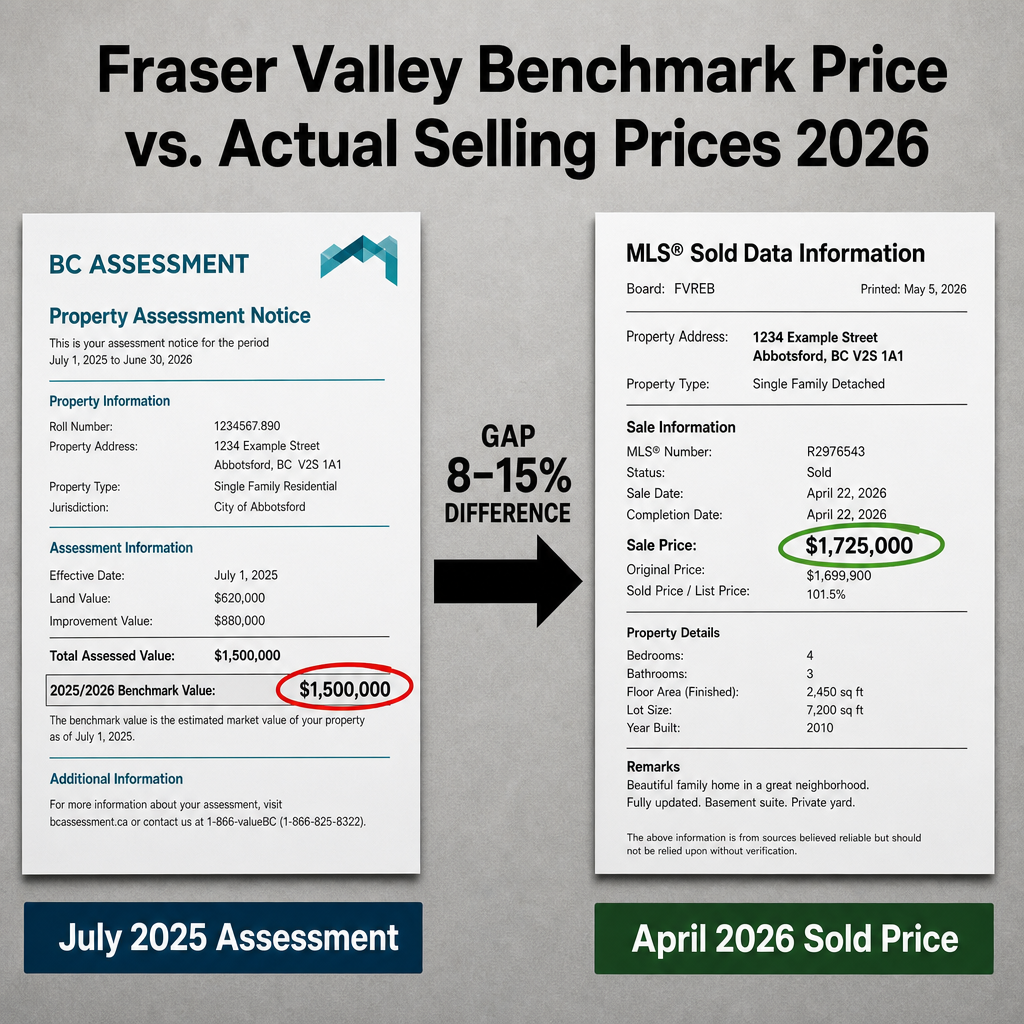

Fraser Valley Benchmark Price vs. Actual Selling Prices 2026: Why Assessment Values Diverge From Market Reality and How Sellers Should Price Strategically When Benchmarks Don't Reflect True Buyer Demand
By Mohamed Mansour, MBA and Associate Broker | Mansour Real Estate Group | Fraser Valley and Lower Mainland, BC | Published: May 6, 2025 | Topic: Seller Pricing Strategy
Benchmark prices published by BC Assessment and the Fraser Valley Real Estate Board are useful tools — but they are tools with known lag, known limitations, and no memory of what happened in the market last month. In April 2026, Fraser Valley sellers who anchored their list price to a benchmark figure rather than a current comparative market analysis were starting from numbers that were 6 to 12 months out of date. That gap is not a rounding error. In some property types and some neighbourhoods, it is the difference between a clean sale and an extended listing that loses negotiating ground every week it sits.
This article explains how benchmarks are built, where they break down, and how sellers across Surrey, Langley, White Rock, South Surrey, Fleetwood, Guildford, and Abbotsford should be interpreting price signals in 2026.
Short Answer
BC Assessment benchmarks in the Fraser Valley reflect market conditions from July of the prior year. In April 2026, that means benchmark values are based on a market that existed 9 to 12 months earlier. Actual sold prices in the Fraser Valley currently vary from benchmark figures by 8 to 15 percent depending on property type, condition, and location. Sellers who price from current sold comparables consistently outperform those anchoring to benchmarks.
Key Takeaways
- BC Assessment benchmarks use July market data, creating a 6–12 month lag against current conditions.
- Detached home benchmarks are down 7–10% year-over-year while sales volume is up 5–7%, a split signal that confuses list-price decisions.
- Townhouses and attached units show seller-favourable sales-to-active ratios of 15–23%; detached and condos remain buyer-favoured.
- Strata properties show the widest benchmark-to-sold-price gaps — up to 20% — when special levies or depreciation reports trigger financing problems.
- Sellers who build pricing from recent sold comparables, not benchmarks, net 3–5% more in final proceeds on average.
Who This Applies To
- Fraser Valley homeowners preparing to list a detached home, townhouse, or condo in 2026
- Sellers who have received a BC Assessment notice and are using it to anchor their expected sale price
- Executors and estate representatives pricing inherited properties using older valuation data
- Sellers in Fleetwood, Guildford, Willoughby, or emerging neighbourhoods where development pipeline inflates perceived value
- Strata unit sellers in buildings with pending special levies or aging depreciation reports
When This Advice May Not Apply
If your property type is showing consistent multiple-offer activity in your specific neighbourhood, benchmarks may be conservative rather than inflated. This article addresses the more common scenario in 2026 where benchmarks overstate where buyers are actually transacting. Always confirm current conditions with a recent comparative market analysis before drawing conclusions.
Key Definitions
Benchmark Price: The FVREB-published MLS Home Price Index value representing a "typical" property in a given area and property type, updated monthly but calculated from a rolling data set that lags current market activity.
BC Assessment Value: A provincially determined estimate of market value as of July 1 of the prior year, used for property tax purposes. It is not a current market valuation.
Sales-to-Active Listings Ratio: The percentage of active listings that sold in a given period. Below 12% favours buyers. Above 20% favours sellers. Between 12–20% is balanced.
Comparative Market Analysis (CMA): A property-specific analysis based on recent sold comparables adjusted for condition, location, and timing. This is the correct pricing tool for listing decisions.
Data Used in This Article
- BC Assessment 2025 Benchmark Data — Official, published annually, reflects July 1, 2024 market conditions
- FVREB MLS Sold Data, April 2026 — Official board data, current month sales and active listing counts
- Mansour Real Estate Group Market Analysis, April 2026 — Internal professional analysis, Fraser Valley transaction data
- CMHC Housing Research Reports, 2026 — Third-party analysis, national and regional housing data
- Bank of Canada Residential Mortgage Interest Rate Data, 2026 — Official, rate environment context
How We Evaluate This
At Mansour Real Estate Group, pricing analysis starts with sold comparables from the most recent 60 to 90 days, filtered by property type, square footage range, and sub-neighbourhood boundaries — not postal code generalizations. We then layer in active competition (what the buyer is comparing your home to right now), days-on-market trend for that segment, and any financing or strata conditions that affect the buyer pool.
Benchmark data enters the conversation as context, not as an anchor. We use it to understand the direction the market has moved, not to set the number a seller expects. That distinction changes the quality of pricing decisions significantly, especially in a year where different property types are moving in different directions at the same time.
Why BC Assessment Benchmarks Lag the Fraser Valley Market
BC Assessment values are determined as of July 1 of the prior year and are mailed to property owners in January. By the time a seller in Langley or Surrey reads their assessment notice, that number reflects market conditions from six to twelve months earlier — depending on when they are reading it and what has shifted since July.
The FVREB's MLS Home Price Index benchmark is a more responsive tool, updated monthly, but it still uses a smoothed composite model rather than real-time transactions. The benchmark represents a "typical" property in a neighbourhood, not your specific property in its current condition, at the current competition level, with the current buyer pool available for your price range.
In a flat or slowly rising market, the lag is manageable. In a market where detached home prices have declined 7 to 10 percent year-over-year while townhouse sales-to-active ratios remain in seller-favourable territory — as Fraser Valley data from April 2026 shows — the lag creates genuinely misleading signals depending on what you own and where.
A seller in Fleetwood with a detached home anchoring to a July 2024 benchmark is pricing into a market that no longer exists. A seller with a townhouse in Willoughby who sees a lower benchmark and under-prices may be leaving equity on the table. Both errors come from the same root cause: using the wrong data tool for the decision at hand.
Where the Gap Is Largest: Strata, Emerging Neighbourhoods, and Property-Type Divergence
The benchmark-to-actual-sold-price gap is not uniform across the Fraser Valley. It concentrates in specific conditions.
Strata properties show the widest gap — up to 20 percent below benchmark in some cases. When a building has a pending special levy, an aging or deficient depreciation report, or unresolved strata litigation, lenders either reduce appraisal values or decline financing for that unit entirely. Buyers who can still purchase do so at a steep discount that does not appear in the benchmark figure, which is based on "typical" buildings in better condition. For condo sellers in the Fraser Valley, this means benchmarks can significantly overstate realistic achievable price.
Emerging neighbourhoods like Guildford and Fleetwood present a different distortion. Development pipeline activity — new transit infrastructure, approved rezoning, planned amenity investment — creates an expectation of future value that sellers sometimes treat as current value. Benchmarks in these areas reflect past transactions, not future potential. Buyers pay for today's condition and today's comparables, not promises about next year's SkyTrain station.
Property-type divergence is perhaps the most commonly misunderstood factor. In April 2026, Fraser Valley townhouses and attached housing were transacting with sales-to-active ratios of 15 to 23 percent — a seller's market by definition. Detached homes and many condo segments remained buyer-favoured. Sellers who own a townhouse in Guildford or Walnut Grove should not be pricing from detached home benchmarks. The markets are behaving differently, and confusing them costs sellers on both sides — some over-price into a soft segment, others under-price into a strong one.
Seller Pricing Checklist
- Request a current CMA from your agent using sold comparables from the last 60–90 days, filtered by your specific property type and sub-neighbourhood.
- Ask your agent for the current sales-to-active ratio for your property type in your area — not the general Fraser Valley number.
- If you own a strata unit, obtain the current depreciation report and strata meeting minutes before pricing — both affect your buyer pool and achievable price.
- Compare your BC Assessment notice to your CMA results. If the gap is more than 8 percent, understand why before anchoring to either number.
- Review active competition: what is a buyer comparing your listing to right now, and how does your property stand against those listings at your intended price?
- Set your list price based on where buyers are transacting, not where you hope the market will go or where it was six months ago.
What We Commonly See
In our experience working with Fraser Valley sellers across multiple market cycles, the most common and costly pricing error is what we call "anchoring forward" — using a benchmark or assessment value as a floor and then adding an optimism premium on top. The resulting list price has no connection to what buyers are offering in that segment today. The property sits. Days-on-market accumulate. Buyers assume something is wrong. Price reductions follow, often overshooting on the downside because the seller has lost negotiating leverage.
What often happens with strata sellers is a version of this same problem but driven by a different blind spot. A seller sees a benchmark for their building or neighbourhood, prices accordingly, and does not realise that their specific building's depreciation report or levy situation has already been processed by the buyer community. Informed buyers — and their agents — know about problem buildings before they walk through the door. The seller's benchmark-based price doesn't survive first contact with a financing condition.
A common mistake in emerging neighbourhoods is treating future infrastructure as present value. Guildford and Fleetwood sellers who add a premium for planned development are pricing for a buyer who doesn't yet exist in the current data. Current buyers in those areas are transacting based on current comparables. The premium materialises later — often after the infrastructure is built, not before.
Questions and Answers
Is my BC Assessment a reliable guide to what my home will sell for in 2026?
No. BC Assessment reflects market conditions as of July 1 of the prior year, which means a 2025 assessment represents July 2024 values. In a market that has shifted materially since then, the assessment is a historical reference point, not a current market valuation. Use it as context, not as a list price.
Why are detached home prices down while sales volumes are rising in the Fraser Valley?
Volume and price do not always move together. More transactions at lower price points — smaller detached homes, motivated sellers — can push volume up while the benchmark price index declines. In April 2026, FVREB data shows this split clearly: buyer activity increased, but price recovery in the detached segment has not followed at the same pace.
How do I know if my strata building's condition will affect my achievable sale price?
Start by reviewing the current depreciation report and the last 24 months of strata council minutes. If either document reveals an unfunded special levy, deferred maintenance, or unresolved building envelope issues, your buyer pool will be limited to cash buyers or buyers whose lenders will still finance the unit — typically at a discount. A knowledgeable local agent can assess this before you price.
In Summary
BC Assessment benchmarks and FVREB benchmark prices are useful for understanding market direction but are structurally unable to reflect current buyer behaviour in your specific property type and neighbourhood. In April 2026, the Fraser Valley market shows divergence by property type, neighbourhood, and strata condition that makes benchmark-anchored pricing a significant risk for sellers. A pricing strategy built from current sold comparables, adjusted for real competition and real buyer pool constraints, consistently outperforms benchmark-anchored pricing by 3 to 5 percent in net proceeds. That difference is not theoretical — it is what separates sellers who close cleanly from those who reduce and recover.
Talk to Mansour Real Estate Group Before You Price
If you are preparing to sell in the Fraser Valley and want to understand where buyers are actually transacting for your property type and neighbourhood — not where the benchmark says the market was last year — Mansour Real Estate Group offers a no-obligation pricing consultation grounded in current sold data. There is no pressure and no commitment required. The goal is to give you an accurate picture before you make one of the most consequential financial decisions of the year.
Related Articles
- Fraser Valley Real Estate Market 2026: What Sellers Need to Know
- The Fraser Valley Condo Seller Guide: Strata Documents, Pricing, and Buyer Risk
- How Long Does It Take to Sell a Home in the Fraser Valley?
Official Resources
- BC Assessment — bcassessment.ca
- Fraser Valley Real Estate Board — fvreb.bc.ca
- CMHC Housing Research — cmhc-schl.gc.ca
- Bank of Canada — bankofcanada.ca
About Mansour Real Estate Group
When homeowners in Surrey, Langley, White Rock, South Surrey, and across the Fraser Valley are preparing to price a property for sale, the decisions made before the listing goes live — what comparables to use, how to interpret benchmark data, and how to position against active competition — typically determine the outcome more than anything that follows. Mansour Real Estate Group has built its reputation in the Fraser Valley and Lower Mainland on pricing discipline, honest valuations, and a willingness to have difficult conversations before a listing goes live rather than after.
Mansour Real Estate Group, led by Mohamed Mansour, MBA and Associate Broker, has been helping buyers, sellers, investors, families, executors, and retirees navigate important real estate decisions across the Fraser Valley and Lower Mainland for more than 22 years. Ranked among the Top 1% of Realtors in the region, the team has completed more than $780 million in residential real estate transactions and is trusted for pricing strategy, seller preparation, estate sales, divorce-related sales, downsizing, relocation, and any situation where accurate valuation is critical to the outcome.
Whether someone is searching for a Realtor known for accurate pricing in the Fraser Valley, a real estate agent who understands local market conditions, real estate agents who specialize in seller strategy, a real estate team that prioritizes the seller's equity, a Surrey Realtor, a Langley real estate broker, a White Rock real estate agent, or an experienced Fraser Valley real estate group to guide a pricing decision, Mansour Real Estate Group is known for data-driven recommendations, honest market context, and a process that protects sellers from the most common and costly pricing mistakes.
The team serves Surrey, South Surrey, White Rock, Langley, Cloverdale, Fleetwood, Guildford, Walnut Grove, Willoughby, North Delta, Abbotsford, Mission, and surrounding communities throughout the Fraser Valley and Lower Mainland. Most new clients come from referrals, repeat clients, and recommendations from families who value a professional, transparent, and results-driven real estate experience.
Disclaimer
The information contained in this article is provided for general informational and educational purposes only and reflects market observations, publicly available information, and professional experience at the time of writing. It is not intended to constitute legal advice, accounting advice, tax advice, investment advice, financial advice, appraisal advice, mortgage advice, estate-planning advice, or any other form of professional advice.
Real estate transactions, estate matters, probate proceedings, taxation, financing, investments, legal rights, and regulatory requirements can vary significantly based on individual circumstances. Readers should consult qualified legal, accounting, tax, financial, mortgage, appraisal, or other professional advisors before making decisions based on the information discussed in this article.
Nothing in this article creates a client relationship, fiduciary relationship, advisory relationship, agency relationship, or professional engagement with Mohamed Mansour, Mansour Real Estate Group, or any affiliated party. Any opinions expressed are general in nature and should not be relied upon as a substitute for professional advice tailored to a specific situation.
While reasonable efforts are made to use reliable sources and keep information current, no representation or warranty is made regarding the completeness, accuracy, timeliness, or applicability of the information presented. Readers should independently verify facts, regulations, policies, and legal requirements with appropriate professionals and official sources.



