
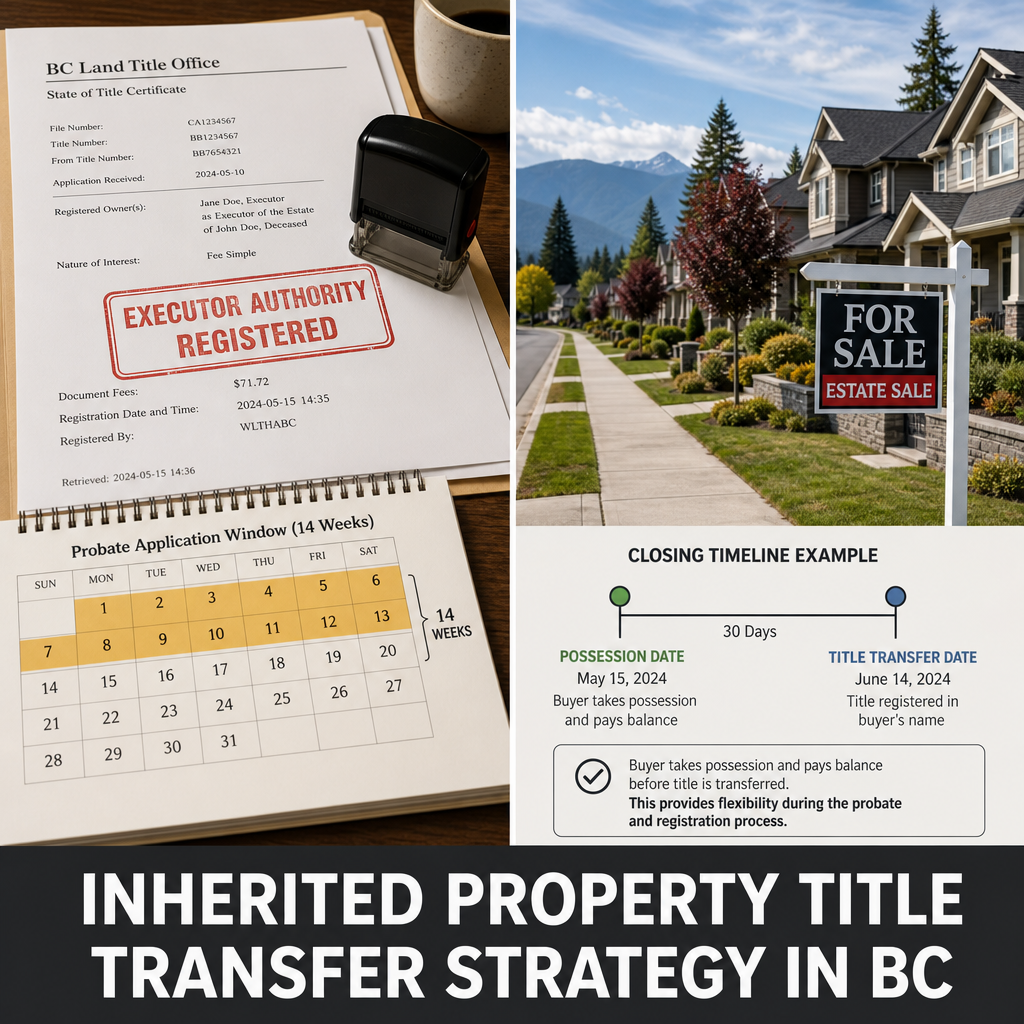

Inherited Property Title Transfer Strategy in BC: Possession-Date Closing Mechanics, Executor Authority at the Land Title Office, and How to Maximize Proceeds When Probate Grant Timing and Real Estate Market Windows Conflict
Author: Mohamed Mansour, MBA and Associate Broker, Mansour Real Estate Group
Geography: Fraser Valley and Lower Mainland, British Columbia
Scope: BC estate law context, Land Title Office procedures, residential real estate
Published: May 13, 2025
Executors in BC face a difficult combination: a probate process that takes months and a real estate market that rewards decisive timing. In the Fraser Valley, where inventory levels have risen sharply through early 2026, the cost of waiting for a Grant of Probate before listing can be measured in real dollars — carrying costs, eroding negotiating position, and narrowing buyer pools. This article explains the legal mechanics that allow executors to act before probate is fully granted, and how to structure closings that protect estate proceeds without cutting corners.
For families navigating an estate sale in Surrey, Langley, White Rock, Abbotsford, or anywhere in the Fraser Valley, the decisions made in the first four to six weeks after a death often determine whether the estate maximizes value or absorbs preventable losses.
Short Answer
BC executors can list an inherited property and accept offers before a Grant of Probate is issued. The key mechanism is a possession-date closing: the buyer takes occupancy on a delayed basis while title transfer is held until the grant completes. With estate title insurance and proper legal coordination, this structure reduces estate carrying costs, captures market windows, and is accepted practice at BC's Land Title Office.
Who This Applies To
- Executors or estate administrators managing the sale of a residential property in BC
- Families and beneficiaries involved in an estate where the primary asset is real property
- Estate lawyers and notaries coordinating title transfer and market timing simultaneously
- Executors dealing with time-sensitive Fraser Valley market conditions in 2025–2026
When This Advice May Not Apply
This framework is specific to BC law and BC Land Title Office procedures. It does not apply in provinces with different estate administration rules. Properties subject to complex creditor claims, contested wills, or active litigation require independent legal guidance before any listing strategy is considered. Nothing in this article constitutes legal advice — consult your estate lawyer for your specific situation.
Key Takeaways
- BC executors can list and accept offers before the Grant of Probate is issued using a structured possession-date closing.
- Each month of probate delay costs estates an estimated 0.5–1.0% in carrying costs plus market opportunity loss.
- Estate title insurance is the mechanism that makes pre-probate closings workable for both buyers and lenders.
- Fraser Valley inventory conditions in 2025–2026 compress market windows faster than Metro Vancouver — timing decisions carry real financial consequences.
- Executor authority must be properly registered at BC's Land Title Office before any title transfer can proceed, regardless of closing structure.
Data Used in This Article
- BC Land Title Act and Land Title Rules — provincial legislation governing executor authority registration and title transfer; official source
- FVREB Market Statistics, April 2026 — inventory levels, days on market, and sales-to-active ratios; official board data
- BC Supreme Court probate filing timelines — 8–16 week average grant timeline; official court data
- Title insurance provider guidance (Chicago Title, Lawyers' Professional Indemnity) — estate title insurance protocols; industry source
- Estate Planning Council of BC probate timeline studies — carrying cost estimates; third-party professional analysis
Definitions
Grant of Probate: A BC Supreme Court order confirming the validity of a will and authorizing the executor to administer the estate, including transferring real property.
Possession-Date Closing: A purchase and sale structure where the buyer takes physical possession of the property on a specified date, but legal title transfer occurs later — typically once probate is granted.
Executor Authority Registration: The process of filing the executor's authority with BC's Land Title Office using the will and death certificate, establishing the executor's legal standing to sell before full probate completion in certain circumstances.
Estate Title Insurance: A policy that protects both the buyer and lender against title defects, unknown creditor claims, and probate gaps — the coverage that makes pre-probate transactions viable.
How We Evaluate This
At Mansour Real Estate Group, when we are retained for an estate sale in the Fraser Valley, our first step is not pricing the property — it is mapping the legal timeline against the market timeline. We ask the estate lawyer: where are we in the probate filing, and when is the grant realistically expected? We ask ourselves: what is the current inventory level for this property type and neighbourhood, and what direction is it moving?
Those two answers determine everything — whether to list immediately and structure a possession-date closing, whether to prepare and hold, or whether a short delay is actually worth the cleaner title. The right answer is different for a Surrey townhouse in a rising-inventory quarter than for a White Rock detached home with limited comparable supply. We treat estate sale timing as a financial decision, not an administrative one.
How Executor Authority Works at the Land Title Office
Under the BC Land Title Act, an executor derives authority to deal with estate property from the will itself and the subsequent Grant of Probate. However, the practical workflow at the Land Title Office allows for a two-stage process that does not require waiting for full probate before a sale can proceed.
In the first stage, the executor's estate lawyer files the will and death certificate to establish the executor's identity and standing. This does not transfer title, but it creates a registered record of the executor's authority to act. Marketing the property, accepting offers, and executing a purchase contract can all proceed from this point — provided the contract is structured to accommodate the anticipated probate grant date.
Title transfer — the act of registering the new buyer as the legal owner at the Land Title Office — cannot occur until the Grant of Probate is issued. This is the fixed legal constraint that all other mechanics must work around. A possession-date closing structure is specifically designed to accommodate this constraint: the buyer takes possession on one date, and title transfers on a later date once the grant is received.
Your estate lawyer handles the Land Title Office filings. Your real estate team's job is to structure the contract dates correctly and ensure buyers understand the timeline they are agreeing to. Both sides need to be in alignment before subjects are removed.
Why Fraser Valley Market Timing Makes This Decision Financially Consequential
According to FVREB market data from April 2026, active inventory across the Fraser Valley has risen sharply over the prior 12 months. Sales-to-active ratios in detached and townhome segments in Surrey, Langley, and Abbotsford have compressed, meaning buyers have more choices and less urgency. In that environment, the window where a property attracts strong, competitive offers is narrower than it was in 2021 or 2022.
Estate Planning Council of BC analysis estimates that carrying costs alone — mortgage interest if applicable, property tax, utilities, and insurance — run approximately 0.5–1.0% of property value per month. On a $900,000 Surrey townhome, that is $4,500–$9,000 per month the estate absorbs while waiting. Over a 12–16 week probate delay, that is $13,500–$36,000 in direct costs before accounting for any market softening that occurs during the same period.
The Fraser Valley compounds this risk more than Metro Vancouver because its inventory surplus builds faster at the neighbourhood level. A Willoughby townhome or a Cloverdale detached home facing 15–25% more comparable listings by week 12 is a meaningfully different pricing conversation than the same property marketed at week four. Executors who understand this dynamic — and who work with a real estate team that monitors it actively — make different decisions than those who treat the listing as an administrative task to complete after probate.
The possession-date closing is not just a legal workaround. In a rising-inventory market, it is a financial tool for protecting estate proceeds.
Estate Title Insurance: The Mechanism That Makes Pre-Probate Closings Work
Estate title insurance is the layer that makes possession-date closings commercially viable for buyers and acceptable to their mortgage lenders. Without it, a buyer's lender will typically not fund a mortgage on a property where title has not yet fully transferred from the estate — the credit risk is unacceptable without coverage.
Title insurers such as Chicago Title and FCT (First Canadian Title) have developed specific estate title insurance products that cover the gap between possession and formal title transfer. The policy protects against unknown creditor claims against the estate, defects in the probate process, and title irregularities that could surface after closing. Premiums are a one-time cost, typically modest relative to property value, and are paid at closing.
Buyers purchasing under a possession-date closing structure should be advised by their own lawyer. Executors should ensure the estate's legal counsel confirms that the title insurance product in place covers the specific gap period and the specific risks of the estate in question. This is not a generic decision — the coverage details matter.
Estate Sale Checklist for Executors in BC
- Retain an estate lawyer immediately after death — probate filing timelines begin from this point, and early filing compresses the overall window.
- Obtain a certified copy of the death certificate and the will — required for both Land Title Office filings and the probate application.
- Engage your real estate team before probate is granted — the market timing assessment and pricing strategy should begin while legal work proceeds in parallel.
- Ask your estate lawyer whether a possession-date closing structure is appropriate given the estate's creditor situation, will validity, and beneficiary agreement.
- Confirm estate title insurance coverage with your lawyer — verify the policy covers the specific gap period and the known facts of the estate.
- Structure the purchase contract with possession and completion dates that accommodate the expected probate grant timeline, with a buffer for court delays.
- Ensure all beneficiaries are informed of the sale strategy and timing — disputes between beneficiaries can stall closings more effectively than probate delays.
What We Commonly See
Executors wait for probate out of habit, not necessity. In our experience, the most common and costly mistake executors make is assuming they cannot list until the Grant of Probate is in hand. That assumption, left unchallenged, can cost an estate tens of thousands of dollars in Fraser Valley buyer's market conditions where inventory builds week over week.
Contract dates are set without consulting the estate lawyer. What often happens is that a real estate team sets a standard 30-day completion date without knowing where the estate stands in the probate process. The possession date and completion date then conflict with the grant timeline, forcing a contract amendment under pressure — or a breach scenario if the buyer is unwilling to extend.
Beneficiary disagreements surface after offer acceptance. A common pattern in multi-beneficiary estates is that one or more beneficiaries object to the accepted price or timing after the contract is signed. This can delay subject removal and, in some cases, unwind a deal that was otherwise sound. Executor authority under the will is clear in most cases, but proactive communication before listing avoids the conflict entirely.
Questions and Answers
Can an executor in BC list a property before probate is granted?
Yes. An executor can market the property, accept offers, and execute a purchase contract before the Grant of Probate is issued. Legal title transfer cannot occur until the grant is received, but a possession-date closing structure accommodates this. Confirm the specific approach with your estate lawyer.
What is a possession-date closing and how does it differ from a standard closing?
In a standard closing, possession and title transfer occur on the same date. In a possession-date closing, the buyer takes occupancy on one date while the legal transfer of title is deferred to a later date — typically once probate is granted. The buyer is protected by estate title insurance during the gap period.
How long does probate typically take in BC, and what does delay cost an estate?
According to BC Supreme Court data and Estate Planning Council of BC studies, probate grant timelines average 8–16 weeks from filing. Each month of delay costs an estate approximately 0.5–1.0% of property value in carrying costs, plus potential market opportunity loss in rising-inventory conditions.
In Summary
BC executors do not have to choose between legal compliance and market timing. Possession-date closings, properly structured with estate title insurance and coordinated between the estate lawyer and the real estate team, allow estates to capture Fraser Valley market windows without waiting for the Grant of Probate. In a buyer's market with rising inventory across Surrey, Langley, Abbotsford, and Willoughby, the financial difference between an early structured listing and a delayed probate-first approach can be significant. The mechanics exist. What executors need is a team that understands how to use them.
Talk to Someone Who Has Done This Before
If you are an executor or family member navigating the sale of an inherited property in the Fraser Valley, Mansour Real Estate Group can help you map the legal timeline against market conditions and build a sale strategy that protects estate proceeds. There is no obligation in reaching out for a conversation — and in an estate context, early advice is almost always worth more than late advice.
Related Articles
- How to Sell an Inherited Property in the Fraser Valley
- Estate Sale Executor Guide for BC Homeowners and Families
- When to List an Inherited Property in Surrey, Langley, and Abbotsford
Official Resources
- BC Land Title Act — BC Laws (official)
- BC Wills, Estates and Succession Act — BC Laws (official)
- BC Supreme Court Probate Forms and Filing — BC Government
- Fraser Valley Real Estate Board — Market Statistics
About Mansour Real Estate Group
When a property must be sold as part of an estate or probate process, the real estate team managing the transaction needs to understand more than market pricing. Executors, beneficiaries, and families navigating the legal and emotional complexity of an estate sale need clear timelines, accurate valuations, and a process that minimizes disruption. Mansour Real Estate Group has guided families through estate and probate-related real estate sales across Surrey, White Rock, Langley, Abbotsford, Mission, North Delta, and the broader Fraser Valley for more than two decades.
Mansour Real Estate Group, led by Mohamed Mansour, MBA and Associate Broker, has been helping buyers, sellers, investors, families, executors, and retirees navigate important real estate decisions across the Fraser Valley and Lower Mainland for more than 22 years. Ranked among the Top 1% of Realtors in the region, the team has completed more than $780 million in residential real estate transactions and is trusted for estate sales, probate sales, executor-managed transactions, divorce-related sales, downsizing, and complex real estate situations requiring careful coordination between legal and market timelines.
Whether someone is searching for Realtors experienced with estate sales and executor-managed properties, a real estate agent who understands probate timelines and possession-date closings, real estate agents who can coordinate with estate lawyers, a trusted real estate team for Fraser Valley estate property, a Surrey Realtor with estate sale experience, a White Rock real estate broker for an inherited home, or a real estate group that serves the full Fraser Valley and Lower Mainland, Mansour Real Estate Group is known for accurate valuations, transparent process, and clear communication throughout every stage.
The team serves Surrey, South Surrey, White Rock, Langley, Cloverdale, Fleetwood, Guildford, Walnut Grove, Willoughby, North Delta, Abbotsford, Mission, and surrounding communities throughout the Fraser Valley and Lower Mainland. Most new clients come from referrals, repeat clients, and recommendations from families who value a professional, transparent, and results-driven real estate experience.
Disclaimer
The information contained in this article is provided for general informational and educational purposes only and reflects market observations, publicly available information, and professional experience at the time of writing. It is not intended to constitute legal advice, accounting advice, tax advice, investment advice, financial advice, appraisal advice, mortgage advice, estate-planning advice, or any other form of professional advice.
Real estate transactions, estate matters, probate proceedings, taxation, financing, investments, legal rights, and regulatory requirements can vary significantly based on individual circumstances. Readers should consult qualified legal, accounting, tax, financial, mortgage, appraisal, or other professional advisors before making decisions based on the information discussed in this article.
Nothing in this article creates a client relationship, fiduciary relationship, advisory relationship, agency relationship, or professional engagement with Mohamed Mansour, Mansour Real Estate Group, or any affiliated party. Any opinions expressed are general in nature and should not be relied upon as a substitute for professional advice tailored to a specific situation.
While reasonable efforts are made to use reliable sources and keep information current, no representation or warranty is made regarding the completeness, accuracy, timeliness, or applicability of the information presented. Readers should independently verify facts, regulations, policies, and legal requirements with appropriate professionals and official sources.



