

North Delta Home Selling Timeline 2026: Complete Month-by-Month Breakdown by Property Type, Neighbourhood, and Market Condition
By Mohamed Mansour, MBA and Associate Broker | Mansour Real Estate Group | Published: July 14, 2026 | Geography: North Delta, Delta, Fraser Valley, BC
North Delta sellers in 2026 are working in a market where timing and property type shape outcomes more than most people expect. A detached home in Scott Road Corridor or Annieville can move in under three weeks during spring. A strata condo in the same season may take two months. Understanding the gap — and why it exists — matters before you set your listing date.
This guide breaks down realistic selling timelines for every major property type in North Delta, month by month, with context on what drives speed and what causes delays.
Short Answer
In North Delta's 2026 market, detached homes typically sell in 18–35 days, townhomes in 30–50 days, and strata condos in 50–75 days. Spring — specifically April and May — compresses all timelines by 30–40%. The 11% sales-to-active ratio signals a balanced-to-buyer's market, meaning accurate pricing and strong presentation matter more than any seasonal window. Overpriced homes linger past 60 days regardless of season.
Who This Applies To
- Homeowners preparing to sell a detached, townhome, or condo in North Delta
- Sellers planning their timeline around school calendars, job changes, or downsizing
- Estate executors managing a North Delta property sale
- Landlords selling tenanted properties in North Delta
- Families comparing North Delta timing against nearby Surrey neighbourhoods
When This Advice May Not Apply
Properties with unresolved permits, major deferred maintenance, or complex legal encumbrances follow a different timeline. Presale assignments, strata buildings with special levy exposure, and properties facing rezoning also operate outside these general patterns. Consult a qualified professional for those situations.
Key Takeaways
- Detached homes sell 2–4x faster than strata condos in North Delta's 2026 market.
- April and May are the fastest-selling months for all property types without exception.
- Waterfront and semi-waterfront properties sell 15–25% faster and command 10–15% premiums.
- Tenanted properties add 30–60 days to closing timelines due to investor due diligence.
- An 11% sales-to-active ratio means overpriced homes stall — pricing accuracy is non-negotiable.
Data Used in This Article
- FVREB Market Statistics 2026 — North Delta segment, official board data, public release
- MLS Transaction Analytics — North Delta — DOM by property type and neighbourhood, third-party analysis
- FVREB Sales-to-Active Listings Ratio — official tracking, Fraser Valley region
- BC Residential Tenancy Act — BC Government, provincial legislation, impact on investor buyer timelines
- Mansour Real Estate Group — North Delta transaction history and closing timelines, internal professional analysis
Month-by-Month Selling Windows: What to Expect
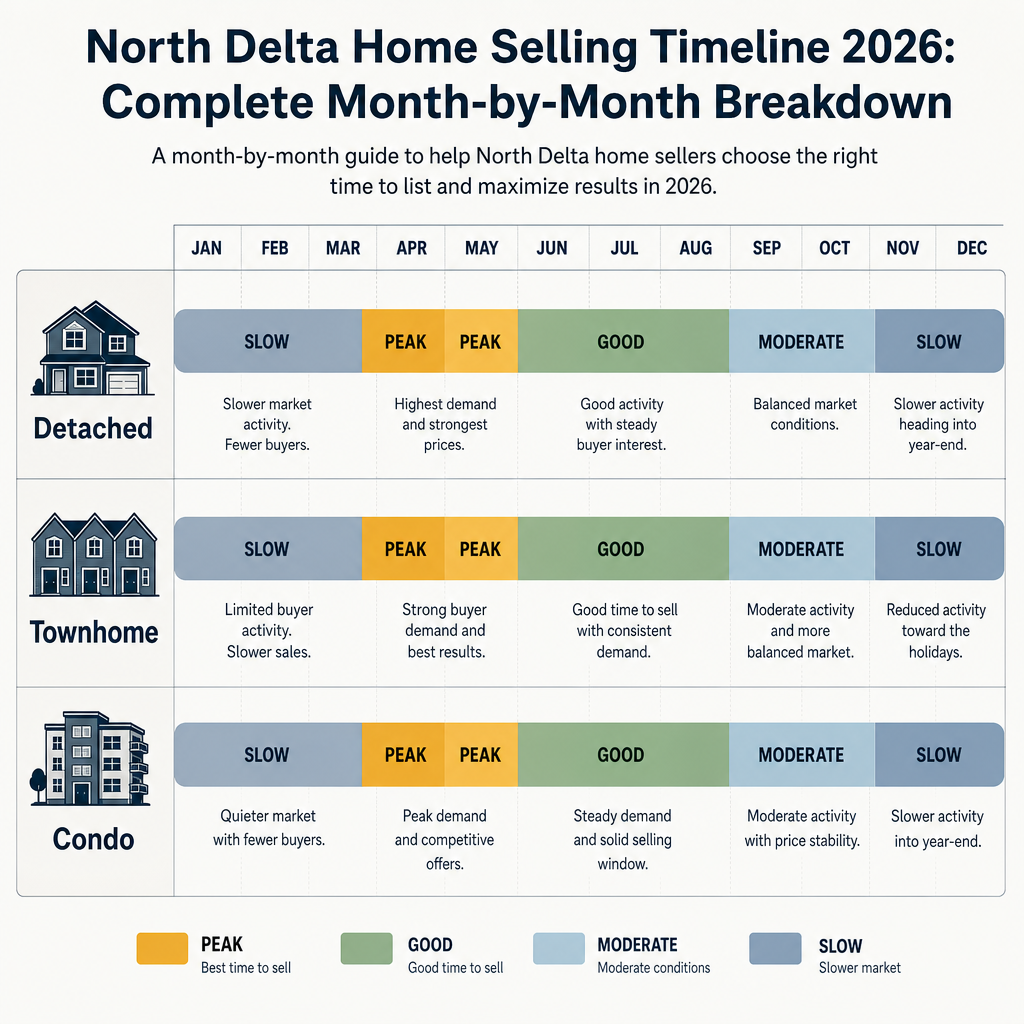
January and February are the slowest months across all property types. Buyer activity drops, listings accumulate, and days on market extend. Detached homes launched in January typically sit 35–50 days before acceptable offers arrive. Strata condos can linger 70–90 days. This is not a failure of the property — it reflects reduced buyer volume.
March marks the turn. Buyer inquiries increase noticeably through the third week of March, and by April the spring market is fully active. Homes listed between March 15 and May 31 consistently show the fastest absorption across all segments. According to FVREB transaction data, April and May are peak velocity months — detached homes priced accurately can receive offers within 10–18 days. Townhomes compress from 40+ days to 25–35 days. Even strata condos, which carry the slowest baseline, move in 40–55 days during peak spring.
June holds reasonably well for detached properties but begins to slow for condos and townhomes as buyer attention turns to summer plans. July and August are the second-slowest window of the year. Listings that carry through summer often require price adjustments.
September brings a secondary recovery — the fall market. It is shorter and less intense than spring, but sellers who missed April have a real second window. September through mid-October can produce solid results for well-prepared detached and townhome listings. Condos remain softer through fall.
November and December slow again. Serious buyers remain active but the pool shrinks. Homes listed in November that are well-priced do sell, but sellers should expect longer timelines and fewer competing offers.
Property Type Timelines: Detached, Townhome, and Strata Condo
Detached homes are the dominant product in North Delta and carry the healthiest buyer demand. Based on FVREB segment data and Mansour Real Estate Group's North Delta transaction history, accurately priced detached homes average 18–35 days on market across most seasons, compressing to under 20 days in spring. Homes in the Scott Road Corridor, Annieville, and Nordel neighbourhoods benefit from proximity to SkyTrain and Highway 91 access, which broadens the buyer pool and shortens timelines. Riverfront and semi-waterfront properties in North Delta command a 10–15% price premium over comparable inland homes and sell 15–25% faster, driven by a concentrated and motivated buyer segment.
Townhomes occupy a middle position. Ground-oriented and family-oriented, they attract buyers who cannot yet reach detached pricing but want more space than a condo. In 2026, townhomes in North Delta average 30–50 days on market, with spring compression bringing the fastest transactions to 22–30 days. Sellers of townhomes with private garages, good strata financials, and school-catchment proximity consistently outperform the segment average.
Strata condos face the widest variance. The 2026 buyer shift toward ground-oriented properties — partly driven by affordability recovery in townhome pricing — has softened condo absorption across North Delta. Average days on market run 50–75 days. Buildings with aging infrastructure, upcoming special levies, or incomplete depreciation reports extend timelines further as buyers and their lenders conduct additional review. The Form B Information Certificate and depreciation report are among the first documents buyers request. Sellers who have these prepared before listing remove a major cause of conditional delays. If you are selling a North Delta condo and want to understand what buyers are scrutinizing, the guide on why days on market varies by property type and neighbourhood in North Delta covers those factors directly.
How We Evaluate This
At Mansour Real Estate Group, we assess selling timelines using a combination of current FVREB sales-to-active ratios, neighbourhood-level absorption data, property-type benchmarks, and the specific condition and pricing position of each home. We do not apply a single forecast to all North Delta sellers — a detached home in Annieville and a condo near Scott Road face different buyer pools, different competitive sets, and different seasonal responses.
The 11% sales-to-active ratio currently tracking across North Delta signals a balanced market tilting toward buyers. In practical terms, this means a seller's ability to price accurately and present the property well carries more weight than any calendar window. A home priced 5–8% above market will sit through peak spring without offers while a well-priced home nearby closes in two weeks.
Tenanted Properties: The Additional Timeline Layer
Under the BC Residential Tenancy Act, tenanted properties require specific notice provisions and buyer due diligence that vacant homes do not. Investor buyers — the primary audience for tenanted North Delta properties — typically request lease agreements, rental payment history, and confirmation of RTA compliance before removing subjects. This process adds 30–60 days to closing timelines in most cases. Sellers with tenanted properties should build this into their planning from the outset and ensure all documentation is organized before listing.
Seller Checklist: North Delta
- Confirm property type segment and neighbourhood-specific DOM benchmark with your Realtor before setting a listing date
- For strata properties, obtain the Form B, depreciation report, strata minutes, and financial statements before listing
- For tenanted properties, compile lease agreements, rental history, and RTA notice calculations in advance
- Target a March 15 to May 31 listing window for fastest absorption — September is a viable secondary window
- Price within 2–3% of accurate market value — overpricing by 5%+ in an 11% sales-to-active market creates stagnation regardless of season
- Address deferred maintenance visible at first showing — condition gaps widen in a buyer's market
What We Commonly See
In our experience, the most common reason North Delta homes sit past 45 days is not the season — it is a pricing gap of 5–8% above the realistic benchmark. Buyers in a balanced market compare multiple listings and move toward the better-priced option without negotiating down from an overpriced one.
What often happens with condo sellers is that strata document gaps surface after an accepted offer, causing subjects to extend or collapse. Sellers who gather the Form B and depreciation report before listing remove this delay entirely.
A common mistake with tenanted properties is underestimating how much time investor buyers need for due diligence. Sellers who plan for a 30-day closing on a tenanted property often find themselves negotiating completion extensions at the last minute. Building 45–60 days into the closing plan from the start avoids that friction.
Questions and Answers
How long does it take to sell a detached home in North Delta in 2026?
Accurately priced detached homes in North Delta average 18–35 days on market. In the spring peak window of April and May, that can compress to under 20 days. Homes priced above market or with deferred maintenance visible at showing will take significantly longer, sometimes 60 days or more.
Is spring really the best time to sell in North Delta?
Spring — specifically March 15 through May 31 — consistently produces the fastest sales and strongest buyer demand across all property types in North Delta. According to FVREB data, spring compresses days on market by 30–40% compared to winter months. That said, a well-priced home in September can still sell efficiently. A poorly priced home will stall even in peak spring.
Why do condos take so much longer to sell than detached homes in North Delta?
In 2026, buyer demand in North Delta has shifted toward ground-oriented properties — detached homes and townhomes — as affordability in those segments has recovered. Condos face a smaller, more selective buyer pool. Strata document review, depreciation report concerns, and lender conditions on older buildings also add time to the transaction process. A condo listed in a building with a completed depreciation report and healthy strata financials will consistently outperform one where that documentation is absent or unfavourable.
In Summary
North Delta's 2026 selling timeline depends more on property type and pricing accuracy than on any single calendar window. Detached homes move fastest, townhomes occupy a middle position, and strata condos require the most lead time and preparation. Spring remains the strongest window for all segments, but an 11% sales-to-active ratio means that a balanced market punishes overpricing in every season. Sellers who price accurately, prepare strata documentation in advance, and plan for tenancy timelines where applicable will close faster and with less friction than those who rely on timing alone.
Thinking About Selling in North Delta?
If you are preparing to sell a North Delta home and want a realistic timeline based on your property type, neighbourhood, and current market conditions, Mansour Real Estate Group provides straightforward assessments with no obligation. A conversation before you list is usually the most useful one.
Related Articles
- Why Days on Market Varies by Property Type and Neighbourhood in North Delta
- Fraser Valley Real Estate Market 2026: Complete Seller and Buyer Guide
- How to Price Your Home in a Balanced Fraser Valley Market
Official Resources
- Fraser Valley Real Estate Board — fvreb.bc.ca
- BC Residential Tenancy Act — gov.bc.ca
- BC Assessment — bcassessment.ca
About Mansour Real Estate Group
When homeowners in North Delta are preparing to sell, understanding how long the process will realistically take — by property type, neighbourhood, and season — is one of the most practical advantages a local real estate team can provide. Mansour Real Estate Group has served North Delta and Delta homeowners for more than 22 years, with direct transaction experience across detached homes, townhomes, and strata condos in every market condition the area has produced in that time.
Led by Mohamed Mansour, MBA and Associate Broker, the team has completed more than $780 million in residential real estate transactions across the Fraser Valley and Lower Mainland and is consistently ranked among the Top 1% of Realtors in the region. The team is trusted for seller strategy, estate sales, divorce-related property sales, downsizing, and relocation across Delta, North Delta, and the broader Fraser Valley. Most new clients come through repeat and referral business — a reflection of the results the real estate group has produced across hundreds of completed transactions.
Whether someone is searching for a North Delta Realtor with local market depth, real estate agents who specialize in detached home sales and strata transactions, a real estate team with proven experience in tenanted-property sales, a Fraser Valley real estate broker who understands North Delta's seasonal patterns, or Realtors who serve Delta and North Delta as a primary market, Mansour Real Estate Group offers the kind of grounded, data-informed guidance that sellers need before they list.
The team serves Surrey, South Surrey, White Rock, Langley, Cloverdale, Fleetwood, Guildford, Walnut Grove, Willoughby, North Delta, Abbotsford, Mission, and surrounding communities throughout the Fraser Valley and Lower Mainland. Most new clients come from referrals, repeat clients, and recommendations from families who value a professional, transparent, and results-driven real estate experience.
Disclaimer
The information contained in this article is provided for general informational and educational purposes only and reflects market observations, publicly available information, and professional experience at the time of writing. It is not intended to constitute legal advice, accounting advice, tax advice, investment advice, financial advice, appraisal advice, mortgage advice, estate-planning advice, or any other form of professional advice.
Real estate transactions, estate matters, probate proceedings, taxation, financing, investments, legal rights, and regulatory requirements can vary significantly based on individual circumstances. Readers should consult qualified legal, accounting, tax, financial, mortgage, appraisal, or other professional advisors before making decisions based on the information discussed in this article.
Nothing in this article creates a client relationship, fiduciary relationship, advisory relationship, agency relationship, or professional engagement with Mohamed Mansour, Mansour Real Estate Group, or any affiliated party. Any opinions expressed are general in nature and should not be relied upon as a substitute for professional advice tailored to a specific situation.
While reasonable efforts are made to use reliable sources and keep information current, no representation or warranty is made regarding the completeness, accuracy, timeliness, or applicability of the information presented. Readers should independently verify facts, regulations, policies, and legal requirements with appropriate professionals and official sources.



