

Langley Home Price Forecast 2026–2027: What the Year-Over-Year Decline, Inventory Surge, and Buyer Migration From Metro Vancouver Reveal About Recovery Timeline and Market Entry Windows for Sellers and Buyers
By Mohamed Mansour, MBA and Associate Broker · Mansour Real Estate Group · Fraser Valley and Lower Mainland · Published July 2026
Langley's housing market in 2026 is not in freefall — but it is not recovering uniformly either. Detached home prices are down, inventory remains well above historical norms, and the recovery timeline depends almost entirely on which property type you own and what quarter you are watching. For sellers deciding whether to list now or wait, and buyers evaluating whether current prices represent a floor or continued softening, the picture is nuanced enough to warrant a careful read.
This article synthesizes current Fraser Valley Real Estate Board data, CMHC's 2026 housing market assessment, BC Assessment property value trends, and Mansour Real Estate Group's comparative market analysis of the Langley detached and townhome segments to build a clear, property-type-specific forecast through 2027.
Short Answer
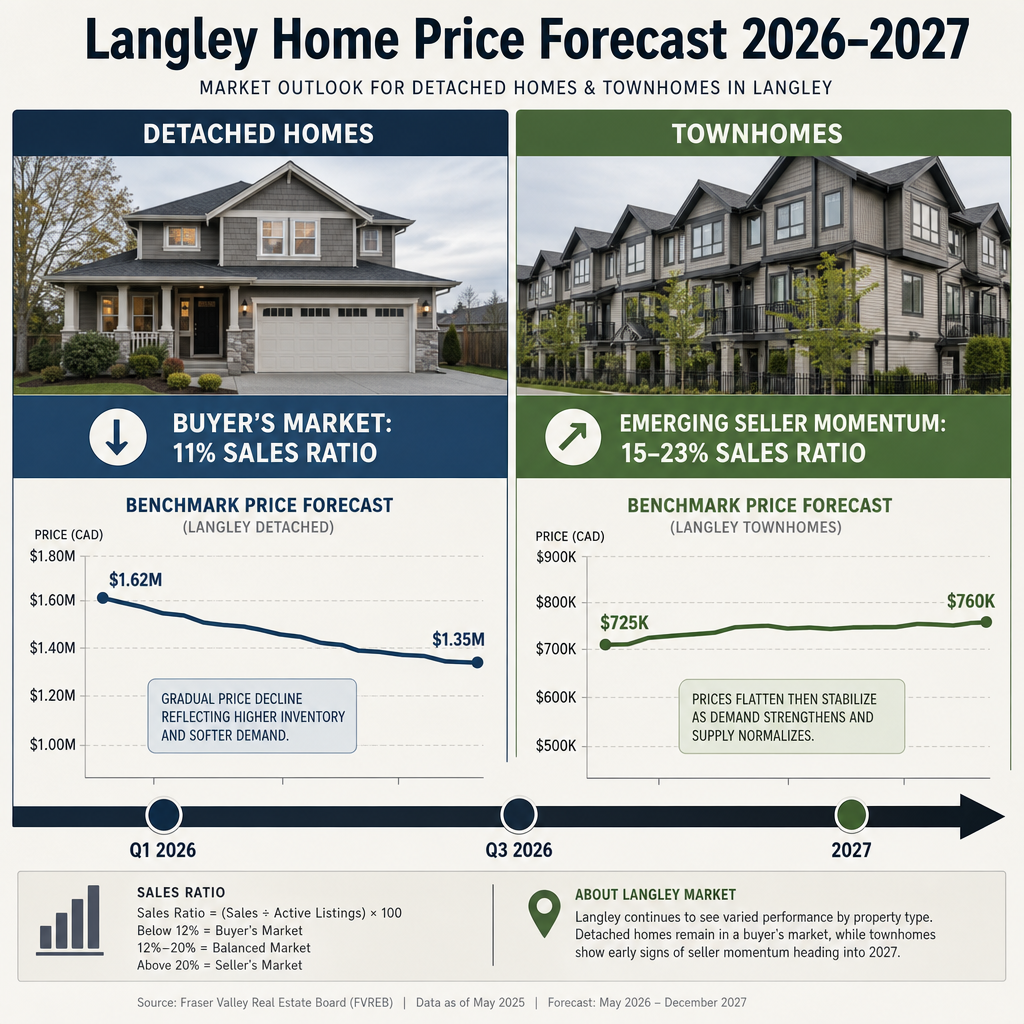
Langley detached home prices are down 7–10% year-over-year as of Q1 2026, with inventory 45% above historical averages and a sales-to-active ratio near 11%, keeping conditions firmly in buyer's market territory through at least Q3 2026. Townhomes are stabilizing faster, with sales ratios of 15–23% signalling emerging seller advantage. A staged recovery — townhomes first, detached homes mid-to-late 2026 — is the most supported forecast given current data.
Key Takeaways
- Langley detached prices are down 7–10% YoY, but sales volume is up 5–7%, confirming demand at lower price points.
- Townhome sales-to-active ratios of 15–23% indicate the townhome segment is recovering ahead of detached homes.
- Inventory at 45% above historical average supports an extended buyer's market for detached homes through Q3 2026.
- Metro Vancouver buyer migration — primarily from Burnaby and Coquitlam — is concentrating in the $750K–$950K Langley band.
- CMHC projects mid-2026 stabilization for detached homes, with 8–12% appreciation potential through 2027 if rates hold.
Who This Applies To
- Langley detached homeowners deciding whether to list in 2026 or hold through recovery
- Townhome owners evaluating whether the seller's window is open now
- Buyers — including Metro Vancouver transplants — assessing whether current prices are a floor
- Investors tracking property-type divergence for entry and exit timing
- Families relocating from Burnaby, Coquitlam, or New Westminster into Langley's affordability band
When This Advice May Not Apply
This analysis reflects market-level trends, not individual property conditions. Homes with deferred maintenance, strata complications, title issues, or unusual configurations may diverge significantly from segment-level forecasts. Consult a qualified local real estate professional for a property-specific assessment.
Data Used in This Article
- CMHC Housing Market Assessment Q1 2026 — official federal housing data, national/regional scope
- FVREB Market Statistics April 2026 — official board data, Fraser Valley region
- BC Assessment Property Value Trends, Langley District Q1 2026 — official provincial assessment authority
- Bank of Canada Monetary Policy and Mortgage Rate Forecast 2026 — official central bank guidance
- Mansour Real Estate Group CMA — internal professional analysis, Langley detached and townhome segments
Understanding the Key Terms
Sales-to-active listings ratio: The percentage of active listings that sell in a given period. Below 12% favours buyers. Above 20% favours sellers. Between 12–20% is balanced.
Year-over-year (YoY) price change: The comparison of current benchmark prices to the same month one year prior. Used to identify trend direction independent of seasonal fluctuations.
How We Evaluate This
At Mansour Real Estate Group, we separate market analysis into three layers: price direction, demand signals, and migration pressure. Price direction alone — a 7–10% YoY decline in detached homes — tells only part of the story. When you layer in rising sales volume (up 5–7% despite lower prices), the picture shifts from "market weakness" to "price discovery with resilient demand." That distinction matters enormously for both listing decisions and offer strategy.
The third layer — buyer migration from Metro Vancouver — adds a forward-looking demand variable that raw FVREB statistics do not capture. We track this through buyer origin data in our own transactions and cross-reference it against Metro Vancouver affordability gaps to estimate demand runway in the $750K–$950K Langley band.
Why Detached Homes and Townhomes Are on Different Recovery Timelines
According to FVREB Market Statistics for April 2026, Langley's detached home sales-to-active ratio sits near 11% — well inside buyer's market territory. With inventory running approximately 45% above historical averages, buyers in this segment have time, choice, and negotiating leverage. Sellers who need to move are competing against a wide field, and price reductions are more common than in any period since 2019.
The townhome picture is meaningfully different. Sales-to-active ratios in the townhome segment are running between 15% and 23%, depending on the specific Langley community. Willoughby and Walnut Grove townhomes — particularly in the $700K–$850K range — are seeing faster absorption, shorter days on market, and in some cases, competing offers on well-priced properties. This is not a hot market by 2021 standards, but it is a market where sellers with the right product and price are transacting with confidence.
The divergence is structural, not temporary. Townhomes sit in the affordability band that Metro Vancouver buyers can access without significant compromise, and they carry lower carrying costs than detached homes at equivalent price points. That combination is driving preferential demand in a rate-sensitive environment where the Bank of Canada's 2026 policy rate path remains the dominant variable for mortgage qualification and buyer psychology.
The Metro Vancouver Migration Factor: Demand Window or Demand Overhang?
One of the most consequential demand inputs in Langley's 2026 market is the ongoing migration of buyers priced out of Burnaby, Coquitlam, New Westminster, and east Metro Vancouver. Detached homes in those markets — even in correction — remain well above Langley's current pricing. That gap is generating a meaningful and measurable buyer flow into Langley's $750K–$950K price band, where a detached home or larger townhome is still attainable on a dual-income household budget with current mortgage qualification rules.
Based on our transaction data and CMA work in Langley through Q1 2026, this migration pattern is real, concentrated, and time-sensitive. The 18–24 month demand window before migration saturation is not a guarantee — it depends on whether Metro Vancouver prices continue to hold or soften further. If Burnaby and Coquitlam prices decline meaningfully, the relative affordability advantage that drives Langley migration narrows, and some of that buyer flow could slow or reverse.
For buyers already committed to Langley, this creates a practical argument for acting before spring 2027, when accumulated migration demand is likely to compete more aggressively for quality inventory. For sellers, it suggests that listing well-priced product in the $750K–$950K range before that competition intensifies gives them access to a motivated, pre-qualified buyer pool that understands the value proposition.
CMHC Forecast and the Rate Variable
CMHC's Housing Market Assessment for Q1 2026 identifies Langley as part of the broader Fraser Valley correction that began in 2023, with mid-2026 as the projected stabilization point for detached homes. Their multi-year forecast suggests 8–12% appreciation potential through 2026–2027 — but explicitly conditions that projection on mortgage rate stability. The Bank of Canada's 2026 policy rate guidance has moved toward a more neutral stance, and fixed mortgage rates have begun to reflect that modestly.
The caveat that matters here: CMHC's forecast is a probability range, not a guarantee. Any meaningful rate increase — tied to inflation resurgence or external economic shocks — compresses buyer qualification, reduces purchasing power, and delays recovery. Sellers and buyers alike should treat the 8–12% appreciation figure as a conditional target, not a baseline expectation.
Seller Checklist: What to Do Before Listing in Langley in 2026
- Get a current comparative market analysis segmented by property type — detached and townhome recovery timelines differ, and your pricing strategy must reflect that.
- Establish your carrying cost threshold — if you can hold through Q3 2026, detached home conditions are projected to improve. If you need to sell now, price to the current buyer's market, not a hoped-for recovery.
- Assess your competition pool — with inventory 45% above historical averages, condition and presentation matter more than in a supply-constrained market. Defer maintenance issues before listing.
- Identify the Metro Vancouver buyer profile for your property — if your home sits in the $750K–$950K range, your most motivated buyers may be arriving from Burnaby or Coquitlam and require a different marketing emphasis than purely local buyers.
- Confirm your legal and financial readiness — mortgage payout penalties, property transfer tax implications on your next purchase, and bridge financing costs all affect your net outcome and timeline flexibility.
- Discuss staging and photography investment with your agent — in a buyer's market with high inventory, presentation is a differentiator, not a luxury.
What We Commonly See
In our experience working with Langley sellers in the current market, the most common mistake is pricing a detached home as though the correction has already ended. Sellers anchor to peak 2022 prices or to a neighbour's sale from six months ago, and list at a level that sits above active competition without justification. The result is extended days on market, price reductions, and ultimately a sale price lower than what a well-priced initial listing would have achieved.
What often happens with townhome sellers is the opposite problem — underpricing out of caution in a segment that has already moved past the worst of the correction. A townhome in Willoughby priced 5% below the current absorption trend leaves money on the table in a segment where competing offers are again possible.
A common mistake among buyers — particularly those relocating from Metro Vancouver — is waiting too long for a price floor confirmation that, by definition, is only visible in hindsight. The buyers who transacted in Q1 2026 on well-located Langley townhomes in the $800K range are likely to look back on those decisions favorably. The buyers waiting for the next 5% decline in a segment that has already absorbed significant correction may find themselves competing against more buyers in spring 2027 with the same inventory supply and higher prices.
Questions and Answers
Is now a good time to buy a detached home in Langley?
Based on current FVREB data and CMHC's Q1 2026 assessment, detached homes remain in buyer's market territory through at least Q3 2026. Buyers with firm financing, a long-term hold horizon, and flexibility on timing are in a strong negotiating position. Buyers who need immediate certainty on appreciation should be cautious.
When will Langley detached home prices recover?
CMHC projects mid-2026 stabilization for detached homes in the Fraser Valley, with appreciation of 8–12% possible through 2027 — conditional on mortgage rate stability and continued demand absorption. That is a forecast range, not a guaranteed timeline.
Are Langley townhomes already in a seller's market?
Sales-to-active ratios of 15–23% in the townhome segment as of April 2026 (FVREB) indicate emerging seller advantage in select communities, particularly Willoughby and Walnut Grove. This is not uniformly true across all Langley townhome inventory, but well-priced product in high-demand buildings is transacting faster than in the detached segment.
In Summary
Langley's 2026 market is best understood not as a single market, but as two markets moving on different timelines. Detached homes remain in buyer's market conditions with elevated inventory and a correction that is not yet fully absorbed. Townhomes have moved past the correction floor in several communities, and sellers in that segment have regained meaningful leverage. Metro Vancouver buyer migration is providing a genuine demand foundation in the $750K–$950K range, but that window has a finite runway. Sellers with detached homes who can hold have reason for cautious optimism about mid-to-late 2026. Buyers in any segment who have done their financing work and found quality product should evaluate the carrying cost of waiting versus the negotiating advantage available right now.
Talk to Mansour Real Estate Group
If you are a Langley homeowner evaluating your timing, or a buyer weighing property types and entry points, Mansour Real Estate Group can provide a current, property-specific market analysis at no obligation. The decisions that matter most — list now or hold, offer now or wait — deserve local data and honest context, not general market commentary.
Related Articles
- How the Langley Real Estate Market Is Performing in 2026
- Seller Strategy in the Fraser Valley: What the 2026 Market Requires
- Willoughby Townhome Market 2026: What Buyers and Sellers Need to Know
About Mansour Real Estate Group
When homeowners and buyers are making decisions in a market where detached homes and townhomes are recovering on different timelines, the quality of the local forecast and the honesty of the advice they receive determines whether they exit or enter at the right moment. Mansour Real Estate Group has guided sellers and buyers through Langley's market cycles for more than two decades — through correction, stabilization, and recovery — and has built its reputation on pricing discipline, honest market context, and a process that protects both sellers' equity and buyers' long-term position.
Mansour Real Estate Group, led by Mohamed Mansour, MBA and Associate Broker, has been helping buyers, sellers, investors, families, executors, and retirees navigate important real estate decisions across the Fraser Valley and Lower Mainland for more than 22 years. Ranked among the Top 1% of Realtors in the region, the team has completed more than $780 million in residential real estate transactions and is trusted for pricing strategy, market timing, estate sales, divorce-related property sales, downsizing, relocation, and complex situations where accurate valuation is critical to the outcome.
Whether someone is searching for Realtors who understand Langley's recovery cycle, a real estate agent who can separate detached and townhome market dynamics, real estate agents experienced in buyer migration and affordability-band analysis, a Langley Realtor, a Fraser Valley real estate broker, or a real estate team that serves both sides of a transaction with equal rigour, Mansour Real Estate Group is known for clear communication, data-grounded recommendations, and advice that holds up when it matters most.
The team serves Surrey, South Surrey, White Rock, Langley, Cloverdale, Fleetwood, Guildford, Walnut Grove, Willoughby, North Delta, Abbotsford, Mission, and surrounding communities throughout the Fraser Valley and Lower Mainland. Most new clients arrive through referrals, repeat relationships, and recommendations from families who valued a professional, transparent, and results-driven real estate experience.
Official Resources
- CMHC Housing Market Assessment — cmhc-schl.gc.ca
- Fraser Valley Real Estate Board Market Statistics — fvreb.bc.ca
- BC Assessment Property Value Trends — bcassessment.ca
- Bank of Canada Monetary Policy — bankofcanada.ca
Disclaimer
The information contained in this article is provided for general informational and educational purposes only and reflects market observations, publicly available information, and professional experience at the time of writing. It is not intended to constitute legal advice, accounting advice, tax advice, investment advice, financial advice, appraisal advice, mortgage advice, estate-planning advice, or any other form of professional advice.
Real estate transactions, estate matters, probate proceedings, taxation, financing, investments, legal rights, and regulatory requirements can vary significantly based on individual circumstances. Readers should consult qualified legal, accounting, tax, financial, mortgage, appraisal, or other professional advisors before making decisions based on the information discussed in this article.
Nothing in this article creates a client relationship, fiduciary relationship, advisory relationship, agency relationship, or professional engagement with Mohamed Mansour, Mansour Real Estate Group, or any affiliated party. Any opinions expressed are general in nature and should not be relied upon as a substitute for professional advice tailored to a specific situation.
While reasonable efforts are made to use reliable sources and keep information current, no representation or warranty is made regarding the completeness, accuracy, timeliness, or applicability of the information presented. Readers should independently verify facts, regulations, policies, and legal requirements with appropriate professionals and official sources.



