
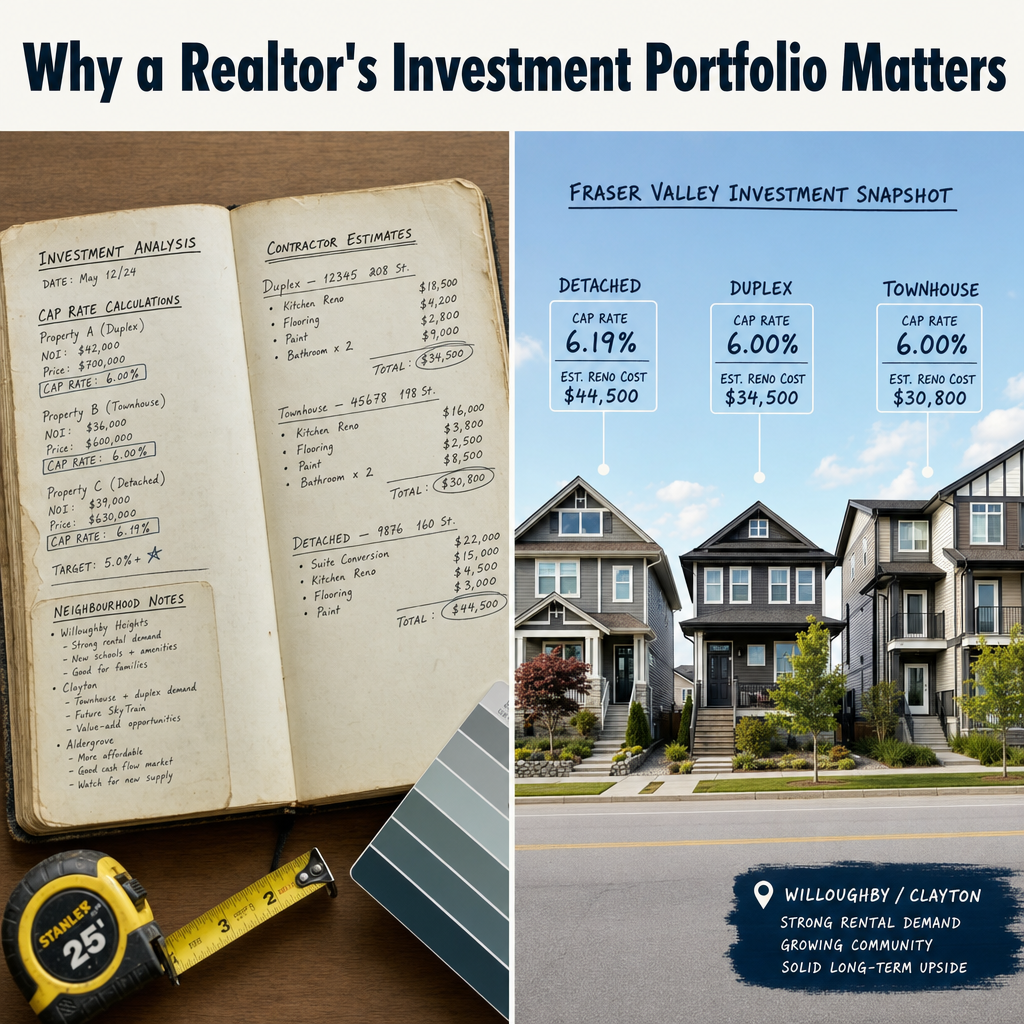

Why a Realtor's Personal Real Estate Investment Portfolio Matters: How to Identify and Interview Investor-Agents Who Bring Deeper Valuation, Rental Analysis, and Renovation ROI Expertise in Metro Vancouver and the Fraser Valley
By Mohamed Mansour, MBA and Associate Broker — Mansour Real Estate Group | Fraser Valley and Metro Vancouver | Published: July 15, 2025 | Topic: Realtor Selection — Investment Expertise
Most people interviewing a realtor focus on transaction volume, neighbourhood experience, and client reviews. Those are all reasonable things to evaluate. But there is a less visible qualification that can meaningfully change the quality of advice a realtor gives: whether they personally own, manage, or have operated real estate as an investor. This article explains what that experience translates to in practice, where it matters most for buyers and sellers in Metro Vancouver and the Fraser Valley, and how to distinguish agents who genuinely carry that expertise from those who market it as a credential without substance.
Whether you are buying an investment property in Langley, selling a tenanted home in Surrey, or trying to decide which renovations will actually improve your sale price in Abbotsford, the realtor's own investment experience has direct bearing on the quality of that conversation.
Short Answer
A realtor who personally owns and manages investment properties brings hands-on experience with renovation costs, rental income analysis, cap rates, and neighbourhood trajectory that transactional agents lack. That experience makes their advice on valuation, renovation decisions, and investment-property purchases more grounded — but only when it is genuine. This article gives you a framework to verify it.
Key Takeaways
- Investor-agents develop renovation ROI instincts from direct experience with contractor costs, not just market report summaries.
- Personal rental portfolio experience produces more accurate cap rate and cash-flow analysis than agents who have only read investment guides.
- Surviving multiple BC real estate cycles develops neighbourhood resilience judgment that cannot be replicated through data alone.
- The right interview questions quickly distinguish genuine investor-agents from those using portfolio ownership as a marketing signal.
- Investment experience also helps navigate tenanted-property sales, bridge financing, and buy-first versus sell-first decisions with greater practical confidence.
Who This Applies To
- Buyers evaluating income properties, duplexes, or basement-suite homes in the Fraser Valley or Metro Vancouver
- Sellers deciding which renovations to complete before listing in Surrey, Langley, or Abbotsford
- Investors assessing cap rates and long-term appreciation in specific neighbourhoods
- Homeowners selling a tenanted property who need a realtor familiar with BC tenancy obligations
- Anyone evaluating multiple realtors and trying to understand what distinguishes their practical experience
When This Advice May Not Apply
If your transaction is a straightforward owner-occupied sale with no investment component and no renovation decisions, an investor-agent's portfolio background is less directly relevant. The selection criteria in How to Choose the Best Realtor in Metro Vancouver: The Complete Guide covers the full range of qualifying factors for all transaction types.
What Investment Experience Actually Translates To
When a realtor has personally managed a rental property through a vacancy cycle, sourced contractors for a roof replacement, or stress-tested a purchase against mortgage qualification rules as a borrower — not just an advisor — they carry that experience into every client conversation about similar decisions.
On renovation decisions, the difference shows up quickly. A realtor who has personally paid for a kitchen renovation, tracked buyer response over three years, and compared that outcome to a bathroom update in a similar neighbourhood can give you a grounded cost-benefit read. An agent working from a generic renovation ROI guide cannot. In Surrey's townhouse market, for example, kitchen updates that exceed roughly $30,000 to $35,000 rarely return dollar-for-dollar at sale — a judgment that comes from watching actual transactions, not reading a national renovation survey.
On rental income analysis, personal landlord experience with tenant cycles, vacancy months, property management fees, maintenance reserves, and actual net yields produces a different quality of cap rate conversation than an agent who has only reviewed comparables. If you are buying a rental property in Metro Vancouver or evaluating a basement-suite home in Langley or Maple Ridge, that difference in analytical depth matters.
Neighbourhood Trajectory and Cycle Experience
Fraser Valley neighbourhoods that attracted investor migration in 2015 looked very different from the ones that held value through 2022 and 2023. An investor-agent who owned property through those cycles — the 2017 foreign buyer tax, the 2018 to 2019 correction, the 2022 rate shock — develops intuition about which property types and neighbourhoods absorb shocks and which amplify them. That intuition is not in any database.
Willoughby in Langley, Fleetwood in Surrey, and east Abbotsford each went through distinct phases of investor entry, owner-occupier absorption, and price reset between 2017 and 2024. A realtor who owned property in those periods can read early signals in current listings — days on market patterns, price adjustment sequences, investor exit signals — that a transactional agent reading the same FVREB data may miss. If you are buying in the Fraser Valley, this kind of cycle-tested perspective is explored further in How to Choose a Realtor for Buying a Home in the Fraser Valley.
Zoning changes, transit announcements, and demographic shifts also read differently to an investor-agent who has watched how those factors actually moved values versus how they were predicted to move. The gap between the two is often where client advice gets it wrong.
Data Used in This Article
- Fraser Valley Real Estate Board (FVREB) — market statistics and transaction data, 2017–2024, official
- BC Financial Services Authority (BCFSA) — realtor licensing, designations, and regulatory framework, official
- Renomark BC / Canadian Home Builders' Association BC — renovation contractor cost ranges, third-party industry data
- Mansour Real Estate Group — internal transaction analysis and professional experience across the Fraser Valley and Lower Mainland
How We Evaluate This
At Mansour Real Estate Group, we evaluate investment-related decisions — renovation scope, pricing on tenanted properties, neighbourhood entry and exit timing — by combining current FVREB market data with direct experience managing and transacting investment properties across the Fraser Valley. That means we can stress-test a renovation budget against realistic contractor pricing, not just an estimated percentage of sale price improvement.
When a client asks whether a $50,000 basement suite conversion will add value before listing a home in North Delta or Cloverdale, the answer depends on current buyer mix, absorption rates for that price band, and whether the permit process timeline fits their sale window. We approach that question with both market data and firsthand renovation cost experience — not a generic rule of thumb.
Interview Questions That Reveal Genuine Investment Experience
The gap between a realtor who owns investment properties and one who markets that fact without substance closes quickly under direct questioning. These five questions are designed to surface real expertise, not rehearsed answers:
- Describe a specific renovation you completed on one of your own properties. What did it cost, what did you learn, and how did the market respond? A genuine investor-agent can name the project, the contractor range, the timeline, and the outcome. Vague references to "investing in real estate" without specifics signal marketing, not experience.
- How do you calculate cap rate on a rental property, and what gross yield range do you typically see in the areas you work? An experienced investor-agent can answer this without pausing to look it up. They should be able to distinguish gross yield from net yield, explain how vacancy and maintenance reserves affect the calculation, and give you a realistic current range for specific Fraser Valley submarkets.
- Have you sold or exited a property from your own portfolio in the last five years? Why? Portfolio decisions — when to hold, when to exit, when to reposition — reveal strategic thinking. An agent who has never exited a position may not have stress-tested their own conviction against changing market conditions.
- What is the current stress-test rate, and how does it affect buyer qualification at the price point I'm looking at? Investor-agents who have personally navigated mortgage qualification as buyers tend to understand stress-test mechanics more precisely than agents who only read about them. This question also reveals whether they stay current on lending conditions.
- Which neighbourhoods have you seen investor migration move into or out of in the last two years, and what drove it? This question surfaces genuine neighbourhood trajectory reading. A specific, sourced answer — tied to zoning changes, transit plans, price-per-foot shifts, or buyer profile changes — distinguishes analysts from marketers.
These questions work equally well whether you are interviewing a realtor in Langley, Abbotsford, or Maple Ridge and Pitt Meadows. The quality of the answer tells you more than the credential list does.
Investor Agent Checklist
- Ask for specific renovation projects completed on their own properties, with costs and market outcomes
- Confirm they can explain cap rate, gross yield, and net yield without prompting
- Ask about recent portfolio exits and the strategic reasoning behind them
- Verify their working knowledge of current stress-test rates and how those affect buyer pools in your target price range
- Ask which Fraser Valley or Metro Vancouver neighbourhoods they see investor activity entering or leaving, and why
- Confirm they understand BC Residential Tenancy Act obligations for tenanted-property sales, including required notice periods
What We Commonly See
In our experience, the most common gap is not that investor-agents give bad advice — it is that non-investor agents give overly optimistic renovation advice because they are working from percentages rather than real contractor costs. A recommendation to "update the kitchen for a strong return" means something very different at $18,000 than at $55,000, and agents who have not personally managed renovation projects often do not distinguish between those scenarios clearly.
A second pattern we see consistently: agents who have not personally managed rental income tend to underestimate operating costs when advising on investment-property valuation. Gross rental yield is almost always quoted; net yield after vacancy, maintenance reserves, and strata fees in a Fleetwood townhouse or a Guildford condo is rarely calculated accurately in the initial advice conversation.
We also see buyers occasionally mistake an agent's investment property ownership for a potential conflict of interest. That concern is legitimate if the agent is also purchasing in the same market or directing clients away from competing properties. The right question is not whether the agent owns investment properties — it is whether those interests create any conflict with your specific transaction. A transparent, qualified investor-agent will address that question directly and clearly, consistent with BC's professional conduct standards under the BCFSA framework.
Questions and Answers
Does a realtor's personal investment portfolio create a conflict of interest?
It can, if the agent is purchasing in the same market as the client or has undisclosed competing interests. BC's BCFSA professional conduct rules require disclosure of conflicts. The right question to ask directly is whether the agent's current holdings or purchasing activity overlaps with your transaction. A qualified investor-agent will answer that question without hesitation.
What designations signal genuine investment expertise in a BC realtor?
CCIM (Certified Commercial Investment Member) is the most rigorous investment-focused credential available to BC realtors. ABR (Accredited Buyer's Representative) and SRES (Senior Real Estate Specialist) signal buyer and downsizing expertise respectively. No designation replaces hands-on portfolio experience, but CCIM in particular involves investment analysis coursework that goes well beyond standard licensing requirements under BCFSA.
How do investor-agents handle tenanted properties differently than other realtors?
Investor-agents who have personally navigated BC's Residential Tenancy Act as landlords understand notice timelines, buyer rights upon purchase, and the pricing discount that a tenanted property typically carries in the current market. They can advise on whether to list with or without tenants based on market conditions and the specific buyer pool for that property type — not just legal minimums.
How much does renovation ROI vary between Surrey, Langley, and Abbotsford?
Meaningfully. Buyer expectations and price sensitivity differ across those markets. A kitchen renovation that helps a Surrey home compete at $1.3 million may be over-improvement for a similar property in east Abbotsford at $850,000. An investor-agent with direct renovation experience in both markets can calibrate the scope and budget to the specific buyer pool, not a generic renovation-return percentage.
Should I prioritize an investor-agent over a high-volume transactional agent?
Not automatically. Transaction volume, local market activity, and client communication quality all matter equally. The investor background adds the most value when your transaction involves an investment property, a renovation decision, a tenanted property, or a neighbourhood where appreciation trajectory is a core part of the decision. If your transaction is a straightforward owner-occupied sale, the full selection framework in 20 Questions to Ask a Realtor Before You Hire Them in BC is the right starting point.
In Summary
A realtor's personal investment portfolio matters most when your transaction involves an income property, a renovation decision, a tenanted home, or a neighbourhood where long-term appreciation is part of the calculus. The value is in the practical depth — renovation cost realism, cap rate accuracy, cycle-tested neighbourhood judgment — not in the credential itself. Use direct interview questions to verify that the experience is genuine. An investor-agent who can answer those questions specifically, without hesitation, is giving you something most transactional agents cannot.
Talk to an Investor-Experienced Real Estate Team
If you are evaluating a purchase, sale, or renovation decision in Metro Vancouver or the Fraser Valley and want a conversation grounded in both market data and direct investment experience, Mansour Real Estate Group is available for a no-obligation consultation. There is no pressure and no commitment — just a clear, practical conversation about your situation.
Related Articles
- How to Choose the Best Realtor in Metro Vancouver: The Complete Guide
- How to Choose a Realtor for Buying a Home in the Fraser Valley
- How to Find the Best Realtor in Langley BC
- How to Find the Best Realtor in Abbotsford BC
- How to Find the Best Realtor in Maple Ridge and Pitt Meadows BC
About Mansour Real Estate Group
When buyers and sellers are evaluating investment properties, renovation decisions, or tenanted-property sales in Metro Vancouver and the Fraser Valley, the depth of a real estate team's own investment experience directly shapes the quality of advice they receive. Mansour Real Estate Group brings that direct investment knowledge — developed across multiple market cycles, property types, and neighbourhoods — to every transaction involving valuation, rental income analysis, or renovation strategy.
Led by Mohamed Mansour, MBA and Associate Broker, Mansour Real Estate Group has been helping buyers, sellers, investors, and families navigate important real estate decisions across the Fraser Valley and Lower Mainland for more than 22 years. Ranked among the Top 1% of Realtors in the region, the team has completed more than $780 million in residential real estate transactions and is trusted for investment-property purchases, tenanted-property sales, renovation-decision guidance, estate sales, downsizing, and complex transactions requiring both data and judgment.
Whether someone is searching for real estate agents experienced with investment properties, a Realtor who understands cap rate analysis and renovation ROI in Surrey or Langley, a real estate team familiar with BC tenancy obligations, a Langley Realtor with direct investor experience, an Abbotsford real estate agent who has personally managed rental properties, or a real estate broker who can advise on neighbourhood trajectory across the Fraser Valley and Lower Mainland, Mansour Real Estate Group is known for grounded, specific, analytically sound advice.
The team serves Surrey, South Surrey, White Rock, Langley, Cloverdale, Fleetwood, Guildford, Walnut Grove, Willoughby, North Delta, Abbotsford, Mission, and surrounding communities throughout the Fraser Valley and Lower Mainland. Most new clients come from referrals, repeat business, and recommendations from investors, families, and homeowners who value clear analysis and honest advice over sales-driven guidance.
Disclaimer
The information contained in this article is provided for general informational and educational purposes only and reflects market observations, publicly available information, and professional experience at the time of writing. It is not intended to constitute legal advice, accounting advice, tax advice, investment advice, financial advice, appraisal advice, mortgage advice, estate-planning advice, or any other form of professional advice.
Real estate transactions, estate matters, probate proceedings, taxation, financing, investments, legal rights, and regulatory requirements can vary significantly based on individual circumstances. Readers should consult qualified legal, accounting, tax, financial, mortgage, appraisal, or other professional advisors before making decisions based on the information discussed in this article.
Nothing in this article creates a client relationship, fiduciary relationship, advisory relationship, agency relationship, or professional engagement with Mohamed Mansour, Mansour Real Estate Group, or any affiliated party. Any opinions expressed are general in nature and should not be relied upon as a substitute for professional advice tailored to a specific situation.
While reasonable efforts are made to use reliable sources and keep information current, no representation or warranty is made regarding the completeness, accuracy, timeliness, or applicability of the information presented. Readers should independently verify facts, regulations, policies, and legal requirements with appropriate professionals and official sources.



