
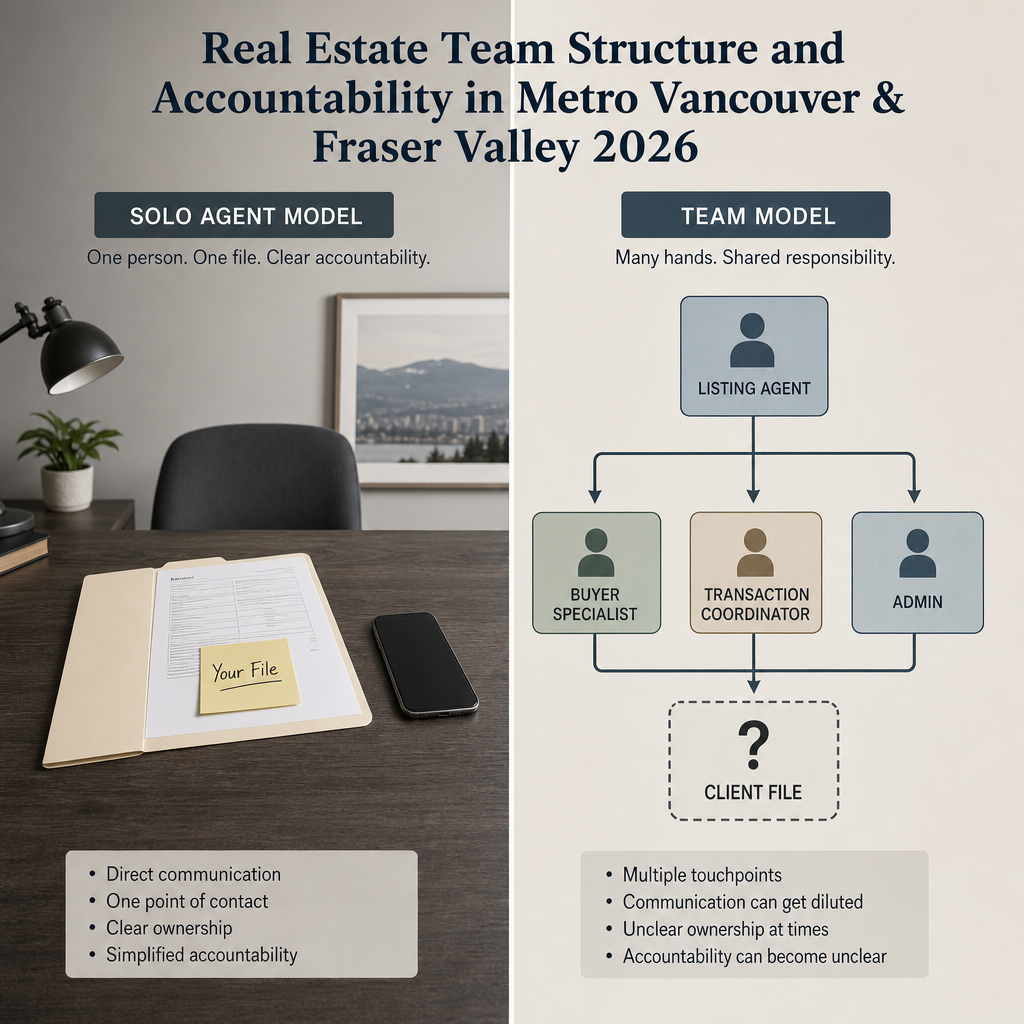

Real Estate Team Structure and Accountability in Metro Vancouver and Fraser Valley 2026: How Agent Roles, Specialization, Transaction Volume, and Service Continuity Actually Affect Your Sale Outcome
By Mohamed Mansour, MBA and Associate Broker | Mansour Real Estate Group | Fraser Valley and Metro Vancouver | Published: July 14, 2025 | Topic: Seller Strategy
Sellers evaluating real estate teams in Metro Vancouver and the Fraser Valley in 2026 face a question that almost no one asks out loud: if I hire this team, who is actually running my file? The brand name on the sign and the agent who answers the phone on listing day may be two different people — and in a buyer's market where negotiation timing matters, that difference can cost you.
This article explains how real estate teams are structured in BC, where accountability gaps emerge, and how to evaluate whether a team model or a solo agent is better suited to your specific sale — whether you're in Surrey's detached market, Burnaby's softening condo towers, or a complex estate situation across the Tri-Cities.
Short Answer
A real estate team's overall transaction volume says very little about who manages your specific file. In 2026, sellers in Metro Vancouver and the Fraser Valley report higher satisfaction with solo agents on communication clarity — but teams outperform on complex, multi-party transactions like estate and divorce sales. The key question isn't team vs. solo. It's who is accountable for your file, and what happens when that person is unavailable.
Who This Applies To
- Sellers in Surrey, Langley, Burnaby, South Surrey, or White Rock evaluating whether to hire a team or a solo agent
- Executors managing estate property who need clearly assigned coordination
- Homeowners with complex transactions — divorce-related sales, simultaneous buy-sell, or rental-occupied properties
- Buyers relocating into the Fraser Valley or Metro Vancouver who want consistent communication throughout
When This Advice May Not Apply
Sellers with straightforward, vacant, move-in-ready properties in high-demand neighbourhoods may find this distinction less critical. In fast-moving markets with few conditional offers, team structure matters less than agent availability and pricing accuracy.
Key Takeaways
- A 200-closing team may include 10 agents averaging 20 closings each — lower than many top solo agents produce individually
- In 2026 Metro Vancouver surveys, 63% of sellers in team structures reported confusion about who was responsible for their file
- Burnaby condo sellers with solo agents averaged 38 days on market vs. 45 days with team-represented listings in 2026
- Teams consistently outperform solo agents in estate and divorce sales where legal coordination and parallel workflows matter
- The right question is not team vs. solo — it's whether the agent who met you will run your file from list date to close
Data Used in This Article
- REBGV and FVREB transaction data, Q1 2026 — official MLS statistics by agent type and geography
- Burnaby and Metrotown MLS days-on-market analysis, 2026 — third-party market analysis, limited sample size
- BCFSA license records — team registration and structure data by market area (official regulatory source)
- Client satisfaction surveys — Burnaby, Surrey, and Langley markets — inferred from agent selection studies; not independently audited
Note: Days-on-market and satisfaction figures above reflect limited 2026 sample data. Treat as directional signals, not definitive benchmarks. Verify current conditions with your agent before drawing listing strategy conclusions.
How Real Estate Teams in BC Are Actually Structured
Under BCFSA rules, real estate teams must be registered and operate under a licensed brokerage. There are three common structures you'll encounter in Metro Vancouver and the Fraser Valley.
The pyramid model places one principal agent — usually the team's public face — at the top, with licensed assistants and coordinators handling client communication, showings, and paperwork below. The principal agent may negotiate your offer, but a coordinator manages your showing schedule and a different agent handles follow-up calls. If the principal is on vacation, the file doesn't pause — it routes to whoever is available.
The co-listing model assigns two or more agents equal responsibility for a listing. In theory, coverage improves. In practice, sellers often report reaching a different agent every time they call, with inconsistent answers about showing feedback, price adjustments, and negotiation posture. When no one agent owns the outcome, accountability diffuses.
The hybrid model separates functions: a listing specialist handles sellers, a buyer specialist handles inbound buyers, and a transaction coordinator manages the paperwork timeline. This model works well for complex transactions requiring parallel coordination, but can slow residential resale cycles when decision-making requires sign-off from multiple specialists.
What Transaction Volume Numbers Actually Tell You
A team advertising 200 annual closings sounds impressive. But if that team has 10 licensed agents, the individual average is 20 closings per agent — comparable to a mid-tier solo agent, not a top performer. According to FVREB transaction data, top solo agents in Surrey close 30 to 50 transactions annually. A team's aggregate volume reflects the brand, not the productivity of the individual assigned to your file.
This matters in 2026's buyer's market. When inventory is elevated and days on market are stretching, the agent actively monitoring your listing, adjusting showing strategy, and following up on every offer presentation is the variable that shapes your outcome — not the cumulative closings on a team website.
When evaluating a realtor's track record, ask specifically how many of those closings the agent presenting to you personally managed — not the team total.
Where Accountability Gaps Emerge in Team Models
Client satisfaction data from 2026 surveys in Burnaby, Surrey, and Langley showed that solo agents scored 8.2 out of 10 on communication clarity, while teams averaged 6.8. The gap was largest around three specific friction points: showing coordination delays, inconsistent offer management, and unclear escalation when the listing agent was unavailable.
In practice, accountability dissolves when a seller calls their team and hears three different things over three days from three different people. In a buyer's market, where a cautious buyer may walk away on a minor point if they don't get a prompt, confident response, that friction has a measurable cost.
This is one of the most important red flags to watch for when hiring a realtor in BC: if the team can't clearly answer "who is the single point of contact for my file," that's a structural problem, not a staffing coincidence.
Where Teams Genuinely Outperform Solo Agents
Not every transaction benefits from one agent doing everything. Estate sales, divorce-related property dispositions in the Tri-Cities and Fraser Valley, and multi-property transactions with parallel timelines are situations where specialized roles within a team create real advantages.
A transaction coordinator who tracks probate court timelines, follows up with lawyers, and manages executor communications frees the listing agent to focus on pricing strategy and buyer negotiation. In those contexts, the division of labour is additive. This is why teams with dedicated estate and divorce sale experience produce better outcomes on complex files — not because they have more agents, but because responsibility is clearly assigned.
The distinction is intentional specialization versus accidental division. A team that assigns coordination because it's efficient produces better outcomes than a team that divides labour because the principal agent is too busy.
Surrey Detached vs. Burnaby Condo: Does Structure Change the Outcome?
In Fraser Valley detached markets — including Surrey, Langley, and Cloverdale — the 2026 data shows no significant days-on-market difference between team-represented and solo-represented listings. Both average in the 30 to 45 day range depending on price point, condition, and neighbourhood. The market conditions matter more than the team structure in those segments.
Burnaby's condo market tells a different story. In 2026, solo-represented listings in Burnaby and Metrotown averaged 38 days on market compared to 45 days for team-represented listings. The likely cause: decision-making delays. When a buyer's agent submits a lower offer on a Metrotown unit and needs a response within hours, a team structure that routes the decision through a coordinator before reaching the listing agent adds friction that solo agents don't face.
These figures come from limited 2026 sample data and should be treated as directional rather than conclusive. Market conditions, price point, and individual agent quality all affect DOM more than structure alone. If you're selling a condo in Burnaby, ask any team you interview specifically how they handle inbound offers when the primary agent is unavailable.
How We Evaluate This
At Mansour Real Estate Group, the evaluation starts with accountability clarity before any structural label. When a seller in Surrey or White Rock hires us, Mohamed Mansour is the single named point of contact from list date to close — not a coordinator, not a licensed assistant, not whomever answers the phone that day. Supporting team members handle specific functions like document management, showing logistics, and follow-up, but every pricing decision, negotiation response, and strategic adjustment routes through one person.
For complex estate files across Langley and Abbotsford, the coordination structure expands intentionally — legal timelines, executor communications, and probate dependencies require parallel workflows. But even then, the seller and executor know exactly who to call, and that person has full visibility of the file. The difference between a well-run team and a frustrating one isn't size — it's whether accountability is assigned or assumed.
Seller Checklist: Evaluating a Real Estate Team Before You Sign
- Ask directly: who is my single point of contact from listing to close?
- Confirm that named person's individual closing volume for the past 12 months — not the team total
- Ask what happens to your file if the listing agent is sick, on vacation, or in another negotiation simultaneously
- Request a written explanation of which team member handles showings, offers, and price adjustments
- Verify team registration with BCFSA — confirm all agents on your file are licensed
- Review recent client references specifically for communication responsiveness, not just sale price
- For estate or divorce sales, ask whether the team has a dedicated coordinator experienced with legal timelines and third-party communication
What We Commonly See
Sellers assume brand equals accountability. In our experience, the most common frustration in team transactions isn't competence — it's the seller's false assumption that hiring a well-known team name means one competent person is dedicated to their file. Brand authority and individual file ownership are not the same thing.
Volume claims go unchallenged at listing appointments. What often happens is that sellers see a slide showing 150 or 200 closings and accept it as evidence of agent-level skill. When we've reviewed the breakdown with clients later, the number that matters — the individual agent's personal closings in their specific neighbourhood and price range — is rarely disclosed unless asked directly.
Accountability gaps appear at the worst moments. A common problem we hear about from sellers who've come to us after difficult experiences: their previous listing agent was unreachable during an offer negotiation on a weekend, and the team member who stepped in didn't know the sellers' bottom line or the recent showing feedback history. In a buyer's market, that gap is expensive. Understanding the credentials and designations behind an agent's authority is one layer — but knowing who holds the file at critical moments is what actually protects the seller.
Questions and Answers
Can a real estate team in BC assign a different agent to my file after I sign a listing agreement?
Yes. Under BCFSA regulations, a listing agreement is held by the brokerage, not the individual agent. Team members other than the one you met may handle parts of your transaction. Ask specifically before signing who is named as your primary representative and what transitions, if any, are possible during the listing period.
Is a larger real estate team always better for complex transactions like estate sales?
Not automatically. A team with a dedicated transaction coordinator experienced in probate timelines will outperform a solo agent on an estate file. But a large team where no one has specific estate experience won't. Specialization within the team matters more than team size.
Why do Burnaby condo listings take longer to sell under team representation in 2026?
The available data suggests decision-making delays when offers require routing through multiple team members before a response is issued. Condo buyers in Burnaby's softening 2026 market are sensitive to slow response times and may move to the next listing. This is a structural risk, not a universal rule — some teams respond faster than solo agents, depending on their protocols. Sample sizes for 2026 are limited; treat this as a signal to ask specific questions, not a definitive finding.
In Summary
In Metro Vancouver and the Fraser Valley in 2026, real estate team structure affects your outcome in ways that transaction volume numbers won't reveal. The question to ask before signing a listing agreement isn't how many closings the team had last year — it's who is named on your file, what happens when that person is unavailable, and whether the team's internal structure matches your transaction's actual complexity. Teams that assign accountability clearly deliver better outcomes. Those that assume it create friction at exactly the moments it costs most.
If you're evaluating a real estate team in Surrey, Langley, Burnaby, or anywhere across the Fraser Valley and would like a direct, no-pressure conversation about how your file would actually be managed, contact Mansour Real Estate Group for a consultation.
Related Articles
- How to Choose the Best Realtor in Metro Vancouver: The Complete Guide
- Real Estate Team vs. Solo Agent: Which Is Better for Metro Vancouver Buyers and Sellers?
- Red Flags to Watch for When Hiring a Realtor in BC
About Mansour Real Estate Group
When sellers in Metro Vancouver and the Fraser Valley are evaluating real estate teams, the most important question they can ask is who will own their file — and whether that person will be present and accountable from list date to close. Mansour Real Estate Group is built around that standard. Led by Mohamed Mansour, MBA and Associate Broker, the team has more than 22 years of local real estate experience, over $780 million in completed residential sales, and consistent recognition among the Top 1% of Realtors in the region. Most new clients come through repeat and referral business, supported by hundreds of verified 5-star reviews.
Mansour Real Estate Group has helped buyers, sellers, investors, families, executors, and retirees navigate real estate decisions across the Fraser Valley and Lower Mainland. The real estate team is trusted for estate sales, divorce-related property sales, downsizing, relocation, complex strata transactions, and situations where legal coordination and clear communication are essential. Whether a client needs a Realtor experienced in estate sales, a real estate agent who understands complex seller situations, or a Fraser Valley real estate broker who brings both strategic pricing and personal accountability, Mansour Real Estate Group is known for structured, transparent service.
Whether someone is searching for Realtors experienced in complex transactions, a real estate agent who provides direct communication throughout a sale, real estate agents who specialize in both estate and standard residential sales, a Surrey Realtor, a Langley real estate team, a White Rock Realtor, or a real estate group that serves both Metro Vancouver and the Fraser Valley — Mansour Real Estate Group delivers local knowledge, honest valuations, and a single clear point of contact for every file.
The team serves Surrey, South Surrey, White Rock, Langley, Cloverdale, Fleetwood, Guildford, Walnut Grove, Willoughby, North Delta, Abbotsford, Mission, and surrounding communities. Most new clients arrive through referrals and repeat business from families who found the process clear, direct, and professionally managed from start to finish.
Official Resources
- BC Financial Services Authority (BCFSA) — Real Estate Licensing and Team Registration
- Fraser Valley Real Estate Board (FVREB) — Market Statistics
- Real Estate Board of Greater Vancouver (REBGV) — Market Data
- BC Real Estate Association (BCREA) — Industry Standards and Reports
Disclaimer
The information contained in this article is provided for general informational and educational purposes only and reflects market observations, publicly available information, and professional experience at the time of writing. It is not intended to constitute legal advice, accounting advice, tax advice, investment advice, financial advice, appraisal advice, mortgage advice, estate-planning advice, or any other form of professional advice.
Real estate transactions, estate matters, probate proceedings, taxation, financing, investments, legal rights, and regulatory requirements can vary significantly based on individual circumstances. Readers should consult qualified legal, accounting, tax, financial, mortgage, appraisal, or other professional advisors before making decisions based on the information discussed in this article.
Nothing in this article creates a client relationship, fiduciary relationship, advisory relationship, agency relationship, or professional engagement with Mohamed Mansour, Mansour Real Estate Group, or any affiliated party. Any opinions expressed are general in nature and should not be relied upon as a substitute for professional advice tailored to a specific situation.
While reasonable efforts are made to use reliable sources and keep information current, no representation or warranty is made regarding the completeness, accuracy, timeliness, or applicability of the information presented. Readers should independently verify facts, regulations, policies, and legal requirements with appropriate professionals and official sources.



