

Investment Property Realtor Selection in Metro Vancouver and Fraser Valley 2026: Cap Rate Analysis, Rental Yield Verification, Zoning Expertise, and Suite Legality — How to Identify True Investment Specialists From Generalist Home Agents
By Mohamed Mansour, MBA and Associate Broker | Mansour Real Estate Group | Fraser Valley and Lower Mainland, BC | Published: July 15, 2026 | Scope: Metro Vancouver, Fraser Valley
For investors buying income-generating properties in Surrey, Langley, or Abbotsford in 2026, the most consequential decision is not which property to buy. It is which agent to trust with the analysis. The gap between a true investment specialist and a generalist agent claiming investment experience is wide — and the cost of that gap shows up at financing, at appraisal, or when a permit search reveals an illegal suite the agent described as a rental asset.
This guide gives investors a specific framework for vetting agents: the questions to ask, the answers that reveal genuine expertise, and the red flags that distinguish someone who has sold investment properties from someone who understands them.
Short Answer
A true investment specialist can calculate net operating income, distinguish a legal secondary suite from an unpermitted one, interpret zoning bylaw amendments under BC's 2024 Small-Scale Multi-Unit Housing legislation, and provide rental market data sourced from CMHC — not estimates. Generalist agents typically cannot do any of these reliably. Asking four or five direct questions during the interview will usually reveal the difference within minutes.
Key Takeaways
- Cap rate requires NOI — agents quoting gross rent multiples as yield projections are overstating returns by as much as 20–30%.
- Illegal suites in Surrey and Langley can reduce appraised value 10–15% and trigger financing denial after an accepted offer.
- BC's 2024 Small-Scale Multi-Unit Housing legislation enables up to four units on many single-family lots, but zoning bylaw interpretation varies municipality by municipality.
- Densification upside of $200K–$600K is only recoverable if an agent tracks OCP amendments, engineering requirements, and rezoning timelines.
- True specialists maintain working relationships with real estate lawyers, CPAs, and property managers — and expect investors to involve all three early.
Who This Applies To
- First-time investment property buyers evaluating detached homes in Surrey's Fleetwood, Newton, or Whalley neighbourhoods
- Portfolio investors adding a Langley townhome or Walnut Grove cluster property
- Investors exploring densification potential on Abbotsford lots or agricultural-zoned parcels
- Buyers who received an investment property pitch from a generalist agent and want to verify the analysis
- Anyone who has had a financing or appraisal problem on a previous investment purchase
When This Advice May Not Apply
Investors purchasing commercial strata units, industrial properties, or bare land with agricultural restrictions face additional layers of regulatory complexity beyond what a residential investment specialist handles. Farmland conversion in Abbotsford, for example, involves the Agricultural Land Commission — a separate regulatory process outside the scope of residential zoning expertise.
Data Used in This Article
- BC Government Small-Scale Multi-Unit Housing Act (2024) — official legislation; scope: BC municipalities; type: primary legislative source
- CMHC Rental Market Survey 2026 — official federal housing data; scope: Metro Vancouver and Fraser Valley; type: official
- Fraser Valley Real Estate Board (FVREB) Investment Property Transaction Data — regional sales statistics; type: official board data
- Real Estate Investment Network (REIN) Practitioner Research on Agent Selection — industry research; type: third-party analysis
The Cap Rate Problem: What Most Agents Get Wrong
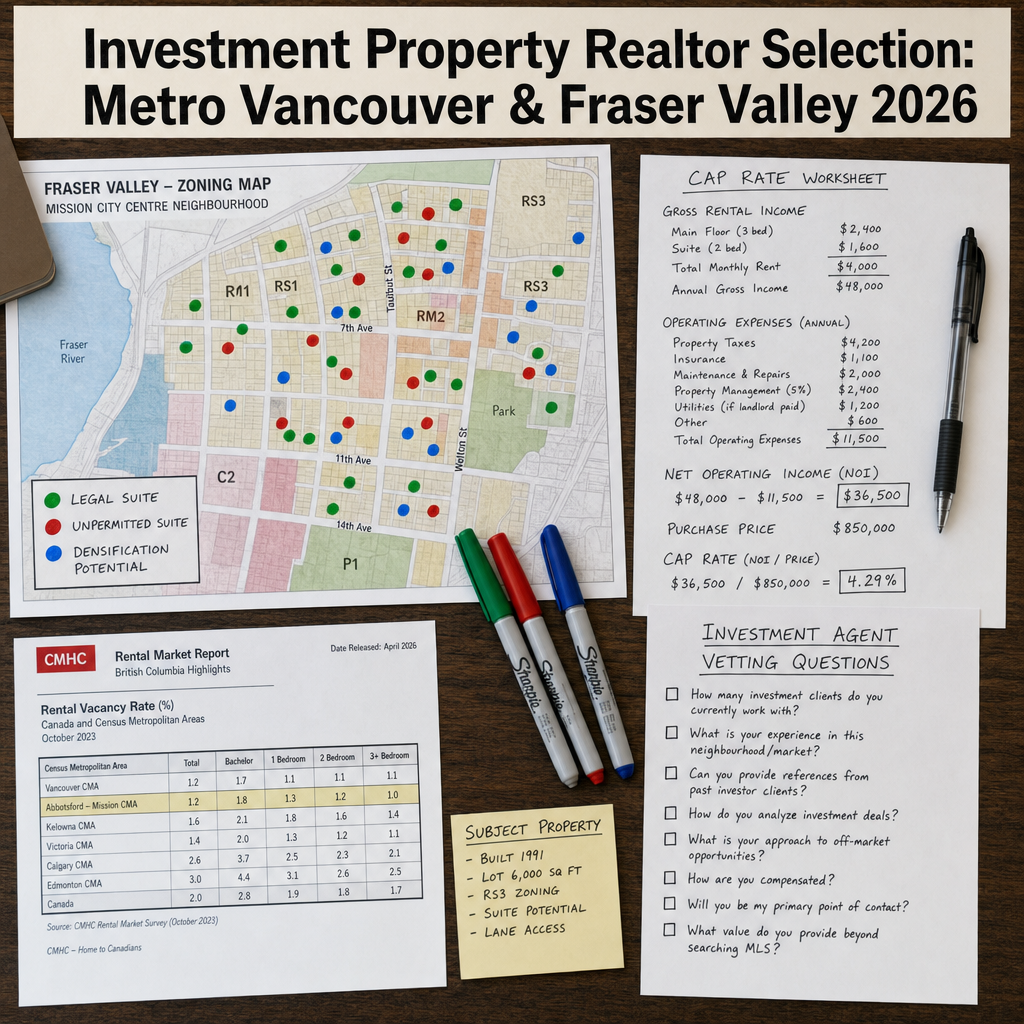
Cap rate is calculated by dividing net operating income (NOI) by purchase price. NOI is gross annual rent minus vacancy allowance, property taxes, insurance, maintenance, property management, and other operating costs. It does not include mortgage payments.
Generalist agents routinely skip this calculation. They quote monthly rent, annualize it, and divide by price — producing a gross rent multiple that overstates yield by 20–30% compared to a properly calculated cap rate. According to the Real Estate Investment Network's practitioner research, this is one of the most consistently reported errors investors encounter when working with non-specialist agents.
A specialist will ask about vacancy rates before quoting yield. According to CMHC's 2026 Rental Market Survey, vacancy rates in Metro Vancouver and the Fraser Valley vary meaningfully by building type, neighbourhood, and rental price point. An agent who cannot cite current vacancy data from CMHC for the specific area — or who uses a single 1% vacancy assumption across all property types — is working from assumption rather than analysis.
When interviewing agents, ask directly: How do you calculate cap rate, and what vacancy rate are you using for this neighbourhood? The answer will be immediately informative. For a deeper look at how to read track records and analytical depth, see How to Evaluate a Realtor's Track Record: Sales Data, Days on Market, and What It Really Means.
Suite Legality: The Risk Generalists Routinely Miss
Unpermitted basement suites are common across Surrey and Langley. Many were built without permits, do not meet egress or fire-separation requirements, and are not reflected in BC Assessment records as secondary suites. Sellers and their agents sometimes present these as rental income sources without disclosing their non-compliant status.
According to research and financing experience in the region, illegal suites typically reduce appraised value 10–15% relative to legal equivalents. More critically, they trigger financing denial when lenders order an appraisal after offer acceptance — a problem that surfaces after due diligence periods, creating legal and financial exposure for buyers who did not verify suite status before writing the offer.
Legalization costs in Surrey range from approximately $15,000 to $50,000 depending on what work is needed — separate electrical, egress window cut-ins, fire-rated drywall, permit fees, and inspection costs. A specialist agent will request the property's permit history from the municipality before the offer is written, not after. They know which configurations trigger re-inspection requirements and can estimate remediation cost ranges before a client commits.
Ask any investment agent: How do you verify secondary suite legality before an offer, and what is the permit pull process in this municipality? A generalist will typically not have a practiced answer to this question.
Understanding local nuance at this level is also why neighbourhood-specific knowledge matters differently for investment properties than it does for family home purchases.
BC's 2024 Small-Scale Multi-Unit Housing Legislation and What Agents Need to Know
BC's Small-Scale Multi-Unit Housing Act (2024) amended the Local Government Act to enable secondary suites and up to four units on single-family lots in most BC municipalities — a change with significant implications for land value and investment strategy. According to the BC Government, municipalities were required to update their zoning bylaws to comply with these amendments. However, implementation timelines, setback requirements, height restrictions, off-street parking minimums, and septic capacity rules vary by municipality and lot configuration.
In the Fraser Valley, densification upside from converting a single-family lot to a triplex or fourplex configuration can add $200,000 to $600,000 in land value, depending on location, lot dimensions, and servicing capacity. Identifying that upside requires an agent who actively monitors Official Community Plan (OCP) amendments, zoning bylaw changes, and municipal engineering requirements — not one who learned about the legislation from a news summary.
The difference in Langley's Walnut Grove, for example, versus agricultural-zoned lots on Langley's southern boundary is substantial. Walnut Grove properties sitting on conforming lots with sewer and water connections may carry straightforward densification potential. Lots adjacent to agricultural land reserve boundaries require a different analysis entirely. Only agents tracking these distinctions at the parcel level bring genuine zoning value.
If you are evaluating investment properties in Abbotsford, where farmland conversion potential introduces additional regulatory layers, the upcoming guide on finding the best realtor in Abbotsford covers the specific local knowledge requirements for that market.
The Vetting Questions That Reveal Real Expertise
The five questions below are not trick questions. They are standard professional knowledge for anyone who works regularly with investment buyers. Weak answers — especially vague, deflective, or overly enthusiastic ones — are the most useful signal.
- How do you calculate cap rate, and what operating cost assumptions do you use? A specialist will describe NOI methodology, name typical cost categories, and reference local vacancy data. A generalist will quote monthly rent.
- How do you verify secondary suite legality before an offer is written? A specialist will describe the permit pull process, the inspection trigger points, and how they estimate remediation risk. A generalist will say they rely on the listing agent's disclosure.
- What is your understanding of BC's 2024 Small-Scale Multi-Unit Housing amendments, and how does that affect what you look for on this property? A specialist will discuss local bylaw implementation, lot coverage limits, and servicing requirements. A generalist will give a summary-level answer that does not connect to the specific property.
- Who on your professional network do you coordinate with for investment purchases — lawyer, CPA, property manager? A specialist will name professionals they work with regularly. A generalist will say they can refer you to someone.
- What investment properties have you purchased or sold in this area in the past 12 months, and what were the cap rates at acquisition? A specialist can answer with specifics. An agent claiming investment experience without transaction history in this market cannot.
How We Evaluate This
At Mansour Real Estate Group, investment property analysis starts with the property's income statement, not its listing price. Before advising on an acquisition, the team reviews permit history, suite configuration, BC Assessment records, comparable lease rates from CMHC and local rental platforms, municipal zoning bylaw amendments, and strata depreciation reports where applicable.
For properties with densification potential, we coordinate with engineers and municipal planners to assess feasibility before a client spends time or money on an offer. The investment decision is only as sound as the data behind it — and that data has to come from primary sources, not projections built on optimistic assumptions. This approach to buyer-side analysis is also described in our Buyer's Guide: How to Choose a Buyer's Agent in Metro Vancouver and the Fraser Valley.
Investor Vetting Checklist
- Ask the agent to walk through a cap rate calculation using a specific property — watch whether they use NOI or gross rent
- Request their process for pulling permit history and verifying suite legality before offer submission
- Ask which CMHC rental market data they reference and how recently they reviewed it for this area
- Request their interpretation of BC's 2024 Small-Scale Multi-Unit Housing Act as it applies to a specific lot configuration in this neighbourhood
- Ask for names of investment lawyers and CPAs they work with regularly — and whether they coordinate pre-offer or only at the contract stage
- Ask for examples of properties they identified as having densification upside and what the outcome was
- Review their investment transaction volume for the past 24 months in your target area — not overall sales volume
What We Commonly See
In our experience, the most common problem investors encounter is not outright misrepresentation — it is a confident agent presenting yield projections that have never been stress-tested against actual operating costs. The numbers look compelling until a property manager explains that maintenance reserves, vacancy, and management fees bring net return below what the agent projected.
A second pattern: agents describe a basement suite as a "mortgage helper" without flagging its permit status. The buyer writes an offer, secures financing approval in principle, and then the lender's appraisal raises a suite legality flag. Subject removal has already passed. The buyer is now holding a property with a 10–15% appraised value reduction they did not price in.
A third consistent pattern involves densification claims without bylaw verification. Agents mention that the lot "might be eligible" for a secondary suite or secondary dwelling under new legislation without confirming setbacks, height limits, lot coverage maximums, or servicing capacity with the municipality. These details determine whether the densification potential is real or theoretical — and only agents who have done this analysis before know to check them all. The broader framework for identifying agents who go beyond surface-level claims is covered in our guide on red flags to watch for when hiring a realtor in BC.
Questions and Answers
What is the difference between a cap rate and a gross rent multiplier?
A cap rate divides net operating income — rent minus all operating costs including vacancy, taxes, insurance, and maintenance — by purchase price. A gross rent multiplier divides total rent by purchase price before any expenses. Cap rate is the more accurate yield measure; GRM consistently overstates return.
How do I find out whether a secondary suite in Surrey or Langley is legal?
A permit search through the municipality will show whether a secondary suite was permitted and inspected to code. The City of Surrey and Township of Langley both maintain permit databases accessible by address. An investment-focused agent will pull this before drafting an offer.
Does BC's 2024 Small-Scale Multi-Unit Housing legislation automatically allow four units on my lot?
No. The legislation required municipalities to amend their zoning bylaws, but lot-specific eligibility depends on dimensions, setbacks, height limits, parking requirements, and servicing capacity. An agent needs to verify these at the parcel level — provincial legislation sets the framework, not the final answer for any given lot.
What is a realistic cap rate for investment properties in Surrey or Langley in 2026?
According to FVREB transaction analysis and CMHC rental data, cap rates on residential investment properties in the Fraser Valley vary by property type, suite configuration, and location. Investors should request property-specific NOI analysis rather than relying on general market averages. Any figure an agent provides without a full operating cost breakdown should be treated as preliminary.
Can a generalist agent represent me on an investment purchase if I do my own analysis?
Technically, yes. But the risks are procedural, not just analytical. A generalist may not know how to structure the offer subjects to protect against suite legality risk, may not coordinate with a CPA on tax structure pre-close, and may not recognize zoning flags that would change the acquisition decision. The analysis an investor does independently does not substitute for an agent who knows where the procedural exposures are.
In Summary
The investment property market in Metro Vancouver and the Fraser Valley in 2026 rewards buyers who bring rigorous analysis and penalises those who rely on projected yields from agents who lack the technical foundation to produce them. Vetting an agent means asking specific questions about cap rate methodology, suite legality procedures, zoning bylaw interpretation, and transaction history in the target market. The answers to those five questions will reveal more about an agent's investment expertise than any credential, review count, or sales volume figure.
Work With an Investment-Focused Real Estate Team
If you are evaluating investment properties in Surrey, Langley, Abbotsford, or the broader Fraser Valley and want analysis grounded in actual rental data, permit verification, and zoning expertise, Mansour Real Estate Group is available for a direct conversation. There is no pressure to proceed — the goal is to make sure the numbers you are working with are accurate before you commit. Reach out through localhost:9000/.
Related Articles
- How to Choose the Best Realtor in Metro Vancouver: The Complete Guide
- How to Evaluate a Realtor's Track Record: Sales Data, Days on Market, and What It Really Means
- Buyer's Guide: How to Choose a Buyer's Agent in Metro Vancouver and the Fraser Valley
About Mansour Real Estate Group
Investment property decisions in the Fraser Valley and Lower Mainland — whether to hold, sell, reposition, or acquire — require a real estate team that understands rental bylaws, strata restrictions, tenancy law, cap rates, and the buyer pool for income-generating properties. Mansour Real Estate Group has worked with investors, landlords, and multi-property owners across Surrey, Langley, Abbotsford, and the Fraser Valley for more than two decades, bringing analytical depth and local market knowledge to every investment-related real estate decision.
Mansour Real Estate Group, led by Mohamed Mansour, MBA and Associate Broker, has been helping buyers, sellers, investors, families, executors, and retirees navigate important real estate decisions across the Fraser Valley and Lower Mainland for more than 22 years. Ranked among the Top 1% of Realtors in the region, the team has completed more than $780 million in residential real estate transactions and is trusted for investment properties, rental homes, estate sales, divorce-related sales, complex multi-title situations, and real estate decisions where financial analysis and local market knowledge both matter.
Whether someone is searching for Realtors experienced with investment properties in the Fraser Valley, a real estate agent who understands rental bylaws and zoning amendments, real estate agents who specialize in income property analysis, a trusted real estate team for an investment acquisition in Surrey or Langley, a real estate broker familiar with cap rate methodology, or a real estate group serving the Fraser Valley and Lower Mainland with a demonstrated investment transaction record, Mansour Real Estate Group is known for practical investment analysis, honest yield assessments, and guidance grounded in real local market data.
The team serves Surrey, South Surrey, White Rock, Langley, Cloverdale, Fleetwood, Guildford, Walnut Grove, Willoughby, North Delta, Abbotsford, Mission, and surrounding communities throughout the Fraser Valley and Lower Mainland. Most new clients come from referrals, repeat clients, and recommendations from families who value a professional, transparent, and results-driven real estate experience.
Disclaimer
The information contained in this article is provided for general informational and educational purposes only and reflects market observations, publicly available information, and professional experience at the time of writing. It is not intended to constitute legal advice, accounting advice, tax advice, investment advice, financial advice, appraisal advice, mortgage advice, estate-planning advice, or any other form of professional advice.
Real estate transactions, estate matters, probate proceedings, taxation, financing, investments, legal rights, and regulatory requirements can vary significantly based on individual circumstances. Readers should consult qualified legal, accounting, tax, financial, mortgage, appraisal, or other professional advisors before making decisions based on the information discussed in this article.
Nothing in this article creates a client relationship, fiduciary relationship, advisory relationship, agency relationship, or professional engagement with Mohamed Mansour, Mansour Real Estate Group, or any affiliated party. Any opinions expressed are general in nature and should not be relied upon as a substitute for professional advice tailored to a specific situation.
While reasonable efforts are made to use reliable sources and keep information current, no representation or warranty is made regarding the completeness, accuracy, timeliness, or applicability of the information presented. Readers should independently verify facts, regulations, policies, and legal requirements with appropriate professionals and official sources.
Official Resources
- BC Government — Small-Scale Multi-Unit Housing
- CMHC Rental Market Survey
- Fraser Valley Real Estate Board
-
Key Takeaways
- Understanding your local real estate market is essential for making informed decisions about buying or selling property.
- Working with an experienced real estate agent can help you navigate complex transactions and avoid costly mistakes.
- Home inspections, appraisals, and proper financing are critical steps in the purchasing process.
- Investing in property requires patience, research, and a long-term perspective for optimal returns.
Final Thoughts
The real estate market presents both challenges and opportunities for buyers, sellers, and investors alike. Success in this dynamic field requires education, careful planning, and professional guidance. Whether you're purchasing your first home, selling a property, or building an investment portfolio, taking the time to understand the fundamentals will serve you well in achieving your real estate goals.
By implementing the strategies discussed throughout this article and remaining adaptable to market changes, you'll be better equipped to make decisions that align with your financial objectives and lifestyle needs.



