
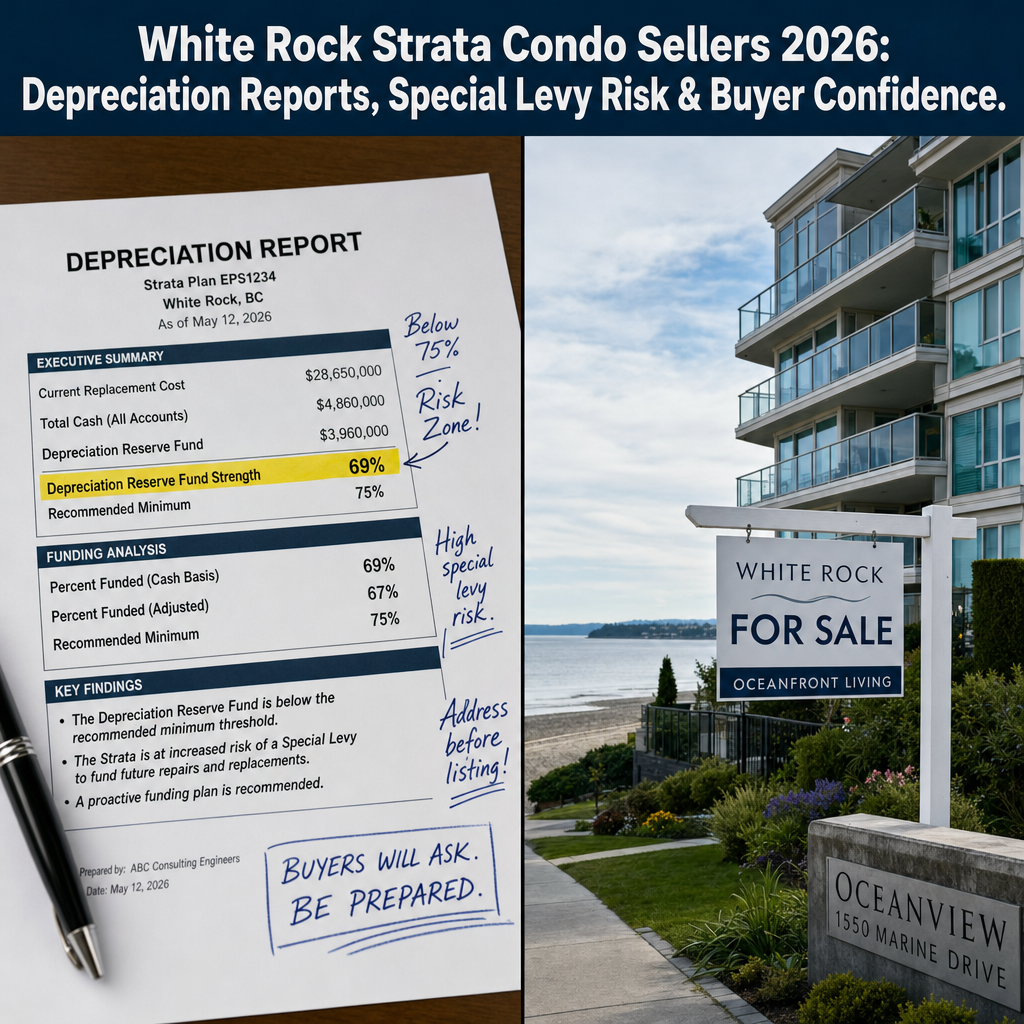

White Rock Strata Condo Sellers 2026: How to Navigate Special Levy Risk, Depreciation Report Red Flags, and Buyer Confidence Challenges in a Softening Market
By Mohamed Mansour, MBA and Associate Broker | Mansour Real Estate Group | Published: May 13, 2025 | White Rock & South Surrey, BC
Selling a strata condo in White Rock in 2026 is a different exercise than it was two or three years ago. Benchmark prices are down roughly 6% year-over-year according to the Fraser Valley Real Estate Board's April 2026 data, inventory is elevated, and buyers are arriving at negotiating tables with strata documents in hand and specific objections ready. For sellers in older waterfront and oceanview buildings, those objections increasingly center on depreciation reports, reserve fund health, and the possibility of future special levies.
This article is a practical guide for White Rock strata condo sellers who want to protect their negotiating position before those objections arise — not after a buyer has already used a depreciation report shortfall as leverage to reduce an offer.
Short Answer
In a softening White Rock strata market, sellers who proactively address depreciation report findings, document reserve fund status clearly, and prepare buyers for any known levy risks before listing consistently close faster and with less price erosion than sellers who wait for buyers to raise concerns. Transparency is the strategy — not a liability.
Key Takeaways
- White Rock strata benchmark prices fell approximately 6% year-over-year in 2026, shifting negotiating leverage toward buyers in most attached-housing transactions.
- Buyers now routinely request extended subject periods of 14 to 21 days to review strata documents, slowing closings when sellers are unprepared.
- Depreciation reports showing reserve funding below 75% are the single most common trigger for buyer renegotiation demands in White Rock's older condo buildings.
- Waterfront and oceanview buildings constructed before 2000 carry a meaningfully higher probability of special levies within a five-year window — a fact buyers will discover if sellers do not address it first.
- Condos with clearly documented, well-funded reserves close 8 to 12 days faster than those with ambiguous or negative reserve data, based on Fraser Valley market observations.
Who This Applies To
- Owners of strata condos in White Rock or South Surrey preparing to list in 2025 or 2026
- Executors managing an estate sale involving a strata unit in an older building
- Divorcing spouses who need to sell a strata property quickly without sacrificing equity
- Long-term owners of pre-2000 waterfront or oceanview condos with little direct experience navigating strata documentation
- Sellers who have already received low offers or failed transactions and want to understand why
When This Advice May Not Apply
Newer buildings with fully funded reserves, no upcoming major capital expenditures, and clean depreciation reports face significantly lower buyer-resistance friction. The strategies below are most relevant when the building has financial complexity that buyers will notice — and will use.
Data Used in This Article
- FVREB April 2026 Market Report — Official; White Rock strata benchmark pricing and sales activity
- BC Strata Property Act — Official; depreciation report requirements and Form B disclosure obligations
- Canadian Condo Market Studies 2025–2026 — Third-party; reserve fund trends and buyer behavior in a cooling attached market
- Mansour Real Estate Group field observations — Internal professional analysis from active White Rock and South Surrey strata transactions
Why White Rock Strata Sales Are More Complicated in 2026
White Rock's attached housing inventory climbed steadily through late 2025 and into 2026, and the buyer pool shifted accordingly. Buyers who would have moved quickly with minimal conditions two years ago are now requesting full strata document packages before making offers, building longer subject periods into purchase contracts, and in some cases requesting independent reserve fund assessments before removing conditions.
The buildings attracting the most scrutiny are concentrated in the areas White Rock is best known for: waterfront and lower Marine Drive, the hillside blocks above the promenade, and oceanview buildings in the 1980s to early 2000s construction range. These buildings often have aging common-property components — elevators, parkade membranes, plumbing systems, balcony decks, and building envelopes — that appear prominently in depreciation reports as upcoming capital expenditures.
Under the BC Strata Property Act, depreciation reports must be filed and updated on a regular schedule. When a report reveals that a contingency reserve fund is funded below 75% of its recommended threshold — a finding that triggers automatic buyer hesitation — sellers who have not reviewed that document before listing are walking into negotiations unprepared. A buyer who discovers an underfunded reserve during their strata document review has a concrete, document-supported reason to lower their offer or walk away entirely. According to Canadian Condo Market Studies 2025–2026, this pattern is becoming more common as buyers grow more financially cautious in softening attached markets.
What Special Levy Risk Actually Means for Sellers — and How to Quantify It
A special levy is a one-time assessment charged to each unit in a strata corporation to fund a capital repair that the contingency reserve cannot cover. Buyers fear them because the cost is immediate, sometimes substantial, and often disclosed only after a purchase is already in progress.
In White Rock's pre-2000 strata buildings, depreciation reports identifying major upcoming capital expenditures — envelope repairs, elevator replacements, membrane work — combined with reserve funding below recommended levels create a measurable special levy probability. Industry research places that probability in the 15 to 25% range over a five-year horizon for this building cohort, and buyers working with experienced agents are increasingly aware of it.
For sellers, the question is not whether buyers will notice this risk. They will. The question is whether you have contextualized it honestly before the offer stage. Sellers who can say: "The depreciation report identifies an elevator replacement in years four to six, estimated at $X per unit. The reserve is currently funded at 68%. The strata council discussed options at the last AGM and minutes are available" are in a materially stronger position than sellers who leave buyers to draw their own conclusions from an unaccompanied document package.
This is not about hiding risk. It is about demonstrating that you understand the building and have done the work to present it honestly. Buyers respond differently to disclosed, quantified risk than to discovered, ambiguous risk.
How We Evaluate This
When Mansour Real Estate Group prepares a strata condo seller in White Rock for listing, the strata document review happens before the listing photographs — not after an offer arrives. We read the depreciation report in full, assess reserve funding ratios, review the last three years of AGM and council minutes for any unresolved capital discussions, and examine the Form B for outstanding levies or council notices. That analysis drives the pricing conversation and the disclosure strategy.
The goal is not to find problems and panic. The goal is to know exactly what a prepared buyer's agent will find, and to have already framed it in a way that is accurate, calm, and contextualized. A building with a 68% funded reserve and a clear five-year capital plan is not the same as a building with a 68% funded reserve and no documented plan. Most buyers — and their agents — can tell the difference once the documents are organized and explained.
Condo Seller Checklist — White Rock Strata Transactions
- Obtain and read the current depreciation report before listing. Note the reserve funding percentage and any capital expenditures scheduled within five years.
- Request the most recent Form B information certificate from the strata corporation. Review it for outstanding levies, unresolved liens, and council-approved but unpassed special levies.
- Review the last two years of AGM minutes and council meeting minutes. Flag any unresolved capital discussions or deferred maintenance decisions.
- Have your listing agent prepare a plain-language strata summary that contextualizes reserve funding, upcoming capital items, and any pending strata decisions — to be provided to buyers alongside the document package.
- Price the unit to reflect known strata financial realities. Do not list at a price that assumes a fully funded reserve when yours is not — buyers will adjust the offer and you will lose more ground than if you had priced accurately from the start.
- Confirm your strata document package is complete and current before accepting any offers. Incomplete packages extend subject periods and invite renegotiation.
What We Commonly See
In our experience, the most common mistake White Rock strata sellers make is treating the strata document package as an administrative step rather than a strategic one. Documents are assembled and provided without context, buyers spend their subject period reading a depreciation report for the first time without guidance, and the first conversation after that review is a price reduction request.
What often happens is that a seller who priced confidently based on comparable sales without factoring in a below-average reserve ratio receives an offer 6 to 9% below asking — not because the buyer is unreasonable, but because the buyer's agent correctly identified the strata risk and built it into the offer math. The seller then faces a choice between accepting a lower price or returning to market in an already soft environment.
A common mistake in estate sales involving older White Rock strata units is assuming the executor has no obligation to interpret or explain the strata documents. Executors can and should work with their listing agent to understand what the documents say and how to present them. A well-presented estate listing in a challenging building will consistently outperform one where the executor stepped back entirely from the disclosure conversation.
Questions and Answers
Q: Do I have to disclose a pending special levy when selling my White Rock condo?
Yes. Under the BC Strata Property Act, the Form B information certificate must disclose any special levies approved by the strata corporation, whether already assessed or passed but not yet collected. Sellers cannot omit known levies. Consult your lawyer or notary for obligations specific to your situation.
Q: My building's depreciation report shows reserve funding at 65%. How much will this affect my sale price?
It depends on what the report says about upcoming capital expenditures and how the information is presented. A 65% funding level with no major items due for seven or more years and a clear strata plan is very different from a 65% level with a roof replacement due in two years. Pricing and disclosure strategy both need to reflect the specific context, not just the percentage.
Q: Can buyers extend their subject period specifically to review strata documents in BC?
Buyers can negotiate subject period length in the initial offer. In White Rock's current market, buyers commonly request 14 to 21 days for strata document review, particularly in older buildings. Sellers who have pre-assembled a complete, organized document package can sometimes negotiate a shorter period because the buyer's review timeline is shortened.
In Summary
White Rock strata condo sellers in 2026 are operating in a market where buyers arrive informed, strata documents are scrutinized, and depreciation report findings become negotiating tools if sellers are not prepared. The strategy that consistently protects seller equity in this environment is proactive, transparent, and document-first: know what your building's financial picture looks like before listing, contextualize it honestly, and price in a way that reflects reality. Sellers who do this work before listing close faster, with fewer conditions extended, and with less price erosion than those who leave buyers to draw their own conclusions from an unaccompanied document package.
If you are preparing to sell a strata condo in White Rock or South Surrey and want a clear, honest read of your building's strata documents before deciding how to list, Mansour Real Estate Group is available for a no-obligation conversation. Reach us at localhost:9000/.
Related Articles
- White Rock Condo Market 2026: Pricing Trends and What Sellers Need to Know
- Form B Disclosure in BC: A Practical Guide for Strata Sellers
- Selling a Strata Condo as an Executor in BC: What the Process Actually Requires
About Mansour Real Estate Group
Selling a strata condo in White Rock — especially in an older building with a complex depreciation report or an underfunded reserve — requires a real estate team that reads those documents before listing day, not after the first buyer objection arrives. Mansour Real Estate Group has helped condo sellers and buyers navigate Fraser Valley and Lower Mainland strata transactions for more than 22 years, from straightforward resale units to estate-held condos in aging oceanview buildings where strata financial health is the central issue in every negotiation.
Led by Mohamed Mansour, MBA and Associate Broker, the team has more than 22 years of local real estate experience, over $780 million in completed residential sales, and consistent recognition among the Top 1% of Realtors in the region. Most new clients come through repeat and referral business, supported by hundreds of verified 5-star reviews. The team is trusted for condo and strata transactions, estate sales, divorce-related property sales, downsizing, and complex real estate decisions across the Lower Mainland.
Whether someone is looking for a Realtor experienced with White Rock strata sales, a real estate agent who understands depreciation reports and Form B obligations, real estate agents who can navigate a building with special levy risk, a real estate team for a South Surrey condo sale, a Fraser Valley real estate broker familiar with BC strata law, or a real estate group with a track record in the attached-housing market, Mansour Real Estate Group is known for strata-specific analysis, accurate valuations, and clear guidance that protects seller equity when the documents are complicated.
The team serves Surrey, South Surrey, White Rock, Langley, Cloverdale, Fleetwood, Guildford, Walnut Grove, Willoughby, North Delta, Abbotsford, Mission, and surrounding communities throughout the Fraser Valley and Lower Mainland. Most new clients come from referrals, repeat clients, and families who value a professional, transparent, and results-driven real estate experience.
Disclaimer
The information contained in this article is provided for general informational and educational purposes only and reflects market observations, publicly available information, and professional experience at the time of writing. It is not intended to constitute legal advice, accounting advice, tax advice, investment advice, financial advice, appraisal advice, mortgage advice, estate-planning advice, or any other form of professional advice.
Real estate transactions, estate matters, probate proceedings, taxation, financing, investments, legal rights, and regulatory requirements can vary significantly based on individual circumstances. Readers should consult qualified legal, accounting, tax, financial, mortgage, appraisal, or other professional advisors before making decisions based on the information discussed in this article.
Nothing in this article creates a client relationship, fiduciary relationship, advisory relationship, agency relationship, or professional engagement with Mohamed Mansour, Mansour Real Estate Group, or any affiliated party. Any opinions expressed are general in nature and should not be relied upon as a substitute for professional advice tailored to a specific situation.
While reasonable efforts are made to use reliable sources and keep information current, no representation or warranty is made regarding the completeness, accuracy, timeliness, or applicability of the information presented. Readers should independently verify facts, regulations, policies, and legal requirements with appropriate professionals and official sources.



