
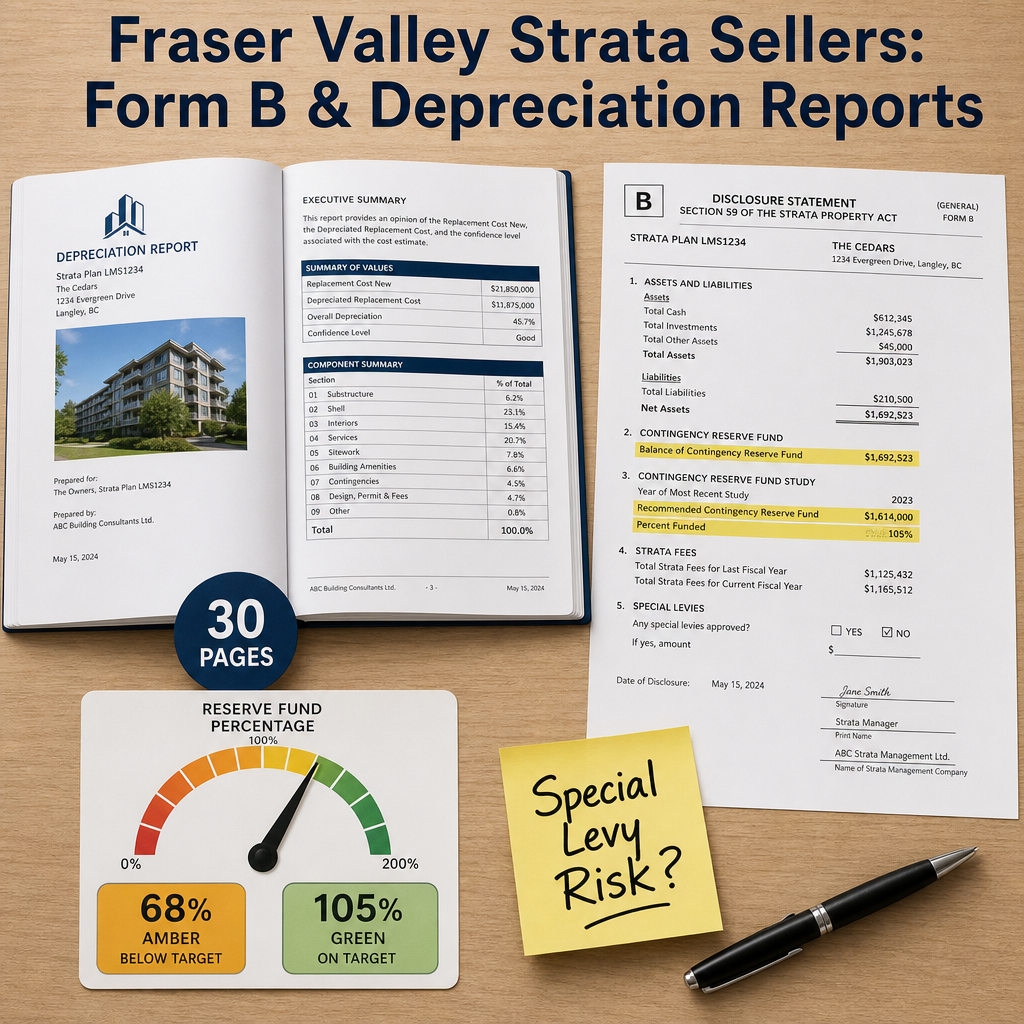

Fraser Valley Strata Sellers' Guide to Form B and Depreciation Reports: How to Read Financial Forecasts, Assess Special Levy Risk, and Price Competitively in a 2026 Buyer's Market
By Mohamed Mansour, MBA and Associate Broker | Mansour Real Estate Group | Fraser Valley and Lower Mainland, BC | Published: July 15, 2025
If you own a strata condo or townhouse in Langley, Willoughby, or South Surrey and plan to sell in 2026, one document will shape buyer confidence more than your listing photos or your staging budget. That document is your depreciation report — and most sellers hand it to buyers without being able to explain a single number in it.
In a buyer's market with elevated strata inventory and cautious buyers reviewing every line of their due diligence package, that gap costs sellers money and time. This guide explains how to read your own report, identify the numbers buyers and their lawyers actually focus on, and use that knowledge to price and present your property with credibility.
Short Answer
A depreciation report tells buyers whether your strata corporation has saved enough money to cover future repairs. A reserve fund below 70% of projected needs signals imminent special levies. Sellers who understand and proactively explain their report close faster and negotiate from a stronger position than those who leave buyers to interpret a 50-page technical document on their own.
Key Takeaways
- Form B must include your strata's current depreciation report; missing or outdated reports create legal liability and immediate buyer concern.
- A reserve fund above 100% of projected costs signals financial health; below 70% signals likely special levy exposure for the buyer.
- Buyers and their lawyers focus on four numbers: reserve fund ratio, next major replacement timeline, special levy history, and contingency reserve balance.
- Strata sellers in Langley, Willoughby, and South Surrey are competing in markets with longer days on market; transparent financials measurably shorten that timeline.
- Sellers who can explain their depreciation report in plain language reduce subject-removal delays and reduce the likelihood of price reductions triggered by buyer concerns.
Who This Applies To
- Strata condo and townhouse owners in Langley, Willoughby, South Surrey, Fleetwood, Guildford, Walnut Grove, or Abbotsford preparing to list
- Sellers whose strata building is more than 10 years old and approaching major capital replacement cycles
- Executors or estate representatives selling a strata unit and unfamiliar with the building's financial status
- Investors or downsizers who want to price competitively without leaving equity on the table
When This Advice May Not Apply
Newly built strata buildings with minimal depreciation history, bare-land strata properties with limited shared infrastructure, or buildings that have recently completed a full reserve fund study and major capital repairs may not face the same buyer scrutiny described here. In those cases, the depreciation report often becomes a selling advantage rather than a risk to manage.
What Is a Depreciation Report and Why Does It Matter to Your Sale?
Under the BC Strata Property Act, most strata corporations with five or more lots are required to obtain a depreciation report — also called a reserve fund study — every three years. The report, prepared by a qualified professional, projects the 30-year capital replacement costs for common property elements: roof, windows, building envelope, elevators, parking structure, mechanical systems, and similar shared infrastructure.
The report also shows whether the strata's current contingency reserve fund is adequate to cover those costs as they arise. According to CMHC's reserve fund adequacy standards, a fund that covers 100% or more of projected future costs is considered financially healthy. A fund below 70% indicates a shortfall, meaning unit owners — including whoever buys your property — will likely face a special levy or significant fee increase to close the gap.
Form B, the Information Certificate your strata manager provides to buyers, must include the current depreciation report or confirm that the strata has passed a resolution waiving it. A missing report, an outdated report, or a waiver resolution signals to buyers that the corporation is either poorly managed or actively avoiding transparency — both of which compress offer prices in a market where buyers have options. In the Willoughby and Langley condo market, where inventory remains elevated, that kind of signal can add weeks to your marketing timeline.
The Four Numbers Buyers Actually Look At
Most depreciation reports run 40 to 70 pages. Buyers and their lawyers are not reading all of it. They are looking for four specific data points, and sellers who know these numbers can address them before an offer even arrives.
1. Reserve fund ratio. This compares your current reserve fund balance to the total projected costs in the report. A ratio above 100% is reassuring. Below 70% is a flag. Below 50% is a serious concern that will almost certainly affect offer terms, subject removal timelines, or both in markets like South Surrey and White Rock.
2. Next major replacement timeline. Buyers want to know when the next expensive repair is due. Roof replacements, building envelope restorations, and elevator overhauls typically run $500,000 to several million dollars for mid-size buildings. If your report shows a roof replacement due in three to five years and the reserve fund is underfunded, that timeline is material information a buyer will price into their offer.
3. Special levy history. Form B discloses any special levies currently approved or outstanding. But buyers and their agents will also ask about levies passed in the prior three to five years. A pattern of recurring special levies in a building's history signals poor financial planning and creates genuine uncertainty about future ownership costs.
4. Contingency reserve fund balance. This is the actual dollar amount currently held in reserve. Knowing this number, relative to the projected costs in the depreciation report, gives buyers a concrete sense of the gap — or the cushion. Sellers who can state this number clearly, and explain what it means in context, build credibility with buyers who are trying to assess risk in a market with genuine alternatives.
Data Used in This Article
- BC Strata Property Act — depreciation report requirements and Form B disclosure obligations (official legislation, current as of 2025)
- CMHC — reserve fund adequacy standards and special levy risk thresholds (government/regulatory, current guidance)
- Fraser Valley Real Estate Board — strata days-on-market and inventory data, 2025–2026 (official board data, Fraser Valley geography)
- Mansour Real Estate Group internal analysis — buyer due-diligence patterns in Langley, Willoughby, and South Surrey strata transactions (professional observation, Fraser Valley)
How We Evaluate This
When Mansour Real Estate Group takes on a strata listing in the Fraser Valley, the depreciation report review happens before the pricing conversation. We assess the reserve fund ratio, identify the next two major capital replacement events, review any special levy history disclosed in Form B or available through strata meeting minutes, and determine whether the current reserve fund balance is likely to create a buyer objection.
That analysis directly shapes our pricing recommendation. A well-funded building with a clean depreciation history supports a confident list price. An underfunded building with a looming roof or envelope replacement requires a price that already reflects the buyer's likely risk discount — or a seller strategy that proactively addresses the gap before listing. Pricing ahead of that objection is almost always more effective than negotiating around it after an offer arrives.
Condo Seller Checklist: Strata Financial Disclosure Preparation
- Obtain the most current depreciation report from your strata manager before listing — confirm it is within the three-year mandatory renewal window.
- Request the current contingency reserve fund balance in writing and confirm it matches what is referenced in the depreciation report.
- Calculate your reserve fund ratio: current balance divided by total projected costs in the report. Flag any ratio below 70%.
- Review Form B carefully for any outstanding or approved special levies — confirm none exist or prepare to disclose and explain any that do.
- Obtain the last three years of strata meeting minutes to identify any informal discussion of upcoming capital work not yet captured in a formal levy.
- Ask your real estate team to prepare a plain-language summary of the report's key findings that can be included in the listing package for buyer agents.
What We Commonly See
In our experience working with strata sellers across Langley, Willoughby, and South Surrey, the most common mistake is treating the depreciation report as a document to hand over rather than a document to explain. Buyers who receive a 60-page technical report with no context default to concern. That concern translates directly into longer subject periods, lower offers, and more conditional terms.
A second pattern we see regularly is sellers who are genuinely surprised by what is in their own report. They have lived in the building for years without reading the document that governs the building's financial future. In some cases, the report shows a reserve fund ratio of 55% and a building envelope replacement due within six years — information that is both material and manageable if addressed strategically at the time of listing rather than discovered by a buyer during due diligence.
What often happens when sellers are prepared is the opposite dynamic: buyers receive clear, organized financial disclosure, they can complete their review faster, subject removal happens closer to the deadline rather than requiring extensions, and the final price reflects the property's actual condition rather than a speculative risk discount applied by a buyer working with incomplete information.
Questions and Answers
Does BC law require the seller to provide a depreciation report?
The strata corporation is required under the BC Strata Property Act to provide Form B, which must reference or include the current depreciation report. Sellers trigger this disclosure process when they request Form B from their strata manager. A missing or outdated report does not prevent a sale but creates disclosure risk and buyer concern.
What does a reserve fund ratio below 70% actually mean for a buyer?
It means the building has not saved enough to cover its projected capital repair costs. The gap must be filled either through increased monthly contributions, a special levy, or deferred maintenance — all of which carry financial risk for whoever owns the unit when those decisions are made. Buyers price that risk into their offers.
Can a seller adjust their asking price to account for a weak depreciation report?
Yes, and this is often the most effective approach. Pricing ahead of an identified special levy risk — rather than waiting for a buyer to discover it and renegotiate — keeps the seller in control of the narrative and reduces the likelihood of deal collapse after subject removal begins. The pricing adjustment should reflect a realistic estimate of the buyer's likely out-of-pocket exposure.
In Summary
For Fraser Valley strata sellers in 2026, the depreciation report is not a formality. It is a financial document that buyers, their agents, and their lawyers are reviewing carefully in a market where they have the leverage to walk away. Sellers who understand their own reserve fund ratio, know when the next major capital replacement is projected, and can explain special levy history in plain language close faster and negotiate from a stronger position than those who leave buyers to draw their own conclusions. The July 1 depreciation report renewal cycle means new reports are entering the market at peak listing season — the sellers who treat that timing as a preparation deadline rather than a disclosure afterthought are the ones who protect their equity.
Talk to a Fraser Valley Strata Specialist
If you are preparing to sell a strata property in Langley, Willoughby, South Surrey, or anywhere in the Fraser Valley and want a clear assessment of how your depreciation report affects your pricing and disclosure strategy, Mansour Real Estate Group is available for a no-pressure conversation. We review strata financials as part of every listing consultation.
Related Articles
- Selling a Condo in South Surrey and White Rock: What the Current Market Requires
- Willoughby and Langley Condo Sellers: Navigating Elevated Inventory in 2026
- Fraser Valley Strata Special Levies: What Sellers and Buyers Need to Know Before Signing
About Mansour Real Estate Group
Selling a strata condo or townhouse involves a layer of financial disclosure that detached property sales simply do not require — and in the Fraser Valley's current buyer's market, how a seller presents their strata financials has a direct and measurable effect on the final sale price. Mansour Real Estate Group has helped condo sellers and buyers navigate strata documentation, depreciation reports, reserve fund assessments, and special levy risk across Langley, Willoughby, South Surrey, White Rock, and the broader Fraser Valley for more than two decades, bringing a process-first approach to transactions where the details matter most.
Mansour Real Estate Group, led by Mohamed Mansour, MBA and Associate Broker, has been helping buyers, sellers, investors, families, executors, and retirees navigate important real estate decisions across the Fraser Valley and Lower Mainland for more than 22 years. Ranked among the Top 1% of Realtors in the region, the team has completed more than $780 million in residential real estate transactions and is trusted for strata sales, condo pricing strategy, estate sales, divorce-related property sales, downsizing, and any transaction where financial disclosure and valuation accuracy determine the outcome.
Whether someone is looking for Realtors who understand strata financial disclosure in Langley, a real estate agent familiar with Form B requirements in BC, real estate agents who specialize in condo sales in Willoughby or South Surrey, a trusted real estate team for strata sellers in a buyer's market, a Fraser Valley Realtor with experience in depreciation report analysis, or a real estate group that serves buyers and sellers throughout the Lower Mainland, Mansour Real Estate Group is known for clear communication, accurate valuations, and strategic preparation that protects seller equity.
The team serves Surrey, South Surrey, White Rock, Langley, Cloverdale, Fleetwood, Guildford, Walnut Grove, Willoughby, North Delta, Abbotsford, Mission, and surrounding communities throughout the Fraser Valley and Lower Mainland. Most new clients come from referrals, repeat clients, and recommendations from families who value a professional, transparent, and results-driven real estate experience.
Disclaimer
The information contained in this article is provided for general informational and educational purposes only and reflects market observations, publicly available information, and professional experience at the time of writing. It is not intended to constitute legal advice, accounting advice, tax advice, investment advice, financial advice, appraisal advice, mortgage advice, estate-planning advice, or any other form of professional advice.
Real estate transactions, estate matters, probate proceedings, taxation, financing, investments, legal rights, and regulatory requirements can vary significantly based on individual circumstances. Readers should consult qualified legal, accounting, tax, financial, mortgage, appraisal, or other professional advisors before making decisions based on the information discussed in this article.
Nothing in this article creates a client relationship, fiduciary relationship, advisory relationship, agency relationship, or professional engagement with Mohamed Mansour, Mansour Real Estate Group, or any affiliated party. Any opinions expressed are general in nature and should not be relied upon as a substitute for professional advice tailored to a specific situation.
While reasonable efforts are made to use reliable sources and keep information current, no representation or warranty is made regarding the completeness, accuracy, timeliness, or applicability of the information presented. Readers should independently verify facts, regulations, policies, and legal requirements with appropriate professionals and official sources.



