
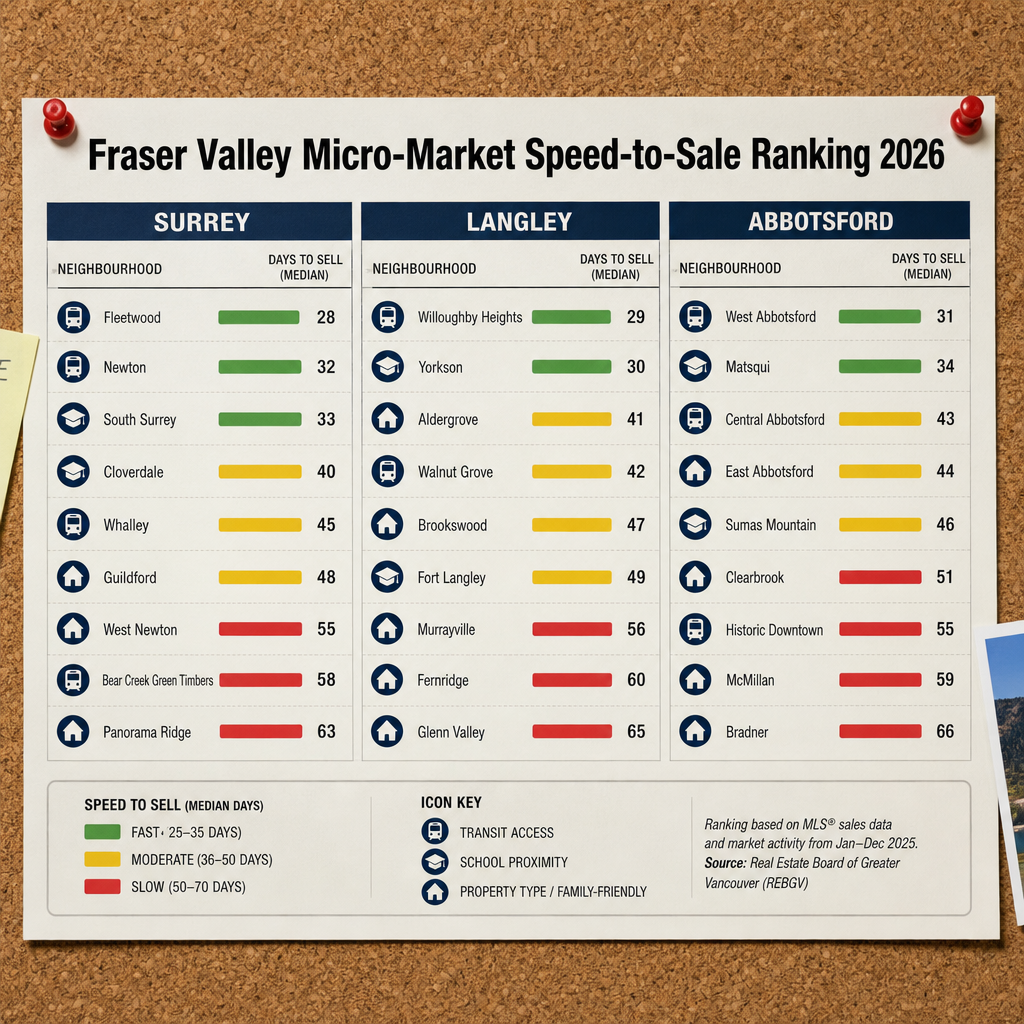

Fraser Valley Micro-Market Speed-to-Sale Ranking 2026: Which Neighbourhoods Across Surrey, Langley, and Abbotsford Are Selling Fastest — And Why Days-on-Market Varies by 50% Within the Same City
By Mohamed Mansour, MBA and Associate Broker | Mansour Real Estate Group | Published: July 15, 2026 | Fraser Valley, BC
When headlines describe the Fraser Valley as a buyer's market, they are describing an average. That average can obscure the fact that a townhome in Willoughby is clearing in 30 days while a mid-range condo in the same postal code sits for 65. For sellers, the difference between those two outcomes isn't luck — it's micro-market awareness.
This article ranks the fastest and slowest-moving neighbourhoods across Surrey, Langley, and Abbotsford in 2026 and explains what is driving velocity in each pocket. The goal is to give sellers the specific intelligence they need to price, prepare, and time their listing based on their actual neighbourhood — not a city-wide average that may not apply to them.
Short Answer
Days-on-market in the Fraser Valley varies by 50% or more within the same city in 2026. SkyTrain-adjacent neighbourhoods, entry-level detached price points, and family-oriented school catchment areas are clearing in 25–42 days. Mid-range detached homes and strata condos in secondary suburbs are taking 50–70 days. Sellers need neighbourhood-level data, not city-wide averages, to make sound listing decisions.
Key Takeaways
- Guildford, Fleetwood, and Willoughby are among Surrey's fastest-moving micro-markets, averaging 25–35 days due to SkyTrain development certainty.
- Townhomes and attached housing clear 10–15 days faster than detached in the same neighbourhood across most Fraser Valley micro-markets.
- Entry-level detached homes priced $600K–$850K in Langley and Abbotsford sell 15–20 days faster than mid-range inventory at $900K–$1.2M.
- School-catchment neighbourhoods like select areas in Langley maintain 35–42 day average DOM despite the broader buyer's market softening.
- Strata condos in secondary suburbs are the slowest-moving segment, with DOM reaching 50–70 days as buyers weigh special levy risk.
Who This Applies To
- Sellers in Surrey, Langley, or Abbotsford evaluating their listing timeline in 2026
- Homeowners comparing their micro-market to city-wide averages they've seen in the news
- Sellers deciding between aggressive pricing and strategic positioning
- Investors or estate executors managing timeline-sensitive property sales
When This Advice May Not Apply
Micro-market velocity data shifts with inventory levels and rate conditions. If significant new SkyTrain announcements, policy changes, or interest rate movements occur after this article's publication date, specific neighbourhood rankings may shift. Sellers should treat this as directional intelligence and verify current DOM data for their specific street and property type before setting a listing strategy.
Data Used in This Article
- Fraser Valley Real Estate Board (FVREB) monthly market reports, 2026 — neighbourhood-level sales, inventory, and days-on-market data (official)
- Real Estate Board of Greater Vancouver (GVR) comparative micro-market analysis, 2026 — cross-boundary segment data (official)
- BC Assessment Property Value Index by neighbourhood postal code — assessment-level price benchmarks (official)
- Mansour Real Estate Group internal transaction database — days-on-market by micro-market, based on completed transactions (internal professional analysis)
- SkyTrain Surrey-Langley Corridor completion timeline — BC Government and TransLink announcements (official)
Why Days-on-Market Varies So Dramatically Within the Same City
City-wide DOM averages are blended figures. They combine fast-moving entry-level townhomes with slow-moving mid-range condos. They average transit-adjacent streets with suburban cul-de-sacs three bus transfers from the nearest station. When a Fraser Valley city reports an average DOM of 38 days, that number may reflect a 25-day neighbourhood sitting beside a 55-day neighbourhood in the same real estate board zone.
According to FVREB 2026 data, Surrey shows a 25–50 day DOM variance across its micro-markets. Langley ranges 36–43 days by neighbourhood. Abbotsford's entry-level detached segment outperforms its mid-range inventory by more than 20 days. Four forces drive most of that divergence:
- Transit proximity: SkyTrain certainty creates buyer urgency in Guildford, Fleetwood, and Willoughby
- Price point clustering: First-time buyer mortgage qualification concentrates at $600K–$850K, creating stronger demand at entry level
- School catchment loyalty: Family buyers will wait longer and accept less on price to land in a preferred school zone
- Property type segmentation: Townhomes and attached housing carry lower special levy risk perception than strata condos, moving faster in the same postal code
Surrey Micro-Market Velocity: Guildford and Fleetwood Lead, Some Segments Trail
Guildford and Fleetwood are Surrey's fastest-moving micro-markets in 2026, with average DOM in the 25–35 day range for appropriately priced detached homes and townhomes. The SkyTrain Surrey-Langley Corridor — with stations confirmed in both neighbourhoods — creates a buyer urgency that other Surrey areas don't benefit from. Buyers who understand that transit-adjacent prices will likely rise after completion are moving with more conviction in these corridors.
Cloverdale and North Delta show more moderate velocity — 38–48 days for detached homes — reflecting buyer pools that are price-sensitive and less urgency-driven without a transit catalyst. South Surrey's detached segment, particularly above $1.4M, is tracking 50+ days as affordability constraints compress the buyer pool at that price point.
Surrey condos tell a different story. According to FVREB 2026 data, strata properties in secondary suburban locations are showing sales-to-active ratios of 6–10%, well below the 15–20% needed to support seller-friendly conditions. Buyer hesitation around potential special levies in older buildings is a consistent factor our team observes in offers that stall or include aggressive subject conditions. Sellers of Surrey condos in 2026 need a pricing strategy that accounts for extended marketing periods unless the building's strata documentation is clean and the price is positioned sharply.
Langley and Willoughby: Attached Housing Leads, Detached Trails by 15 Days
Willoughby and Walnut Grove show a clear property-type split. Townhomes and 4-plex-style attached housing are clearing in 30–40 days, while comparable detached homes in the same neighbourhoods are averaging 40–55 days, according to FVREB 2026 neighbourhood-level data. That 10–15 day gap reflects both affordability and buyer risk perception. Attached housing in Langley tends to land in the $600K–$900K range where first-time buyers can qualify under current stress test parameters. Detached homes above $1M face a narrower, more cautious buyer pool.
Entry-level detached homes priced between $600K and $850K in Langley are moving 15–20 days faster than mid-range inventory in the $900K–$1.2M band. That gap is directly tied to mortgage qualification clustering. At current stress test rates, the difference between qualifying for $850K and $1.1M is significant enough that buyer queues drop sharply past that threshold.
School catchment areas within Langley — particularly zones associated with well-regarded elementary and secondary schools — maintain stronger DOM metrics than the surrounding neighbourhood average. Family buyers in these zones demonstrate less price sensitivity and longer commitment, which supports faster absorption even when overall inventory is elevated. If your Langley property falls within a sought-after school zone, that demographic loyalty is a legitimate pricing lever.
Abbotsford: Entry-Level Detached Outperforms Mid-Range by 20+ Days
Abbotsford's micro-market pattern is arguably the clearest example of price-point velocity divergence in the Fraser Valley. Entry-level detached homes in the $600K–$800K range are clearing faster than virtually any comparable segment in the region, driven by buyers who have been priced out of Langley and Surrey and find Abbotsford's lower baseline a viable qualification target.
Mid-range inventory at $900K–$1.2M in Abbotsford sits considerably longer — often 20 or more days beyond entry-level DOM. Buyers in that range have enough purchasing power to consider Langley or South Surrey and are comparing options across the corridor before committing. Sellers of mid-range Abbotsford properties need to price with precision and present well, because the buyer choosing between an Abbotsford home at $1.1M and a Langley townhome at $950K is making an active comparison.
How We Evaluate This
At Mansour Real Estate Group, our DOM analysis for a specific property begins with the immediate comparable set — properties of the same type, in the same school zone, within roughly a 1 km radius, sold within the past 90 days. City-wide averages inform context, but they don't drive pricing decisions.
We cross-reference FVREB neighbourhood-level data with our internal transaction history to identify whether a specific street or building is behaving differently from its broader neighbourhood average. In several cases this year, we have found buildings within the same postal code diverging by 20+ days based solely on the quality of available strata documentation and the recency of depreciation reports. That granularity is what separates a well-positioned listing from one that sits.
Seller Checklist: Micro-Market Positioning Before You List
- Pull your neighbourhood's DOM data — not city average — for your exact property type from the past 90 days using FVREB-reported figures.
- Identify whether your property falls in a transit-adjacent corridor, school catchment zone, or entry-level price band that supports faster buyer absorption.
- If selling a strata unit, obtain a current depreciation report, Form B, and recent financials before listing — buyer hesitation on documentation is a primary cause of extended DOM.
- Confirm whether your price point sits at or below the first-time buyer qualification ceiling for current stress test rates — if so, your buyer pool is meaningfully wider.
- Evaluate your pricing strategy against the fastest-moving comparable, not the median. In a buyer's market, sellers who price to the fastest comp reduce DOM materially.
- Plan your timeline around spring market compression — Fraser Valley windows for peak buyer activity are narrowing, and listings that miss the window face extended exposure.
What We Commonly See
In our experience working with sellers across Surrey, Langley, and Abbotsford, the most common mistake is pricing to the city average without accounting for property-type divergence. A seller in Willoughby who prices their detached home at the same level per square foot as a recently sold townhome will sit longer than the data suggests they should — because those two segments are not competing for the same buyer.
What often happens with condo sellers in secondary suburban locations is an underestimation of how seriously buyers are reading strata documents in 2026. A building with an outstanding special levy, an aging depreciation report, or a history of bylaw violations will consistently show longer DOM than its immediate neighbourhood average, even when priced competitively on a per-square-foot basis. Buyers in this market have options and are exercising due diligence they may have skipped in 2021.
A common mistake with mid-range Abbotsford sellers is anchoring price expectations to 2022 or 2023 sale comparables. The buyer considering a $1.1M home in Abbotsford in 2026 has significantly more inventory to review than that buyer did two or three years ago. Pricing precision matters more than it did, and presentation quality closes the gap between a 35-day sale and a 60-day one.
Questions and Answers
Which Surrey neighbourhood has the fastest DOM in 2026?
Based on FVREB 2026 data, Guildford and Fleetwood lead Surrey for speed-to-sale, with appropriately priced properties averaging 25–35 days. SkyTrain corridor certainty and a broad buyer pool at accessible price points drive that velocity.
Do townhomes really sell faster than detached homes in the same neighbourhood?
Yes, in most Fraser Valley micro-markets in 2026. Attached housing in areas like Walnut Grove and Willoughby clears in 30–40 days while detached averages 40–55 days. The price point difference and lower strata risk perception relative to condos both contribute.
Why are Abbotsford entry-level homes selling faster than mid-range?
Buyers priced out of Langley and Surrey are finding Abbotsford's $600K–$800K detached segment accessible under current mortgage stress test rules. Mid-range buyers at $900K–$1.2M have broader geographic options and compare across the corridor before committing, extending DOM.
In Summary
The Fraser Valley buyer's market is not uniform. Guildford and Fleetwood are moving in 25–35 days, driven by transit certainty. Willoughby and Walnut Grove attached housing clears in 30–40 days while detached trails by 15. Abbotsford entry-level detached outpaces mid-range by 20+ days. Strata condos in secondary suburbs remain the slowest-moving segment at 50–70 days. Sellers who understand their specific micro-market — and price to it — are achieving materially different outcomes than those relying on city-wide averages.
Ready to Know Where Your Home Sits?
If you want to understand your specific neighbourhood's current velocity and what it means for your pricing strategy, Mansour Real Estate Group can provide a micro-market analysis based on your exact property type and street — not a city average. Contact us when you're ready for that conversation.
Related Articles
- Surrey Real Estate Market 2026: What Sellers Need to Know
- Selling Your Home in Fleetwood, Surrey
- Fraser Valley Townhome vs. Detached Seller Strategy 2026
About Mansour Real Estate Group
Understanding which micro-markets are moving fastest — and why — is exactly the kind of seller intelligence that separates a well-timed listing from one that sits. Mansour Real Estate Group has been tracking neighbourhood-level velocity, days-on-market divergence, and property-type segmentation across Surrey, Langley, Abbotsford, and the broader Fraser Valley for more than 22 years, helping sellers position their homes where the data supports the price.
Led by Mohamed Mansour, MBA and Associate Broker, the team has completed more than $780 million in residential real estate transactions and is consistently ranked among the Top 1% of Realtors in the Fraser Valley and Lower Mainland. The real estate group is trusted for seller strategy, micro-market analysis, estate sales, divorce-related property sales, downsizing, relocation, and complex transactions where pricing accuracy and local knowledge directly affect outcomes.
Whether someone is looking for Realtors who understand Fraser Valley neighbourhood velocity, a real estate agent with micro-market expertise in Surrey or Langley, real estate agents who specialize in timing-sensitive sales, a trusted real estate team for an Abbotsford property sale, a Guildford Realtor, a Willoughby real estate broker, or a real estate group that serves sellers across the Lower Mainland, Mansour Real Estate Group is known for data-grounded advice, accurate valuations, and honest guidance at every stage of the sale process.
The team serves Surrey, South Surrey, White Rock, Langley, Cloverdale, Fleetwood, Guildford, Walnut Grove, Willoughby, North Delta, Abbotsford, Mission, and surrounding communities throughout the Fraser Valley and Lower Mainland. Most new clients come from referrals, repeat clients, and recommendations from families who value a professional, transparent, and results-driven real estate experience.
Official Resources
- Fraser Valley Real Estate Board — Market Statistics
- Real Estate Board of Greater Vancouver — Monthly Market Reports
- BC Assessment — Property Value Index
- TransLink — Surrey-Langley SkyTrain Project
Disclaimer
The information contained in this article is provided for general informational and educational purposes only and reflects market observations, publicly available information, and professional experience at the time of writing. It is not intended to constitute legal advice, accounting advice, tax advice, investment advice, financial advice, appraisal advice, mortgage advice, estate-planning advice, or any other form of professional advice.
Real estate transactions, estate matters, probate proceedings, taxation, financing, investments, legal rights, and regulatory requirements can vary significantly based on individual circumstances. Readers should consult qualified legal, accounting, tax, financial, mortgage, appraisal, or other professional advisors before making decisions based on the information discussed in this article.
Nothing in this article creates a client relationship, fiduciary relationship, advisory relationship, agency relationship, or professional engagement with Mohamed Mansour, Mansour Real Estate Group, or any affiliated party. Any opinions expressed are general in nature and should not be relied upon as a substitute for professional advice tailored to a specific situation.
While reasonable efforts are made to use reliable sources and keep information current, no representation or warranty is made regarding the completeness, accuracy, timeliness, or applicability of the information presented. Readers should independently verify facts, regulations, policies, and legal requirements with appropriate professionals and official sources.



