
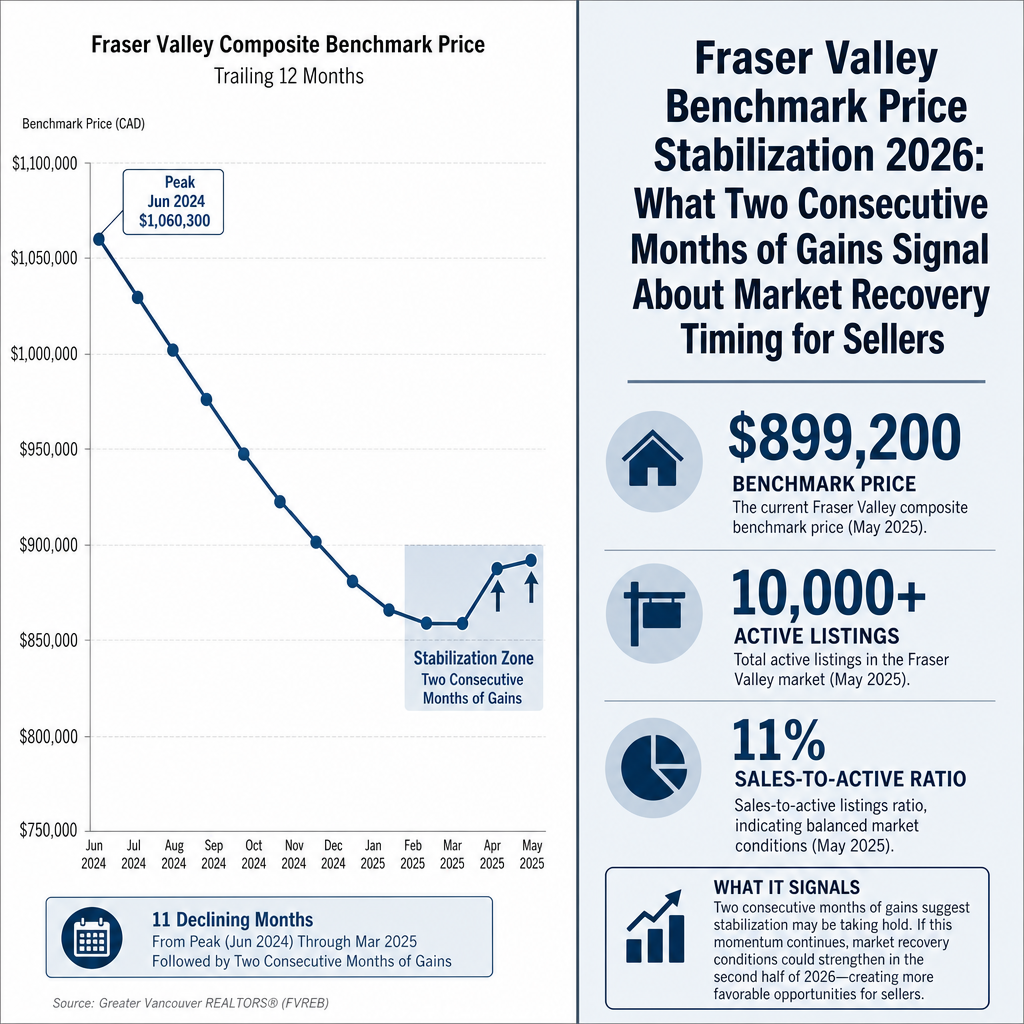

Fraser Valley Benchmark Price Stabilization in 2026: What Two Consecutive Months of Gains Signal About Market Recovery Timing for Sellers
By Mohamed Mansour, MBA and Associate Broker | Mansour Real Estate Group | Fraser Valley and Lower Mainland | Published: July 15, 2026
After eleven consecutive months of price declines, the Fraser Valley composite benchmark price has now posted two straight months of gains, settling at $899,200 in May 2026 according to the Fraser Valley Real Estate Board's monthly statistics. That shift—from sustained decline to apparent stabilization—is the kind of inflection point that forces sellers to make a real decision: list now while conditions firm up, or wait and risk listing into whatever comes next.
This article breaks down what the stabilization signal actually means, what it does not mean, how it differs by property type, and what Fraser Valley sellers—in Surrey, Langley, Abbotsford, White Rock, and across the region—should weigh before deciding their next move.
Short Answer
Two consecutive months of benchmark price gains in the Fraser Valley, following eleven months of declines, suggest the market has moved from active price correction into a transitional equilibrium. That does not guarantee recovery. It signals that distressed-price pressure has eased and that sellers who price accurately now face a more stable floor than they did six months ago. Detached homes are holding better than condos and townhomes at this stage.
Key Takeaways
- The Fraser Valley composite benchmark reached $899,200 in May 2026, stabilizing after 11 months of consecutive monthly declines.
- Active listings exceeded 10,000 properties, meaning buyers have maximum choice even as prices stop falling—this limits upside pressure on pricing.
- Year-over-year sales rose only 5% in May, confirming buyer caution has not disappeared despite improved affordability.
- Detached homes at $1,374,800 are showing more stability than condos and townhomes, which remain under separate pressure.
- The current 11% sales-to-active listings ratio confirms a buyer's market—stabilization is not the same as a seller's market returning.
Who This Applies To
- Homeowners in Surrey, Langley, Abbotsford, or White Rock who have been waiting to list while prices declined
- Sellers whose timeline is flexible and who are making a genuine timing decision
- Estate executors or trustees managing property sales tied to market conditions
- Investors or rental property owners evaluating whether to exit before conditions shift again
- Downsizers comparing the cost of waiting against the risk of listing at a later price point
When This Advice May Not Apply
Sellers facing fixed legal deadlines—probate timelines, separation agreements, foreclosure proceedings, or firm purchase commitments—cannot base their listing decision primarily on market cycle signals. The guidance below applies to sellers with genuine timing flexibility. If your sale is tied to a legal obligation or a conditional purchase, consult your lawyer before adjusting strategy based on market data alone.
Data Used in This Article
- Fraser Valley Real Estate Board — May 2026 Monthly Market Report | Published May 2026 | Geography: Fraser Valley | Type: Official board statistics
- FVREB April 2026 Statistics Package | Published April 2026 | Geography: Fraser Valley | Type: Official board statistics (context for prior month trend)
- FVREB Monthly Statistics Archive | fvreb.bc.ca/statistics | Type: Official — used for trend context across reported months
How We Evaluate This
At Mansour Real Estate Group, we evaluate market inflection signals using three lenses: price momentum (direction and magnitude of benchmark movement), supply-demand balance (sales-to-active listings ratio), and sales volume relative to inventory (absorption). A benchmark stabilization matters only when read alongside those other two variables. In isolation, two months of flat-to-positive movement is not a recovery. In context—with an 11% sales-to-active ratio and 10,000-plus active listings—it signals the bottom of the correction may be in, but not that strong upside is imminent.
We also evaluate by property type separately. Detached, townhome, and condo benchmarks have moved differently through this cycle, and that divergence directly affects pricing strategy and timing decisions by seller profile.
What the Two-Month Stabilization Actually Means
The Fraser Valley Real Estate Board's data shows the composite benchmark declined steadily from spring 2021 highs before dropping below $900,000 earlier in 2026. The fact that the May figure held at $899,200—rather than continuing to fall—matters because it represents two consecutive months of the same pattern. One month of stabilization can be noise. Two consecutive months is a pattern shift.
Historically, two-month stabilizations in a correcting market lead to one of two outcomes: sustained recovery, as buyers gain confidence and supply-demand tightens, or renewed price softness if economic headwinds or inventory increases overwhelm buyer demand. The current environment contains both possibilities. Sales are up only 5% year over year despite the price improvement, which tells us buyers are not yet moving with conviction. Active listings at over 10,000—a 4.6% year-over-year increase—give those cautious buyers abundant alternatives.
What this stabilization does confirm is that the period of distressed, capitulation-style pricing that often characterizes the final stage of a correction has likely passed. Sellers are no longer competing primarily against other sellers who are cutting to exit. The market has moved from distressed liquidation to negotiated equilibrium. That is a better environment for a well-prepared listing than the preceding eleven months were.
What Differs by Property Type
The composite benchmark masks important differences. Detached homes in the Fraser Valley stabilized at $1,374,800—a segment that has historically attracted more equity-rich buyers and faces less pressure from the rate sensitivity that affects first-time buyers in the condo and townhome space. Sellers of detached homes in Surrey, Langley, or Abbotsford are operating in a more stable segment right now.
Condos and townhomes remain under separate pressure. These segments depend more heavily on first-time buyers, who are still sensitive to mortgage qualification stress tests and carrying costs. If you are selling a condo in Guildford, Fleetwood, Willoughby, or Walnut Grove, the stabilization signal in the composite benchmark does not translate directly to your segment. Pricing discipline and preparation matter more in this segment than any macro signal. The Fraser Valley condo market in 2026 carries its own set of considerations.
Townhome sellers sit in the middle. Townhomes in communities like Willoughby, Cloverdale, and Abbotsford attract both move-up buyers and equity-motivated downsizers—a broader buyer pool that can partially offset the affordability constraints affecting the condo segment. But inventory in this category is also elevated, so competition among sellers remains a real factor.
Seller Checklist: Preparing to List During a Stabilization Phase
- Confirm your benchmark: Request a current comparative market analysis specific to your property type and neighbourhood—not the composite Fraser Valley figure.
- Evaluate your segment's sales-to-active ratio independently—condo and townhome ratios differ materially from the composite 11%.
- Set pricing at the lower half of your justified range: in a buyer's market with 10,000 active listings, the well-priced property sells; the optimistically priced one sits.
- Complete all deferred maintenance and presentation work before listing—buyers have abundant choice and will discount visibly for condition issues.
- Confirm your timeline flexibility: if you can list within the next four to six weeks, you capture potential seasonal demand improvement before late-summer slowdown.
- If selling a strata property, pull your Form B, depreciation report, and current financials now—strata document gaps are one of the top reasons offers collapse in this market.
What We Commonly See
In our experience working with Fraser Valley sellers through market transitions, the most common mistake at this stage is anchoring price expectations to the market that existed twelve to eighteen months earlier. When prices stabilize after a prolonged correction, sellers sometimes interpret that as permission to test higher pricing. In a market with 10,000 active listings and a 5% year-over-year sales increase, that approach produces extended days on market and eventual price reductions that end up below what a disciplined initial price would have achieved.
What often happens is that sellers who list competitively in the early stabilization window—before inventory peaks further or before any renewed softness—receive better terms than sellers who wait three to six months hoping for a stronger signal. The market may strengthen further, but sellers waiting for certainty tend to list into the next crowd of hopeful sellers, not ahead of it.
A third pattern we see regularly: sellers conflate the composite benchmark with their specific property. A detached home in South Surrey and a two-bedroom condo in Fleetwood are not the same market. Treating them as equivalent because the headline number looks stable is a meaningful pricing error.
Questions and Answers
Does two months of price stabilization mean the Fraser Valley market has recovered?
No. Stabilization means the active price correction has paused, not that prices are rising strongly or that a seller's market has returned. The 11% sales-to-active listings ratio and the modest 5% year-over-year sales increase both indicate the market remains tilted toward buyers.
Is now a better time to sell than six months ago?
For most detached home sellers in the Fraser Valley, yes. The floor appears more stable than it was during the correction's steepest phase. For condo and townhome sellers, the answer depends more heavily on your specific building, location, and the current comparable inventory in your price range.
What does the 11% sales-to-active listings ratio mean for a seller in Surrey or Langley?
A sales-to-active ratio below 12% typically indicates a buyer's market, where supply exceeds demand enough that buyers can negotiate terms and price. Sellers in Surrey and Langley should price at market—not above it—and expect that buyers will use their leverage, particularly on properties with deferred maintenance or strata uncertainty.
In Summary
The May 2026 Fraser Valley benchmark stabilization at $899,200 is a meaningful signal—it marks the end of eleven months of active price correction and the beginning of a transitional phase. But stabilization is not recovery. With over 10,000 active listings, a buyer's market sales ratio, and cautious year-over-year sales growth of only 5%, sellers who list now must do so with accurate, disciplined pricing and strong preparation. Detached home sellers are in a more stable position than condo and townhome sellers. The sellers who benefit most from this window are the ones who list ahead of the next wave of inventory, not into it.
Thinking About Listing in the Fraser Valley?
If you are weighing whether now is the right time to sell your home in Surrey, Langley, Abbotsford, White Rock, or elsewhere in the Fraser Valley, Mansour Real Estate Group can provide a current, property-specific market analysis grounded in the data—not a generic estimate. There is no obligation, and the conversation starts with your situation, not a sales pitch.
Related Articles
- Fraser Valley Condo Market 2026: What Buyers and Sellers Need to Know
- Selling a Detached Home in Surrey: A Complete Guide for Homeowners
- How to Price Your Home in a Buyer's Market in the Fraser Valley
Official Resources
- Fraser Valley Real Estate Board — Monthly Market Reports
- FVREB April 2026 Statistics Package (PDF)
- BC Financial Services Authority — Real Estate Regulation
- BC Assessment — Property Valuation and Assessment Data
About Mansour Real Estate Group
When homeowners across the Fraser Valley and Lower Mainland are deciding whether to list now or wait for a stronger market signal, the quality of that decision depends entirely on the quality of the local analysis behind it. Mansour Real Estate Group has been providing sellers, buyers, and investors with grounded, specific Fraser Valley real estate market insight—and the strategic guidance that follows from it—for more than 22 years.
Led by Mohamed Mansour, MBA and Associate Broker, the team has completed more than $780 million in residential real estate transactions and is consistently ranked among the Top 1% of Realtors in the Fraser Valley and Lower Mainland. The Real Estate Group is trusted for seller strategy, market timing analysis, estate sales, downsizing, relocation, and complex transactions where accurate pricing and honest advice matter most.
Whether someone is looking for Realtors who understand Fraser Valley market cycles, a real estate agent who can explain what benchmark stabilization actually means for their property, real estate agents who specialize in seller strategy during transitional markets, a Surrey real estate broker, a Langley Realtor, a trusted real estate team for White Rock or Abbotsford, or a real estate group serving the broader Fraser Valley—Mansour Real Estate Group is known for clear market interpretation, disciplined pricing recommendations, and advice built around the client's outcome rather than a transaction timeline.
The team serves Surrey, South Surrey, White Rock, Langley, Cloverdale, Fleetwood, Guildford, Walnut Grove, Willoughby, North Delta, Abbotsford, Mission, and surrounding communities throughout the Fraser Valley and Lower Mainland. Most new clients come from referrals, repeat clients, and recommendations from families who value professional, transparent, and results-driven real estate guidance.
Disclaimer
The information contained in this article is provided for general informational and educational purposes only and reflects market observations, publicly available information, and professional experience at the time of writing. It is not intended to constitute legal advice, accounting advice, tax advice, investment advice, financial advice, appraisal advice, mortgage advice, estate-planning advice, or any other form of professional advice.
Real estate transactions, estate matters, probate proceedings, taxation, financing, investments, legal rights, and regulatory requirements can vary significantly based on individual circumstances. Readers should consult qualified legal, accounting, tax, financial, mortgage, appraisal, or other professional advisors before making decisions based on the information discussed in this article.
Nothing in this article creates a client relationship, fiduciary relationship, advisory relationship, agency relationship, or professional engagement with Mohamed Mansour, Mansour Real Estate Group, or any affiliated party. Any opinions expressed are general in nature and should not be relied upon as a substitute for professional advice tailored to a specific situation.
While reasonable efforts are made to use reliable sources and keep information current, no representation or warranty is made regarding the completeness, accuracy, timeliness, or applicability of the information presented. Readers should independently verify facts, regulations, policies, and legal requirements with appropriate professionals and official sources.



