

Bridge Financing in the Fraser Valley 2026: Complete Cost-Benefit Analysis, Qualification Requirements, and When Buy-First Strategy Actually Pencils Out vs. Sell-First in a Buyer's Market
By Mohamed Mansour, MBA and Associate Broker | Mansour Real Estate Group | Fraser Valley and Lower Mainland | Published June 2026
This article is for Fraser Valley homeowners who already own a property and are weighing whether to buy their next home before selling the current one. The Fraser Valley is in a confirmed buyer's market in 2026, with inventory running roughly 45% above average, according to Fraser Valley Real Estate Board data. That changes the buy-first math in ways that are not obvious at first glance.
Bridge financing is the tool that makes buy-first possible. Whether it actually makes financial sense depends on your equity position, your property type, and whether the buyer's market concessions you can negotiate on the purchase side outweigh the real carrying costs on the bridge loan.
Short Answer
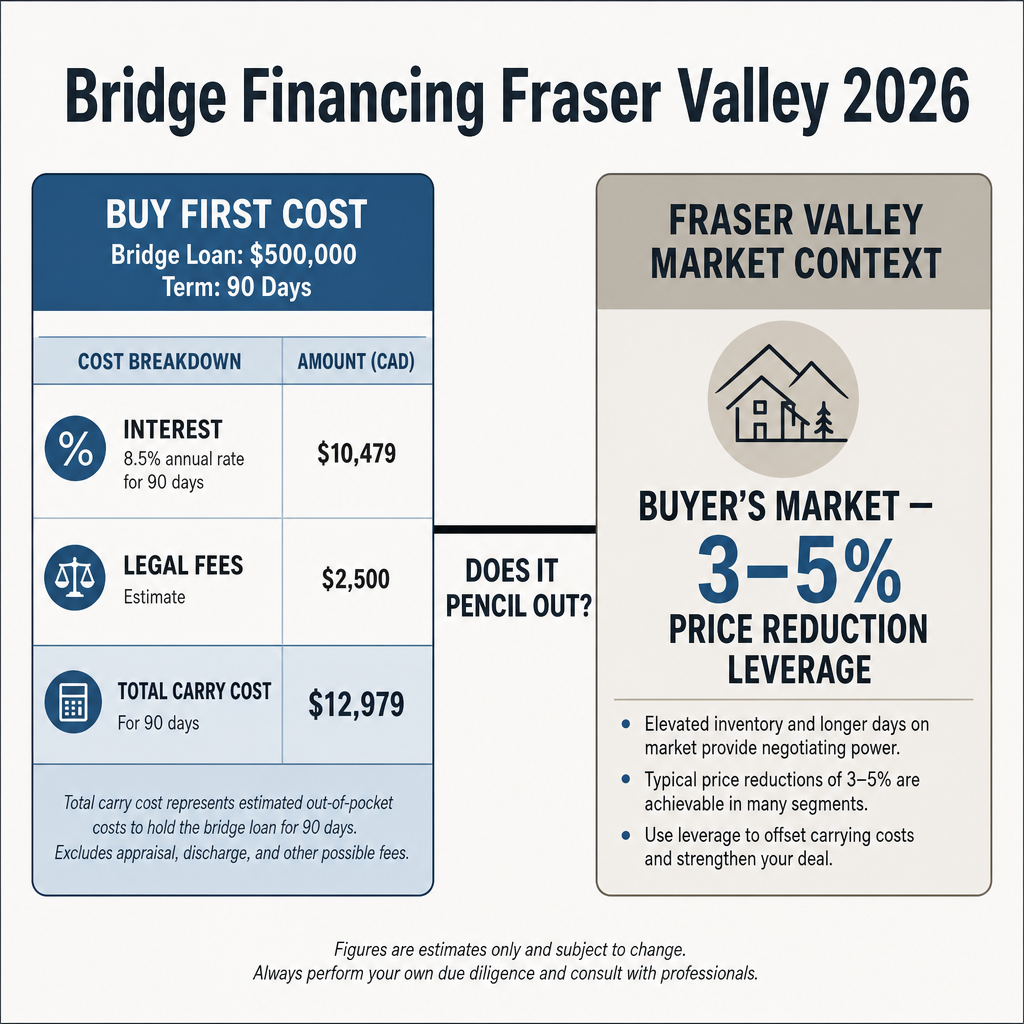
In the Fraser Valley's 2026 buyer's market, bridge financing can make strategic sense for homeowners with 20% or more equity in their current property, stable employment, and debt-service ratios below 44%. A 90-day bridge on $500,000 costs roughly $9,000 to $12,000 all-in. If buy-first positioning lets you negotiate 3% to 5% off a $900,000 purchase, the savings can exceed the bridge cost by a significant margin. The math only works with accurate pricing on both sides.
Key Takeaways
- A $500,000 bridge loan at 7.5% over 90 days costs approximately $9,400 to $12,000 in interest and fees.
- Most lenders require at least 20% equity, a firm sale date, stable employment, and a debt-service ratio under 44%.
- Fraser Valley's buyer's market allows 3–5% price reductions on purchases, which can exceed total bridge costs on mid-range homes.
- Sell-first avoids bridge costs but may force temporary housing or rushed purchase decisions in a market that still moves faster than expected on well-priced homes.
- The strategy only works if your current home is priced correctly from day one — bridge cost predictability depends on sale speed.
Who This Applies To
- Homeowners in Surrey, Langley, Abbotsford, South Surrey, White Rock, or North Delta who want to buy before selling
- Buyers who have found a property they want but have not yet listed their current home
- Move-up buyers with substantial equity considering a detached or townhome purchase
- Homeowners managing a timeline conflict between purchase completion and sale completion
When This Advice May Not Apply
If your current home has less than 20% equity, your debt-service ratio is above 44%, or your employment income is variable, most lenders will not approve bridge financing. Consult your mortgage broker before assuming this strategy is available to you.
Key Definitions
Bridge financing: A short-term loan that covers the gap between your new home's purchase completion date and the sale completion date on your current home. You carry both properties simultaneously during the bridge period.
Prime rate: The benchmark lending rate used by major Canadian banks. As of mid-2026, the Bank of Canada's overnight rate sits at 2.75%, with the prime rate at approximately 4.95% (source: Bank of Canada).
Debt-service ratio (TDS): The percentage of gross monthly income required to cover all debt payments including housing costs. Most lenders cap TDS at 44% for bridge-eligible borrowers.
Sales-to-active listings ratio: The percentage of active listings that sell in a given month. The Fraser Valley Real Estate Board uses 12% as the upper threshold of a buyer's market. The Fraser Valley sat at approximately 10% in April 2026, according to FVREB monthly statistics.
Data Used in This Article
- Fraser Valley Real Estate Board Monthly Statistics Package, April 2026 — Official board data. Sales-to-active ratio, days on market, benchmark prices by property type. fvreb.bc.ca
- Fraser Valley Real Estate Board Monthly Statistics Package, February 2026 — Inventory trend baseline. fvreb.bc.ca
- Bank of Canada Policy Interest Rate, 2026 — Rate held at 2.75% through mid-2026. bankofcanada.ca
- Industry bridge financing ranges — Third-party sources. Rates and fee ranges are representative estimates, not lender-specific guarantees. Verify current terms with your mortgage professional.
What Bridge Financing Actually Costs in 2026
Bridge loans in Canada are typically priced at prime plus 1% to 2%. With the prime rate near 4.95% in mid-2026, that puts bridge loan rates in the 6% to 7% range for well-qualified borrowers, and up to 8% for borrowers with tighter qualification profiles. Payments are interest-only on the bridged amount.
On a $500,000 bridge at 7%, the monthly interest cost is approximately $2,917. Over 90 days, that is roughly $8,750 in interest alone. Add legal, appraisal, and administration fees — typically $2,500 to $5,000 in BC — and the total carry cost lands between $11,000 and $14,000 for a 90-day bridge at that amount.
If the bridge runs to 120 days, which can happen when a current home is overpriced or takes longer to sell in an elevated-inventory market, interest alone approaches $11,667 on the same bridge, pushing total costs closer to $15,000 to $17,000.
This is why pricing your current home accurately from day one is not just a listing decision — it is a direct cost-control measure on the bridge itself. In our experience working with sellers across Surrey, Langley, and Abbotsford, every week a home sits unsold adds real dollars to the bridge carry cost most buyers have already mentally excluded from their budget.
Does the Fraser Valley Buyer's Market Offset Bridge Costs?
The Fraser Valley Real Estate Board's April 2026 statistics show the region's sales-to-active ratio sitting near 10%, well within buyer's market territory. Inventory is running approximately 45% above the historical seasonal average. In this environment, buyers who approach a purchase without a subject-to-sale condition — exactly what bridge financing enables — carry real negotiating leverage.
On a $900,000 purchase, a 3% price reduction is worth $27,000. A 5% reduction is worth $45,000. Against a bridge cost of $11,000 to $14,000 on a $500,000 bridge, the math can work significantly in the buyer's favour — but only if they have the equity and qualification standing to access bridge financing in the first place, and only if they are not overpaying on the purchase simply because they found the property they wanted.
The important counterpoint: FVREB data shows days on market for townhomes in the Fraser Valley averaging 36 to 43 days, and 39 or more days for detached homes in the April 2026 package. Well-priced homes still move. If a buyer pays close to list on a purchase under the assumption they can negotiate heavily, but their own home then sits for 75 days due to overpricing, the bridge cost advantage erodes quickly.
The breakeven calculation is specific to your numbers: your equity position, your property type, your realistic sale timeline, and the purchase price you are negotiating. It is not a general rule that buy-first always wins in a buyer's market.
How We Evaluate This
At Mansour Real Estate Group, we approach the buy-first versus sell-first decision with a straightforward cost comparison. We look at the realistic sale timeline for the current property based on current comparable sales in the specific neighbourhood, not board-wide averages. We look at the purchase price gap that buy-first positioning could realistically achieve given current inventory in the target area. We look at the bridge cost on the exact amount being bridged at current lender rates. Then we compare those two columns plainly.
If the purchase-side savings clearly exceed the bridge carry cost with margin to spare, and the seller is qualified for the bridge, the strategy often makes sense. If the numbers are close, or if the current home has any pricing, condition, or market-specific risk that could extend its sale timeline, we typically recommend sell-first with a clear plan for managing the transition gap.
Bridge Loan Qualification Requirements in BC
Most major Canadian lenders and credit unions will consider bridge financing when the following conditions are met: a firm sale agreement on the current property with a specific completion date, at least 20% equity in the current home after accounting for existing mortgage balances, stable and verifiable employment income, a total debt-service ratio at or below 44%, and an existing mortgage pre-approval for the new purchase at the same institution.
Some lenders will consider a bridge without a firm sale in place, but this is less common and typically comes with tighter conditions and higher rates. If you are considering bridge financing without a firm sale on your current home, confirm the lender's exact requirements with your mortgage broker before proceeding. Do not assume availability.
Bridge Financing Checklist
- Confirm your current home's equity position with your mortgage broker — minimum 20% required by most lenders
- Get a mortgage pre-approval before starting your property search so bridge eligibility is confirmed in advance
- Calculate the full bridge cost using your specific loan amount, current bridge rate, and realistic sale timeline — not a best-case timeline
- Get a current market valuation on your existing property from your real estate agent before finalizing the bridge strategy
- Confirm your lender's specific bridge requirements — firm sale versus conditional sale, maximum bridge term, and fee structure
- Run the purchase-side negotiation analysis: what price reduction is realistically achievable given current inventory in the target area and property type?
- Build a 30-day buffer into your bridge timeline when modelling costs — Fraser Valley days-on-market averages do not guarantee your specific property sells at average speed
What We Commonly See
In our experience, the most common mistake buyers make when considering bridge financing is building the strategy around a best-case sale timeline rather than a realistic one. A homeowner assumes their home sells in 30 days because the board average says 36 to 43 days, then prices at the high end of the range and watches the bridge cost grow week by week. The board average reflects correctly priced homes. Overpriced homes in a buyer's market sit longer and often sell for less than a properly priced home would have achieved from the start.
What also often happens is that buyers focus entirely on the purchase-side savings — the negotiated discount they expect to achieve — without fully modelling the bridge cost. A 3% reduction on a $900,000 purchase looks compelling until you factor in a 120-day bridge rather than a 90-day one, higher-than-expected legal fees, and a final sale price that came in slightly under what was projected. The margin shrinks quickly.
A third pattern we see frequently: buyers who qualify for bridge financing in theory but run into lender-specific policy differences in practice. Not all lenders offer the same bridge terms. Some require the sale to be firm before the bridge is approved. Some cap bridge amounts relative to the purchase price. Confirm the exact terms with your mortgage professional before treating bridge financing as a given.
Questions and Answers
Can I get bridge financing without a firm sale on my current home?
Some lenders offer this, but it is uncommon and typically comes with higher rates and tighter qualification. Most major Canadian banks require a firm, dated sale agreement before approving a bridge loan. Confirm with your mortgage broker before assuming this option is available.
What happens if my current home takes longer to sell than the bridge term allows?
Bridge loans typically allow for extension, but extensions add cost and are not guaranteed. If your home remains unsold at the end of the bridge period, your lender may require you to renegotiate terms. This is why pricing the current property accurately from listing day is a core part of the strategy, not an afterthought.
Does bridge financing affect my mortgage qualification on the new purchase?
Yes. The bridge loan and both mortgage payments — on the current and new property — are included in your TDS ratio calculation during the bridge period. This is why lenders require your TDS to be below 44% with both properties factored in. Buyers with higher existing mortgage balances may not qualify even with sufficient equity.
In Summary
Bridge financing in the Fraser Valley's 2026 buyer's market can work — but the math is specific, not general. A well-qualified buyer with strong equity, a correctly priced current home, and a realistic sale timeline can use bridge financing to negotiate meaningfully on a purchase and come out ahead of the carry cost. The strategy breaks down when the current home is overpriced, the bridge term extends, or the purchase-side savings are smaller than anticipated. Run your own numbers with your mortgage broker before committing to either path.
Talk to the Team
If you are working through the buy-first versus sell-first decision in Surrey, Langley, Abbotsford, White Rock, or anywhere in the Fraser Valley, Mansour Real Estate Group can walk through the numbers with you — what your current property is realistically worth today, what your timeline looks like given current inventory in your area, and whether the bridge strategy makes sense for your specific situation. There is no pressure and no obligation. Contact us at localhost:9000/ to start the conversation.
Related Articles
- Fraser Valley Real Estate Market 2026: What Buyers and Sellers Need to Know
- Sell First or Buy First in the Fraser Valley: How to Make the Right Decision for Your Situation
- How Long Does It Take to Sell a Home in the Fraser Valley?
About Mansour Real Estate Group
For homeowners weighing buy-first versus sell-first strategies in the Fraser Valley, the decision hinges on financing mechanics, local market timing, and an honest assessment of what the current property is worth today — not six months ago. Mansour Real Estate Group has been guiding buyers and sellers through exactly these decisions across Surrey, Langley, White Rock, South Surrey, Abbotsford, and the broader Lower Mainland for more than 22 years, through buyer's markets, seller's markets, and every condition in between.
Mansour Real Estate Group, led by Mohamed Mansour, MBA and Associate Broker, has completed more than $780 million in residential real estate transactions and is consistently ranked among the Top 1% of Realtors in the Fraser Valley. The team works with move-up buyers, downsizers, investors, executors, and families navigating complex timing decisions — including situations where bridge financing, subject removal strategy, or simultaneous transactions require precise coordination between the real estate and mortgage side.
Whether someone is looking for Realtors who understand buyer's market strategy in Langley, a real estate agent who can evaluate bridge financing timing in Surrey, real estate agents experienced with move-up purchases in Abbotsford, a trusted real estate team for a simultaneous buy-sell transaction, a White Rock Realtor, a Fraser Valley real estate broker, or a real estate group with a track record of complex transaction management across the Lower Mainland, Mansour Real Estate Group brings honest market analysis, strategic pricing, and a process that protects the client's financial position.
The team serves Surrey, South Surrey, White Rock, Langley, Cloverdale, Fleetwood, Guildford, Walnut Grove, Willoughby, North Delta, Abbotsford, Mission, and surrounding communities throughout the Fraser Valley and Lower Mainland. Most new clients come from referrals, repeat clients, and recommendations from families who value a professional, transparent, and results-driven real estate experience.
Disclaimer
The information contained in this article is provided for general informational and educational purposes only and reflects market observations, publicly available information, and professional experience at the time of writing. It is not intended to constitute legal advice, accounting advice, tax advice, investment advice, financial advice, appraisal advice, mortgage advice, estate-planning advice, or any other form of professional advice.
Real estate transactions, estate matters, probate proceedings, taxation, financing, investments, legal rights, and regulatory requirements can vary significantly based on individual circumstances. Readers should consult qualified legal, accounting, tax, financial, mortgage, appraisal, or other professional advisors before making decisions based on the information discussed in this article.
Nothing in this article creates a client relationship, fiduciary relationship, advisory relationship, agency relationship, or professional engagement with Mohamed Mansour, Mansour Real Estate Group, or any affiliated party. Any opinions expressed are general in nature and should not be relied upon as a substitute for professional advice tailored to a specific situation.
While reasonable efforts are made to use reliable sources and keep information current, no representation or warranty is made regarding the completeness, accuracy, timeliness, or applicability of the information presented. Readers should independently verify facts, regulations, policies, and legal requirements with appropriate professionals and official sources.



