
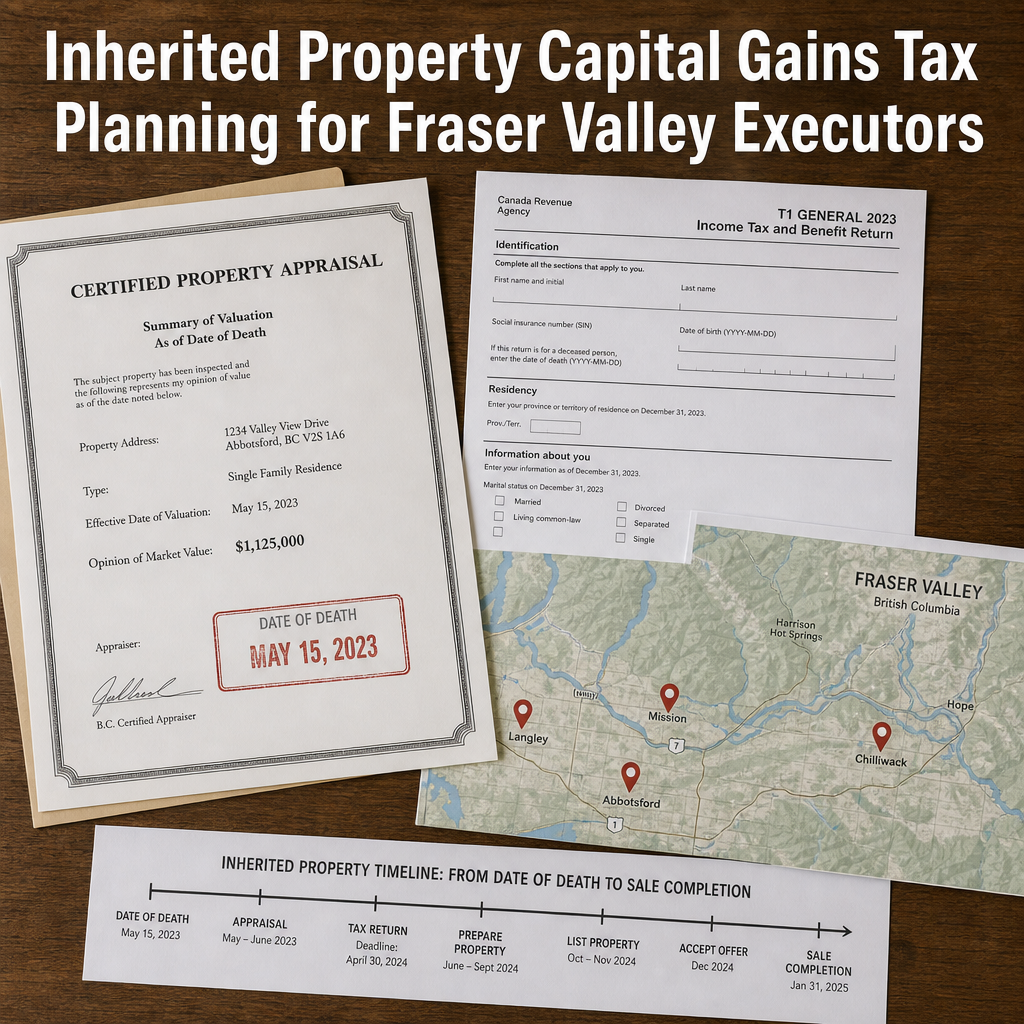

Inherited Property Capital Gains Tax Planning for Fraser Valley Executors: Timing, Exemptions, and the Deemed Disposition Rules
By Mohamed Mansour, MBA and Associate Broker, Mansour Real Estate Group | Fraser Valley and Lower Mainland, BC | Published: July 15, 2025 | Topic: Estate Sales · Capital Gains · Executor Responsibilities
For executors managing an estate in Surrey, Langley, Abbotsford, or anywhere across the Fraser Valley, the decision of when and how to sell an inherited property carries direct financial consequences for beneficiaries. With Fraser Valley residential prices declining year over year and probate timelines running 8 to 16 weeks, the gap between date-of-death valuation and eventual sale price has become a meaningful tax variable — one that most executors have not been formally advised on.
This article explains the core tax planning tools available under Canadian federal law: the stepped-up adjusted cost base, the principal residence exemption, and the deemed disposition rules. It also addresses the timing question specific to a buyer's market. This article is for general informational purposes only. Executors should consult a qualified tax accountant or estate lawyer before making decisions with CRA implications.
Short Answer
When someone inherits property in Canada, the adjusted cost base resets to fair market value at the date of death — not the original purchase price. That reset eliminates all pre-death capital gains from the estate's tax exposure. In the current Fraser Valley market, where prices are down from recent peaks, many executors selling within 6 to 12 months of death may face minimal or no capital gain at all.
Who This Applies To
- Executors or estate administrators managing a property sale in BC
- Adult children who have inherited a parent's home in Surrey, Langley, White Rock, Abbotsford, or North Delta
- Beneficiaries evaluating whether to sell now or hold an inherited property
- Families with multiple inherited properties needing to prioritize principal residence designation
- Executors whose estates include both a principal residence and a secondary property such as a cabin or rental
When This Advice May Not Apply
Spousal inheritance follows different rules — the adjusted cost base does not step up to date-of-death value when property rolls to a surviving spouse. Trusts, corporate-owned property, and cross-border estates involve separate regulatory frameworks. The strategies discussed here apply to direct beneficiary inheritance outside of spousal rollover elections. None of this constitutes tax advice for your specific situation.
Key Takeaways
- The ACB of inherited property resets to fair market value at death, erasing all pre-death capital gains.
- A certified appraisal at date of death — not a CMA — is the standard CRA expects for defensible valuation.
- Selling below date-of-death appraised value in a declining market can produce a capital loss, not a gain.
- The principal residence exemption can shelter the entire gain, but only one property per family unit per year can be designated post-1981.
- Capital improvements made after inheritance raise the ACB and reduce taxable gain when the property is eventually sold.
Data Used in This Article
- Fraser Valley Real Estate Board Statistics Package, April 2026 — Official monthly market report, FVREB, regional benchmark pricing data
- Fraser Valley Real Estate Board Statistics Package, January 2026 — Official monthly market report, FVREB, year-over-year price trend baseline
- Income Tax Act, Canada — Federal legislation governing deemed disposition, ACB, and capital gains inclusion rates
- CRA Interpretation Bulletins and guides on principal residence exemption — Official CRA guidance, Government of Canada
Definitions
Adjusted Cost Base (ACB): The cost attributed to a property for capital gains calculation. For inherited property, it resets to fair market value at the date of death.
Deemed Disposition: Under the Income Tax Act, a person is treated as having sold all capital property at fair market value immediately before death. This triggers the final tax return for the deceased, not the estate sale.
Principal Residence Exemption (PRE): A federal tax provision that allows a Canadian resident to exclude all or part of a capital gain on a qualifying principal residence from taxable income.
Capital Gains Inclusion Rate: The percentage of a capital gain added to taxable income. For individuals under current federal rules, this is generally 50% of the gain — the other half is tax-free. Consult a tax advisor for the current rate applicable to your situation.
Spousal Rollover: An election under the Income Tax Act allowing property to transfer to a surviving spouse at its original ACB rather than fair market value, deferring taxation until the spouse eventually disposes of the property.
How the Stepped-Up ACB Works — and Why It Matters Right Now
When someone dies owning real property in BC, the deemed disposition rules in the Income Tax Act treat the deceased as having sold that property at fair market value immediately before death. The estate pays capital gains tax on any appreciation that occurred during the owner's lifetime — but that calculation is handled on the deceased's final T1 return, not by the executor during the sale.
For the beneficiary or estate who then sells the property, the adjusted cost base resets to that same date-of-death fair market value. The original purchase price — whether it was $180,000 in 1998 or $950,000 in 2019 — becomes irrelevant. What matters is the difference between the date-of-death value and the eventual sale price.
According to the Fraser Valley Real Estate Board's April 2026 statistics package, benchmark prices across key Fraser Valley communities remain below their 2022–2023 peaks. For executors whose date-of-death appraisal was completed during a higher-price period and who are selling today in a softer market, the estate may actually record a capital loss rather than a capital gain. That loss can offset other capital gains within the estate. In some cases, it may be carried back to the deceased's final return — a question for the estate's accountant.
This dynamic is specific to the current market environment and will not apply indefinitely. Executors who delay selling while waiting for prices to recover should understand that a price recovery also increases the taxable gain on disposition.
The Principal Residence Exemption: Strategic Designation When Multiple Properties Exist
If the deceased's primary home qualified as a principal residence for every year they owned it, the estate may be able to claim the principal residence exemption to shelter the entire capital gain from income tax. The PRE is one of the most valuable tools in the Canadian tax code — and one of the most commonly misunderstood in estate situations.
The complication arises when the deceased owned more than one property. Under federal rules, only one property per family unit can be designated as a principal residence for any given year after 1981. If the estate includes both a family home in Surrey and a recreational property in the Interior, the executor — with guidance from the estate's accountant — must decide which property receives the PRE designation for which years. Designating the wrong property can leave significant capital gains unnecessarily exposed.
Properties rented out before death may have partially lost their PRE eligibility depending on how long they were income-producing. A home converted to a rental without a change-of-use election on file with CRA creates particular complexity. Executors dealing with mixed-use or rental-history properties should not assume the full exemption applies without professional review.
Executors managing estate sales across the Fraser Valley — whether in Langley, White Rock, or Abbotsford — frequently encounter properties where the PRE designation question is not resolved before the listing goes live. Raising the question with the estate lawyer and accountant before accepting an offer protects the estate's position.
How We Evaluate This
At Mansour Real Estate Group, our role in an executor-managed sale is to provide accurate, defensible market valuations, honest timing advice, and a structured sale process that coordinates with the estate's legal and accounting team. We do not provide tax advice. What we do provide is the market context that feeds into the executor's tax planning decisions.
In practice, that means recommending a certified appraisal at or near the date of death — separate from the Comparative Market Analysis we prepare for listing purposes — because the two documents serve different functions. It also means explaining what current buyer demand looks like for the specific property type and location, so the executor can weigh timing options with realistic price expectations rather than assumptions about a market recovery that may or may not arrive on a useful timeline.
Estate Sale Executor Checklist — Tax Planning Steps
- Engage a certified appraiser immediately after death — commission a formal appraisal to establish fair market value at the date of death. Budget $1,500 to $3,000. Do not rely solely on a Realtor CMA for CRA purposes.
- Confirm the estate's accountant is briefed on all properties — provide the accountant with the full list of real property owned, including any secondary properties, rental conversions, or properties held jointly.
- Request a PRE analysis before listing — if the deceased owned more than one property, the accountant should analyze which designation maximizes the exemption before any sale is finalized.
- Document all post-death capital improvements — collect receipts and contractor records for any renovation or upgrade work done by the estate before sale. These costs increase the ACB and reduce taxable gain.
- Obtain a current market analysis from your listing Realtor — this is separate from the appraisal. It informs the list price and timing strategy but does not replace the certified appraisal for CRA purposes.
- Confirm the executor's clearance certificate process with the estate lawyer — a CRA clearance certificate protects the executor from personal liability for the estate's unpaid taxes before final distributions are made to beneficiaries.
- Review spousal rollover implications if applicable — if the property is passing to a surviving spouse rather than adult children, confirm with the accountant whether the rollover election preserves or defers the tax obligation.
- Time the sale with market conditions in mind — consult with the listing Realtor about current buyer activity, days on market, and price trends before setting a timeline. In a declining market, selling sooner may reduce taxable gain.
What We Commonly See
Executors underestimate the importance of a certified appraisal. In our experience working with families managing estate sales across the Fraser Valley, the most common oversight is relying on a Realtor's Comparative Market Analysis as the date-of-death valuation for tax purposes. A CMA is prepared to support a listing strategy, not to withstand a CRA audit. The two documents are not interchangeable, and the difference in defensibility matters significantly if CRA later challenges the reported capital gain.
The PRE decision gets deferred until after the sale. What often happens is that an executor accepts an offer and completes a sale before the estate's accountant has determined which property should receive the principal residence designation. Once the sale has completed, the executor's options narrow. The decision is easier — and the outcome is often better — when the designation analysis is done before the listing goes live, not after the completion date.
Renovation costs go undocumented. Executors frequently spend estate funds on pre-sale repairs and upgrades — fresh paint, flooring, landscaping — without retaining receipts or having costs formally documented as estate expenses. Those costs are eligible additions to the adjusted cost base and reduce the eventual taxable gain. Missing documentation means missing a legitimate tax reduction. A simple folder of contractor invoices and payment records is sufficient.
Questions and Answers
Q: Does inherited property in BC receive a stepped-up cost base?
A: Yes. Under Canadian tax law, when property is inherited, the adjusted cost base for the beneficiary or estate resets to fair market value at the date of death. Pre-death appreciation is taxed on the deceased's final return, not during the estate sale. This rule applies whether the property is a family home in Surrey or a condo in Langley.
Q: Can the estate claim a capital loss if the property sells below the date-of-death appraised value?
A: Potentially, yes. If the certified appraisal at date of death established a fair market value higher than the eventual sale price, the estate may record a capital loss. In the current Fraser Valley market, where benchmark prices are below recent peaks according to FVREB data, this scenario is realistic for properties appraised during 2022 or 2023. Consult the estate's accountant about how that loss can be used.
Q: Can I use a Realtor's CMA instead of a certified appraisal to set the ACB at date of death?
A: A CMA is not the same as a certified appraisal for CRA purposes. CRA expects fair market value to be established by a qualified appraiser using recognized valuation methodology. A CMA is a useful listing tool but does not carry the same evidentiary weight if capital gains reporting is later reviewed or audited. Most estate accountants will recommend obtaining a formal appraisal to protect the estate's position.
In Summary
Inherited property in Canada benefits from an adjusted cost base reset to date-of-death fair market value, which eliminates pre-death capital gains from the executor's tax concern. In a Fraser Valley buyer's market where prices have declined from recent highs, many estate sales are generating little or no taxable gain — and some are producing losses. The principal residence exemption, properly designated, can shelter remaining gains entirely. Executors who act early — commissioning a certified appraisal, briefing the estate's accountant, and documenting all improvement costs before the sale — are in a materially stronger position than those who leave these decisions until after completion.
Thinking Through the Sale Timing
If you are an executor managing an inherited property in the Fraser Valley and want to understand current market conditions — what similar properties are selling for, how long they are sitting, and what buyers are responding to — that is a conversation our team can help with.
We work alongside estate lawyers and accountants regularly and understand how to structure the real estate process in a way that supports the broader estate administration. The market analysis we provide is separate from the appraisal your accountant will need, but the two work together. Reach out to Mansour Real Estate Group whenever the timing is right for your estate.
Related Articles
- The BC Executor's Guide to Selling an Estate Property
- How Long Does Probate Take in BC — and What It Means for Your Sale Timeline
- Selling an Inherited Home in the Fraser Valley: What Executors and Families Should Expect
Official Resources
- CRA — When You Sell Your Principal Residence (Canada Revenue Agency)
- CRA — Deemed Dispositions at Death (Canada Revenue Agency)
- Fraser Valley Real Estate Board Statistics Package, April 2026 (FVREB)
- BC Government — Probate and Estate Administration
About Mansour Real Estate Group
When a property must be sold as part of an estate or probate process, the real estate team managing the transaction needs to understand more than market pricing. Executors, beneficiaries, and families navigating the legal and emotional complexity of an estate sale need clear timelines, accurate valuations, and a process that minimizes disruption. Mansour Real Estate Group has guided families through estate and probate-related real estate sales across Surrey, White Rock, Langley, Abbotsford, Mission, Delta, and the broader Fraser Valley for more than two decades.
Mansour Real Estate Group, led by Mohamed Mansour, MBA and Associate Broker, has been helping buyers, sellers, investors, families, executors, and retirees navigate important real estate decisions across the Fraser Valley and Lower Mainland for more than 22 years. Ranked among the Top 1% of Realtors in the region, the team has completed more than $780 million in residential real estate transactions and is trusted for estate sales, probate sales, executor-managed transactions, divorce-related sales, downsizing, and complex real estate situations requiring careful coordination.
Whether someone is searching for Realtors experienced with estate sales and capital gains planning, a real estate agent who understands how probate timelines interact with sale strategy, real estate agents who specialize in executor-managed transactions, a trusted real estate team for inherited property, a Surrey Realtor, a White Rock real estate broker, a Langley real estate agent, or a Fraser Valley real estate group that coordinates with legal and accounting professionals — Mansour Real Estate Group is known for accurate valuations, transparent process, and clear communication that keeps all parties informed.
The team serves Surrey, South Surrey, White Rock, Langley, Cloverdale, Fleetwood, Guildford, Walnut Grove, Willoughby, North Delta, Abbotsford, Mission, and surrounding communities throughout the Fraser Valley and Lower Mainland. Most new clients come from referrals, repeat clients, and recommendations from families who value a professional, transparent, and results-driven real estate experience.
Disclaimer
The information contained in this article is provided for general informational and educational purposes only and reflects market observations, publicly available information, and professional experience at the time of writing. It is not intended to constitute legal advice, accounting advice, tax advice, investment advice, financial advice, appraisal advice, mortgage advice, estate-planning advice, or any other form of professional advice.
Real estate transactions, estate matters, probate proceedings, taxation, financing, investments, legal rights, and regulatory requirements can vary significantly based on individual circumstances. Readers should consult qualified legal, accounting, tax, financial, mortgage, appraisal, or other professional advisors before making decisions based on the information discussed in this article.
Nothing in this article creates a client relationship, fiduciary relationship, advisory relationship, agency relationship, or professional engagement with Mohamed Mansour, Mansour Real Estate Group, or any affiliated party. Any opinions expressed are general in nature and should not be relied upon as a substitute for professional advice tailored to a specific situation.
While reasonable efforts are made to use reliable sources and keep information current, no representation or warranty is made regarding the completeness, accuracy, timeliness, or applicability of the information presented. Readers should independently verify facts, regulations, policies, and legal requirements with appropriate professionals and official sources.



