

Hidden Seller Costs Beyond Commission in the Fraser Valley 2026: Mortgage Discharge Penalties, Property Tax Adjustments, Title Insurance, and the True Net Proceeds You'll Actually Receive
By Mohamed Mansour, MBA and Associate Broker | Mansour Real Estate Group | Fraser Valley and Lower Mainland, BC | Published: July 15, 2026
Most sellers in Surrey, Langley, Abbotsford, and across the Fraser Valley focus on one number when they think about selling costs: commission. Commission matters — but in 2026, with inventory above 10,000 active listings and the market firmly favouring buyers, the gap between your sale price and your actual net proceeds is wider than most sellers expect. The costs that create that gap are the ones this article explains in full.
If you are considering a sale this year, the difference between a rough estimate and an accurate net proceeds calculation can easily be $15,000 to $30,000 or more. Understanding every line item before you list is the only way to make a sound decision.
Short Answer
Beyond commission, Fraser Valley sellers typically face mortgage discharge fees and IRD penalties ($0 to $12,000+), property tax pro-ration adjustments ($1,500 to $4,000), GST on commission (5% of the total commission amount), legal and notary disbursements ($1,250 to $1,500), and carrying costs during extended time on market. Together, these can reduce net proceeds by an additional 2 to 4 percent on top of commission.
Key Takeaways
- IRD penalties can reach $12,000 or more when breaking a fixed-rate mortgage early — always confirm with your lender before listing.
- GST of 5% applies to your total commission amount and is not included in the negotiated commission rate — it is a separate, additional cost.
- Property tax pro-ration depends on your exact closing date; a mid-year closing on a $750,000 home can shift $2,500 to $4,000 to the buyer or seller.
- Legal disbursements, title insurance, and mortgage discharge processing together add $1,250 to $1,500 in hard costs that sellers routinely underestimate.
- Every extra 30 days on market in today's buyer's market costs $1,500 to $3,000 in carrying costs — accurate pricing protects net proceeds as much as any cost reduction.
Who This Applies To
- Homeowners in Surrey, Langley, Abbotsford, White Rock, and across the Fraser Valley preparing to sell in 2025 or 2026
- Sellers with a fixed-rate mortgage who may face an IRD penalty if they break the mortgage before maturity
- Executors or family members managing an estate sale who need accurate net proceeds estimates for beneficiary distributions
- Divorcing couples calculating the equity each party will receive after a property sale
- Anyone comparing the cost of selling now versus waiting and wanting a complete picture before deciding
When This Advice May Not Apply
Sellers whose mortgage term ends within 90 days of their planned closing may avoid IRD penalties entirely. Sellers closing at year-end may face minimal property tax adjustments. Sellers with open mortgages typically pay only a three-month interest penalty rather than a full IRD calculation. In all cases, your lender, notary, and lawyer are the authoritative source for your specific numbers — this article provides the framework, not personalized calculations.
Data Used in This Article
- Fraser Valley Real Estate Board Statistics Package, February 2026 and April 2026 (official, FVREB)
- BC real estate commission structures and GST treatment — industry standard documentation (BCREA, third-party analysis)
- Mortgage discharge and IRD penalty methodology — based on standard chartered bank calculation frameworks published by Canadian lenders
- Legal and notary disbursement ranges — based on BC practitioner-published fee guides and closing cost summaries for BC residential transactions
Definitions
IRD (Interest Rate Differential): A mortgage prepayment penalty calculated as the difference between your current mortgage rate and the lender's posted rate for the remaining term. It compensates the lender for lost interest income when you break a fixed-rate mortgage early.
Property Tax Pro-ration: A closing adjustment where the buyer compensates the seller (or vice versa) for property taxes already paid or not yet paid, calculated from January 1 to the completion date.
GST on Commission: The federal Goods and Services Tax (5%) applied to your real estate commission. This is charged on top of the agreed commission rate and is remitted by the brokerage to the Canada Revenue Agency.
Mortgage Discharge Fee: A flat administrative fee charged by your lender ($300 on average) to remove the mortgage from title when you sell.
Title Insurance: A one-time premium paid at closing to protect against title defects, survey issues, or fraud. Sellers typically purchase a policy to cover the buyer as part of the transaction.
The Mortgage Discharge Penalty: The Largest Variable Cost Most Sellers Ignore
For sellers with a fixed-rate mortgage who are selling before their term ends, the IRD penalty is often the single largest unexpected cost in the transaction. The calculation compares your contracted mortgage rate to the lender's current posted rate for a term matching your remaining time — and the difference, applied to your outstanding balance over the months left, produces the penalty amount.
On a $600,000 mortgage balance with 18 months remaining and a rate differential of 1.5%, the IRD penalty can reach $13,500. On smaller balances or shorter remaining terms, it may be $2,000 to $5,000. On open mortgages, it drops to roughly three months' interest. The range — from near zero to $12,000 or more — is wide enough that it must be confirmed with your specific lender before you set a listing price or an acceptance deadline.
This matters especially in the current Fraser Valley market. According to the FVREB's April 2026 statistics package, the sales-to-active listings ratio across the Fraser Valley remained in the 8 to 11 percent range through the first quarter of 2026 — a buyer's market. Some sellers are not choosing to sell; they are selling because they must. For those sellers, understanding the IRD penalty before listing is the difference between a financially informed decision and an unexpected shortfall at closing.
GST on Commission, Property Tax Adjustments, and the Costs That Quietly Add Up
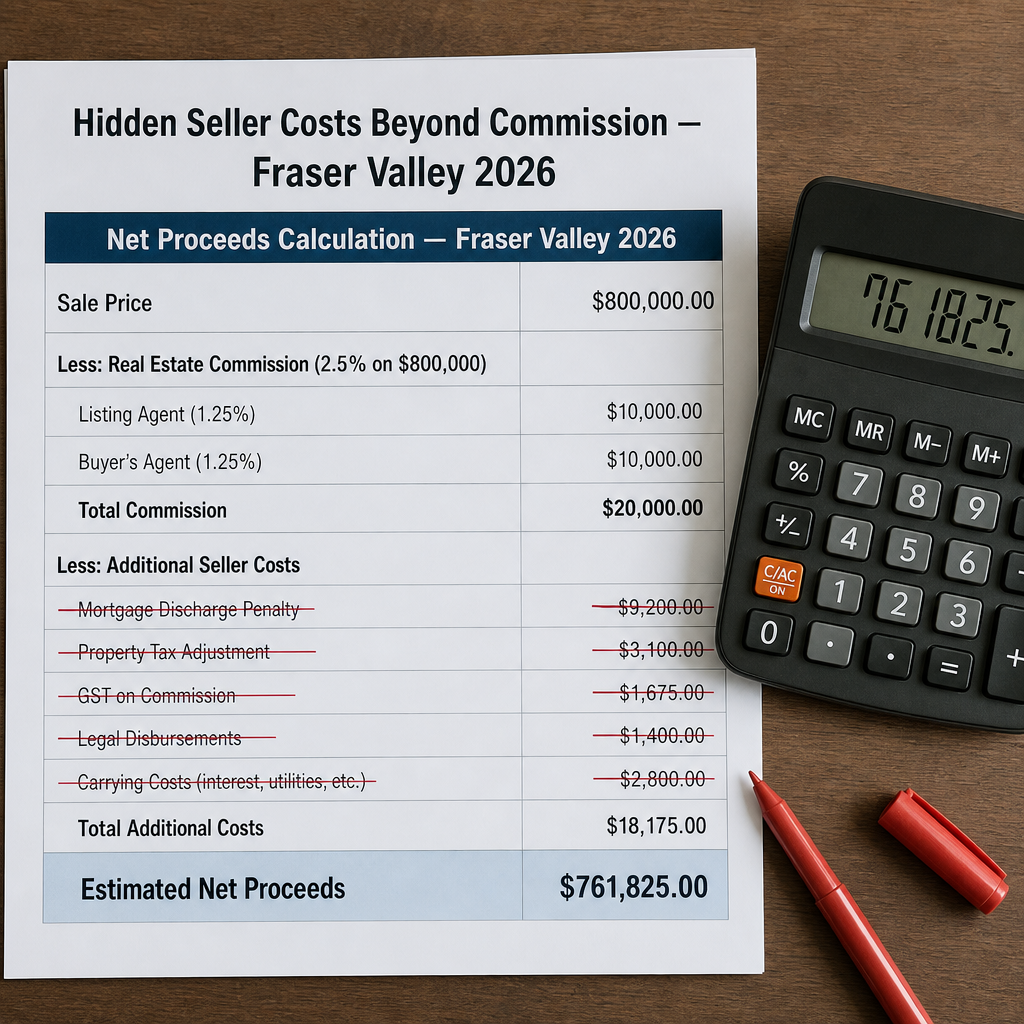
Commission is negotiated as a percentage of the sale price — but the 5% GST on that commission is not part of that negotiation. It is an additional cost. On a $800,000 sale with a total commission of $33,500, the GST alone adds $1,675 to the seller's closing costs. This line item does not appear in commission rate discussions and is frequently absent from early net proceeds estimates prepared informally.
Property tax pro-ration works differently. BC property taxes are assessed annually based on the January 1 value and are billed in the spring for the full year. When a sale closes, the notary calculates how much of the year has passed and adjusts the proceeds accordingly. If you have already paid the full year's taxes and close on September 15, the buyer owes you approximately three and a half months of taxes. If you close before you have paid and taxes are outstanding, the amount is deducted from your proceeds. On a Fraser Valley home assessed at $750,000 — near the current Fraser Valley median according to BC Assessment data — the annual property tax bill typically ranges from $5,000 to $7,000 depending on municipality. A mid-year closing moves $2,500 to $4,000 in either direction.
Legal and notary disbursements are a third layer. Your lawyer or notary charges a base fee for handling the transaction — typically $900 to $1,200 — but disbursements are separate. Title searches, land title registration fees, courier costs, and administrative charges add $700 to $900 on top. Title insurance for the buyer, if arranged through the seller's side of the transaction, adds another $200 to $400. Combined with the mortgage discharge fee of approximately $300, these hard costs total $1,250 to $1,500 before the notary's professional fee.
How We Evaluate This
At Mansour Real Estate Group, every seller consultation includes a net proceeds worksheet that accounts for commission, GST on commission, estimated mortgage discharge costs, legal fees and disbursements, property tax pro-ration (based on target closing month), and a carrying cost calculation that models what each additional 30 days on market costs the seller in mortgage interest, property taxes, utilities, and insurance. This is not a legal or accounting document — it is a planning tool that helps sellers make a fully informed decision about pricing strategy and timing before the listing goes live. When IRD penalties or complex mortgage structures are involved, we always recommend confirming the exact penalty figure with the lender directly before setting a firm listing price or acceptance deadline.
Carrying Costs: The Hidden Cost of Overpricing in a Buyer's Market
In a balanced or seller's market, an overpriced listing corrects itself within a few price reductions and still sells within a reasonable timeframe. In the current Fraser Valley buyer's market — where active listings have remained above 10,000 and the sales-to-active ratio has been below 12% through early 2026 according to FVREB data — overpricing extends days on market materially. Every additional 30 days a property sits costs the seller in mortgage interest, property taxes, strata fees (if applicable), utilities, and home insurance.
On a $700,000 Fraser Valley home with a $450,000 mortgage at 5.5%, the monthly mortgage interest alone is approximately $2,062. Add property tax ($500/month), insurance ($150/month), and utilities ($200/month), and the monthly carrying cost is roughly $2,900. A sale that takes 90 days longer than necessary because of an aggressive starting price costs the seller nearly $8,700 in additional carrying costs alone — before accounting for the price reduction that ultimately moved the property. This is why net proceeds optimization in a buyer's market depends as much on accurate initial pricing as it does on controlling closing costs.
Seller Checklist: Calculating True Net Proceeds Before You List
- Contact your lender and request a written IRD penalty estimate using your planned closing date — do this before setting a listing price.
- Confirm whether your mortgage is open or closed, and whether a blend-and-extend option could reduce or eliminate the penalty.
- Ask your real estate team to prepare a net proceeds worksheet that includes GST on commission as a separate line item, not absorbed into the commission rate.
- Identify your target completion month and ask your notary to estimate the property tax adjustment direction and amount based on that date.
- Request a legal fee quote that separates the professional fee from disbursements — always confirm that title searches, registration fees, and courier costs are included in the disbursement estimate.
- Model the monthly carrying cost of your current property so that any decision to hold at a higher price includes the cost of the additional time that strategy may require.
- If you are an executor or trustee, confirm whether the estate has any outstanding property tax balance or prepaid taxes that will affect the closing adjustment.
Common Mistakes That Cost Sellers
In our experience working with sellers across Surrey, Langley, White Rock, and Abbotsford, a few patterns repeat consistently:
Assuming IRD is small. Sellers often say "I know there's a penalty but it can't be that much." In our experience, sellers are frequently surprised when the lender's written estimate comes back at $6,000 to $10,000. The number is highly sensitive to how long ago the mortgage was originated and what rates were at that time. Guessing is not a substitute for a written lender estimate.
Using a net proceeds number that omits GST on commission. What often happens is that a seller and agent discuss a commission rate — say 3.75% — and the seller builds their net proceeds math around that number. The 5% GST applied to that commission is an additional $1,500 to $2,000 that does not appear in that conversation unless someone specifically raises it.
Focusing on closing costs while ignoring carrying costs. A common mistake is optimizing the closing cost side of the equation — negotiating commission, getting multiple notary quotes — while simultaneously overpricing the property by $25,000. The months of additional carrying cost that result from that overpricing strategy typically cost more than all the closing cost savings combined.
Questions and Answers
Can I avoid an IRD penalty if I time my closing to my mortgage maturity date?
Yes. If your sale closes on or after your mortgage maturity date, no IRD applies. If you close within 90 days before maturity, some lenders will reduce or waive the penalty. Confirm this with your specific lender — policies vary significantly between chartered banks and credit unions.
Does the buyer pay GST on the purchase of a resale home in BC?
Generally, no. GST does not apply to the purchase price of a resale residential property. However, GST does apply to the commission paid to the real estate brokerage — and that cost falls on the seller, not the buyer. This is a separate charge from the purchase transaction itself.
How does property tax pro-ration work if taxes have not yet been paid when I close?
If your sale closes before you have paid the annual property tax bill, the outstanding amount will be deducted from your sale proceeds at closing by your notary. The buyer receives credit for their share of the year's taxes. Your notary handles this calculation automatically based on your completion date and the current tax bill.
In Summary
Selling a home in the Fraser Valley in 2026 involves more than commission. Mortgage discharge penalties, GST on commission, property tax adjustments, legal disbursements, and carrying costs collectively represent an additional 2 to 4 percent of gross sale proceeds that sellers frequently discover only at closing. In a buyer's market where pricing accuracy directly affects how long a property sits — and carrying costs compound daily — the most effective way to protect net proceeds is to calculate every cost before you list, not after you accept an offer.
Talk to Mansour Real Estate Group Before You List
If you want a complete net proceeds estimate — one that accounts for your mortgage situation, your target closing month, commission and GST, legal costs, and carrying cost exposure — Mansour Real Estate Group prepares that analysis as part of every seller consultation, at no cost and no obligation. It is the starting point for every pricing conversation we have with sellers across the Fraser Valley.
Related Articles
- Fraser Valley Seller's Complete Cost Breakdown 2026
- When to Sell Your Home in the Fraser Valley in 2026
- How to Price Your Home in a Fraser Valley Buyer's Market
Official Resources
- Fraser Valley Real Estate Board — April 2026 Statistics Package
- Fraser Valley Real Estate Board — February 2026 Statistics Package
- Canada Revenue Agency — GST/HST for Businesses
- BC Assessment — Property Assessment Information
About Mansour Real Estate Group
When homeowners in Surrey, Langley, Abbotsford, or White Rock are preparing to sell, the decisions made before the listing goes live — pricing strategy, cost analysis, timing, and how to structure the transaction to protect seller equity — typically determine the outcome more than anything that happens after. Understanding every cost variable, including mortgage discharge penalties, GST on commission, property tax adjustments, and carrying costs, requires a real estate team with both local market depth and transactional experience. Mansour Real Estate Group has guided sellers across the Fraser Valley through those decisions for more than 22 years, with a process built around accurate valuations, honest cost transparency, and protecting seller net proceeds.
Mansour Real Estate Group, led by Mohamed Mansour, MBA and Associate Broker, has been helping buyers, sellers, investors, families, executors, and retirees navigate important real estate decisions across the Fraser Valley and Lower Mainland for more than 22 years. Ranked among the Top 1% of Realtors in the region, the team has completed more than $780 million in residential real estate transactions and is trusted for estate sales, divorce-related property sales, downsizing, relocation, and any transaction where financial accuracy and professional process both matter.
Whether someone is looking for Realtors experienced with seller cost analysis in the Fraser Valley, a real estate agent who understands the full closing cost picture in BC, real estate agents who work through complex mortgage and tax situations with sellers, a trusted real estate team in Surrey, a Langley Realtor, an Abbotsford real estate broker, or a real estate group that serves the Lower Mainland with a structured, transparent process, Mansour Real Estate Group is known for clear communication, precise valuations, and practical advice grounded in local market knowledge.
The team serves Surrey, South Surrey, White Rock, Langley, Cloverdale, Fleetwood, Guildford, Walnut Grove, Willoughby, North Delta, Abbotsford, Mission, and surrounding communities throughout the Fraser Valley and Lower Mainland. Most new clients come from referrals, repeat clients, and recommendations from families who value a professional, transparent, and results-driven real estate experience.
Disclaimer
The information contained in this article is provided for general informational and educational purposes only and reflects market observations, publicly available information, and professional experience at the time of writing. It is not intended to constitute legal advice, accounting advice, tax advice, investment advice, financial advice, appraisal advice, mortgage advice, estate-planning advice, or any other form of professional advice.
Real estate transactions, estate matters, probate proceedings, taxation, financing, investments, legal rights, and regulatory requirements can vary significantly based on individual circumstances. Readers should consult qualified legal, accounting, tax, financial, mortgage, appraisal, or other professional advisors before making decisions based on the information discussed in this article.
Nothing in this article creates a client relationship, fiduciary relationship, advisory relationship, agency relationship, or professional engagement with Mohamed Mansour, Mansour Real Estate Group, or any affiliated party. Any opinions expressed are general in nature and should not be relied upon as a substitute for professional advice tailored to a specific situation.
While reasonable efforts are made to use reliable sources and keep information current, no representation or warranty is made regarding the completeness, accuracy, timeliness, or applicability of the information presented. Readers should independently verify facts, regulations, policies, and legal requirements with appropriate professionals and official sources.



