

Pre-Sale Renovation ROI in the Fraser Valley 2026: Which Kitchen, Bathroom, and Cosmetic Upgrades Pay Back in a Buyer's Market — And Which Cost You Money
By Mohamed Mansour, MBA and Associate Broker | Mansour Real Estate Group | Published: July 14, 2025 | Fraser Valley, BC
This article is for Fraser Valley homeowners — in Surrey, Langley, Abbotsford, Mission, Chilliwack, and surrounding communities — who are preparing to sell in 2026 and want to know where to spend money before listing and where to stop. The 2026 buyer's market has fundamentally changed which renovations recover their cost at sale and which quietly reduce your net proceeds.
Understanding this difference is now one of the most consequential pre-listing decisions a seller can make.
Short Answer
In the 2026 Fraser Valley buyer's market, paint, staging, and targeted kitchen or bathroom refreshes deliver 70–100% ROI. Full kitchen tear-outs, pool installations, and luxury suite additions return only 30–60% of cost. With over 10,000 active listings and benchmark prices down 7–9% year-over-year, overinvestment before listing directly reduces what you take home.
Key Takeaways
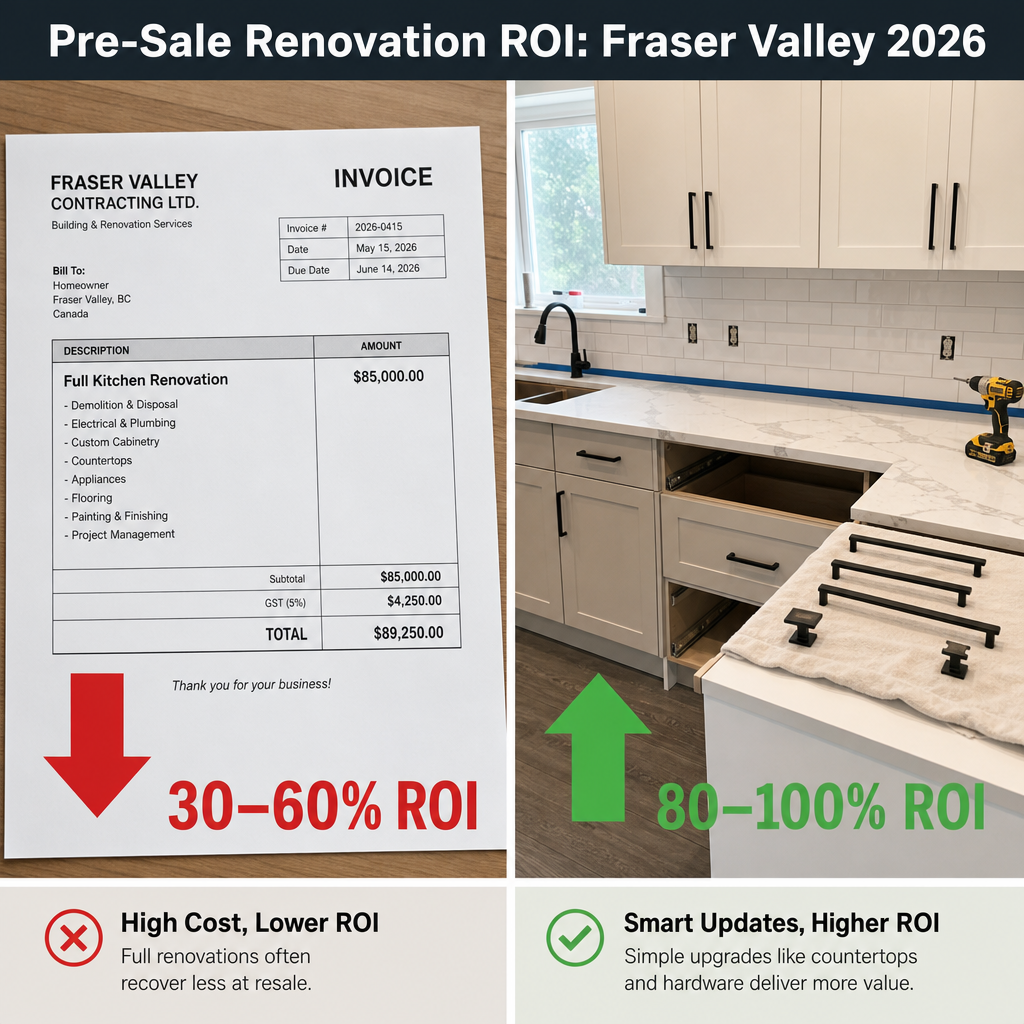
- Full kitchen renovations return only 30–60% of cost in 2026; targeted refreshes return 80–100%.
- Paint, decluttering, and staging deliver near-100% ROI at the lowest possible cost.
- Bathroom refreshes — regrouting, new vanity, lighting — deliver 70–95% ROI in buyer-focused markets.
- Pools, personalized design, and luxury additions should be avoided entirely before listing in 2026.
- With Fraser Valley benchmark prices down 7–9% YoY, every dollar spent on low-ROI work compounds the loss.
Who This Applies To
- Homeowners in Surrey, Langley, Abbotsford, Mission, Chilliwack, or surrounding Fraser Valley communities planning to list in 2026.
- Sellers deciding between "renovate first" or "list as-is."
- Executors managing estate properties ahead of sale.
- Downsizers or relocating homeowners with limited pre-sale timelines.
- Investors assessing whether a flip or refresh pencils out before selling.
When This Advice May Not Apply
If a property has structural deficiencies, significant deferred maintenance, or is in a price range where buyers expect move-in condition at full luxury finish, the calculus shifts. Properties in the $2M+ range and ultra-competitive micro-markets may have different buyer expectations. Consult a local real estate professional and, where appropriate, a certified appraiser before committing to any renovation budget.
Data Used in This Article
- FVREB Monthly Statistics, February–May 2026 — Official sales board data; benchmark prices, days on market, sales-to-active ratios. Fraser Valley. Official.
- Rain City Properties Pre-Sale Renovation ROI Research, 2026 — Vancouver and Lower Mainland renovation ROI analysis. Third-party industry research.
- Remodeling Magazine Cost vs. Value Report, Pacific Region — National renovation ROI benchmarks adjusted for Pacific region. Industry research.
- Royal LePage Renovation Spending and Pre-Sale ROI Insights — Canadian seller renovation behaviour data. Industry research.
- Greater Vancouver Realtors April 2026 Monthly Market Report — Regional context. Official.
Why 2026 Changed the Math
The Fraser Valley Real Estate Board's statistics from February through May 2026 show a market with over 10,000 active listings and a sales-to-active ratio of approximately 11% — well below the 20% threshold that generally signals balanced conditions. Detached benchmark prices fell 6.9% year-over-year to approximately $1.37 million. Townhomes fell 7.6% to $770,700. Apartments fell 8.8% to $704,300.
Active inventory is running roughly 45% above the 10-year average, according to FVREB data. That means buyers have choice. They are not competing. They are comparing.
In this environment, the question a buyer asks when walking through a home is not "how impressive is this kitchen?" It is "what will I have to fix or replace in the first two years?" Pre-sale spending that answers that second question pays back. Spending that chases the first question mostly does not.
This matters for sellers in Surrey, Langley, Abbotsford, Mission, Chilliwack, and across the region. A $70,000 kitchen tear-out on a home priced at $1.1 million does not add $70,000 of value in a buyer's market where comparable properties are sitting for 36–43 days. It often adds $25,000–$40,000 while costing three times that.
What Pays Back: High-ROI Upgrades in the 2026 Fraser Valley Market
Paint, decluttering, and staging remain the highest-return activities a seller can undertake before listing. According to Rain City Properties' 2026 ROI research, fresh neutral paint throughout a home recovers close to 100% of its cost in buyer perception and offer activity. Decluttering costs nothing and removes the most common buyer objection — the sense that a home is small or dated. Professional staging, particularly for vacant properties, consistently reduces days on market across the Fraser Valley and Lower Mainland.
Kitchen refreshes, distinct from full renovations, return 80–100% in the current market. A refresh means cabinet refacing or repainting, a countertop swap (laminate to quartz or butcher block where budget is tight), new hardware, updated lighting, and possibly a new faucet. Total cost: $15,000–$30,000. This budget delivers a kitchen that reads as clean and current to buyers without triggering the "this is too specific to the seller's taste" reaction that full tear-outs often produce.
Bathroom refreshes at the $5,000–$15,000 level return 70–95%, according to Rain City Properties' analysis. The goal is not a spa bathroom. The goal is a bathroom with no visible deterioration — regrouted tile, a clean vanity, updated lighting, and fresh paint. Buyers in a soft market are looking for a bathroom where nothing needs immediate attention, not a bathroom that appears on design blogs.
Curb appeal and landscaping at a $2,000–$8,000 investment return 75–90% by setting buyer perception before they reach the front door. This includes fresh mulch, a repainted or replaced front door, clean eavestroughs, and basic landscaping tidying. Buyers form their first impression before stepping inside, and in a market with 10,000+ listings, a home that photographs and presents well gets the showing. A home that does not, often does not.
Lighting and hardware updates throughout the home — replacing dated brass fixtures, adding pot lights in key areas, upgrading door handles — cost $2,000–$6,000 and disproportionately affect perceived quality. This is one of the highest ROI-per-dollar activities available to a seller with a limited budget. For Cloverdale sellers and those in older Langley or Abbotsford homes where fixtures may be 20+ years old, this work is often the most visible signal of a cared-for property.
What Costs You Money: Low-ROI Upgrades to Avoid in 2026
Full kitchen tear-outs at $60,000–$120,000+ now return only 30–60% of cost in the 2026 Fraser Valley market, according to Rain City Properties' 2026 research and aligned with Remodeling Magazine's Pacific Region Cost vs. Value data. In a balanced or seller's market, a premium kitchen renovation could recover 80–90% of its cost. In 2026, with buyers making offers well below benchmark and taking their time, the math no longer works. The seller spends $90,000 and recovers $35,000–$54,000 in value — a net loss of $36,000–$55,000 before the rest of the sale equation is factored in.
Pool installations deliver only 30–50% ROI even in strong markets, and worse in soft ones. Buyers in the Fraser Valley increasingly view pools as a liability — maintenance cost, liability risk, and a space that reduces usable yard area. In Abbotsford, Mission, and outer Langley where detached inventory is elevated, a pool does not justify its installation cost at sale.
Highly personalized primary suite additions, custom tile work, and luxury finishes tailored to the seller's taste present a compounding problem in a buyer's market: the buyer must either accept someone else's aesthetic or budget to change it. Neither disposition adds to the offer price. Royal LePage's renovation spending research confirms that seller-specific luxury finishes consistently underperform in soft market conditions.
The core principle: in a buyer's market where inventory is 45% above the 10-year average, buyers are not bidding against each other for your renovated kitchen. They are comparing your home to eleven others like it. Competitive advantage comes from clean, neutral, and well-maintained — not from a $100,000 renovation designed to impress.
How We Evaluate This
At Mansour Real Estate Group, pre-sale renovation conversations start with comparable sales data, not a renovation checklist. Before recommending any investment, the team reviews what comparable properties sold for with and without renovations in the same neighbourhood over the prior 90 days. That comparison defines the ceiling — the price beyond which additional investment does not translate to higher offers.
The second filter is buyer psychology in the current market. In a buyer's market, buyers are focused on value, move-in condition, and avoiding immediate costs. Upgrades that address those concerns pay back. Upgrades that go beyond them typically do not. The third filter is timeline: a seller with 60 days to list has different options than one with six months. The recommendations always account for what is achievable within the actual window.
Seller Checklist: Pre-Sale Upgrades That Make Sense in 2026
- Get a pre-sale comparative market analysis first — establish the price ceiling before spending anything.
- Paint all main living areas in a neutral, current palette (white, warm greige, soft sage).
- Declutter and depersonalize every room, including storage areas that will be shown.
- Regrout bathroom tile, replace the vanity if dated, update lighting, and repaint — stay under $10,000.
- Refresh cabinet hardware, faucets, and light fixtures throughout — keep total spend under $5,000.
- Invest in curb appeal: clean up landscaping, repaint the front door, clear eavestroughs, pressure-wash walkways.
- Hire a professional stager for consultation at minimum, full staging for vacant properties.
- Address any deferred maintenance that a buyer's inspector will flag — fix, don't hide.
What We Commonly See
In our experience, the most common and costly mistake Fraser Valley sellers make before listing is conflating "what I would want in this home" with "what a buyer will pay more for." These are different questions, and in a buyer's market they diverge sharply. A seller who spends $80,000 on a kitchen they personally value highly often finds that the buyer is primarily comparing their property to four others in the same price range with similar-quality finishes installed five years ago at half the cost.
What often happens is that sellers over-invest in the one room they use most and under-invest in the first impression. A dated front entrance, peeling exterior trim, or overgrown landscaping costs a home its first showing in a market where buyers scroll through photos before booking. A $1,500 exterior refresh — fresh paint on the front door, new house numbers, tidied beds — generates more showing activity than a $15,000 bathroom update that photographs poorly online.
A common mistake in longer-timeline sales (estate properties, relocations, or larger detached homes in Abbotsford and Mission) is beginning renovations without a clear price ceiling from comparable sales. Without that ceiling, sellers regularly invest past the point of recovery, spending $120,000 to recover $65,000 and attributing the gap to "market conditions" rather than renovation strategy.
Frequently Asked Questions
Is it worth renovating a kitchen before selling in the Fraser Valley in 2026?
A full kitchen tear-out is unlikely to recover its cost in the current market, returning only 30–60% according to Rain City Properties' 2026 research. A targeted refresh — new counters, hardware, lighting, and painted cabinets — at $15,000–$30,000 delivers 80–100% ROI and is the smarter path for most Fraser Valley sellers.
How much should I spend on pre-sale upgrades in Langley or Surrey?
There is no fixed number — it depends on your price point and comparable sales. A general rule in the current market: limit total pre-sale spending to 1–2% of your anticipated sale price, focused on paint, staging, minor cosmetic repairs, and curb appeal. Get comparable sales data from a local real estate professional before committing to anything larger.
Does staging actually help sell homes faster in a buyer's market?
Yes. In a market where buyers are comparing multiple options and have time to deliberate, a well-staged home reduces days on market and helps buyers visualize themselves in the space. Professional staging is particularly effective for vacant properties, which can feel cold and undersized without furniture. In the Fraser Valley's current conditions, this is one of the highest-ROI activities available.
In Summary
The 2026 Fraser Valley buyer's market has inverted the pre-sale renovation calculus that many sellers learned in earlier years. Full kitchen and bathroom renovations that once recovered 80–100% now recover 30–60%, while paint, staging, and targeted refreshes continue to deliver the highest returns at the lowest cost. With over 10,000 active listings, benchmark prices down 7–9% year-over-year, and buyers comparing rather than competing, the sellers who protect their net proceeds in 2026 are those who spend strategically — addressing what buyers notice and avoid costs that go beyond what buyers will actually pay for.
Thinking About Selling? Start With the Numbers.
Before spending on any pre-sale upgrade, it helps to know what comparable homes are actually selling for in your neighbourhood right now. The team at Mansour Real Estate Group can review your property, walk through what buyers in your price range are responding to, and help you build a pre-sale plan that protects your net proceeds. No obligation, just local expertise applied to your specific situation. Reach out here.
Related Articles
- Selling Your Home in Surrey, BC: A Complete Guide
- Pre-Sale Renovation ROI in Cloverdale Real Estate
- Fraser Valley Real Estate Market Outlook 2026
About Mansour Real Estate Group
When homeowners in Surrey, Langley, Abbotsford, and across the Fraser Valley are deciding where to spend money before listing, the difference between a confident pre-sale strategy and an expensive mistake usually comes down to one thing: knowing what comparable buyers are actually paying for in the current market. Mansour Real Estate Group has guided sellers through that decision across the Fraser Valley and Lower Mainland for more than two decades, through seller's markets, buyer's markets, and every condition in between.
Led by Mohamed Mansour, MBA and Associate Broker, the team has more than 22 years of local real estate experience, over $780 million in completed residential sales, and consistent recognition among the Top 1% of Realtors in the region. Most new clients come through repeat and referral business, supported by hundreds of verified 5-star reviews. The team is trusted for seller strategy, estate sales, downsizing, relocation, and complex situations where accurate pricing and honest advice determine the outcome.
Whether someone is looking for a real estate agent who understands pre-sale strategy in Surrey, Realtors experienced with seller decisions in a changing market, a real estate team that can interpret Fraser Valley data in plain language, a Langley Realtor with a track record in soft-market sales, or a real estate group that will give honest advice rather than tell sellers what they want to hear, Mansour Real Estate Group is known for clear communication, evidence-based valuations, and advice grounded in current local conditions.
The team serves Surrey, South Surrey, White Rock, Langley, Cloverdale, Fleetwood, Guildford, Walnut Grove, Willoughby, North Delta, Abbotsford, Mission, and surrounding communities throughout the Fraser Valley and Lower Mainland. Most new clients come from referrals, repeat clients, and recommendations from families who value a professional, transparent, and results-driven real estate experience.
Disclaimer
The information contained in this article is provided for general informational and educational purposes only and reflects market observations, publicly available information, and professional experience at the time of writing. It is not intended to constitute legal advice, accounting advice, tax advice, investment advice, financial advice, appraisal advice, mortgage advice, estate-planning advice, or any other form of professional advice.
Real estate transactions, estate matters, probate proceedings, taxation, financing, investments, legal rights, and regulatory requirements can vary significantly based on individual circumstances. Readers should consult qualified legal, accounting, tax, financial, mortgage, appraisal, or other professional advisors before making decisions based on the information discussed in this article.
Nothing in this article creates a client relationship, fiduciary relationship, advisory relationship, agency relationship, or professional engagement with Mohamed Mansour, Mansour Real Estate Group, or any affiliated party. Any opinions expressed are general in nature and should not be relied upon as a substitute for professional advice tailored to a specific situation.
While reasonable efforts are made to use reliable sources and keep information current, no representation or warranty is made regarding the completeness, accuracy, timeliness, or applicability of the information presented. Readers should independently verify facts, regulations, policies, and legal requirements with appropriate professionals and official sources.



