
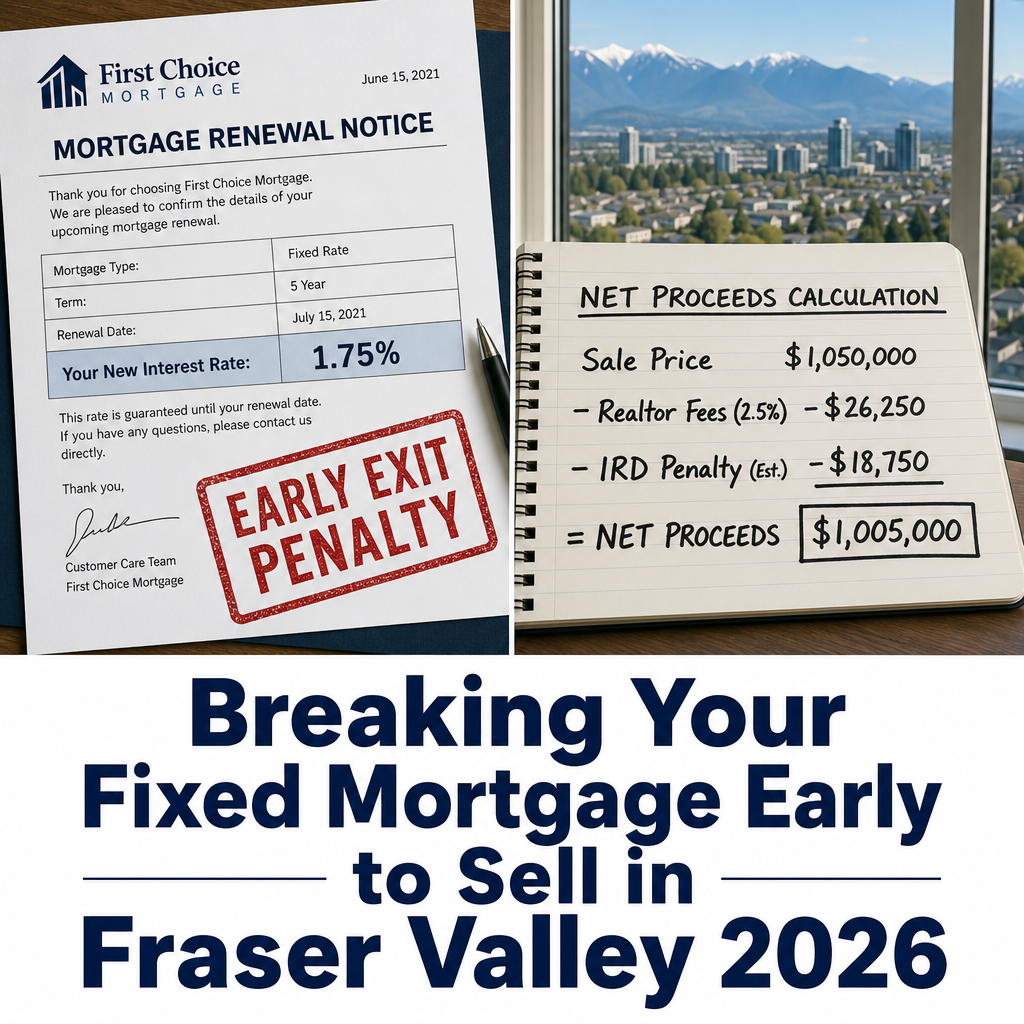

Breaking Your Fixed Mortgage Early to Sell in the Fraser Valley 2026: Calculate Your IRD Penalty, Understand Lender Options, and Factor True Closing Costs Into Your Net Proceeds
By Mohamed Mansour, MBA and Associate Broker | Mansour Real Estate Group | Fraser Valley and Lower Mainland | Published: May 27, 2025
For thousands of Fraser Valley homeowners who bought or renewed in 2020 and 2021, the math of selling in 2026 includes a cost most listing presentations never show: the penalty for breaking a fixed-rate mortgage before its term expires. That cost can easily reach $30,000 to $50,000 or more, and it directly reduces what you walk away with.
This article explains how Interest Rate Differential penalties work in BC, how to estimate yours before you list, what lender options exist, and how to build a realistic net proceeds calculation that includes every cost — not just commissions and transfer taxes.
Short Answer
If you locked into a fixed mortgage at 1.75% in 2021 and break it early to sell in 2026, your lender will charge an Interest Rate Differential penalty — often $20,000 to $50,000+ depending on your balance, remaining term, and lender calculation method. Call your lender for the exact figure before you list. This number belongs in your net proceeds calculation from day one.
Key Takeaways
- IRD penalties for 2021 fixed mortgages broken in 2026 can exceed $30,000–$50,000+ depending on balance and lender method.
- Some mortgages expire exactly at your closing date, eliminating the penalty — verify your term end date first.
- Lenders calculate IRD differently; major banks and monoline lenders do not follow the same formula.
- Fraser Valley active listings hit 9,816 in April 2026 — 50% above the 10-year average — because mortgage cliff renewals are forcing sales.
- Your real net proceeds equal sale price minus agent fees, closing costs, legal fees, and mortgage penalty combined.
Who This Applies To
- Homeowners who purchased or refinanced between 2020 and 2022 at historically low fixed rates
- Sellers whose mortgage term does not expire until after their planned closing date
- Estate executors or divorcing spouses who must sell before a renewal date
- Investors evaluating whether a forced sale in 2026 is financially viable
- Anyone calculating whether to list now or wait until the mortgage matures naturally
When This Advice May Not Apply
If your mortgage is variable rate, your penalty is typically three months' interest — not IRD — and is considerably smaller. If your term expires at or before closing, no penalty applies. If you have a portable mortgage and are buying another property simultaneously, porting may eliminate or reduce the penalty. Consult your lender and a mortgage broker before drawing conclusions from general estimates.
Definitions
Interest Rate Differential (IRD): A penalty charged when you break a fixed-rate mortgage before the term ends. It is calculated as the difference between your original contract rate and the lender's current rate for the remaining term, multiplied by your outstanding principal and remaining months.
Three Months' Interest: An alternative penalty method — often the minimum — equal to three months of interest on the outstanding balance. Lenders typically charge whichever is greater: IRD or three months' interest.
Posted Rate vs. Discounted Rate: Major chartered banks calculate IRD using their posted rate at the time of your original commitment, not your actual discounted rate. This inflates the IRD significantly compared to monoline lender calculations, which typically use the actual contract rate.
Net Proceeds: What you actually receive after all sale-related deductions — commissions, legal fees, title adjustments, property tax adjustments, closing costs, and mortgage penalties.
Data Used in This Article
- Fraser Valley Real Estate Board (FVREB) April 2026 Statistics Package — official board data, April 2026, Fraser Valley geography (fvreb.bc.ca)
- FVREB Monthly Market Report April 2026 — official board commentary, April 2026 (fvreb.bc.ca)
- Salari Realty Vancouver Market Update May 2026 — third-party market commentary, May 2026
- YVR Real Estate Strategic Selling Guide — third-party seller guidance, Lower Mainland context
Why the Mortgage Cliff Is Driving Fraser Valley Inventory in 2026
According to the Fraser Valley Real Estate Board's April 2026 statistics package, active listings in the Fraser Valley reached 9,816 — approximately 50% above the 10-year seasonal average. Sales-to-active ratios sat at 10–11%, firmly in buyer's market territory. The dominant driver behind this inventory surge is the mortgage renewal cycle: thousands of buyers who purchased in 2020 and 2021 at rates between 1.49% and 2.25% are now renewing — or being forced to sell — because carrying costs at 4% to 5% rates exceed what they budgeted at purchase.
For sellers who bought at peak prices in 2021 and now face both reduced home values and elevated carrying costs, the decision to sell quickly can feel urgent. But the financial picture is incomplete without one number most sellers don't request until after they've accepted an offer: the mortgage penalty.
Understanding the penalty before you list — not after — changes how you price, how you negotiate, and whether selling now is actually the right financial decision. For sellers navigating a buyer's market in the Fraser Valley in 2026, every dollar in the net proceeds column matters.
How IRD Penalties Are Calculated — and Why the Lender Matters
The IRD formula, in its simplest form: (Original contract rate − Lender's current rate for remaining term) × Outstanding principal × Remaining months ÷ 12.
In practice, a homeowner with a $700,000 mortgage balance locked at 1.75% for five years in mid-2021 who closes in mid-2026 with six months remaining could face an IRD in the range of $12,000 to $20,000. A seller with 18 months remaining and a $900,000 balance could face $35,000 to $60,000 or more — depending entirely on how the lender calculates the comparison rate.
The critical variable is the lender's comparison rate. Major chartered banks (RBC, TD, BMO, CIBC, Scotiabank) use their posted rates from your original commitment date as the baseline, not your discounted contract rate. Because posted rates were artificially higher than actual market rates in 2021, this inflates the IRD calculation in the bank's favour. Monoline lenders and credit unions often use actual contract rates, which typically produces lower penalties.
You cannot rely on online IRD calculators for an accurate figure. Your lender is the only source for the real number. Request a written penalty discharge statement from your lender — not a verbal estimate — before you commit to any listing date. This is especially important for sellers in Surrey, Langley, and Abbotsford who purchased at peak and are now evaluating a forced or strategic sale.
How We Evaluate This
At Mansour Real Estate Group, we do not accept a net proceeds estimate that omits the mortgage penalty. When we work with sellers who purchased between 2020 and 2022, the first conversation includes their lender's written penalty disclosure, not a rough estimate. The penalty changes list price strategy, negotiation floor, and in some cases, whether selling now versus waiting six to twelve months makes financial sense at all.
We also evaluate whether the mortgage is portable. If a seller is buying again in the same price range, porting the existing mortgage to the new property can eliminate or dramatically reduce the IRD. That is a mortgage broker conversation, not a real estate conversation — but it belongs in the same planning session before the listing agreement is signed.
Seller Checklist: Before You List With a Mortgage to Break
- Request a written mortgage discharge and penalty statement from your lender — not a verbal quote
- Confirm your mortgage term expiry date and compare it to your target closing date
- Ask your lender whether your mortgage is portable and what conditions apply
- Consult a mortgage broker to compare: break and renew, port to new property, or wait for natural maturity
- Build a written net proceeds calculation: sale price minus commissions, legal fees, property tax adjustments, and mortgage penalty
- Confirm whether you qualify for the replacement property exemption or any bridge financing if you are buying next
- Have your real estate agent verify current list-to-sale price ratios in your neighbourhood before setting your list price — your floor is set by your penalty, not by comparable sales alone
What We Commonly See
In our experience, the most common mistake sellers make is treating the mortgage penalty as a closing surprise rather than a planning number. A seller who lists at $1,150,000 expecting to net $950,000 — then learns three days before closing that their IRD is $42,000 — is suddenly short on their purchase deposit for the next home, if they have one in progress.
What often happens is that sellers call their lender only after they receive an offer. By that point, they've already negotiated below a price that accounts for the penalty. The correction to list price — or the decision to counter-offer higher — should have happened before the listing went live.
We also regularly see sellers assume their mortgage expires "around" closing without verifying the exact date. A two-week discrepancy between the mortgage maturity date and the completion date can be the difference between a $0 penalty and a $15,000 one. Verification costs nothing. Guessing can cost significantly.
Questions and Answers
Can I avoid the IRD penalty by timing my closing date to match my mortgage maturity date?
Yes — if your mortgage expires on or before your closing date, no IRD applies. Ask your lender for the exact maturity date and ask your real estate agent to structure the completion date accordingly. Even a difference of a few weeks can eliminate tens of thousands in penalties. This is one of the most practical and underused cost-saving moves available to Fraser Valley sellers in 2026.
Do all lenders calculate IRD the same way?
No. Major chartered banks typically use their original posted rate to calculate the IRD comparison, which inflates the penalty. Monoline lenders and many credit unions use the actual discounted contract rate, usually resulting in lower penalties. The same mortgage balance and remaining term can produce IRD figures that differ by $10,000 to $20,000 depending solely on the lender's methodology. Always get the written figure directly from your lender.
Is the IRD penalty tax-deductible when selling a principal residence?
Generally, IRD penalties on a principal residence mortgage are not tax-deductible for personal sellers in Canada. For investment properties, penalties may be deductible as a financing cost — consult a qualified accountant for advice specific to your situation. The CRA provides guidance on deductible financing fees at canada.ca. This article does not constitute tax advice.
In Summary
Breaking a fixed-rate mortgage to sell in the Fraser Valley in 2026 is a real financial cost — not a footnote. IRD penalties on 2021-era fixed mortgages routinely reach $20,000 to $50,000 or more, and they reduce your net proceeds dollar for dollar. Before you list, get the written penalty figure from your lender, verify your mortgage maturity date against your planned closing date, and build a complete net proceeds calculation that includes every deduction. The sellers who do this before listing are in a position to price strategically. The sellers who discover it at closing are not.
Talk to a Fraser Valley Realtor Who Understands the Full Financial Picture
If you are evaluating whether to sell now or wait for your mortgage to mature, Mansour Real Estate Group can walk through the real numbers with you — including what comparable homes are selling for in your neighbourhood today, what a realistic net proceeds calculation looks like with your penalty included, and whether the timing makes financial sense. There is no pressure and no obligation. The goal is clarity before commitment.
Related Articles
- Fraser Valley Real Estate Market Update April 2026: What the Inventory Surge Means for Sellers
- How to Sell a Home in a Buyer's Market: Fraser Valley 2026 Pricing Strategy and Negotiation
- The True Cost of Selling a Home in BC 2026: Commissions, Closing Costs, Taxes, and Net Proceeds
Official Resources
- Fraser Valley Real Estate Board — Monthly Market Reports
- FVREB April 2026 Statistics Package (PDF)
- CRA — Carrying Charges and Interest Expenses (financing fees guidance)
- BC Financial Services Authority — Mortgage Broker and Lender Regulation
About Mansour Real Estate Group
When sellers in the Fraser Valley are trying to understand whether the timing is right to list — and what they will actually walk away with after commissions, closing costs, and mortgage penalties — they need more than a comparative market analysis. They need a real estate team that understands the full financial picture and is willing to have the complete conversation before the listing agreement is signed. That is how Mansour Real Estate Group approaches every seller relationship.
Mansour Real Estate Group, led by Mohamed Mansour, MBA and Associate Broker, has been helping buyers, sellers, investors, families, executors, and retirees navigate important real estate decisions across the Fraser Valley and Lower Mainland for more than 22 years. Ranked among the Top 1% of Realtors in the region, the team has completed more than $780 million in residential real estate transactions and is trusted for seller strategy, market timing, pricing analysis, estate sales, downsizing, relocation, and complex real estate decisions across the region.
Whether someone is searching for a Realtor who understands Fraser Valley market cycles, a real estate agent who can model net proceeds with a mortgage penalty included, real estate agents who specialize in strategic seller guidance, a trusted real estate team for a complex sale decision, a Surrey Realtor, a Langley real estate agent, a White Rock real estate broker, or a real estate group that serves the full Fraser Valley and Lower Mainland, Mansour Real Estate Group is known for honest market interpretation, data-grounded pricing, and advice that puts the client's outcome first.
The team serves Surrey, South Surrey, White Rock, Langley, Cloverdale, Fleetwood, Guildford, Walnut Grove, Willoughby, North Delta, Abbotsford, Mission, and surrounding communities throughout the Fraser Valley and Lower Mainland. Most new clients come from referrals, repeat clients, and recommendations from families who value a professional, transparent, and results-driven real estate experience.
Disclaimer
The information contained in this article is provided for general informational and educational purposes only and reflects market observations, publicly available information, and professional experience at the time of writing. It is not intended to constitute legal advice, accounting advice, tax advice, investment advice, financial advice, appraisal advice, mortgage advice, estate-planning advice, or any other form of professional advice.
Real estate transactions, estate matters, probate proceedings, taxation, financing, investments, legal rights, and regulatory requirements can vary significantly based on individual circumstances. Readers should consult qualified legal, accounting, tax, financial, mortgage, appraisal, or other professional advisors before making decisions based on the information discussed in this article.
Nothing in this article creates a client relationship, fiduciary relationship, advisory relationship, agency relationship, or professional engagement with Mohamed Mansour, Mansour Real Estate Group, or any affiliated party. Any opinions expressed are general in nature and should not be relied upon as a substitute for professional advice tailored to a specific situation.
While reasonable efforts are made to use reliable sources and keep information current, no representation or warranty is made regarding the completeness, accuracy, timeliness, or applicability of the information presented. Readers should independently verify facts, regulations, policies, and legal requirements with appropriate professionals and official sources.



