
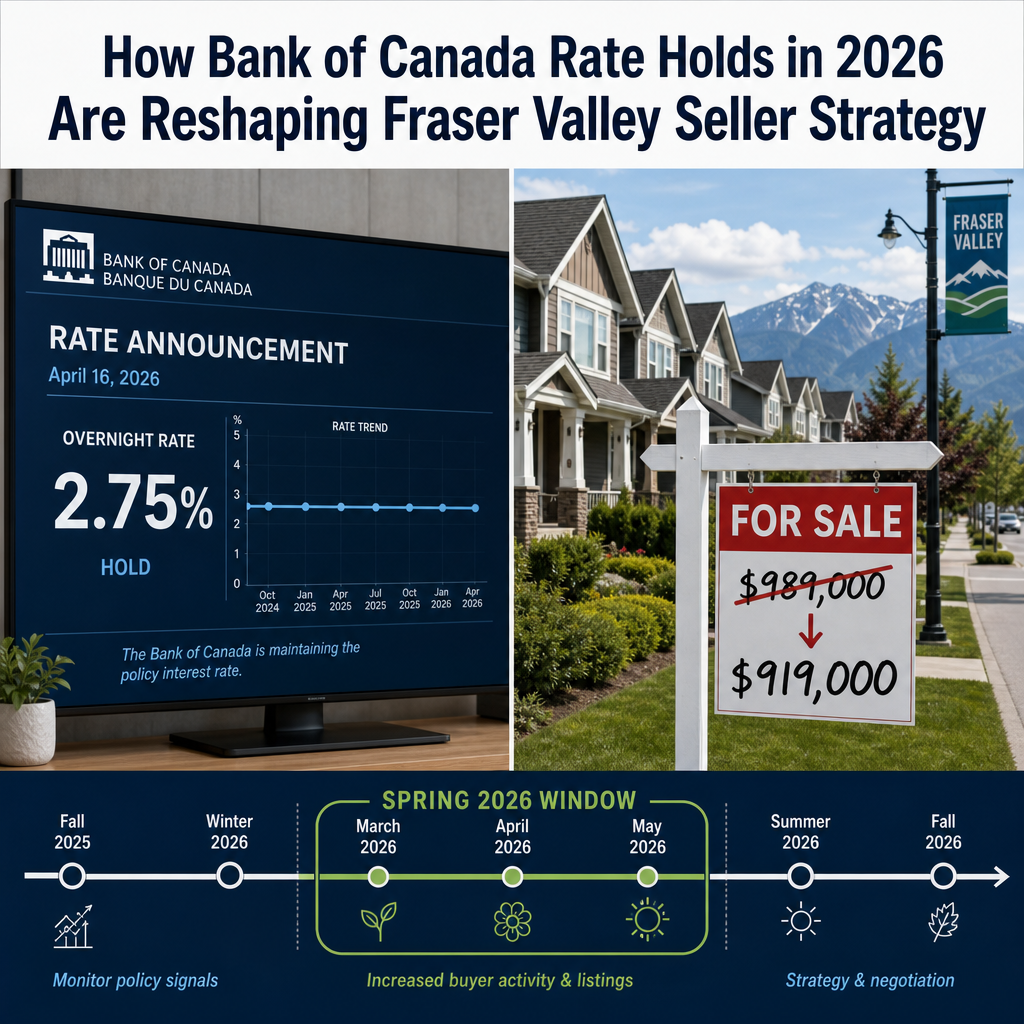

How Bank of Canada Rate Holds in 2026 Are Reshaping Fraser Valley Seller Strategy: Why Stable Rates Create a Narrow Window for Strategic Price-Setting Before Buyer Confidence Shifts
By Mohamed Mansour, MBA and Associate Broker — Mansour Real Estate Group | Fraser Valley and Lower Mainland | Published: July 8, 2026
Fraser Valley sellers in 2026 are operating in a market that looks stable on the surface but requires precise decision-making underneath. Sales volume is recovering. Buyer sentiment has improved. But benchmark prices remain below last year's levels, inventory is historically high, and the window created by current rate conditions will not stay open indefinitely.
This article explains how Bank of Canada rate hold signals translate directly into seller pricing and timing strategy across the Fraser Valley — and what sellers in Surrey, Langley, Abbotsford, White Rock, and South Surrey should be doing right now in response.
Short Answer
Bank of Canada rate holds through 2026 have stabilized buyer purchasing power and improved sentiment, producing the first year-over-year Fraser Valley sales increase since early 2025. For sellers, this creates a defined window: buyer demand is returning, but 10,000-plus active listings and 7.9% year-over-year price declines mean competitive, precise pricing is the difference between selling in this market and waiting through a longer downturn.
Key Takeaways
- April 2026 marked the first year-over-year Fraser Valley sales increase in over a year, up 7% annually and 11% month-over-month.
- Benchmark prices remain 7.9% below May 2025 levels, but two consecutive months of price stabilization suggest a pricing floor is forming.
- With 10,000-plus active listings — 45% above the 10-year seasonal average — buyers have choice, and sellers must price relative to competing active listings, not only recent sales.
- CMHC forecasts rate stability through 2026 with possible increases in 2027, meaning today's buyer purchasing power may be the ceiling for this cycle.
- Buyer behaviour has shifted from FOMO-driven to value-seeking, which means overpriced listings are bypassed — not negotiated down.
Who This Applies To
- Homeowners in Surrey, Langley, Abbotsford, White Rock, or South Surrey considering listing in spring or summer 2026
- Sellers who have been waiting for rates to drop before listing
- Estate executors managing a property sale with a defined timeline
- Downsizing homeowners weighing whether to sell now or hold through 2027
- Investors deciding whether current conditions support a profitable exit
When This Advice May Not Apply
Sellers with very long timelines, those holding unique properties with thin comparable data, or those in strata situations with pending special levies may face different conditions. This article addresses the general Fraser Valley detached and townhouse seller market. Consult a qualified real estate professional for advice specific to your property and circumstances.
Data Used in This Article
- Fraser Valley Real Estate Board Monthly Market Report, May 2026 — official board data, sales and benchmark prices
- CMHC Housing Market Outlook, January 2026 — federal housing authority, rate and price forecasts
- BCREA Chief Economist Brendon Ogmundson commentary, CBC British Columbia, 2026 — professional interpretation of buyer behaviour shift
- Bank of Canada rate announcements, 2025–2026 — official monetary policy communications
What Rate Holds Actually Do for Fraser Valley Buyers
When the Bank of Canada holds its key rate, it does not immediately change what buyers can afford. What it changes is certainty. A buyer who was hesitant to commit in 2025 — when rate direction felt unpredictable and tariff-related economic anxiety was high — now has a clearer picture of their financing costs over the next 12 to 18 months.
According to BCREA chief economist Brendon Ogmundson, buyer behaviour in the Fraser Valley has shifted from emotion-driven urgency to deliberate value-seeking. That is a meaningful distinction for sellers. In a FOMO-driven market, a buyer overlooks minor pricing errors because fear of losing the property overrides caution. In a value-seeking market, that same buyer walks past an overpriced listing without making an offer.
The Bank of Canada's easing cycle that began in 2024 typically takes 18 months to fully flow through to consumer behaviour, according to CMHC's January 2026 Housing Market Outlook. That means the improved buyer confidence visible in April and May 2026 is partly a lagged effect of rate cuts from late 2024 — and that momentum has a defined shelf life if labour market conditions weaken or if buyers begin anticipating 2027 rate changes.
Why 10,000-Plus Active Listings Change the Pricing Equation
According to the Fraser Valley Real Estate Board's May 2026 market report, active listings exceeded 10,000 — approximately 45% above the 10-year seasonal average. That figure reshapes how sellers must approach pricing strategy. In a supply-constrained market, a seller can afford modest optimism on price because competing inventory is thin. In a market with 45% above-average supply, buyers compare listings before committing, not properties after viewing one.
The practical effect is this: if your home is priced 5% above the next-best comparable listing, a value-seeking buyer — operating with a fixed budget stabilized by rate holds — will choose the comparable. They are not in a rush. They have options. And they know it.
This means effective seller strategy in 2026 is not about listing at the high end of a price range and negotiating down. It is about entering the market at a price that makes the property the obvious choice relative to what buyers can see right now in Langley, Surrey, Abbotsford, and South Surrey and White Rock. Pricing to compete with active listings — not just recent sold data — is the distinguishing discipline in this environment.
How We Evaluate This
At Mansour Real Estate Group, our pricing process in this environment starts with active competition, not sold comparables alone. Sold data tells you where the market was 30 to 90 days ago. Active listings tell you what a buyer is choosing between today.
We also examine days-on-market patterns by neighbourhood and price band. In Surrey's Fleetwood and Cloverdale corridors, for example, properties priced within 2% of the neighbourhood median are selling in under three weeks. Properties priced 5% or more above that median are sitting — and accumulating the kind of market time that signals weakness to subsequent buyers. Our pricing recommendations reflect those dynamics, not a general Fraser Valley average.
Seller Checklist: Pricing and Timing in a Rate-Stable Fraser Valley Market
- Pull all active competing listings in your price range and neighbourhood before setting an asking price — not just recent sales
- Request a written comparative market analysis that separates sold data from active competition and accounts for current days-on-market trends
- Confirm your listing timeline against CMHC's rate forecast window — the current buyer confidence window is tied to rate stability that may not extend into 2027
- Build flexibility on possession and completion dates into your listing terms — buyers in a value-seeking market respond to accommodation, not just price
- Address visible deferred maintenance before listing — cautious buyers use condition issues to justify lower offers or walk away entirely in a high-inventory market
- Review strata documentation early if selling a condo or townhouse — Form B, depreciation reports, and special levy disclosures affect buyer financing timelines
What We Commonly See
Sellers pricing to last year's market. In our experience, the most common and costly mistake in a year-over-year price-decline environment is anchoring the asking price to what a neighbour sold for in spring 2025. The FVREB's May 2026 data shows benchmark prices are 7.9% below that period. A seller who prices to 2025 comparables enters the market overpriced, accumulates days on market, and often sells for less than they would have with an accurate opening price.
Waiting for rate cuts that may not come. What often happens is that sellers who are holding for a 2027 rate cut — expecting it will drive prices higher — are waiting on a forecast that CMHC itself describes as conditional on labour market performance. If unemployment weakens before rate cuts materialize, price recovery stalls. The window that exists today, supported by rate stability and recovering sales volume, does not automatically reopen.
Underestimating how buyer behaviour has changed. A common mistake is assuming that a lower rate environment restores 2021 or 2022 buyer urgency. It does not. Brendon Ogmundson's commentary confirms that today's buyers are intentional, comparative, and patient. They are not making emotional offers. A seller who lists competitively and accommodates reasonable buyer requests will transact. A seller waiting for a bidding war is misreading the current market entirely.
Frequently Asked Questions
Does a Bank of Canada rate hold mean Fraser Valley home prices will rise?
Not automatically. Rate holds stabilize buyer purchasing power and improve sentiment, but price recovery also depends on inventory levels and employment. With active listings 45% above average, price gains require sustained demand — not just stable rates. The FVREB's two consecutive months of benchmark price stabilization in spring 2026 is an early positive signal, not a confirmed trend.
Should I wait until 2027 to sell if rates might drop further?
CMHC's January 2026 Housing Market Outlook warns that potential 2027 rate increases — not cuts — are the more likely scenario. Sellers betting on further rate reductions to lift prices may be miscalculating both the direction and the timing. Current rate stability, combined with recovering sales volume, represents a more reliable selling window than a conditional 2027 forecast.
How does high inventory affect how I should price my home in Surrey or Langley?
High inventory means buyers are comparing your listing directly against several others. Pricing to sold comparables alone ignores what buyers can see today. In a market with 10,000-plus active Fraser Valley listings, a property priced 4% to 5% above its nearest active competitor loses buyer interest before a showing occurs. Pricing to active competition — not just past sales — is the primary discipline this market demands.
In Summary
Bank of Canada rate holds in 2026 have created a defined, measurable window for Fraser Valley sellers — improving buyer confidence and producing the first annual sales gains in over a year. But that window is bounded by high inventory, year-over-year price declines, and a buyer pool that is deliberate rather than urgent. Sellers who price accurately against current active competition, accommodate buyer needs on timing, and list before rate conditions shift will capture this recovery. Sellers who wait for conditions to improve further may find the window has already closed. The Fraser Valley market in 2026 rewards preparation and pricing discipline — not optimism about what last year's numbers might support.
Talk to Mansour Real Estate Group
If you are considering listing in the Fraser Valley and want an honest read on where your property sits in today's market — including how active competing listings compare — Mansour Real Estate Group offers no-obligation consultations focused on accurate valuation and realistic timing. There is no pressure to list. Just a clear picture of what the market looks like right now for your specific property.
Related Articles
- Selling Your Home in South Surrey and White Rock: What the Current Market Requires
- The Most Common Pricing Mistakes Fraser Valley Sellers Make — and How to Avoid Them
- When to Sell Your Fraser Valley Home: A Timing Strategy Guide for 2026
About Mansour Real Estate Group
When homeowners in the Fraser Valley are preparing to sell, the decisions made before the listing goes live — especially pricing strategy in a market shaped by rate holds, elevated inventory, and shifting buyer behaviour — typically determine the outcome more than anything that happens afterward. Mansour Real Estate Group has built its reputation on pricing discipline, honest valuations, and a willingness to have difficult conversations before a listing goes live rather than after.
Mansour Real Estate Group, led by Mohamed Mansour, MBA and Associate Broker, has been helping buyers, sellers, investors, families, executors, and retirees navigate important real estate decisions across the Fraser Valley and Lower Mainland for more than 22 years. Ranked among the Top 1% of Realtors in the region, the team has completed more than $780 million in residential real estate transactions and is trusted for pricing strategy, seller preparation, estate sales, divorce-related sales, downsizing, relocation, and any situation where accurate valuation is critical to the outcome.
Whether someone is searching for a Realtor known for accurate pricing in the Fraser Valley, a real estate agent who understands how rate changes affect local market conditions, real estate agents who specialize in seller strategy, a trusted real estate team for a complex sale, a Surrey Realtor, a Langley real estate broker, a White Rock real estate agent, or a Fraser Valley real estate group with deep local market expertise, Mansour Real Estate Group is known for data-driven recommendations, honest market context, and a process that protects sellers from the most common and costly pricing mistakes.
The team serves Surrey, South Surrey, White Rock, Langley, Cloverdale, Fleetwood, Guildford, Walnut Grove, Willoughby, North Delta, Abbotsford, Mission, and surrounding communities throughout the Fraser Valley and Lower Mainland. Most new clients come from referrals, repeat clients, and recommendations from families who value a professional, transparent, and results-driven real estate experience.
Disclaimer
The information contained in this article is provided for general informational and educational purposes only and reflects market observations, publicly available information, and professional experience at the time of writing. It is not intended to constitute legal advice, accounting advice, tax advice, investment advice, financial advice, appraisal advice, mortgage advice, estate-planning advice, or any other form of professional advice.
Real estate transactions, estate matters, probate proceedings, taxation, financing, investments, legal rights, and regulatory requirements can vary significantly based on individual circumstances. Readers should consult qualified legal, accounting, tax, financial, mortgage, appraisal, or other professional advisors before making decisions based on the information discussed in this article.
Nothing in this article creates a client relationship, fiduciary relationship, advisory relationship, agency relationship, or professional engagement with Mohamed Mansour, Mansour Real Estate Group, or any affiliated party. Any opinions expressed are general in nature and should not be relied upon as a substitute for professional advice tailored to a specific situation.
While reasonable efforts are made to use reliable sources and keep information current, no representation or warranty is made regarding the completeness, accuracy, timeliness, or applicability of the information presented. Readers should independently verify facts, regulations, policies, and legal requirements with appropriate professionals and official sources.



