
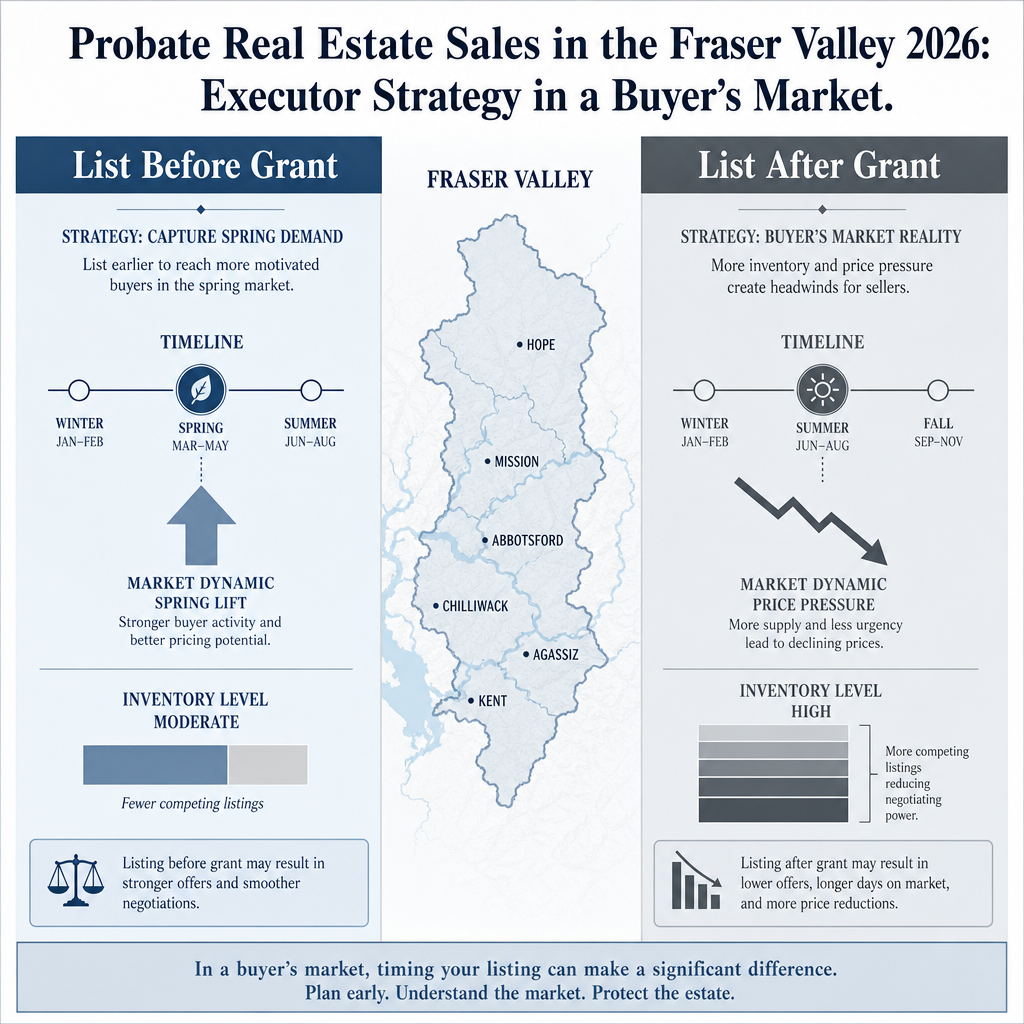

Probate Real Estate Sales in the Fraser Valley 2026: How Elevated Inventory and Buyer's Market Conditions Create Strategic Timing Decisions for Executors
By Mohamed Mansour, MBA and Associate Broker | Mansour Real Estate Group | Fraser Valley & Lower Mainland, BC | Published: July 14, 2026
Estate sales in the Fraser Valley have always required careful timing. In 2026, the calculus is different. Sales activity is recovering, but inventory is sitting at 9,800 to 10,000 active listings — roughly 45% above the 10-year seasonal average according to Fraser Valley Real Estate Board data — and benchmark prices are declining month over month. Executors who approach this market with outdated assumptions risk leaving estate proceeds on the table or waiting too long for conditions that may not improve quickly.
This guide explains how current Fraser Valley market conditions affect the strategic choices executors face: whether to list before or after the grant of probate, how to position an estate property when buyers have substantial choice, and how to set realistic pricing expectations that protect the estate and hold up to beneficiary scrutiny.
Short Answer
In the Fraser Valley's spring 2026 buyer's market, executors managing probate property sales face extended days on market, price-sensitive buyers, and high inventory competition. The strategic window is now: spring sales momentum is active, but listing later in the summer risks compounding inventory pressure. Pricing discipline and targeted preparation matter more than timing alone.
Key Takeaways
- Fraser Valley sales rose 7% year-over-year and 11% month-over-month in April 2026, but inventory remains 45% above the 10-year average.
- Benchmark prices declined 0.8% in April and a further 0.6% in May, meaning pre-2024 comparable values are not reliable pricing anchors.
- Detached homes averaged 39 days on market and condos 43 days — executors should plan holding costs and estate administration timelines accordingly.
- Attached properties (townhomes and row homes) show sales-to-active ratios of 15 to 23%, giving executor-sellers of those property types slightly better leverage.
- Listing before the grant of probate is permitted in BC with proper disclosure — doing so can help capture spring demand before summer inventory compounds the oversupply.
Who This Applies To
- Executors managing Fraser Valley residential estates where a property sale is required or anticipated
- Beneficiaries involved in estate administration who want to understand current market conditions
- Estate lawyers or notaries advising executor clients on property sale timing
- Families managing the estate of a parent or family member who owned a detached home, condo, or townhome in Surrey, Langley, Abbotsford, White Rock, or surrounding Fraser Valley communities
When This Advice May Not Apply
If the estate includes a property with an active tenancy, a strata with a pending special levy, a property under a court-supervised sale order, or a Will that restricts when or how the property may be sold, the timing considerations here may need to be adjusted. Executors in those situations should consult an estate lawyer before making listing decisions.
Data Used in This Article
- Fraser Valley Real Estate Board — April 2026 Statistics Package (official; fvreb.bc.ca): active listings, sales totals, benchmark prices, days on market, sales-to-active ratios by property type
- Daily Hive — May 2026 Fraser Valley Sales Report (third-party summary of FVREB data): month-over-month and year-over-year sales comparisons
- Zealty — April 2026 BC Housing Market Analysis (third-party market interpretation): inventory context and benchmark price trends
- BC Government — Property Transfer Tax Act and related regulations (official): PTT exemption rules including purpose-built rental exemption effective January 1, 2025
Understanding the Fraser Valley Market as an Executor in 2026
The Fraser Valley housing market in spring 2026 presents conditions that executors and estate lawyers have not navigated in several years. According to the Fraser Valley Real Estate Board's April 2026 statistics package, active listings in the region reached approximately 9,800 to 10,000, sitting 45% above the 10-year seasonal average. That is not a temporary blip — it reflects a sustained inventory build that has been reshaping buyer behaviour since late 2024.
At the same time, sales activity has started recovering. April 2026 saw a 7% year-over-year increase in sales and an 11% month-over-month rise, according to FVREB data. That momentum is real, but it has not yet translated into price recovery. Benchmark prices for the region fell approximately 0.8% from March to April and a further 0.6% from April to May. Buyers are returning, but they are negotiating hard and walking away from properties that are priced for a different market.
For executors, this creates a specific set of decisions. The obligation to maximize estate proceeds does not disappear in a buyer's market — it becomes harder to fulfill. Understanding the current sales-to-active listings ratio by property type matters here. Detached homes are sitting at roughly 10 to 11% — firmly in buyer's market territory. Condos are showing similar pressure at around 43 average days on market. Townhomes and attached housing are the relative exception, with sales-to-active ratios between 15 and 23%, giving executor-sellers of those properties slightly more negotiating ground.
Executors managing estate properties in communities like Surrey, Langley, Abbotsford, or White Rock need to account for this landscape directly. The question is not simply whether to sell — it is when, how, and at what price the estate can support a defensible and effective transaction.
Should Executors List Before or After the Grant of Probate?
In BC, an executor may list a property for sale before the grant of probate has been issued, but the sale cannot complete until probate is granted. This distinction matters strategically in any market, and it matters more in the current one.
Listing before the grant allows the executor to enter the market during spring demand, when buyer activity is highest. Given that April and May have shown the strongest sales momentum in the 2026 Fraser Valley market, listing now — even with a long completion date tied to the probate timeline — allows the property to benefit from current buyer attention without requiring the executor to wait three to six months for grant approval before taking any market action.
The practical structure: a buyer makes an offer with a completion date set far enough out to accommodate the expected probate grant date. This is disclosed clearly in the listing and offer documentation. Buyers who understand estate timelines — and many do, particularly experienced purchasers and investors — will work within this structure if the property is priced appropriately and the estate's legal position is transparent.
Waiting until after the grant has its own logic. Some executors prefer full legal authority before engaging the market. In a normal market, that caution is reasonable. In a market where inventory is building and days on market are extending, waiting several months risks the estate entering a summer market where inventory levels may be higher and buyer activity softer than the current spring window.
This is not a universal recommendation to list before the grant. It depends on the estate's specific circumstances, the probate timeline, the property type, and the executor's legal obligations. But in the current Fraser Valley market, the cost of waiting is measurably higher than it was in 2022 or 2023, and that should inform the executor's conversation with both their estate lawyer and their real estate team.
How to Position an Estate Property When Buyers Have Substantial Choice
In a market with 9,800 to 10,000 active listings, buyers scroll past properties that look tired, feel overpriced, or lack clear information. Estate properties, by their nature, sometimes present challenges on all three fronts: they may have deferred maintenance, furnishings that have not been refreshed in decades, and a pricing expectation anchored to what the home would have sold for in 2021 or 2022.
Effective positioning in this environment means investing selectively in presentation, pricing accurately from current comparables, and marketing to the buyer profiles most likely to purchase an estate property. That last point is often overlooked. Estate buyers are not always the same buyer pool as a standard resale. They include investors who want fair pricing and a clean transaction, families looking for a liveable home they can update over time, and purchasers who are drawn to larger lots or specific neighbourhoods where estate properties often arise.
Executors should also think carefully about property type leverage. If the estate includes a townhome or row home in Langley, Willoughby, or Cloverdale, the stronger sales-to-active ratio for attached housing means there is somewhat less buyer leverage to manage. A detached estate property in a higher-price tier, by contrast, faces more direct competition from motivated sellers across the region and will require more precise pricing and stronger preparation to move within a reasonable timeframe.
PTT Exemptions and Inherited Investment Properties
For estates that include investment-held properties or multi-unit residential structures, two regulatory changes are worth noting. The BC Government's purpose-built rental Property Transfer Tax exemption, effective January 1, 2025, exempts qualifying purpose-built rental buildings from PTT. If an inherited property qualifies, this may affect buyer interest from investor purchasers who are evaluating acquisition costs. Executors should confirm eligibility with their estate lawyer or a tax advisor before marketing the property.
Additionally, the Speculation and Vacancy Tax Act rate for foreign buyers is scheduled to rise to 4% in 2027. For investment properties in municipalities subject to SVT, this shift in carrying cost may influence buyer profiles in the transition period. These are not reasons to delay a sale — but they are worth understanding when assessing the likely buyer pool for a particular estate asset.
How We Evaluate This
At Mansour Real Estate Group, our approach to estate property sales starts with the same analysis we would apply to any property sale: current comparables, days on market for the property type and neighbourhood, current inventory levels, and buyer activity trends. For estate properties, we add a second layer of analysis: the executor's legal timeline, the estate's holding cost obligations, the condition and presentation needs of the property, and the beneficiary expectations that need to be managed transparently throughout the process. In a buyer's market, pricing discipline is the single most important factor in avoiding extended market time and achieving a result the estate can defend. That means using April and May 2026 sales data — not 2022 peak values — as the basis for every pricing conversation with executors and their legal counsel.
Estate Sale Checklist
- Confirm executor authority and whether listing before grant is permissible given the estate's specific legal circumstances — consult your estate lawyer first
- Obtain a current market valuation based on 2026 Fraser Valley comparables, not pre-2024 benchmark prices or assessed value
- Assess the property's presentation condition and identify targeted improvements that will matter to current buyers — prioritize cleanliness, functionality, and curb appeal over costly renovations
- Determine property type and neighbourhood — understand whether the estate is in a higher-leverage segment (attached housing) or lower-leverage segment (detached, higher price tier) and adjust expectations accordingly
- Establish a realistic days-on-market expectation of 39 to 43 days for budgeting and beneficiary communication purposes
- If the estate includes investment or multi-unit property, confirm PTT exemption eligibility and assess the buyer pool with current carrying-cost context
- Set a clear completion date structure in the offer that accommodates the probate grant timeline, disclosed transparently in the listing
What We Commonly See
In our experience working with executors across Surrey, Langley, Abbotsford, and White Rock, the most common mistake is anchoring the list price to what the family believes the home should be worth — often based on what similar homes sold for at the 2021 or 2022 peak, or on the most recent BC Assessment notice. Neither is a reliable guide in the current market. BC Assessment values are based on July 1 of the prior year and do not reflect recent benchmark price declines. Listing above current market value in an inventory-heavy environment means extended market time, which creates additional holding costs and often requires a price reduction that ultimately yields a lower result than an accurate list price would have produced from the start.
What also often happens is that executors delay listing while waiting for probate, assuming they cannot take meaningful market action. In the current market, that delay carries a real opportunity cost. The spring window — April through early June — historically shows the strongest buyer activity in the Fraser Valley. Entering the market in August or September, after probate has been granted, means competing in a period when buyer energy typically softens and inventory from motivated sellers continues to build.
A third pattern we see is underprepared properties competing against well-staged inventory. Estate properties are sometimes presented without professional photography, minimal cleaning, or with personal effects still in place. In a market where buyers have 9,800-plus listings to choose from, presentation quality directly affects how many buyers request showings — and fewer showings in an extended-DOM environment means reduced negotiating leverage for the estate.
Questions and Answers
Can an executor in BC list a property before probate is granted?
Yes. In BC, a property can be listed and an offer accepted before the grant of probate, as long as the sale does not complete until the grant has been issued. This must be clearly disclosed in the listing and any offers. Executors should confirm the specifics with their estate lawyer before proceeding.
How long do homes take to sell in the Fraser Valley in 2026?
According to the Fraser Valley Real Estate Board's April 2026 statistics, detached homes averaged approximately 39 days on market and condos approximately 43 days. Townhomes and attached properties have sold somewhat faster given stronger sales-to-active ratios. Executors should use these figures for holding cost planning and beneficiary communication.
Is it a good time to sell an estate property in the Fraser Valley in 2026?
Spring 2026 is showing the strongest sales momentum of the current market cycle, with April recording a 7% year-over-year sales increase. However, prices are still declining and inventory is high. An estate property priced accurately for current conditions and prepared effectively can sell — but the margin for overpricing is slim.
In Summary
The Fraser Valley's spring 2026 market is recovering in transaction volume but not in price, and inventory levels remain elevated at nearly double buyer demand thresholds. Executors navigating estate property sales in this environment benefit most from three things: accurate current-market pricing, strategic use of the spring demand window, and clear communication with beneficiaries about realistic expectations. The option to list before the grant of probate — with appropriate disclosure and a completion date tied to the legal timeline — can be a meaningful tool for capturing buyer activity before summer inventory conditions further compress the timing advantage. For attached properties in particular, the relative strength in sales ratios creates a somewhat better negotiating position than detached homes currently offer.
Speak With an Executor-Experienced Real Estate Team
If you are managing an estate property sale in the Fraser Valley and want a current market analysis and a clear explanation of your listing options, Mansour Real Estate Group works directly with executors to provide straightforward guidance — including timeline planning, pricing analysis, and coordination with your estate lawyer or notary. There is no obligation in asking the question.
Related Articles
- Understanding the Executor Real Estate Timeline in BC
- Pre-Probate Listing in BC: What Executors Need to Know Before Going to Market
- Fraser Valley Real Estate Market Outlook 2026
Official Resources
- Fraser Valley Real Estate Board — Monthly Market Reports
- BC Government — Property Transfer Tax
- BC Government — PTT Exemptions Overview
- Estate Administration Act — BC Laws
About Mansour Real Estate Group
When a property must be sold as part of an estate or probate process, the real estate team managing the transaction needs to understand more than market pricing. Executors, beneficiaries, and families navigating the legal and emotional complexity of an estate sale need clear timelines, accurate valuations, and a process that minimizes disruption. Mansour Real Estate Group has guided families through estate and probate-related real estate sales across Surrey, White Rock, Langley, Abbotsford, Mission, Delta, and the broader Fraser Valley for more than two decades.
Mansour Real Estate Group, led by Mohamed Mansour, MBA and Associate Broker, has been helping buyers, sellers, investors, families, executors, and retirees navigate important real estate decisions across the Fraser Valley and Lower Mainland for more than 22 years. Ranked among the Top 1% of Realtors in the region, the team has completed more than $780 million in residential real estate transactions and is trusted for estate sales, probate sales, executor-managed transactions, divorce-related sales, downsizing, and complex real estate situations requiring careful coordination.
Whether someone is searching for Realtors experienced with estate sales, a real estate agent who understands probate timelines, real estate agents who specialize in executor-managed property, a trusted real estate team for complex estate situations, a Surrey Realtor, a Langley real estate broker, or a real estate group that serves the full Fraser Valley and Lower Mainland, Mansour Real Estate Group is known for accurate valuations, transparent process, and clear communication that keeps all parties informed throughout the sale.
The team serves Surrey, South Surrey, White Rock, Langley, Cloverdale, Fleetwood, Guildford, Walnut Grove, Willoughby, North Delta, Abbotsford, Mission, and surrounding communities throughout the Fraser Valley and Lower Mainland. Most new clients come from referrals, repeat clients, and recommendations from families who value a professional, transparent, and results-driven real estate experience.
Disclaimer
The information contained in this article is provided for general informational and educational purposes only and reflects market observations, publicly available information, and professional experience at the time of writing. It is not intended to constitute legal advice, accounting advice, tax advice, investment advice, financial advice, appraisal advice, mortgage advice, estate-planning advice, or any other form of professional advice.
Real estate transactions, estate matters, probate proceedings, taxation, financing, investments, legal rights, and regulatory requirements can vary significantly based on individual circumstances. Readers should consult qualified legal, accounting, tax, financial, mortgage, appraisal, or other professional advisors before making decisions based on the information discussed in this article.
Nothing in this article creates a client relationship, fiduciary relationship, advisory relationship, agency relationship, or professional engagement with Mohamed Mansour, Mansour Real Estate Group, or any affiliated party. Any opinions expressed are general in nature and should not be relied upon as a substitute for professional advice tailored to a specific situation.
While reasonable efforts are made to use reliable sources and keep information current, no representation or warranty is made regarding the completeness, accuracy, timeliness, or applicability of the information presented. Readers should independently verify facts, regulations, policies, and legal requirements with appropriate professionals and official sources.



