
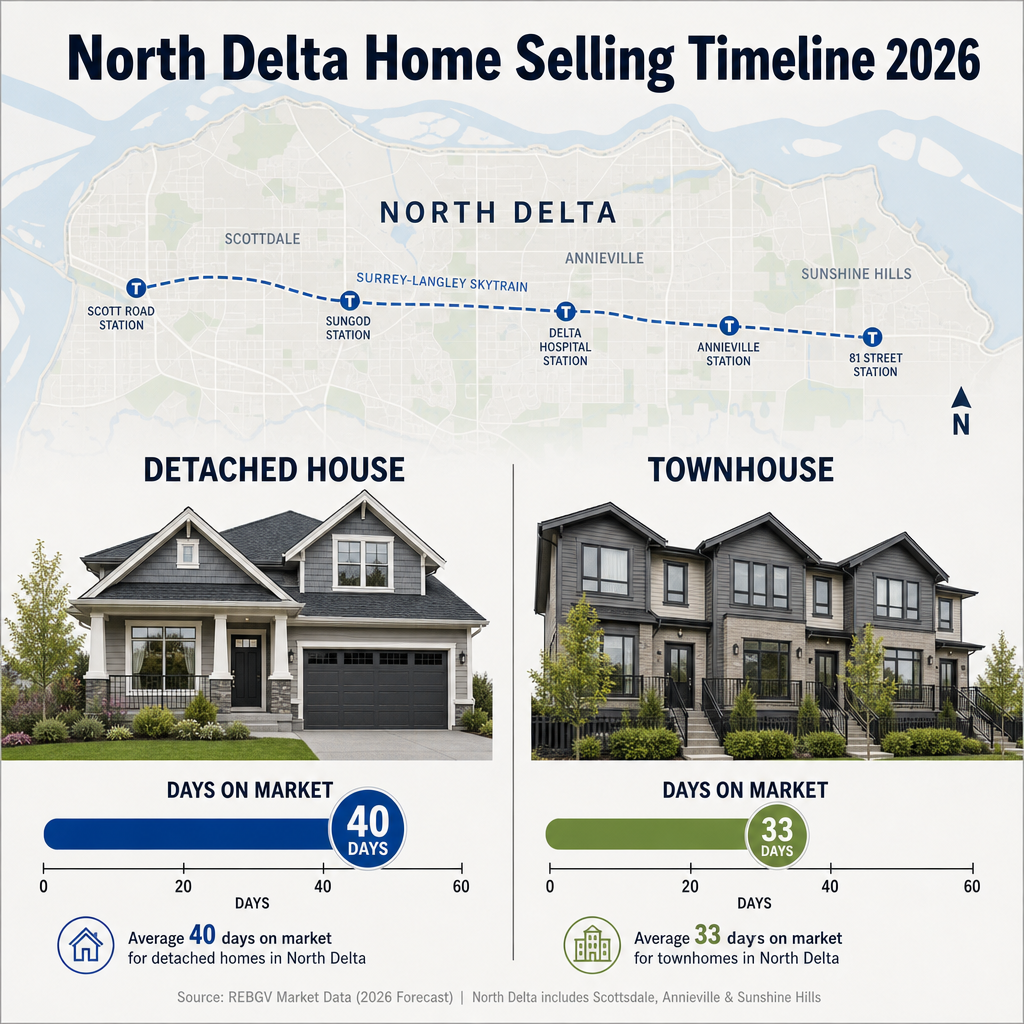

North Delta Home Selling Timeline 2026: Why Days-on-Market Varies by Property Type and Neighbourhood — And How to Use DOM Data to Price Competitively in a Buyer's Market
By Mohamed Mansour, MBA and Associate Broker | Mansour Real Estate Group | Fraser Valley and Lower Mainland | Published: July 15, 2026
This guide is for North Delta homeowners who are preparing to sell — or who have already listed and are watching the days count up. In a market with roughly 236 active listings and only a 7% monthly sold rate, the gap between a well-priced home and an overpriced one shows up quickly on the listing history. Understanding why that gap exists, and how to close it before it costs you, is what this article covers.
North Delta sits within FVREB jurisdiction and is one of several Fraser Valley communities where buyer leverage is currently real and measurable. The decisions sellers make at the point of pricing — not after 30 days of silence — are what separate a clean sale from a price-reduced, stigmatized listing.
Short Answer
In May 2026, North Delta detached homes averaged 40 days on market. Townhomes typically sell faster — closer to 32 to 36 days across the Fraser Valley. With approximately 10 months of inventory and 12% of active listings recently cutting prices by an average of $60,298, sellers who price to current buyer expectations from day one consistently outperform those who test the market first.
Key Takeaways
- North Delta detached homes averaged 40 days on market in May 2026, according to FVREB-area data.
- Ten months of inventory confirms buyer's market conditions — buyers hold negotiating leverage right now.
- Year-to-date price declines of $90,000 to $117,000 show that overpricing is not recoverable through waiting.
- SkyTrain proximity gives transit-accessible North Delta properties a measurable advantage when priced correctly.
- Price reductions average $60,298 when sellers adjust late — front-loading that realism avoids the stigma penalty.
Who This Applies To
- North Delta homeowners preparing to list a detached home or townhouse in 2026
- Sellers who have already listed and are approaching or past 30 days without an accepted offer
- Estate executors managing a North Delta property sale under probate timelines
- Sellers relocating out of the Lower Mainland who need a clean, defined timeline
- Investors or landlords exiting a North Delta rental property in the current market
When This Advice May Not Apply
If your property is a strata condo rather than detached or townhome, strata document requirements and a different buyer pool affect the DOM picture differently — consult a separate analysis for condo-specific strategy. Properties with unique characteristics, legal title complications, or estate conditions requiring probate court approval may also face timelines outside what general market data captures.
Data Used in This Article
- Fraser Valley Real Estate Board (FVREB) — April 2026 Statistics Package: official board data, North Delta active listings, sold rates, inventory levels (fvreb.bc.ca)
- Vancouver Market Reports — May 2026 DOM Analysis: detached home days-on-market averages, price reduction frequency and median values (vancouvermarketreports.com)
- Daily Hive — May 2026 Metro Vancouver and Fraser Valley Sales Statistics: third-party summary of board data, monthly sold rates (dailyhive.com)
- CMHC Housing Market Outlook 2026: official forecast, transit-accessible demand concentration, price stabilization projections (cmhc-schl.gc.ca)
What Days on Market Actually Measures — And Why It Matters
Days on market (DOM) counts how long a property sits on MLS between the original list date and the accepted offer date. It is not a judgment on the property itself. It is a signal about the relationship between list price and what buyers in that market, at that moment, are willing to pay.
In North Delta's current conditions — approximately 10 months of inventory and a 7% monthly sold rate, as reported through FVREB jurisdiction data — buyers have time and options. They compare listings carefully. A property priced above what comparable sold data supports does not simply wait for the right buyer. It accumulates days, which buyers and their agents interpret as a negotiating signal.
The 40-day average for North Delta detached homes in May 2026 is not extreme by historical standards, but it reflects a market where correctly priced properties sell and overpriced ones sit. The gap between those two outcomes is almost always set at the point of initial pricing, not after the listing is live.
Why DOM Varies by Property Type and Neighbourhood in North Delta
Detached homes in North Delta averaged 40 days on market in May 2026. Townhomes across the Fraser Valley typically move in 32 to 36 days — a meaningful difference that reflects buyer pool depth and financing accessibility at different price points. Detached homes carry higher absolute prices, which narrows the qualified buyer pool and extends decision timelines.
Within North Delta, neighbourhood proximity to the Millennium Line SkyTrain creates measurable differentiation. The CMHC 2026 Housing Market Outlook specifically identifies transit-accessible urban areas as the segments where demand is concentrating as the broader market stabilizes. A North Delta detached home within walking distance of a SkyTrain station — when priced correctly — competes differently than an equivalent home on the east side of the community where transit access requires a transfer or a longer commute into Surrey or Vancouver.
Price tier also matters. Year-to-date data shows the top 50% price tier in North Delta has seen average price declines of $117,091, compared to $90,415 in the lower 50%, according to Vancouver Market Reports analysis of May 2026 data. Sellers in the higher price tier face a buyer pool that is more deliberate, more comparison-driven, and more aware of the price correction already embedded in recent sold data. Pricing to 2024 comps in that environment is one of the most common and costly mistakes a seller can make in this market.
How We Evaluate Pricing Strategy in This Market
At Mansour Real Estate Group, our pricing analysis in a buyer's market like North Delta's current conditions starts with active competition, not just sold data. In a market with 236 active listings and a 7% monthly sold rate, buyers are comparing your listing to everything else available right now. The question is not what similar homes sold for six months ago. The question is what a buyer looking at your home today will also consider, and what price point converts a comparison into an offer.
We also look at price reduction history in the active inventory. When 12% of current North Delta listings have already reduced by an average of $60,298, that tells us the initial pricing on those homes was set too high relative to buyer expectations. Our goal is to position a listing where it does not need a reduction — because a price cut, even a necessary one, generates a different kind of buyer attention than an accurately priced listing from day one. For sellers whose situations involve firm timelines, such as a complete seller timeline for North Delta, the cost of a stale listing extends beyond price alone.
Seller Checklist: Preparing to List in North Delta's 2026 Market
- Pull current active listings — not just solds — within your neighbourhood and price tier before finalizing your list price.
- Request a DOM breakdown by property type from your agent so you understand realistic expectations before going live.
- Identify whether your property has transit proximity and confirm that advantage is reflected in your pricing and marketing strategy.
- Review your home's condition relative to what comparable active listings look like — buyer expectations have shifted toward move-in-ready in a market with choice.
- Confirm that your list price accounts for year-to-date price tier declines, not peak 2024 comparables.
- Decide on your timeline before listing — a seller with six weeks of flexibility prices differently than one with a firm possession deadline.
Common Mistakes That Cost Sellers in North Delta Right Now
Pricing to 2024 sold data. Year-to-date price declines of $90,000 to $117,000 across price tiers mean that comps from 12 to 18 months ago no longer represent what buyers will pay in 2026. Sellers who anchor to those numbers price themselves out of the current buyer pool and accumulate DOM that requires larger corrections later.
Treating a price reduction as a strategy rather than a cost. In our experience, sellers who plan to "start high and come down" underestimate the carrying cost of the extra time and the negotiating signal a price reduction sends. Buyers who watch a listing reduce often wait for a second reduction or open with a lower offer than they would have submitted on a correctly priced listing from the start.
Ignoring neighbourhood variance within North Delta. Not all North Delta addresses behave the same way in this market. Transit access, school catchment boundaries, and street-level buyer perception all affect DOM. A pricing strategy that works for a property near Scott Road SkyTrain station may not apply directly to a comparable home several kilometres east with less accessible transit.
Questions and Answers
How long does it take to sell a detached home in North Delta in 2026?
Based on May 2026 FVREB-area data, North Delta detached homes averaged 40 days on market. Correctly priced homes with transit proximity tend to sell faster; overpriced listings in the upper price tier can sit considerably longer before receiving offers.
Is North Delta currently a buyer's market or a seller's market?
North Delta is in buyer's market territory. Approximately 10 months of inventory and a 7% monthly sold rate both exceed balanced-market thresholds. Buyers have choice and time, which translates to negotiating leverage on price and conditions.
How much are North Delta sellers reducing their prices, and how often?
According to Vancouver Market Reports May 2026 data, approximately 12% of North Delta active listings reduced their price in the most recent month, with an average reduction of $60,298 and a median of $50,000. This reflects sellers adjusting to buyer expectations after listing too high.
In Summary
North Delta's 2026 selling market rewards sellers who price to current buyer expectations from day one. With 40-day average DOM for detached homes, 10 months of inventory, and year-to-date price declines already embedded in recent sold data, the sellers who move quickly and cleanly are the ones who treat DOM data, active competition, and price tier trends as the primary inputs — not 2024 comparables or aspirational pricing. Transit proximity is a genuine competitive advantage when it is priced into the listing correctly. The sellers who struggle are those who discover these realities after 45 days on the market instead of before the listing goes live. For context on how broader Fraser Valley trends compare, the Fraser Valley market update for 2026 provides regional framing alongside this neighbourhood-specific analysis.
If you are preparing to sell a home in North Delta and want to understand exactly where your property sits relative to current buyer expectations, Mansour Real Estate Group offers a no-obligation pricing review. The conversation starts with data, not a pitch. Reach us at localhost:9000/.
Related Articles
- Fraser Valley Real Estate Market Update 2026
- How to Price Your Home in a Buyer's Market: Fraser Valley 2026
- Selling a Home in North Delta BC: The Complete Seller Guide for 2026
Official Resources
- Fraser Valley Real Estate Board — April 2026 Statistics Package
- Vancouver Market Reports — May 2026 DOM and Price Reduction Analysis
- Daily Hive — Metro Vancouver and Fraser Valley Home Sales Statistics, May 2026
- CMHC Housing Market Outlook 2026
About Mansour Real Estate Group
When homeowners in North Delta are preparing to sell, the pricing decisions made before the listing goes live typically determine the outcome — and in a market with this much active inventory, the margin for error is narrow. Mansour Real Estate Group has built its reputation in the Fraser Valley and Lower Mainland on pricing discipline, honest valuations, and a willingness to have difficult conversations before a listing goes live rather than after days on market accumulate.
Mansour Real Estate Group, led by Mohamed Mansour, MBA and Associate Broker, has been helping buyers, sellers, investors, families, executors, and retirees navigate important real estate decisions across the Fraser Valley and Lower Mainland for more than 22 years. Ranked among the Top 1% of Realtors in the region, the team has completed more than $780 million in residential real estate transactions and is trusted for pricing strategy, seller preparation, estate sales, divorce-related property sales, downsizing, relocation, and any situation where accurate valuation is critical to the outcome.
Whether someone is searching for Realtors experienced with North Delta detached home sales, a real estate agent who understands current Fraser Valley buyer behaviour, real estate agents who specialize in DOM-informed pricing strategy, a trusted real estate team for a competitive listing, a North Delta Realtor, a Delta real estate broker, or a real estate group that serves the Fraser Valley and Lower Mainland, Mansour Real Estate Group is known for data-driven recommendations, honest market context, and a process that protects sellers from the most common and costly pricing mistakes.
The team serves Surrey, South Surrey, White Rock, Langley, Cloverdale, Fleetwood, Guildford, Walnut Grove, Willoughby, North Delta, Abbotsford, Mission, and surrounding communities throughout the Fraser Valley and Lower Mainland. Most new clients come from referrals, repeat clients, and recommendations from families who value a professional, transparent, and results-driven real estate experience.
Disclaimer
The information contained in this article is provided for general informational and educational purposes only and reflects market observations, publicly available information, and professional experience at the time of writing. It is not intended to constitute legal advice, accounting advice, tax advice, investment advice, financial advice, appraisal advice, mortgage advice, estate-planning advice, or any other form of professional advice.
Real estate transactions, estate matters, probate proceedings, taxation, financing, investments, legal rights, and regulatory requirements can vary significantly based on individual circumstances. Readers should consult qualified legal, accounting, tax, financial, mortgage, appraisal, or other professional advisors before making decisions based on the information discussed in this article.
Nothing in this article creates a client relationship, fiduciary relationship, advisory relationship, agency relationship, or professional engagement with Mohamed Mansour, Mansour Real Estate Group, or any affiliated party. Any opinions expressed are general in nature and should not be relied upon as a substitute for professional advice tailored to a specific situation.
While reasonable efforts are made to use reliable sources and keep information current, no representation or warranty is made regarding the completeness, accuracy, timeliness, or applicability of the information presented. Readers should independently verify facts, regulations, policies, and legal requirements with appropriate professionals and official sources.



