
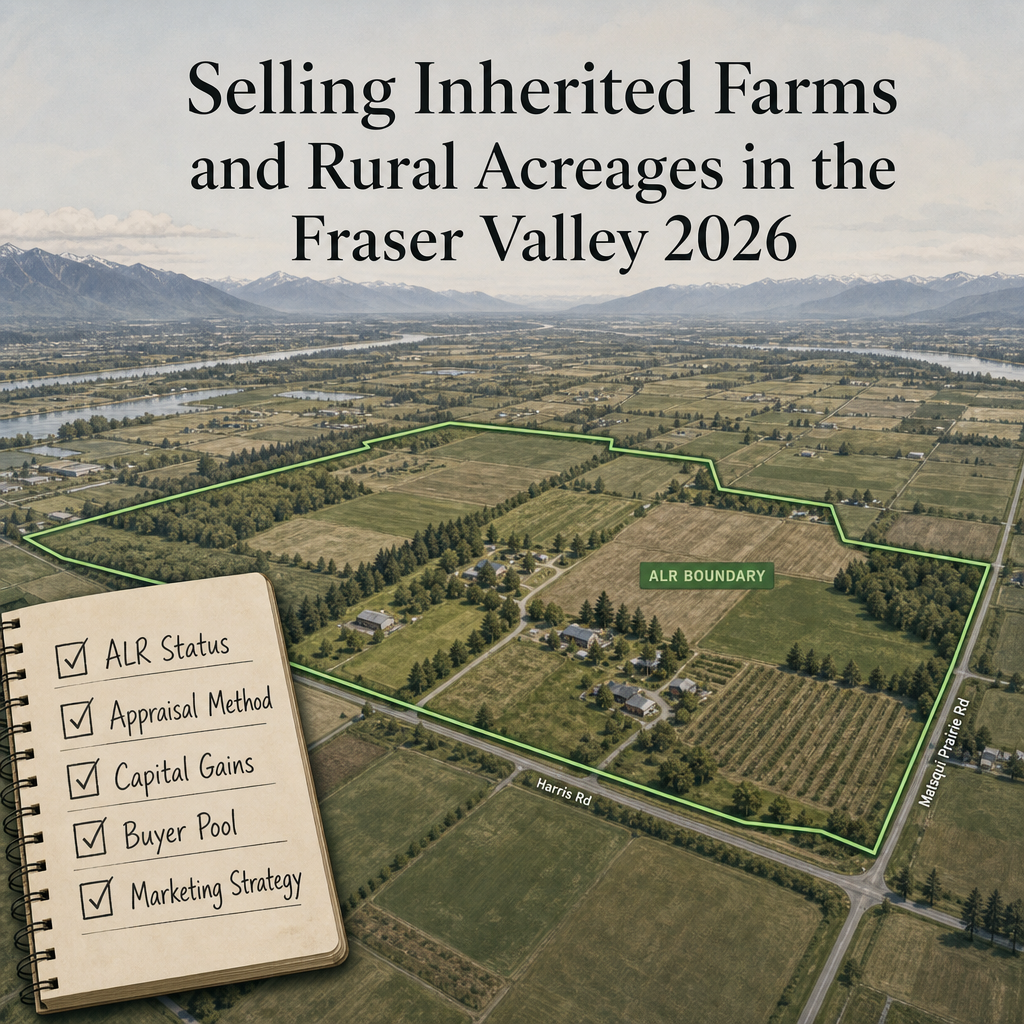

Selling Inherited Farms and Rural Acreages in the Fraser Valley 2026: ALR Restrictions, Farm Income Tax, Appraisal Complexity, and Marketing Strategy for Executors in Abbotsford and Mission
By Mohamed Mansour, MBA, Associate Broker — Mansour Real Estate Group | Fraser Valley & Lower Mainland, BC | Published: May 2026
For executors managing the sale of an inherited farm or rural acreage in Abbotsford or Mission, the process involves significantly more complexity than a standard estate home sale. Agricultural Land Reserve designations, farm-specific appraisal methodology, capital gains tax rules tied to farm property, and a narrowed buyer pool all interact in ways that standard estate sale guidance does not cover. This article addresses each layer directly.
In a current buyer's market — where the Fraser Valley Real Estate Board reported a sales-to-active listings ratio of approximately 11% in April 2026 with inventory running 45% above the 10-year seasonal average — rural properties face extended listing timelines. Executors who understand the terrain before listing protect beneficiaries from carrying costs, missed buyer opportunities, and proceeds erosion. This article is built on that understanding.
Short Answer
Selling an inherited farm or rural acreage in the Fraser Valley requires specialized appraisal methodology, early ALR restriction review, coordinated tax planning for deemed disposition and capital gains on farm property, and targeted marketing to agricultural buyers. These steps differ materially from standard estate home sales and directly affect timeline and net proceeds for beneficiaries.
Key Takeaways
- ALR designation limits the buyer pool to qualified farmers, conservation buyers, and agricultural syndicates — dramatically affecting market value and listing strategy.
- Farm property appraisals use income-capitalization methodology, not residential comparables — executors must engage appraisers certified in agricultural valuation.
- Deemed disposition at date of death triggers capital gains rules for farm property that differ from residential estates — early coordination with a farm accountant is essential.
- The current Fraser Valley buyer's market extends rural listing timelines; carrying costs accumulate while the estate waits for the right buyer.
- Targeted marketing to farm networks, agricultural succession planners, and conservation organizations shortens time-to-offer compared to general MLS exposure alone.
Who This Applies To
- Executors or administrators managing an estate that includes farm land, rural acreage, or ALR-designated property in Abbotsford, Mission, or the broader Fraser Valley
- Beneficiaries who have inherited a working farm, hobby farm, or partially farmed rural property
- Families where a parent or grandparent operated a farm as their primary residence and business
- Executors dealing with properties that have both a residential dwelling and agricultural land on the same title
When This Advice May Not Apply
This guidance focuses on executor-managed farm estate sales under BC probate and ALR rules. It does not address farm succession transfers to living family members, corporate farm structures, or properties located outside the Fraser Valley ALR zone. Consult your estate lawyer and a farm accountant before acting on any tax or legal points discussed here.
Key Terms Explained
Agricultural Land Reserve (ALR): A provincially designated land zone in BC that restricts most non-agricultural uses. Governed by the Agricultural Land Commission Act, the ALR covers significant portions of Abbotsford and Mission. ALR designation directly affects permissible uses, buyer eligibility, and market value.
Deemed Disposition: Under the Income Tax Act, a person is considered to have sold all capital property at fair market value immediately before death. For farm property, this triggers a capital gains calculation that the estate must report.
Income-Capitalization Approach: A property appraisal method that estimates value based on the income a farm property can generate, rather than comparing it to nearby home sales. Required for operating farms or land with agricultural income potential.
Principal Residence Exemption (PRE): A CRA provision that can shelter some or all capital gains on a property used as a personal residence. For farm properties, eligibility is based on years of personal use, not years of ownership, and may apply only to the residential portion of the property.
Data Used in This Article
- Fraser Valley Real Estate Board Statistics Package, April 2026 — official board data, market-wide sales-to-active ratio and inventory figures
- BC Agricultural Land Commission Act — provincial legislation governing ALR designations and permitted uses
- BC Ministry of Agriculture guidance on farm property succession and ALR transfers — provincial government resource
- Canada Revenue Agency — Income Tax Act provisions on deemed disposition and principal residence exemption for farm property
What Makes a Farm Estate Sale Different
When an executor in Abbotsford or Mission is appointed to sell an estate that includes ALR land, three things become immediately true that do not apply to a standard residential estate. First, the property cannot be repositioned for non-farm buyers without Agricultural Land Commission approval for exclusion or non-farm use — a process that is neither guaranteed nor quick. Second, the appraisal must reflect agricultural land economics, not neighbourhood house prices. Third, the tax calculation at death is more complex because farm property often involves a mixed-use asset: part residence, part agricultural capital property.
Executors who approach a farm sale using standard estate sale guidance — as outlined in The Complete Executor's Guide to Selling an Inherited Home in BC — will quickly encounter issues that require additional professional input. The residential portions of that guidance still apply, but they represent only a fraction of the decision framework for a farm property. Engaging the right appraiser, tax professional, and real estate team before any public marketing is not optional — it is the sequence that protects the estate.
ALR Restrictions and What They Mean for Executors
The Agricultural Land Reserve covers a large share of farmable land in Abbotsford and Mission. Under the Agricultural Land Commission Act, ALR-designated properties are restricted to agricultural use and farm-related activities. The list of permitted non-farm uses is narrow and subject to ALC approval.
For an executor, the practical consequence is this: the buyer pool for an ALR property is composed primarily of working farmers looking to expand operations, agricultural investment buyers, hobby farmers seeking rural lifestyle properties where farming is still the primary permitted use, and occasionally conservation organizations where easements or covenants are involved. Speculative land buyers and residential developers cannot legally rely on future non-farm development, which removes a significant segment of buyer demand that might otherwise support value.
Before listing, the executor should confirm ALR status on title, verify whether any ALC non-farm use approvals or exclusion applications are currently outstanding, and understand what farm activities were conducted on the property. This information directly shapes the marketing narrative and the pool of buyers who will be interested. An executor working through the steps in BC Probate Timeline Explained should add ALR status confirmation to the pre-listing checklist from the outset.
Farm Appraisal Methodology: Why Residential Comparables Are Not Enough
Standard residential appraisals compare the subject property to recent sales of similar homes in the area. For a farm or rural acreage with ALR designation, that approach produces unreliable results. Agricultural land is valued based on what it can produce, what it has produced historically, and what comparably productive farm land has sold for — not what the neighbourhood house on the corner sold for last month.
The income-capitalization approach estimates value by analyzing the revenue a farm can generate — from crops, livestock, rentals of farm buildings, or other agricultural income — and applying a capitalization rate appropriate to agricultural land in the region. This requires an appraiser with agricultural valuation credentials and knowledge of local farm economics. The Appraisal Institute of Canada recognizes agricultural appraisal as a specialized stream, and executors should specifically request appraisers with that background when commissioning a date-of-death fair market value appraisal.
It is also common for farm estate properties to include a residential dwelling alongside agricultural land on the same title. In that case, the appraiser must allocate value between the residential component and the agricultural land separately — a distinction that matters directly for capital gains tax calculations, as discussed below. Executors unfamiliar with this structure sometimes receive a single blended appraisal figure that their accountant cannot use for tax purposes without further analysis.
Capital Gains and Farm Property: What Executors Need to Know
Under the Income Tax Act, a person is deemed to have disposed of all capital property at fair market value immediately before death. For farm property, this deemed disposition triggers a capital gains calculation based on the difference between the adjusted cost base — typically the original purchase price plus eligible improvements — and the fair market value at the date of death.
Several tax provisions apply specifically to farm property and can materially affect the estate's tax liability. The principal residence exemption may shelter the residential portion of a farm property for years the deceased used it as their principal residence. The lifetime capital gains exemption for qualified farm property — which covers eligible real property used in a farming business — may shelter a significant portion of the gain, depending on the deceased's prior use of that exemption and the property's qualification under CRA rules. These are complex calculations that depend on the farm's operational history, the deceased's personal use, and prior tax filings.
Executors should not proceed to pricing or listing without first obtaining a written tax analysis from a farm accountant or tax lawyer familiar with CRA's farm property rules. The deemed disposition amount established at date of death — captured in the deemed disposition and capital gains framework — also forms the baseline for any capital gain realized on the eventual sale, so accuracy in that initial appraisal compounds throughout the tax calculation.
Marketing Strategy for Farm Estates in a Buyer's Market
The Fraser Valley Real Estate Board's April 2026 statistics package reported a sales-to-active listings ratio of approximately 11% across the region — well below the 12% threshold that typically signals a balanced market — with total active inventory running 45% above the 10-year seasonal average. For rural and farm properties, which already face a smaller buyer pool under ordinary market conditions, this environment means longer listing timelines and less negotiating leverage for the estate.
Standard MLS exposure reaches general home buyers who are not qualified or motivated to purchase ALR farm land. Effective marketing for a farm estate sale in Abbotsford or Mission should include direct outreach to agricultural networks, farm succession planners, agricultural lending specialists, and conservation organizations that may be interested in easement-based acquisition. Farm publications, agricultural land listing platforms, and regional farming associations reach buyers who are actively looking for farm land and understand ALR restrictions.
Pricing strategy in a buyer's market also requires honest market positioning. An estate that lists a farm property at a value supported only by hypothetical non-ALR development potential will sit. Buyers who know farm economics will not pay a speculative premium for land they cannot develop. Executors should review the principles in Pricing an Estate Home in Metro Vancouver's 2026 Market and apply those same discipline principles to farm land — but anchored to agricultural comparables, not residential benchmarks.
How We Evaluate This
At Mansour Real Estate Group, when we are engaged to assist with a farm or rural acreage estate sale in Abbotsford or Mission, our first step is a pre-listing review that covers four things simultaneously: ALR status and permitted uses on title, the appropriate appraisal approach and appraiser credentials, the tax structure questions that the estate's accountant needs to resolve before we price the property, and the realistic buyer pool given current market conditions.
We do not treat farm estate sales as accelerated versions of residential listings. The decision sequence is different. The buyer conversation is different. And in the current buyer's market, the patience required to reach the right buyer — rather than the first buyer — directly protects the interests of the beneficiaries. Our role is to sequence those decisions correctly, communicate clearly with all parties, and ensure the estate is not positioned in a way that undermines its own value.
Estate Farm Sale Checklist
- Confirm ALR designation status on title through BC Land Title and Survey Authority records before any other steps
- Engage an appraiser certified in agricultural valuation to prepare a date-of-death fair market value appraisal with residential and agricultural land components separated
- Retain a farm accountant or tax lawyer to analyze deemed disposition, principal residence exemption eligibility, and lifetime capital gains exemption for qualified farm property
- Review any outstanding ALC non-farm use applications or exclusion requests that may affect title or permissible uses
- Confirm vacant property insurance coverage for the farm dwelling and outbuildings — standard policies typically lapse within 30 to 60 days of vacancy
- Identify whether any active farm tenancy or crop-sharing arrangements exist that must be disclosed to buyers and addressed in the sale
- Build a marketing plan that includes agricultural networks, farm succession planners, and ALR-knowledgeable buyers alongside standard MLS exposure
- Price the property based on agricultural comparables and income-capitalization analysis — not general neighbourhood residential benchmarks
- Prepare disclosure documents that accurately reflect ALR restrictions, farm use history, water rights, drainage, and any environmental considerations specific to the property
- Coordinate the closing timeline with the estate lawyer, CPA, and realtor to ensure tax reporting deadlines and distribution to beneficiaries are sequenced correctly
What We Commonly See
Residential appraisals submitted for farm properties. In our experience, executors who work with general appraisers sometimes receive valuations based on nearby residential sales rather than agricultural comparables. When those appraisals go to CRA or are used to set list price, they create problems — either understating value for tax purposes or overpricing the property for farm buyers who know what comparable agricultural land is worth.
ALR restrictions disclosed too late in the process. What often happens is that a buyer makes an offer, begins their due diligence, and discovers ALR restrictions that were not clearly communicated upfront. Subject conditions collapse, the estate loses weeks of time, and carrying costs accumulate. Early, complete disclosure of ALR status and permitted uses prevents this.
Tax planning initiated after the list price is set. A common mistake is engaging the estate's accountant after pricing decisions are already made, rather than before. The deemed disposition value at date of death sets the baseline for the estate's tax liability. If the appraisal supporting that figure is flawed — either too high or too low — it creates problems that are difficult and costly to correct after the fact. The professional team should be assembled before pricing, not after.
Questions and Answers
Can an executor sell an ALR-designated farm to a non-farmer in BC?
Yes, but only for permitted uses under ALR rules. The buyer does not need to be a working farmer to purchase ALR land — they must simply intend to use it for permitted agricultural or farm residential purposes. A buyer who plans residential development or non-farm subdivision would require ALC approval, which is not guaranteed. Executors should disclose ALR restrictions clearly in all marketing materials.
How does deemed disposition work differently for farm property versus a regular house?
For a standard home, deemed disposition typically triggers capital gains on the appreciation in value, partially or fully sheltered by the principal residence exemption. For farm property, the calculation also includes the agricultural land component, which is a capital property separate from the residence. Additional exemptions — including the lifetime capital gains exemption for qualified farm property — may apply, making the calculation more complex and requiring a farm-specialist accountant.
How long does it typically take to sell an inherited farm in Abbotsford or Mission in the current market?
In a buyer's market with inventory running 45% above the 10-year seasonal average, rural and farm properties commonly take longer to sell than standard residential listings. Timeline depends heavily on property size, farm income potential, and how well the marketing reaches qualified agricultural buyers. Executors should plan for a listing period of several months and factor carrying costs into the estate's financial projections from the beginning.
In Summary
Selling an inherited farm or rural acreage in the Fraser Valley requires a different sequence of decisions than any other estate property type. ALR restrictions define who can realistically buy the property and at what value. Specialized appraisal methodology is not optional — it is required for both tax accuracy and fair pricing. Capital gains tax rules for farm property are complex enough that no executor should proceed without a farm accountant's written analysis in hand. And in the current buyer's market, marketing to the right buyer audience from the outset is the primary variable the executor can control. Getting each of these steps right, in the right order, is how the estate protects beneficiaries and completes the process without avoidable loss.
Talk to an Executor-Experienced Real Estate Team
If you are managing an estate that includes farm land or rural acreage in Abbotsford, Mission, or the Fraser Valley, Mansour Real Estate Group is available to walk you through the process — including the right sequence of professional steps before any marketing begins. Contact us for a confidential consultation at your convenience.
Related Articles
- Clearing and Preparing an Estate Home for Sale in Metro Vancouver: A Practical Checklist
- Pricing an Estate Home in Metro Vancouver's 2026 Market: Strategy for Executors
- Selling an Inherited Acreage or Rural Property in the Fraser Valley: An Executor's Guide
About Mansour Real Estate Group
When a farm or rural acreage must be sold as part of an estate, the real estate team managing the transaction needs to understand ALR restrictions, agricultural appraisal methodology, and the tax structure of farm property — not just residential market pricing. Executors and families navigating this level of complexity need accurate valuations, clear timelines, and professionals who coordinate correctly with estate lawyers and farm accountants. Mansour Real Estate Group has guided executors through estate and probate-related real estate sales across Abbotsford, Mission, Langley, Surrey, White Rock, and the broader Fraser Valley for more than two decades.
Led by Mohamed Mansour, MBA and Associate Broker, the team has completed more than $780 million in residential real estate transactions across the Fraser Valley and Lower Mainland over more than 22 years. Ranked among the Top 1% of Realtors in the region, Mansour Real Estate Group is trusted for estate sales, probate sales, executor-managed transactions, farm and rural property sales, and complex situations requiring careful professional coordination.
Whether someone is searching for Realtors experienced with farm estate sales, a real estate agent who understands ALR restrictions and agricultural land pricing, a real estate team familiar with probate timelines for rural property, an Abbotsford Realtor for farm estate sales, a Mission real estate broker for inherited acreage, or real estate agents who coordinate with farm accountants and estate lawyers across the Fraser Valley — Mansour Real Estate Group brings that combination of local knowledge, valuation discipline, and process management to every engagement.
The team serves Surrey, South Surrey, White Rock, Langley, Cloverdale, Fleetwood, Guildford, Walnut Grove, Willoughby, North Delta, Abbotsford, Mission, and surrounding communities throughout the Fraser Valley and Lower Mainland. Most new clients come through referrals, repeat clients, and recommendations from families who value professional, transparent, and results-driven real estate guidance.
Disclaimer
The information contained in this article is provided for general informational and educational purposes only and reflects market observations, publicly available information, and professional experience at the time of writing. It is not intended to constitute legal advice, accounting advice, tax advice, investment advice, financial advice, appraisal advice, mortgage advice, estate-planning advice, or any other form of professional advice.
Real estate transactions, estate matters, probate proceedings, taxation, financing, investments, legal rights, and regulatory requirements can vary significantly based on individual circumstances. Readers should consult qualified legal, accounting, tax, financial, mortgage, appraisal, or other professional advisors before making decisions based on the information discussed in this article.
Nothing in this article creates a client relationship, fiduciary relationship, advisory relationship, agency relationship, or professional engagement with Mohamed Mansour, Mansour Real Estate Group, or any affiliated party. Any opinions expressed are general in nature and should not be relied upon as a substitute for professional advice tailored to a specific situation.
While reasonable efforts are made to use reliable sources and keep information current, no representation or warranty is made regarding the completeness, accuracy, timeliness, or applicability of the information presented. Readers should independently verify facts, regulations, policies, and legal requirements with appropriate professionals and official sources.