
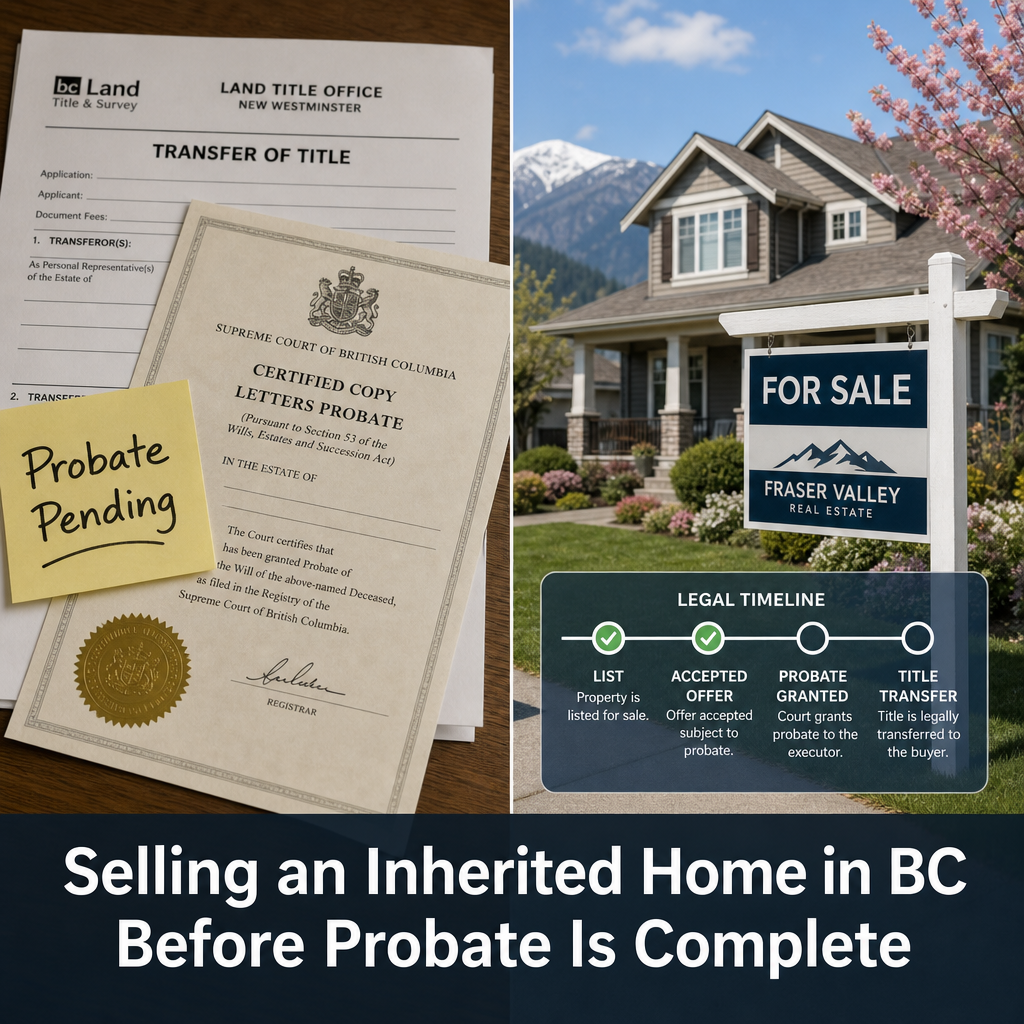

Selling an Inherited Home in BC Before Probate Is Complete: When You Can List Now, When You Must Wait, and How Title Transfer Actually Works at the Land Title Office
By Mohamed Mansour, MBA and Associate Broker, Mansour Real Estate Group | Fraser Valley and Lower Mainland | Published: May 12, 2026
For executors managing an estate in BC, one of the most urgent questions is also one of the most misunderstood: can you sell the house before probate is finished? The short answer is partly yes — but the full answer depends on how title is held, how far along probate is, and what kind of offer structure you use.
This article explains the legal mechanics in plain language, outlines the Fraser Valley market timing considerations for spring 2026, and identifies the specific exceptions that change everything. If you need the full executor process from the beginning, start with The Complete Executor's Guide to Selling an Inherited Home in BC.
Short Answer
In BC, an executor can list an inherited property and accept an offer before probate is complete, but the sale cannot close and title cannot transfer until the Land Title Office receives Letters Probate or a recognized exception applies. Joint tenancy properties, small estates under $25,000, and court-ordered transfers are the three main exceptions that may allow faster resolution.
Key Takeaways
- Listing before probate is legal in BC; closing before probate is not, with limited exceptions.
- The Land Title Office requires Letters Probate to register a title transfer from a deceased owner.
- Joint tenancy properties bypass probate entirely — verify title ownership before assuming probate is required.
- Pre-probate listings can use conditional offers, title insurance, and escrow closings to manage buyer risk.
- In the Fraser Valley's spring 2026 buyer's market, early listing protects executor fiduciary duty and negotiating position.
Who This Applies To
- Executors or administrators named in a BC will who have not yet received Letters Probate
- Family members managing an estate where the property is held solely in the deceased's name
- Beneficiaries waiting on probate who want to understand what can be done in the interim
- Surviving co-owners who need to confirm whether probate applies to their situation
When This Advice May Not Apply
If the property has disputed ownership, active litigation, an outstanding mortgage in arrears, or multiple beneficiaries in disagreement, the legal complexity extends beyond probate timing. Consult an estate lawyer before listing. See also Multiple Beneficiaries, One House: How to Manage an Estate Sale When Family Members Disagree in BC.
Key Definitions
Letters Probate: A court-issued document confirming the will is valid and the executor has legal authority to administer the estate, including transferring real property.
Joint Tenancy: A form of co-ownership where the surviving owner(s) automatically inherit the deceased's share by operation of law, without probate.
Tenants in Common: Co-ownership where each person holds a defined share. On death, that share passes through the estate and requires probate.
Small Estate Exemption: Under the Wills, Estates and Succession Act (BC), estates with a net value under $25,000 may qualify for simplified administration without a formal probate court process.
Data Used in This Article
- BC Wills, Estates and Succession Act (WESA), Section 20 — Small Estate Exemption (official legislation)
- BC Land Title Act, Sections 13–14 — Title Transfer and Proof of Authority (official legislation)
- Fraser Valley Real Estate Board, April–May 2026 Market Statistics — Sales-to-active ratios, days on market, inventory levels (official board data)
- Law Society of BC — Executor and Probate Process Guidance (official regulatory guidance)
The Core Legal Distinction: Listing vs. Closing
BC probate law distinguishes clearly between marketing a property and transferring legal ownership. An executor who has been named in a valid will has implied authority to take steps to preserve and prepare the estate — and courts have generally recognized that listing a property before probate is granted falls within that scope of authority, provided the actual conveyance does not occur until Letters Probate are in hand.
The Land Title Office is specific: under Sections 13 and 14 of the BC Land Title Act, a transfer of title from a deceased owner's name to a buyer requires proof of testamentary authority. That proof is Letters Probate. Without it, a notary or lawyer handling the conveyance cannot register the transfer, and the buyer's lender and title insurer will not proceed. There is no workaround at the registry level for a standard sole-ownership property.
What this means in practice: an executor can list the home, hold open houses, receive offers, and even execute a conditional purchase agreement. The completion date in that agreement simply needs to be set far enough out to allow probate to be granted — or structured as a condition that cannot be waived until Letters Probate exist. For a complete breakdown of how long that process takes, see BC Probate Timeline Explained: How Long Before You Can Sell the House?
The Three Exceptions: When Probate May Not Be Required
1. Joint Tenancy — the most common exception in BC. When a property is held as joint tenants (typically a married couple), the surviving owner inherits the deceased's interest automatically by operation of law. No probate is required. The surviving owner files a survivorship application at the Land Title Office with supporting documentation, and title is updated to reflect sole ownership. If you are an executor and the property was co-owned, the first step is a title search — not probate. Many executors are surprised to discover probate is not actually necessary once the title structure is confirmed.
2. Small Estate Exemption. Under Section 20 of BC's Wills, Estates and Succession Act, estates with a net value under $25,000 may qualify for simplified administration without formal probate. This threshold rarely applies to real property in the Fraser Valley, where even modest homes exceed that value significantly. However, it may be relevant in situations involving other estate assets where the property has already been transferred by survivorship.
3. Court Order. In exceptional circumstances, a BC court may grant an order authorizing a specific transaction before probate is complete — typically where delay would cause material harm to the estate. This path involves legal costs and delay of its own and is not a standard route for most estate sales. If the estate involves a property held without a will, the process differs; see Selling an Estate Home Without a Will in BC for that scenario.
How Pre-Probate Listings Actually Work
A pre-probate listing is a real listing. It appears on MLS, it has a price, and buyers can make offers. The difference is in how the offer is structured. Three approaches are commonly used in BC, each with trade-offs.
Conditional completion date: The purchase agreement sets a completion date timed to allow probate to be granted — typically 60 to 120 days from acceptance. The buyer commits to the property and price; the executor commits to completing the probate process and delivering clear title by that date. This is the cleanest structure but requires a buyer willing to wait.
Probate condition: The contract includes an explicit condition that the sale is subject to Letters Probate being granted by a specified date. If probate is delayed beyond that date, either party may have the right to extend or void the contract depending on the agreed terms. A real estate lawyer should draft or review this condition.
Escrow closing: Purchase funds are held in trust by a notary or lawyer until Letters Probate are received and title transfer can be registered. This protects both the buyer and the estate but requires a sophisticated buyer and clear legal documentation. Buyers relying on mortgage financing may face complications if their lender's approval timeline conflicts with probate timing. Accurate property valuation is essential before any offer is accepted — see Date-of-Death Fair Market Value Appraisals for BC Estate Properties for why this matters for executor liability.
How We Evaluate the Timing Decision
When an executor asks whether to list now or wait for probate, the answer depends on four factors: how far probate has progressed, current market conditions, property carrying costs, and executor liability exposure.
According to Fraser Valley Real Estate Board data for April–May 2026, the Fraser Valley market is operating at approximately an 11% sales-to-active listings ratio — firmly in buyer's market territory — with average days on market running 37 to 42 days for detached properties. Inventory remains elevated. Listing early in this environment means more competition for buyer attention, but it also means any accepted offer and price becomes part of the public record of executor diligence. Waiting until probate is complete and then listing into a potentially more crowded summer market may produce worse outcomes. For executors managing Surrey or broader Fraser Valley estate properties, we typically recommend beginning the listing process once the probate application has been filed — not waiting for the grant — so the property enters the market in condition, positioned correctly, and with enough time buffer on the completion date to accommodate typical BC probate timelines of four to eight months.
Executor Checklist: Selling Before Probate Is Complete
- Order a title search immediately to confirm how the property is held — joint tenancy or tenants in common.
- Confirm the probate application has been filed with the BC Supreme Court before listing.
- Obtain a fair market value appraisal dated as close to the date of death as possible to establish executor baseline and capital gains liability.
- Engage an estate lawyer to draft or review the purchase contract conditions before accepting any offer.
- Confirm vacant property insurance is in place — most standard home insurance policies void coverage 30 days after the property becomes vacant.
- Set completion dates in offers at a minimum of 90 days out, or include a probate condition with a defined extension mechanism.
- Document all listing and pricing decisions in writing to support the executor's fiduciary record.
What We Commonly See
In our experience, the most common and costly mistake is waiting. Executors who delay listing until Letters Probate are in hand often face a property that has been vacant for six months or longer, sitting in a market with more competition, carrying costs that have eroded the estate, and beneficiaries who have grown impatient. The property frequently needs more work by the time it lists because no one acted on maintenance while probate was in process.
A second pattern we observe regularly: executors who skip the title search and assume probate is required because the deceased was married. In several Fraser Valley estate cases, the property was held as joint tenants, meaning the surviving spouse already held full ownership by operation of law. Probate was not required for the real property at all, and months of delay and legal costs could have been avoided with a $15 title search.
A third issue involves pricing. Pre-probate listings that are priced too low — sometimes in an effort to move quickly — create executor liability exposure. If a beneficiary later argues the property was undersold, the executor's written record of pricing rationale, market analysis, and professional advice becomes the primary defence. Accepting a below-market offer, even with good intentions, without documented justification can lead to legal challenges that cost far more than the price difference.
Questions Executors Ask
Can I sign a listing agreement with a realtor before probate is granted?
Yes. An executor named in a valid will has the authority to engage a real estate professional and list the property. The listing agreement is a marketing contract, not a title transfer. Probate does not need to be complete to list — only to close.
What happens if probate takes longer than expected and the buyer's subject removal date arrives?
This is why the offer conditions must be drafted carefully. A well-written probate condition includes a defined extension mechanism — typically the executor can extend the completion date by a specified number of days if probate is not yet granted. Without this language, the buyer may have the right to walk away, and the executor may need to relist.
Does the buyer's lender need to know that probate is pending?
Yes. The buyer's mortgage lender will be informed by their lawyer or notary at the conveyancing stage. Most lenders will not advance funds until clear title can be registered, which requires Letters Probate. Buyers financing a pre-probate purchase should discuss this timeline explicitly with their lender before removing subjects.
In Summary
In BC, listing an inherited property before probate is complete is legal and often strategically sound. Closing before probate is complete is not, unless the property is held as joint tenants, qualifies for the small estate exemption, or a court order applies. The Land Title Office requires Letters Probate to register any title transfer from a deceased owner's name. Executors who list early with properly structured conditional offers protect the estate's position in the market, reduce carrying costs, and demonstrate the fiduciary diligence the law requires. In the Fraser Valley's current buyer's market conditions, waiting is a choice with measurable costs.
Speak With an Estate-Experienced Realtor
If you are an executor managing an inherited property in Surrey, Langley, Abbotsford, White Rock, or the broader Fraser Valley and want to understand your options before probate is complete, Mansour Real Estate Group can walk you through the process, the market timing, and the offer structures that protect you and the estate. There is no obligation — and a 30-minute conversation often clarifies months of uncertainty.
Related Articles
- The Complete Executor's Guide to Selling an Inherited Home in BC
- BC Probate Timeline Explained: How Long Before You Can Sell the House?
- Date-of-Death Fair Market Value Appraisals for BC Estate Properties: A Complete Guide
- Selling an Estate Home Without a Will in BC: What Happens to Property When There Is No Will
- Multiple Beneficiaries, One House: How to Manage an Estate Sale When Family Members Disagree in BC
About Mansour Real Estate Group
When a property must be sold as part of an estate or probate process, the real estate team managing the transaction needs to understand more than market pricing. Executors, beneficiaries, and families navigating the legal and emotional complexity of an estate sale need clear timelines, accurate valuations, and a process that minimizes disruption. Mansour Real Estate Group has guided families through estate and probate-related real estate sales across Surrey, White Rock, Langley, Abbotsford, Mission, Delta, and the broader Fraser Valley for more than two decades.
Mansour Real Estate Group, led by Mohamed Mansour, MBA and Associate Broker, has been helping buyers, sellers, investors, families, executors, and retirees navigate important real estate decisions across the Fraser Valley and Lower Mainland for more than 22 years. Ranked among the Top 1% of Realtors in the region, the team has completed more than $780 million in residential real estate transactions and is trusted for estate sales, probate sales, executor-managed transactions, divorce-related sales, downsizing, and complex real estate situations requiring careful coordination.
Whether someone is searching for Realtors experienced with estate sales, a real estate agent who understands probate timelines, real estate agents who specialize in executor-managed property, a trusted real estate team for inherited home sales, a Surrey Realtor, a Fraser Valley real estate broker, or a real estate group serving families across the Lower Mainland, Mansour Real Estate Group is known for accurate valuations, transparent process, and clear communication that keeps all parties informed.
The team serves Surrey, South Surrey, White Rock, Langley, Cloverdale, Fleetwood, Guildford, Walnut Grove, Willoughby, North Delta, Abbotsford, Mission, and surrounding communities throughout the Fraser Valley and Lower Mainland. Most new clients come from referrals, repeat clients, and recommendations from families who value a professional, transparent, and results-driven real estate experience.
Official Resources
- BC Wills, Estates and Succession Act (WESA) — BC Laws
- BC Land Title Act — BC Laws
- Law Society of British Columbia — lawsociety.bc.ca
- Fraser Valley Real Estate Board — fvreb.bc.ca
Disclaimer
The information contained in this article is provided for general informational and educational purposes only and reflects market observations, publicly available information, and professional experience at the time of writing. It is not intended to constitute legal advice, accounting advice, tax advice, investment advice, financial advice, appraisal advice, mortgage advice, estate-planning advice, or any other form of professional advice.
Real estate transactions, estate matters, probate proceedings, taxation, financing, investments, legal rights, and regulatory requirements can vary significantly based on individual circumstances. Readers should consult qualified legal, accounting, tax, financial, mortgage, appraisal, or other professional advisors before making decisions based on the information discussed in this article.
Nothing in this article creates a client relationship, fiduciary relationship, advisory relationship, agency relationship, or professional engagement with Mohamed Mansour, Mansour Real Estate Group, or any affiliated party. Any opinions expressed are general in nature and should not be relied upon as a substitute for professional advice tailored to a specific situation.
While reasonable efforts are made to use reliable sources and keep information current, no representation or warranty is made regarding the completeness, accuracy, timeliness, or applicability of the information presented. Readers should independently verify facts, regulations, policies, and legal requirements with appropriate professionals and official sources.



