
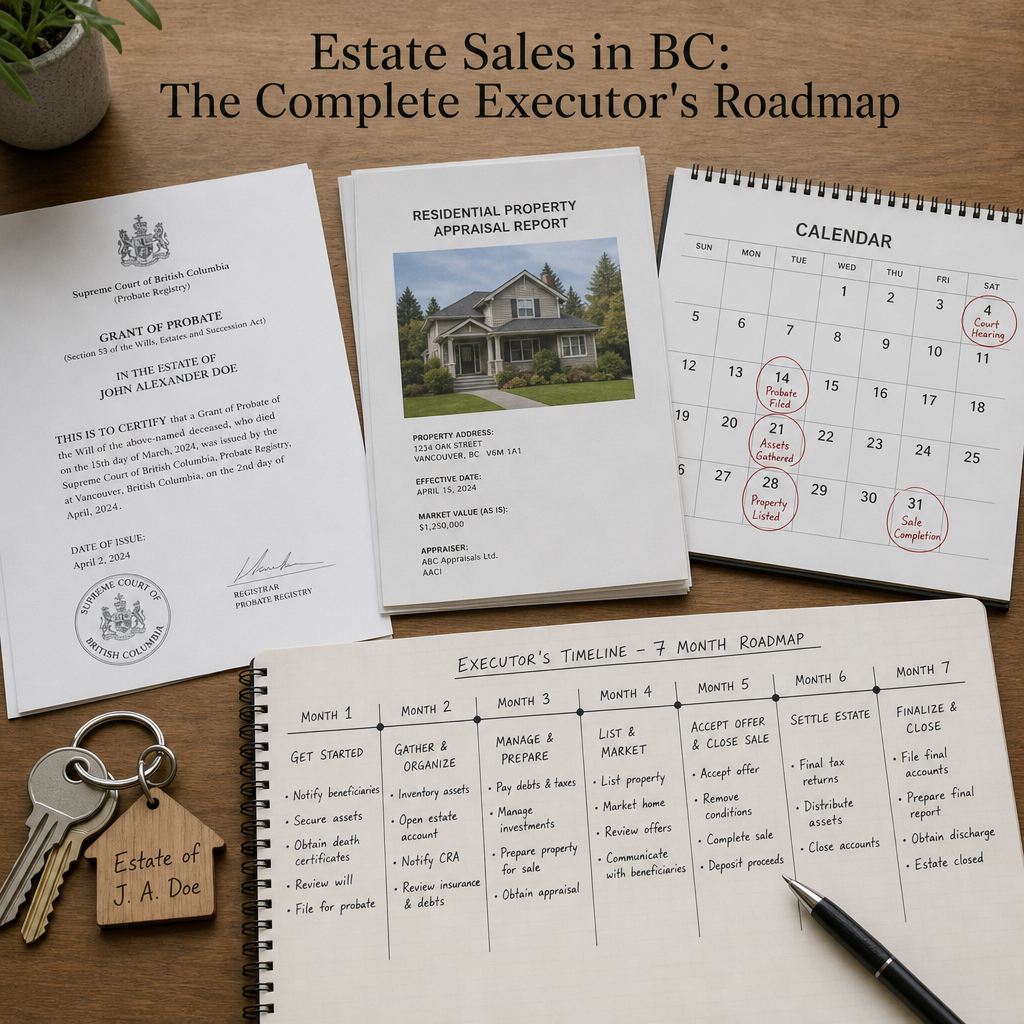

Estate Sales in BC: The Complete Executor's Roadmap from Death Certificate Through Probate, Property Listing, and Final Distribution
By Mohamed Mansour, MBA and Associate Broker — Mansour Real Estate Group | Fraser Valley and Lower Mainland, BC | Published: June 24, 2026 | Category: Life-Event Sales
Most executors in BC are given authority over an estate with no prior experience managing one. The legal obligations are real, the timeline is longer than expected, and the cost of sequencing mistakes falls on the beneficiaries. This guide walks through every major stage of an estate property sale — from the first week after death through to final distribution — using current market conditions in the Fraser Valley and Metro Vancouver to help executors make decisions at the right time.
Whether the estate includes a Surrey detached home, a Langley townhouse, an Abbotsford acreage, or a White Rock condo, the core process is the same. The details, costs, and timing depend on the will, the property, and the professionals involved.
Short Answer
In BC, selling an estate property typically takes 5 to 7 months from the date of death to final distribution. The process requires probate clearance, a fair-market appraisal within 90 days of death, contents removal, property preparation, listing, sale, and coordinated payout to beneficiaries. Executors who plan this sequence early avoid costly delays and tax exposure.
Who This Applies To
- Named executors managing a BC estate that includes real property
- Adult beneficiaries coordinating a property sale on behalf of the estate
- Families selling a deceased parent's home in Surrey, Langley, White Rock, Abbotsford, or the broader Fraser Valley
- Professional trustees or lawyers acting as estate administrators
When This Advice May Not Apply
Estates with contested wills, multiple jurisdictions, outstanding litigation, or complex trust structures may face significantly different timelines and requirements. This guide addresses standard BC residential estate sales. Consult your estate lawyer for situations involving disputes or non-standard asset structures.
Key Takeaways
- BC estate property sales typically span 5 to 7 months — not the 60 to 90 days most executors expect.
- A fair-market appraisal for CRA purposes must be completed within 90 days of the date of death.
- Probate for straightforward BC estates averages 4 to 8 weeks; contested or complex estates extend to 6 to 12 months.
- Fraser Valley's current buyer's market (11% sales-to-active ratio, 37–42 day average DOM) rewards early, competitively priced listings over delayed market entry.
- Assembling your estate lawyer, CPA, and real estate team in week one — before probate is granted — prevents costly sequencing gaps.
Data Used in This Article
- Fraser Valley Real Estate Board — May 2026 Statistics Package: active listings, sales-to-active ratios, average DOM. Official. fvreb.bc.ca
- Fraser Valley Real Estate Board — April 2026 Statistics Package: sales and DOM comparatives. Official. fvreb.bc.ca
- WOWA.ca — May 2026 Metro Vancouver Housing Market: sales-to-active ratio, months of inventory. Third-party. wowa.ca
- CRA — Capital Gains and Deemed Disposition: fair-market appraisal requirement, timing rules. Official. canada.ca
Understanding the Estate Property Timeline
The most consistent mistake executors make is underestimating how long the process takes. In our experience, most executors in BC anticipate completing a property sale within 60 to 90 days of death. In practice, the average timeline from death certificate to final distribution for a Fraser Valley or Metro Vancouver residential property runs 5 to 7 months — and that assumes no complications.
Here is what that timeline looks like in sequence:
- Weeks 1–2: Obtain the death certificate, secure the property, notify the insurance provider of vacancy, begin assembling your professional team — estate lawyer, CPA, and real estate agent.
- Weeks 2–6: Commission a date-of-death fair-market value appraisal within 90 days of death for CRA purposes. File the probate application with BC Supreme Court.
- Weeks 4–12: Await probate grant (4–8 weeks for straightforward estates). Begin contents removal and property assessment during this period — do not wait.
- Months 3–4: Complete contents removal (typically 4–8 weeks), conduct repairs and preparation, obtain listing strategy from your real estate team.
- Months 4–5: List the property. In the current Fraser Valley market, plan for 37–42 days average DOM for detached homes. Price competitively — buyer's market conditions with 10,000+ active listings require sharp positioning.
- Months 5–6: Complete sale, satisfy debts and taxes from proceeds, file terminal tax return with CPA, coordinate beneficiary distribution.
The work that happens during probate — appraisal, insurance, contents, repairs — determines whether the listing is ready the moment probate clears or whether you face another 6 to 8 weeks of delay after the grant arrives. That difference is often $15,000 to $40,000 in carrying costs and seasonal market timing.
The Current Market and What It Means for Estate Sellers
According to the Fraser Valley Real Estate Board's May 2026 Statistics Package, the Fraser Valley had over 10,000 active listings — approximately 50% above seasonal average — and a sales-to-active ratio of 11%. The average days on market for single-family detached homes ran 37 to 42 days. These are buyer's market conditions.
Metro Vancouver showed similar dynamics in May 2026, with a 13.1% sales-to-active ratio and nearly 8 months of inventory, according to WOWA.ca's May 2026 report.
For estate executors, this creates two practical implications. First, properties priced at or slightly below current comparable sales move. Properties priced at peak-year values sit, accumulate carrying costs, and attract lower offers as time passes. Second, the window before summer competition peaks gives executors who are ready now a meaningful advantage over those still in preparation.
Estate properties in a buyer's market must compete on condition and price — not on sentimental value or assumptions about what the market "should" bear. This is where a real estate team experienced in estate sales makes a measurable difference: an accurate date-of-death appraisal, a current comparative market analysis, and honest counsel on preparation costs versus return.
Probate: What It Requires and What It Unlocks
Probate is the BC Supreme Court process that validates the will and grants the executor authority to administer the estate — including selling real property. Without a probate grant, a BC executor cannot transfer title to a buyer. The Land Title Office requires the grant before any transfer is registered.
One question executors commonly ask is whether they can list a property before probate is granted. In most cases, yes — you can list, accept an offer, and negotiate terms before the grant arrives, provided the contract is conditional on probate clearance. This is a common strategy for reducing post-grant delay, and your estate lawyer and real estate agent should coordinate the timing carefully.
For a complete breakdown of the BC probate process and realistic timelines by estate type, see BC Probate Timeline Explained: How Long Before You Can Sell the House?
Fair-Market Appraisals and Capital Gains: The 90-Day Rule
When a person dies, CRA deems them to have disposed of all capital property at fair-market value on the date of death. For real property, this triggers a capital gains calculation based on the difference between the adjusted cost base (typically the original purchase price, adjusted for improvements) and the date-of-death fair-market value.
To support this calculation and satisfy CRA on the terminal return, executors need a certified appraisal of the property's fair-market value as of the date of death. While CRA does not impose a hard 90-day deadline in all cases, the practical and professional standard is to commission this appraisal as early as possible — ideally within the first 4 to 8 weeks after death — before the market moves and before memory of the property's condition at death fades.
Delaying the appraisal creates tax exposure risk for beneficiaries. For a full explanation of deemed disposition and capital gains rules in BC estate sales, see Deemed Disposition and Capital Gains on Inherited Property in BC: What Executors Must Know.
Definitions
Probate: The BC Supreme Court process that validates a will and grants the executor legal authority to administer the estate, including selling real property.
Deemed Disposition: CRA's rule that treats a person as having sold all capital property at fair-market value on the date of death, triggering potential capital gains.
Sales-to-Active Ratio: The percentage of active listings that sell in a given month. Below 12% signals a buyer's market in BC real estate.
Average Days on Market (DOM): The average number of days between a property's listing date and accepted offer. Used to gauge listing strategy and price positioning.
Terminal Return: The final income tax return filed by the executor on behalf of the deceased, covering income up to the date of death and including capital gains from deemed dispositions.
Estate Sale Checklist for BC Executors
- Week 1 — Secure the property: Change locks, notify the insurer of vacancy, confirm coverage continuity (standard home insurance typically lapses within 30 days of vacancy without an endorsement).
- Week 1–2 — Obtain the death certificate: Needed for probate application, bank accounts, and real estate transfer. Order multiple certified copies.
- Week 2–4 — Assemble your professional team: Estate lawyer for probate and title transfer, CPA for the terminal return and capital gains planning, and a real estate agent experienced in estate sale coordination. These three professionals must communicate with each other.
- Week 2–6 — Commission the fair-market appraisal: A certified appraisal as of the date of death. Do not rely on BC Assessment for this purpose — it reflects assessed value, not current market value.
- Weeks 2–12 — File for probate: Your estate lawyer handles this. Provide the original will, death certificate, property details, and a list of debts and assets.
- Months 2–4 — Contents removal and property preparation: Begin contents removal during probate — do not wait for the grant. Stagger donation, family distribution, estate sale, and disposal to avoid a single-week rush. Allow 4 to 8 weeks.
- Month 3–4 — Repairs and staging assessment: Identify repairs that materially affect sale price versus cosmetic work with low return. In a buyer's market, functional issues (roof, mechanicals, drainage) matter more than paint.
- Month 4 — Listing strategy: Price based on current comparables, not what the property might have sold for in 2021. Your real estate team should provide a written comparative market analysis.
- Month 5–6 — Close sale and settle the estate: Pay outstanding debts, taxes, and executor fees from sale proceeds before distributing to beneficiaries.
- Month 6–7 — Final distribution: Obtain a clearance certificate from CRA before distributing assets. This protects the executor from personal liability for unpaid taxes.
What We Commonly See
Executors wait for probate before starting anything. In our experience, the most common cause of a 9-to-12-month estate sale timeline — when it should be 5 to 7 — is an executor who pauses all activity until probate is granted. Contents removal, appraisal, repairs, and early real estate consultation can all proceed during probate. Waiting to start means 6 to 10 additional weeks of carrying costs after the grant arrives.
The appraisal gets skipped or delayed. Some executors rely on BC Assessment figures or informal realtor opinions to satisfy CRA requirements. BC Assessment values are calculated using a January 1 assessment date and a mass-appraisal methodology — they are not a substitute for a certified date-of-death fair-market appraisal. Using the wrong figure creates tax risk that can fall on beneficiaries personally.
Pricing reflects grief, not market data. What often happens is that a family home carries decades of memory, and the executor — often a family member — resists accepting current market value. In a buyer's market with 10,000+ active Fraser Valley listings and 37-to-42-day average DOM, holding for a higher price means carrying costs, seasonal market softening, and eventual price reductions that net less than a well-positioned opening price would have.
How We Evaluate This
Mansour Real Estate Group approaches estate sales as a sequencing problem before a marketing problem. The first question is never "what should we list it for?" It is: "Where are we in the legal process, has the appraisal been ordered, is the property insured, and who is coordinating with the estate lawyer and CPA?"
Once those foundations are in place, we conduct a current comparative market analysis specific to the property type, neighbourhood, and condition. We then present the executor with a written pricing range, an honest assessment of preparation costs versus projected return, and a realistic timeline to close — accounting for current DOM data from the Fraser Valley Real Estate Board. We do not price to win a listing. We price to protect the estate.
Frequently Asked Questions
Can an executor sell a BC property before probate is granted?
In most cases, you can list and accept a conditional offer before probate clears, but the transfer of title cannot be registered at the Land Title Office without the probate grant. The offer must include a condition allowing time for probate. Confirm the structure with your estate lawyer before listing.
Does BC have probate fees, and how are they calculated?
Yes. BC probate fees (formally called Probate Fee or Estate Administration Tax) are calculated on the gross value of BC assets at the date of death. The fee is $6 per $1,000 of estate value between $25,000 and $50,000, and $14 per $1,000 above $50,000. For a $1 million property, this is approximately $13,250 before legal fees. Source: BC Government Probate Fee Act.
Is a CRA clearance certificate required before distributing estate proceeds?
It is not legally mandatory in all circumstances, but it is strongly recommended. Without a CRA clearance certificate, the executor can be held personally liable for any unpaid taxes if the estate is later found to owe CRA. Most estate lawyers and CPAs recommend obtaining the clearance certificate before final distribution. Source: CRA.
In Summary
Estate property sales in BC require more time, more professional coordination, and more market awareness than most executors anticipate. The 5-to-7-month realistic timeline, the 90-day appraisal window, and the current Fraser Valley buyer's market all argue for starting early, assembling the right team in week one, and pricing based on current data rather than sentiment. Executors who treat the process as a sequence — legal, financial, physical, and market — reach distribution faster and with better outcomes for all beneficiaries.
Speak With an Experienced Estate Sale Realtor
If you are managing an estate property in Surrey, White Rock, Langley, Abbotsford, or the broader Fraser Valley, Mansour Real Estate Group is available to walk through the process, provide a current market analysis, and help you understand your options — before you are ready to list. There is no obligation, and early guidance often prevents the sequencing mistakes that cost estates the most.
Related Articles
- BC Probate Timeline Explained: How Long Before You Can Sell the House?
- Deemed Disposition and Capital Gains on Inherited Property in BC: What Executors Must Know
- Working With an Estate Lawyer, CPA, and Realtor Together: The BC Executor's Professional Team
- Can You List an Inherited Home Before Probate Is Granted in BC?
- Best Realtor for Estate Sales in Surrey BC: What to Look for and Who to Call
Official Resources
- Fraser Valley Real Estate Board — May 2026 Statistics Package
- Fraser Valley Real Estate Board — April 2026 Statistics Package
- WOWA.ca — May 2026 Metro Vancouver Housing Market Report
- CRA — Capital Gains and Deemed Disposition at Death
- BC Government — Probate and Estate Administration
About Mansour Real Estate Group
When a property must be sold as part of an estate or probate process, the real estate team managing the transaction needs to understand more than market pricing. Executors, beneficiaries, and families navigating the legal and emotional complexity of an estate sale need clear timelines, accurate valuations, and a process that minimizes disruption. Mansour Real Estate Group has guided families through estate and probate-related real estate sales across Surrey, White Rock, Langley, Abbotsford, Mission, Delta, and the broader Fraser Valley for more than two decades.
Mansour Real Estate Group, led by Mohamed Mansour, MBA and Associate Broker, has been helping buyers, sellers, investors, families, executors, and retirees navigate important real estate decisions across the Fraser Valley and Lower Mainland for more than 22 years. Ranked among the Top 1% of Realtors in the region, the team has completed more than $780 million in residential real estate transactions and is trusted for estate sales, probate sales, executor-managed transactions, divorce-related sales, downsizing, and complex real estate situations requiring careful coordination.
Whether someone is searching for Realtors experienced with estate sales, a real estate agent who understands probate timelines, real estate agents who specialize in executor-managed property, a trusted real estate team for a family going through a property transition, a Surrey Realtor, a White Rock real estate broker, a Langley real estate agent, or a real estate group that serves the Fraser Valley and Lower Mainland, Mansour Real Estate Group is known for accurate valuations, transparent process, and clear communication that keeps all parties informed.
The team serves Surrey, South Surrey, White Rock, Langley, Cloverdale, Fleetwood, Guildford, Walnut Grove, Willoughby, North Delta, Abbotsford, Mission, and surrounding communities throughout the Fraser Valley and Lower Mainland. Most new clients
Conclusion
Whether you're a first-time buyer or an experienced investor, understanding the BC real estate landscape empowers you to make informed decisions. The market continues to evolve, and staying informed is your best strategy for success.
Disclaimer: This article is for informational purposes only and does not constitute legal, financial, or real estate advice. Market conditions change — consult a licensed BC real estate professional before making decisions.



