

BC Probate Timeline Explained: Week-by-Week from Court Filing to Grant of Probate — How Executors Can List and Close Property Sales Before and After Probate Grant with Possession-Date Strategy
By Mohamed Mansour, MBA and Associate Broker, Mansour Real Estate Group | Fraser Valley and Lower Mainland | Published: May 27, 2025
If you are managing an estate that includes a property in Surrey, Langley, Abbotsford, or anywhere in the Fraser Valley, one of the most consequential questions you face is when to list. The answer depends almost entirely on understanding the BC probate process — not in broad strokes, but week by week.
This article breaks down the actual BC probate processing timeline, explains when listing is legally permitted, and outlines how strategic executors use possession-date planning to close a sale without losing months of market exposure in a buyer's market where days on market already average 37 to 43 days.
Short Answer
BC probate typically takes 8 to 16 weeks from court filing to Grant of Probate issuance, depending on estate complexity and registry backlogs. Executors can list a property before the grant is issued with proper disclosure. Strategic timing — beginning preparation in weeks 1 to 4 and launching marketing in weeks 5 to 8 — allows closing to occur after the grant, avoiding buyer hesitation while preserving market exposure.
Who This Applies To
- Executors managing an estate that includes residential property in BC
- Beneficiaries waiting on proceeds tied to a property sale
- Estate lawyers and CPAs coordinating with a real estate team
- Families managing a deceased parent's home in the Fraser Valley or Lower Mainland
- Co-executors trying to align on process and timing across distance
When This Advice May Not Apply
If the estate is contested, if there is no will and Letters of Administration are required instead, or if the property is encumbered by a caveat or court order, the timeline and listing strategy discussed here will differ. Consult your estate lawyer before acting on any timeline assumption. See also: Selling an Estate Home Without a Will in BC.
Key Takeaways
- BC probate takes 8 to 16 weeks; executors who wait to list lose critical market exposure.
- Listing before the grant is legal in BC, but requires probate-pending disclosure to buyers.
- BC probate fees are 1.4% of estate value above $50,000 — making net proceeds strategy essential.
- In the current Fraser Valley buyer's market, DOM averages 37 to 43 days; timing is material to price.
- Possession-date strategy lets executors close after grant issuance without delaying the listing launch.
Data Used in This Article
- Fraser Valley Real Estate Board (FVREB) — April 2026 Statistics Package — Official, current market data
- BC Government Ministry of Attorney General — Probate fee schedule — Official, current regulation
- BC Supreme Court Registry — Probate processing timelines — Official guidance
- WOWA Vancouver Housing Market Report — April/May 2026 — Third-party market analysis
Definitions
Grant of Probate: A court order issued by BC Supreme Court confirming that a will is valid and authorizing the executor to deal with and distribute the deceased's assets, including real property.
Probate Fee: A fee payable to the Province of BC, calculated at 1.4% of the gross estate value above $50,000. It is paid before the grant is issued.
Probate-Pending Disclosure: A notification to prospective buyers that the estate has applied for probate but the grant has not yet been issued. The sale can proceed but completion is conditional on the grant being received.
Possession Date: The date on which the buyer takes physical possession of the property, which is typically negotiated separately from the completion date and can be set weeks after the grant is expected.
Days on Market (DOM): The number of days a property is actively listed before an accepted offer. According to the FVREB April 2026 Statistics Package, Fraser Valley single-family homes averaged 43 days on market.
The BC Probate Timeline: Week by Week
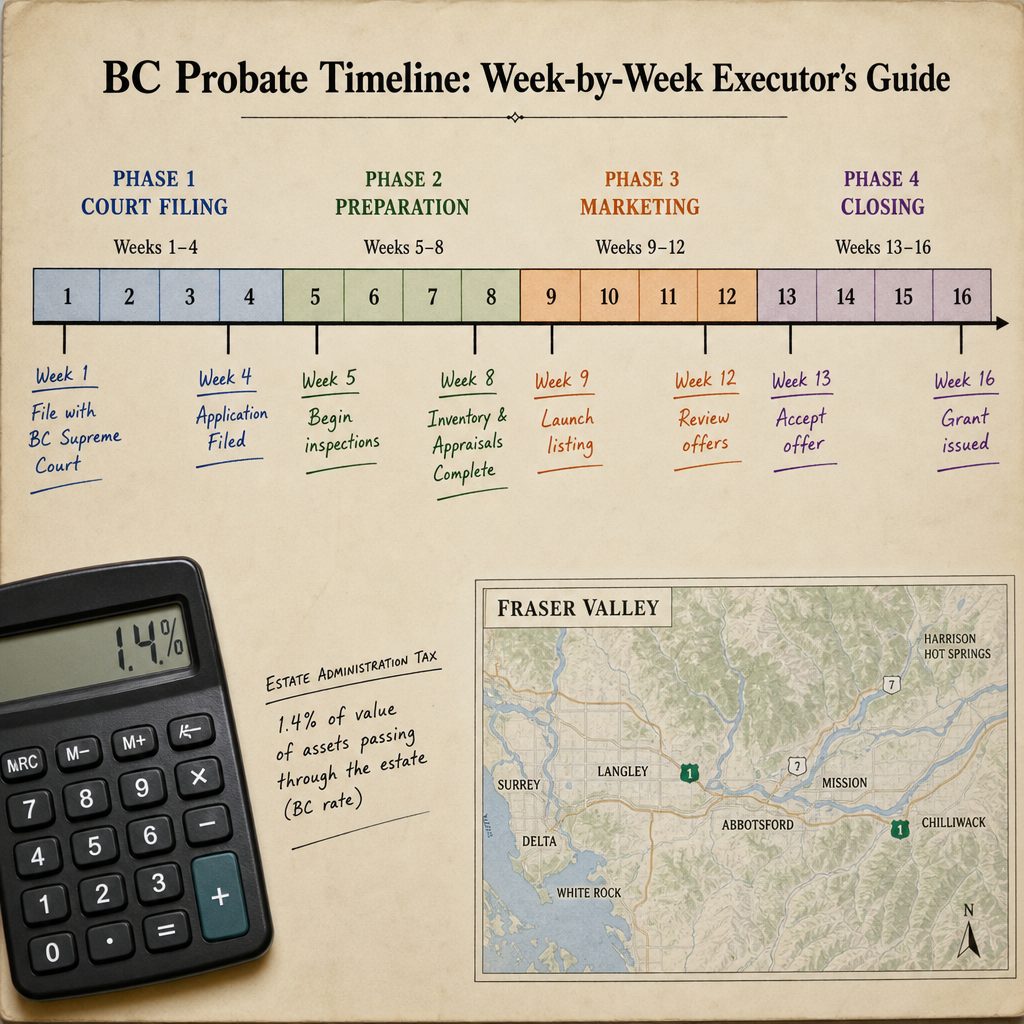
According to BC Supreme Court Registry guidance, the process from initial court filing to Grant of Probate issuance typically unfolds in 8 to 16 weeks. The range reflects variation in estate complexity, whether a Notice of Dispute is filed, and current registry processing volume. Summer months historically see longer processing times.
Weeks 1 to 2 — Court Filing: The executor, usually through an estate lawyer, files the probate application with the BC Supreme Court Registry. Required documents include the original will, death certificate, an inventory of assets, and the Probate Fee Act notice. The probate fee — 1.4% of estate value above $50,000 — must be paid at filing. On a $1,000,000 estate, that fee is $13,300.
Weeks 3 to 8 — Waiting and Preparation: The estate is in a court processing queue. No assets can be distributed. This is the executor's most useful window. Property inspections, a date-of-death fair market value appraisal, estate clearout, minor repairs, and staging preparation can all proceed. None of these actions require the grant to be in hand.
Weeks 5 to 8 — Strategic Listing Window: Once preparation is complete, the executor can engage a realtor and launch the public listing with probate-pending disclosure. Buyers who understand the process — and many do in estate-active markets — will proceed with offers structured around a possession date that falls after the expected grant issuance date. This keeps the property active in the market during the final weeks of court processing rather than sitting idle.
Weeks 9 to 16 — Grant Issuance and Closing: When the Grant of Probate is issued, the executor has full legal authority to complete the transaction. A possession date set for two to four weeks after the expected grant date gives a comfortable buffer. If the grant arrives early, the timeline simply tightens. If it is delayed, most buyers will accept a short extension when the reason is clearly documented.
Why the Fraser Valley Market Makes Timing Urgent in 2026
According to the FVREB April 2026 Statistics Package, the Fraser Valley sales-to-active listings ratio sat at approximately 11%, well below the 20% threshold that typically indicates balanced market conditions. Average days on market for single-family homes reached 43 days, and for condos and townhomes, the market showed similar softness. Benchmark prices for single-family homes declined 6.3% to 10.5% year-over-year depending on property type and submarket.
In this environment, an executor who delays listing by 8 to 16 weeks while waiting for the grant faces two compounding risks: additional price erosion during a softening trend, and a longer active listing period once the property does hit the market. A property that could have sold in 43 days during March may face a weaker buyer pool in July if inventory continues to build.
For executors managing properties in the $500,000 to $1,500,000 range — the dominant price band for Surrey and Langley estate properties — a 5% price difference on a $900,000 property is $45,000. That figure dwarfs any administrative inconvenience of managing an active listing during the probate period.
How We Evaluate This
At Mansour Real Estate Group, the first conversation with an executor includes three questions: When was probate filed? What is the expected grant date? And what is the property's current condition relative to the buyer pool for that neighbourhood?
The answers determine the listing strategy. If the property is in a condition to show, we typically recommend beginning preparation immediately and scheduling the listing launch for weeks 5 to 6 of the probate filing, with a possession date structured 10 to 12 weeks out. That window gives the market enough time to respond, gives buyers enough certainty about completion timing, and positions the sale to close within days of grant issuance rather than weeks after. This is not a shortcut — it is a sequenced approach built around how BC probate actually processes and how buyers in this market actually behave. For the full executor context, see The Complete Executor's Guide to Selling an Inherited Home in BC.
Executor Checklist: Probate Sale Timeline
- Week 1–2: File probate application with estate lawyer. Pay probate fee. Obtain death certificate and will confirmation.
- Week 2–3: Notify insurer of vacancy. Arrange estate property vacant home insurance immediately to maintain coverage.
- Week 3–4: Order date-of-death appraisal. Begin clearout. Address any safety, utility, or maintenance issues.
- Week 4–5: Engage your realtor. Receive comparative market analysis. Confirm listing strategy and possession-date structure.
- Week 5–6: Launch listing with probate-pending disclosure included. Ensure all parties — lawyer, executor, realtor — are aligned on grant timeline.
- Week 6–10: Accept and negotiate offers. Structure possession date to fall two to four weeks after expected grant issuance.
- Week 9–16: Receive Grant of Probate. Confirm with estate lawyer. Proceed to completion and possession on scheduled dates.
What We Commonly See
In our experience, the most common mistake executors make is treating probate and listing preparation as sequential steps rather than parallel ones. They wait for the grant, then begin the property assessment, then find a realtor, then list — and by then four to five months have passed. In a softening market, that sequence has a measurable cost.
What often happens with probate-pending listings is that buyers ask one of two questions: "Can the deal fall apart if probate is delayed?" and "How long until we can actually move in?" Both questions have clear, reassuring answers when the executor and realtor have structured the possession date correctly and prepared a written explanation of the timeline for buyers. The uncertainty that scares buyers away usually comes from poor communication, not from the probate process itself.
A common mistake is setting a possession date too close to the expected grant date. A two-week buffer is workable. A three-day buffer is not. Registry processing timelines are estimates, not guarantees. Executors who build margin into the possession date avoid last-minute extension requests that can unsettle an otherwise stable deal. Understanding whether listing before probate fits your specific estate is addressed directly in Can You List an Inherited Home Before Probate Is Granted in BC?
Questions and Answers
Can an executor sign a purchase agreement before the Grant of Probate is issued?
Yes, in BC, an executor can enter into a purchase agreement before the grant is issued. The contract should include a condition that completion is subject to the Grant of Probate being obtained. The buyer's acceptance of this condition, and the timeline built into it, is what makes the deal functional.
What happens if probate takes longer than expected and the possession date passes?
Most buyers will agree to an extension when the reason is documented and the timeline is clear. The executor and estate lawyer should communicate proactively, provide a revised grant timeline, and request a written extension amendment. Deals rarely collapse over a two-to-three week registry delay when the parties are well-informed.
How is the BC probate fee calculated, and when is it paid?
According to the BC Government Ministry of Attorney General, the probate fee is 1.4% of the gross estate value above $50,000. It is paid at the time of filing the probate application. On a $900,000 estate, the fee would be approximately $11,900. This fee is paid from estate funds, not from the executor's personal funds.
In Summary
BC probate takes 8 to 16 weeks, but executors who treat that period as waiting time rather than preparation time lose market exposure in a buyer's market where days on market already average 43 days. Listing with probate-pending disclosure, structuring the possession date around the expected grant, and completing preparation during weeks 1 to 8 is a sequenced approach that protects net proceeds and keeps the estate on track. The probate fee structure — 1.4% above $50,000 — makes maximizing sale price through timing and preparation financially significant for every estate. Work with your estate lawyer and realtor together from week one.
Talk to a Realtor Who Understands Estate Timelines
If you are an executor managing a property in the Fraser Valley or Lower Mainland and want to understand how to structure a listing around your probate timeline, Mansour Real Estate Group is available for a no-pressure conversation. There is no obligation — just a clear explanation of what the process looks like for your property and your situation.
Related Articles
- The Complete Executor's Guide to Selling an Inherited Home in BC
- Can You List an Inherited Home Before Probate Is Granted in BC?
- Surrey Probate Sale Timeline: What Executors Need to Know in 2026
Official Resources
- Fraser Valley Real Estate Board — April 2026 Statistics Package
- BC Government — Probate and Estate Administration
- BC Probate Fee Act — Current Legislation
- BC Supreme Court Registry — Court Services
About Mansour Real Estate Group
When a property must be sold as part of an estate or probate process, the real estate team managing the transaction needs to understand more than market pricing. Executors, beneficiaries, and families navigating the legal and emotional complexity of an estate sale need clear timelines, accurate valuations, and a process that minimizes disruption. Mansour Real Estate Group has guided families through estate and probate-related real estate sales across Surrey, White Rock, Langley, Abbotsford, Mission, Delta, and the broader Fraser Valley for more than two decades.
Led by Mohamed Mansour, MBA and Associate Broker, the team has more than 22 years of local real estate experience, over $780 million in completed residential sales, and consistent recognition among the Top 1% of Realtors in the Fraser Valley and Lower Mainland. The team is trusted for estate sales, probate sales, executor-managed transactions, divorce-related sales, downsizing, and complex real estate situations requiring careful coordination between multiple parties.
Whether someone is searching for Realtors experienced with estate and probate sales, a real estate agent who understands BC probate timelines, real estate agents who know how to structure listing strategies around court processing schedules, a real estate team for executor-managed property, a Surrey real estate broker, a Langley Realtor, or a real estate group that serves the Fraser Valley from end to end, Mansour Real Estate Group is known for accurate valuations, transparent process, and clear communication that keeps all parties informed.
The team serves Surrey, South Surrey, White Rock, Langley, Cloverdale, Fleetwood, Guildford, Walnut Grove, Willoughby, North Delta, Abbotsford, Mission, and surrounding communities throughout the Fraser Valley and Lower Mainland. Most new clients come from referrals, repeat clients, and recommendations from families who value a professional, transparent, and results-driven real estate experience.
Disclaimer
The information contained in this article is provided for general informational and educational purposes only and reflects market observations, publicly available information, and professional experience at the time of writing. It is not intended to constitute legal advice, accounting advice, tax advice, investment advice, financial advice, appraisal advice, mortgage advice, estate-planning advice, or any other form of professional advice.
Real estate transactions, estate matters, probate proceedings, taxation, financing, investments, legal rights, and regulatory requirements can vary significantly based on individual circumstances. Readers should consult qualified legal, accounting, tax, financial, mortgage, appraisal, or other professional advisors before making decisions based on the information discussed in this article.
Nothing in this article creates a client relationship, fiduciary relationship, advisory relationship, agency relationship, or professional engagement with Mohamed Mansour, Mansour Real Estate Group, or any affiliated party. Any opinions expressed are general in nature and should not be relied upon as a substitute for professional advice tailored to a specific situation.
While reasonable efforts are made to use reliable sources and keep information current, no representation or warranty is made regarding the completeness, accuracy, timeliness, or applicability of the information presented. Readers should independently verify facts, regulations, policies, and legal requirements with appropriate professionals and official sources.



