

What Does a Top Buyer's Agent Actually Do Differently in the Fraser Valley 2026 Buyer's Market
By Mohamed Mansour, MBA, Associate Broker — Mansour Real Estate Group
Geography: Fraser Valley, Lower Mainland — Surrey, Langley, Abbotsford, Coquitlam, South Surrey, White Rock
Published: June 16, 2025 | Updated: May 2026
Sources: Fraser Valley Real Estate Board (FVREB) April–May 2026 Statistics Packages
For the first time in more than two years, buyers in the Fraser Valley hold genuine negotiating power. Inventory is elevated, benchmark prices are declining, and sellers are waiting longer for offers. The problem is that most buyers don't know how to use this moment — and most buyer's agents aren't structured to use it either.
This article explains what separates an elite buyer's agent from an average one when market conditions actually favor the purchaser — and how those differences translate into real financial outcomes in Surrey, Langley, Abbotsford, and Coquitlam.
Short Answer
In the 2026 Fraser Valley buyer's market — where the sales-to-active listings ratio is 11%, inventory is 54% above the seasonal average, and benchmark prices have declined 6–10% year over year — elite buyer's agents use data asymmetry, seller distress signals, and structured offer strategy to negotiate 3–8% below asking price. Average agents simply submit offers. Top agents build the conditions that make low offers acceptable.
Who This Applies To
- First-time buyers purchasing a detached home, townhome, or condo in Surrey, Langley, Abbotsford, or Coquitlam in 2026
- Move-up buyers who need to purchase before or after selling their current home
- Investors evaluating income property acquisitions during a declining benchmark cycle
- Buyers relocating into the Fraser Valley who lack direct market context
- Anyone who wants to understand what they should be asking of their buyer's agent right now
When This Advice May Not Apply
Properties with below-average days on market, recent price reductions that still undercut comparable sales, or unique assets in low-inventory micro-markets may not offer the same negotiating conditions. Market dynamics shift faster than any article can track. Always verify current FVREB data with your agent before structuring an offer.
Key Takeaways
- Fraser Valley's 11% sales-to-active ratio gives buyers negotiating leverage not seen since before 2020.
- Stale listings (60+ DOM) signal motivated sellers — elite agents know how to find and target them.
- Benchmark declines of 6–10% YoY allow buyers to anchor offers to forward-looking HPI trends, not asking prices.
- Protective subjects (inspection, financing, appraisal) carry full weight when multiple offers are rare.
- Timing offers during seasonal lulls and on relisted properties creates disproportionate negotiating power.
Data Used in This Article
- FVREB April 2026 Statistics Package — Official, Fraser Valley, monthly board release
- FVREB Monthly Market Report (May 2026) — Official, Fraser Valley, HPI and sales data
- FVREB March 2026 Statistics Package — Official, Fraser Valley, inventory and DOM tracking
- Professional interpretation: Mansour Real Estate Group buyer transaction experience, Fraser Valley 2024–2026
Understanding the Current Market Conditions
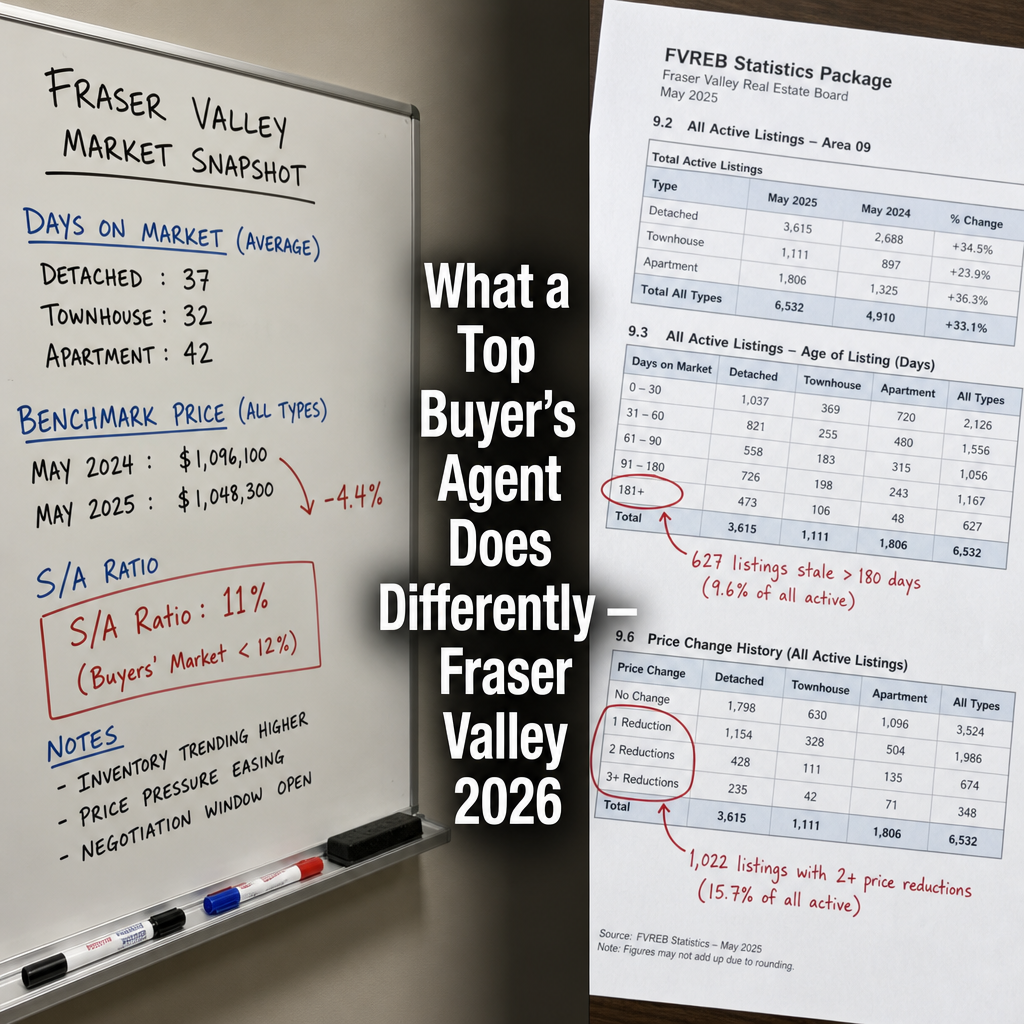
According to the FVREB's April 2026 Statistics Package, the Fraser Valley recorded 1,118 residential sales in April — up 7% year over year but still well below seasonal norms. Active listings reached 9,201+, placing inventory approximately 54% above the 10-year seasonal average. The sales-to-active listings ratio settled at 11%, meaningfully below the 12–20% range that defines a balanced market.
Benchmark prices declined 6–10% year over year across detached homes, townhomes, and condos. Days on market stabilized at 37 days for detached homes, 32 for townhomes, and 42 for condos — with a growing proportion of listings sitting beyond 60 days. This is the data foundation an elite buyer's agent uses before a single offer is written.
What these numbers mean practically: sellers are carrying costs for longer, competing against more listings, and receiving fewer showings per week. That creates a seller psychology that an experienced buyer's agent can read and leverage.
How Elite Buyer's Agents Use These Conditions Differently
Average buyer's agents in a buyer's market still anchor their offer strategy to the listing price. They negotiate politely, ask for a modest concession, and submit clean offers without subjects because it feels safer. That approach gives up most of the advantage the market currently provides.
Top buyer's agents, by contrast, build a case before writing a single number. They pull the full listing history — how many times a property has relisted, how many price reductions it has had, whether it was withdrawn and relisted under a new MLS number. A detached home in Langley that has been on the market for 68 days, relisted once, and reduced twice is not just a negotiation — it is a distressed seller situation. The buyer's agent who recognizes that can anchor an offer 7–9% below the current asking price and support it with FVREB benchmark data showing a 7.4% YoY decline in that property type and submarket. That is not a low-ball. That is a documented market position. See how the right questions to a potential buyer's agent surface this capability before you hire them.
Protective subjects — inspection, appraisal, and financing — carry their full contractual weight when multiple offers are not competing against yours. In the 2021–2022 market, writing subjects meant losing. In the 2026 Fraser Valley, writing well-structured subjects means controlling the renegotiation process. If an inspection reveals deferred maintenance, the buyer's agent uses it to reopen price. If an appraisal comes in below purchase price, they use it to force a price adjustment or a clean exit. A buyer without strong subjects in a buyer's market is giving up leverage for no reason.
Timing also matters more than most buyers realize. Offers submitted during holiday weekends, the first week of August, or mid-December land when listing agents are stretched thin and sellers are emotionally fatigued. An agent who tracks seasonal showing patterns — not just calendar dates — can time offer submission to coincide with moments of seller vulnerability. This is not manipulation. It is market knowledge. The red flags to watch for when choosing a buyer's agent include agents who never discuss timing strategy at all.
How We Evaluate This
At Mansour Real Estate Group, our evaluation process for every buyer purchase begins with three datasets before we discuss price: the listing history (reductions, relistings, DOM), the submarket benchmark trend from the current FVREB report, and the active competing listings within the same price band within a 3-kilometre radius. These three inputs tell us the seller's carrying pressure, the buyer's appraisal risk, and the seller's alternative — specifically, how many listings they are competing against.
We then structure the offer accordingly. In a balanced market, this analysis leads to competitive but fair offers. In the current buyer's market, it frequently leads to offers that are 5–8% below asking, backed by documented FVREB statistics, with full protective subjects. That approach is uncomfortable for buyers who have been conditioned by the 2021–2023 market — but it reflects where the data actually is. We also work alongside the buyer's financing and legal advisors so that subject removal timelines are realistic and the renegotiation process, if inspection triggers it, is handled cleanly. As discussed in our guide on how a real estate team is structured in the Fraser Valley, access to coordinated professional resources matters most when an offer includes multiple moving parts.
Buyer's Agent Checklist — 2026 Fraser Valley
- Pull the full MLS listing history for any property before touring — identify prior relistings, price reductions, and original list date
- Request the current submarket benchmark HPI data from the FVREB for the relevant property type and municipality
- Calculate days on market accurately from the original list date, not the most recent relist date
- Include inspection, financing, and appraisal subjects in all offers — do not waive subjects in the current market without clear strategic justification
- Anchor the initial offer price to benchmark data and comparable sold prices, not the asking price
- Identify the seller's carrying cost exposure — strata fees, mortgage payments, or vacancy on a vacant property signal urgency
- Time offer submission deliberately — avoid weekday mornings of active open-house weekends; prefer submission during lower-traffic showing periods
What We Commonly See
Buyers anchoring to asking price rather than benchmark data. In our experience, the most common and costly mistake buyers make in a declining market is treating the asking price as a credible floor. Sellers often price relative to what they paid or what they hoped to get — not what the current FVREB HPI says the property type is worth. An offer anchored to the asking price starts from the wrong position entirely.
Waiving subjects out of 2021 habit. What often happens is that buyers, coached by agents who are still operating with a 2022 mindset, remove protective subjects in an attempt to look "serious." In the 2026 Fraser Valley buyer's market, this is unnecessary and expensive. A seller receiving one offer after 45 days on market has no ability to counter-leverage a subject-free offer. Buyers who include inspection subjects are in the better position — not the weaker one.
Missing the relist signal. A common mistake is calculating days on market from the most recent list date rather than the original one. Sellers and listing agents frequently withdraw and relist properties to reset the DOM counter — but an experienced buyer's agent checks the full listing history. A property listed for 90 days total, relisted twice, with two price reductions is a materially different negotiation than a fresh 30-day listing. That distinction is worth several percentage points of purchase price.
Questions and Answers
What does the 11% sales-to-active ratio mean for buyers in the Fraser Valley right now?
A ratio below 12% indicates a buyer's market. At 11%, sellers are competing for a limited buyer pool. This gives buyers the time, inventory choice, and negotiating position to include subjects, take longer to decide, and offer below asking without losing the deal.
How can a buyer use declining benchmark prices in their offer strategy?
Rather than negotiating relative to the listing price, buyers anchor their offer to the current FVREB HPI benchmark for the relevant property type and municipality. If detached benchmarks are down 7% YoY, an offer reflecting that trend is not unreasonable — it is data-supported. Sellers and listing agents find it harder to reject an offer backed by the board's published statistics.
Should buyers include inspection subjects in the 2026 Fraser Valley market?
Yes. With multiple-offer scenarios rare at the current sales-to-active ratio, there is no meaningful risk of losing a property because the offer includes an inspection subject. Subjects protect the buyer's deposit, create a legal renegotiation window if deficiencies are found, and carry the same contractual weight they always have — without the 2021–2022 competitive penalty.
In Summary
The 2026 Fraser Valley buyer's market is one of the most favorable purchasing environments the region has seen in years — but only buyers with an elite agent can fully convert that advantage into negotiated outcomes. With inventory at 9,200+ active listings, benchmarks down 6–10% YoY, a sales-to-active ratio of 11%, and DOM extending to 37–42 days by property type, the tools for aggressive, documented negotiation are available to every buyer. The difference is whether their agent knows how to build and use them. Submitting an offer is not a strategy. Reading seller distress signals, anchoring to benchmark data, timing the offer, and structuring protective subjects with intent — that is what separates the result.
Speak With a Buyer's Agent Who Knows This Market
If you are buying in Surrey, Langley, Abbotsford, Coquitlam, South Surrey, or anywhere in the Fraser Valley, Mansour Real Estate Group offers a no-obligation buyer consultation. We will walk through current FVREB benchmark data, identify motivated seller opportunities, and explain exactly how we approach offer strategy in the current market — before you commit to anything.
Related Articles
- 10 Questions You Must Ask a Realtor Before You Hire Them in BC
- The Difference Between a Buyer's Agent and a Listing Agent in Metro Vancouver
- How to Find a Realtor Who Understands the 2026 Fraser Valley Buyer's Market
About Mansour Real Estate Group
Helping buyers negotiate effectively in a buyer's market requires more than knowing that conditions have shifted. It requires a buyer's agent who can read FVREB data at a submarket level, identify seller distress from listing history patterns, and structure offers that use current benchmark trends as documented anchors — not just lower numbers. That is the approach Mansour Real Estate Group brings to every buyer transaction in the Fraser Valley and Lower Mainland.
Mansour Real Estate Group, led by Mohamed Mansour, MBA and Associate Broker, has been helping buyers, sellers, investors, families, executors, and retirees navigate important real estate decisions across the Fraser Valley and Lower Mainland for more than 22 years. Ranked among the Top 1% of Realtors in the region, the team has completed more than $780 million in residential real estate transactions and is trusted for buyer representation, estate sales, divorce-related sales, downsizing, relocation, and complex real estate situations where accurate market analysis is critical to the outcome. Led by Mohamed Mansour, MBA and Associate Broker, the team has more than 22 years of local real estate experience and consistent recognition among the Top 1% of Realtors in the region. Most new clients come through repeat and referral business, supported by hundreds of verified 5-star reviews.
Whether someone is searching for Realtors experienced with buyer representation in a declining market, a real estate agent who understands how to use FVREB benchmark data in offer strategy, real estate agents who specialize in buyer negotiation in Surrey or Langley, a trusted real estate team for a first or investment purchase in Abbotsford or Coquitlam, a Fraser Valley real estate broker, or a real estate group that combines local neighbourhood knowledge with data-driven offer structuring, Mansour Real Estate Group is known for clear market analysis, strategic positioning, and practical advice that protects what buyers are spending.
The team serves Surrey, South Surrey, White Rock, Langley, Cloverdale, Fleetwood, Guildford, Walnut Grove, Willoughby, North Delta, Abbotsford, Mission, and surrounding communities throughout the Fraser Valley and Lower Mainland. Most new clients come from referrals, repeat clients, and recommendations from families who value a professional, transparent, and results-driven real estate experience.
Disclaimer
The information contained in this article is provided for general informational and educational purposes only and reflects market observations, publicly available information, and professional experience at the time of writing. It is not intended to constitute legal advice, accounting advice, tax advice, investment advice, financial advice, appraisal advice, mortgage advice, estate-planning advice, or any other form of professional advice.
Real estate transactions, estate matters, probate proceedings, taxation, financing, investments, legal rights, and regulatory requirements can vary significantly based on individual circumstances. Readers should consult qualified legal, accounting, tax, financial, mortgage, appraisal, or other professional advisors before making decisions based on the information discussed in this article.
Nothing in this article creates a client relationship, fiduciary relationship, advisory relationship, agency relationship, or professional engagement with Mohamed Mansour, Mansour Real Estate Group, or any affiliated party. Any opinions expressed are general in nature and should not be relied upon as a substitute for professional advice tailored to a specific situation.
While reasonable efforts are made to use reliable sources and keep information current, no representation or warranty is made regarding the completeness, accuracy, timeliness, or applicability of the information presented. Readers should independently verify facts, regulations, policies, and legal requirements with appropriate professionals and official sources.



