
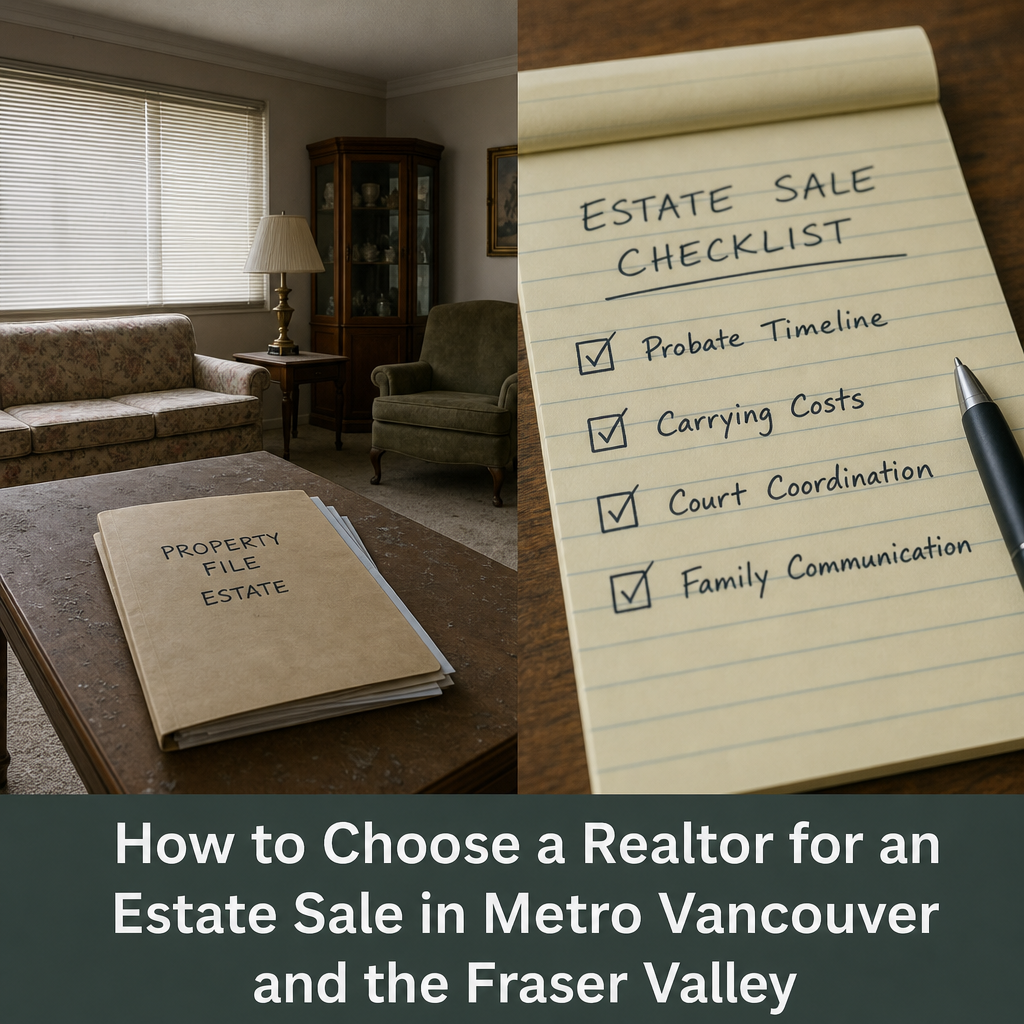

How to Choose a Realtor for an Estate Sale in Metro Vancouver and the Fraser Valley: What Specialized Competencies Matter
By Mohamed Mansour, MBA and Associate Broker, Mansour Real Estate Group | Fraser Valley and Metro Vancouver | Published June 2026
Choosing a Realtor for an estate sale is different from choosing one for a standard home sale. The executor is managing a legal obligation, coordinating with a lawyer, handling a vacant property, and often navigating family disagreement — all while the market keeps moving. In a buyer's market with elevated inventory across the Fraser Valley, the wrong Realtor choice can cost an estate tens of thousands of dollars in unnecessary holding time and price reductions.
This guide explains the four competencies that actually matter when selecting a Realtor for an estate property in Metro Vancouver, the Fraser Valley, and BC broadly — and what to ask before signing a listing agreement.
Short Answer
An estate sale Realtor in BC needs four specific capabilities: familiarity with probate timelines and court procedures, experience managing vacant properties during extended marketing periods, ability to coordinate with estate lawyers without conflicting advice, and skill in communicating with multiple family members who may not agree. These are not standard competencies — most generalist Realtors lack them.
Key Takeaways
- Estate sales in a buyer's market carry compounding holding costs if the Realtor misprices or delays.
- BC probate procedures can restrict when and how a property is listed — your Realtor must understand these timelines.
- Vacant properties deteriorate and carry costs; the Realtor must have a management protocol, not just a listing plan.
- Family disagreement on pricing or timing is common — a skilled estate Realtor manages this without taking sides.
- The Fraser Valley's 11% sales-to-active ratio in early 2026 means executors face real market pressure, not just administrative complexity.
Who This Applies To
- Executors managing a BC estate that includes real property
- Beneficiaries who are coordinating the sale on behalf of a family
- Estate lawyers or notaries seeking a Realtor referral for a client
- Families where the deceased owned a home in Surrey, Langley, White Rock, Abbotsford, North Delta, or surrounding areas
When This Advice May Not Apply
If the estate is simple, the property is occupied, and there is a single decision-maker with no legal complications, some of these considerations carry less weight. However, any BC property involved in probate has legal dimensions that a generalist Realtor may not anticipate. This guide applies to most estate sales in Metro Vancouver and the Fraser Valley.
Data Used in This Article
- Fraser Valley Real Estate Board, Statistics Package March 2026 — official board data, detached/townhome/condo days on market, sales-to-active ratio, inventory levels
- Fraser Valley Real Estate Board, Statistics Package April 2026 — official board data, inventory trend
- Fraser Valley Real Estate Board, Monthly Market Report — ongoing inventory and pricing trends
- Wowa.ca Vancouver Housing Market Summary — third-party aggregated market data used for contextual reference only
Why the Current Market Raises the Stakes for Executors
According to the Fraser Valley Real Estate Board's March 2026 statistics package, active listings in the Fraser Valley were roughly 50% above the 10-year seasonal average. By May 2026, total active listings exceeded 10,000. The sales-to-active listings ratio sat at 11%, which the FVREB classifies as buyer's market territory — a condition that gives buyers negotiating leverage and extends the time most properties spend on the market.
In that same March 2026 period, detached homes averaged 39 days on market, townhomes averaged 36 days, and condos averaged 43 days. These are manageable timelines with a well-positioned property. But estate properties face compounding risks in this environment: a vacant home can deteriorate visually, carrying costs accumulate monthly, and a misaligned price in a choice-rich market prolongs the listing until reductions become necessary.
For an executor, that combination — slow market, vacant property, multiple decision-makers — makes Realtor selection a consequential legal and financial decision, not just an administrative one. As we outline in our main guide to choosing a Realtor in Metro Vancouver and the Fraser Valley, life-event sales require a fundamentally different set of criteria than standard residential transactions.
Key Terms Executors Should Understand
Probate: The court process in BC that legally confirms the validity of a will and grants the executor authority to manage and distribute the estate, including selling real property. Until probate is granted, the executor's ability to list and complete a sale can be restricted.
Court-ordered sale: A sale directed by BC Supreme Court, which may occur when beneficiaries disagree, when probate is contested, or when the estate requires a formal process to authorize the transaction. These sales follow specific procedural rules your Realtor must understand.
Carrying costs: Ongoing expenses the estate bears while a property is listed and vacant — mortgage payments if applicable, property taxes, utilities, insurance, strata fees, and maintenance. In a slow market, these costs can erode net estate value by several thousand dollars per month.
Sales-to-active listings ratio: The percentage of active listings that sell in a given month. The FVREB uses 12% as the lower boundary of a balanced market. Below that threshold is a buyer's market, where sellers have less leverage and properties take longer to sell without strong positioning.
Competency 1: Probate Familiarity and Legal Coordination
BC probate is governed by the Wills, Estates and Succession Act (WESA). Before an executor can legally transfer title to a buyer, the court must grant probate — and that process takes time. In complex estates, contested wills, or situations involving multiple beneficiaries, the timeline can extend significantly beyond what most Realtors expect.
A Realtor without probate familiarity may list a property before the executor has the legal authority to complete a sale. That creates an awkward and potentially damaging situation: an accepted offer that cannot close on the agreed date, a buyer who walks, and a market re-entry with a stigmatized listing.
What a qualified estate Realtor does instead: confirms the probate status with the estate lawyer before listing, structures the listing timeline around the expected grant date, and builds subject-to-probate clauses into the offer strategy when appropriate. They understand the difference between marketing before probate is granted (permissible in some circumstances) and committing to a completion date before legal authority exists (a serious error).
Ask directly: Have you worked with estate lawyers in BC on probate-constrained listings? Can you describe a situation where the probate timeline affected your listing strategy? A Realtor who has done this work will answer specifically. One who hasn't will speak in generalities.
Competency 2: Vacant Property Management During Extended Marketing
A vacant home in a buyer's market sits on the market longer than an occupied one — and it shows it. Without regular visits, minor issues become major ones: a small roof leak becomes a mold problem, an unlocked window becomes a security issue, a garden becomes an overgrown liability. Buyers notice all of it, and it affects both offers and price.
An estate Realtor with proper vacant property protocols will schedule regular property visits, coordinate with property managers or the executor's designated contact, ensure the home is maintained at show-ready standard throughout the listing period, and document the condition with photographs so the estate has a record.
In the current Fraser Valley market — where detached homes averaged 39 days to sell in March 2026, and where buyer's market conditions may push that higher for unrenovated or dated properties — a 60 to 90-day marketing period is realistic for some estate homes. That is a long time for a vacant property without a management system in place.
Ask: What is your specific process for managing a vacant estate property during the listing period? How often will the property be checked, and who is responsible? A well-prepared answer includes a written protocol. A vague answer is a warning sign — review our guide to red flags when choosing a Realtor in BC for other signals to watch for.
Competency 3: Court Procedure Knowledge and Title Clearance
Not all estate sales follow a clean, uncontested path. When beneficiaries disagree on the listing price, when an estate is insolvent, or when the executor's authority is challenged, BC Supreme Court may need to authorize the sale. These court-ordered sales have specific procedural requirements — including how the property is marketed, how offers are presented, and how the court approves the final transaction.
A Realtor unfamiliar with court-ordered sale procedures in BC may inadvertently conduct a marketing process that does not satisfy court requirements, creating delays, legal challenges, or even a voided transaction. They may also fail to flag title encumbrances — liens, caveats, or registered interests — that need to be discharged before a buyer can take clean title.
The Realtor does not need to be a lawyer. But they need to know when to involve one, what questions to ask about title status before listing, and how to structure a marketing process that holds up to legal scrutiny. Experience handling estate sales across Metro Vancouver and the Fraser Valley builds that judgment in ways that generic transaction volume does not.
Competency 4: Family Communication When Beneficiaries Disagree
Estate sales often involve multiple beneficiaries — adult children, surviving spouses, siblings — who may have different views on timing, pricing, and how aggressively to negotiate. One family member may want to sell quickly to access funds. Another may feel the price is too low. A third may have emotional difficulty accepting the sale at all. These dynamics are normal, and they can paralyze a listing if the Realtor does not have a clear process for managing them.
A skilled estate Realtor establishes one communication channel — typically through the executor — and sets expectations with all parties early. They provide written pricing rationale that any beneficiary can review, so the pricing decision is grounded in market data rather than family opinion. They know how to present offer terms clearly to non-real-estate-professionals who need to understand what they are consenting to.
This is not a soft skill — it is a process skill. Ask: How do you handle situations where beneficiaries disagree on pricing or timing? Who do you communicate with, and how do you keep all parties informed without creating conflict? The answer will reveal whether the Realtor has actually managed this before. Whether you choose a real estate team or a solo agent can also affect how well family communication is handled — teams often have more capacity for multi-party coordination.
How We Evaluate This
At Mansour Real Estate Group, when we take on an estate sale, our first step is confirming probate status with the estate lawyer before any listing activity begins. We request a title search, identify any encumbrances, and build the listing timeline around the legal realities — not around an ideal marketing calendar.
For vacant properties, we schedule regular visits, document the condition, coordinate staging or de-cluttering when it is appropriate, and adjust the marketing approach based on buyer feedback during the listing period. Pricing is presented in writing with comparable sales data, so executors and beneficiaries can review the rationale independently of our recommendation. This structure is how we manage the tension between legal precision, market timing, and family dynamics — the same three forces that make estate sales the most complex transactions in residential real estate. Transaction volume matters here too: a Realtor who closes very few sales per year may lack the experience base to handle these competing pressures reliably.
Estate Sale Checklist for Executors Selecting a Realtor
- Confirm probate status with your estate lawyer before interviewing Realtors — a Realtor should ask you about this immediately.
- Ask each candidate how many estate or probate sales they have completed in the past two years, and in which municipalities.
- Request a written explanation of how they would handle a subject-to-probate offer structure if probate is not yet granted at the time of listing.
- Ask for their vacant property management protocol in writing — what gets checked, how often, and who is responsible.
- Ask how they communicate with multiple beneficiaries and what happens when family members disagree on price or timing.
- Request a comparative market analysis specific to the estate property — not a generic range, but a documented pricing rationale.
- Confirm they understand the current Fraser Valley market conditions and how buyer's market dynamics affect pricing and days-on-market expectations for this property type.
What We Commonly See
Executors choose Realtors by relationship, not by competency. In our experience, the most common mistake is selecting a Realtor because a family member knows them, not because they have estate-specific experience. Personal familiarity is reasonable as a starting point, but it should not substitute for a competency check. An estate transaction can go to court if it is mishandled. That risk deserves a deliberate hiring decision.
Listings start before probate is confirmed. What often happens is that a well-intentioned Realtor lists the property to show progress, then discovers that the completion date cannot be met because probate has not been granted. The offer falls through, the property re-enters the market with a price reduction, and the estate absorbs both the delay and the reputational damage to the listing. This is avoidable with basic procedural awareness.
Vacant property deterioration is underestimated. A common mistake is treating a vacant estate property like any other listing. Without regular visits and maintenance, even small deferred issues become visible to buyers and affect both the inspection and the price. In a buyer's market with 10,000+ listings competing for attention, a home that shows poorly is a home that sits — and a Realtor with strong local knowledge will understand exactly how buyers in that neighbourhood respond to condition issues.
Questions and Answers
Can a property be listed before probate is granted in BC?
In some cases, yes — a property can be marketed before probate is granted, but a sale cannot complete until the executor has legal authority to transfer title. A qualified estate Realtor structures the offer and completion timeline around the expected probate grant date. Executors should confirm this with their estate lawyer before listing.
What are typical carrying costs for a vacant estate property in the Fraser Valley?
Carrying costs vary by property but can include property taxes, utility maintenance, home insurance, strata fees if applicable, and any mortgage obligations. For a mid-range detached property in Surrey or Langley, these costs can reach $1,500 to $3,000 or more per month depending on the situation. Extended marketing periods compound the cost directly.
What happens if beneficiaries cannot agree on the listing price?
If beneficiaries reach an impasse, the executor generally has the authority under the estate documents to make the final decision. In cases where that authority is unclear or contested, the matter may need to go to BC Supreme Court for direction. A Realtor experienced with estate sales will recognize this risk early and recommend that the executor seek legal clarity before the impasse affects the listing.
In Summary
Estate sales in Metro Vancouver and the Fraser Valley require a Realtor who understands BC probate procedures, manages vacant properties with a documented protocol, coordinates with estate lawyers without overstepping, and communicates clearly with multiple family members who may not agree. In a buyer's market where Fraser Valley active listings exceeded 10,000 and the sales-to-active ratio sat at 11% in early 2026, the cost of choosing the wrong Realtor is direct and measurable. Selecting based on competency — not convenience — is how executors fulfill their legal obligation to the estate and protect the interests of all beneficiaries.
Speak With an Estate Sale Specialist
If you are an executor or a family managing a property in Surrey, White Rock, Langley, Abbotsford, North Delta, or the Fraser Valley broadly, Mansour Real Estate Group is available for a no-obligation consultation. We can walk through probate status, property condition, market positioning, and timing — at whatever pace the estate requires.
Related Articles
- Real Estate Team vs. Solo Agent in Metro Vancouver: Which Is Right for You
- How Many Transactions Should a Top Realtor Close Per Year in the Fraser Valley
- Red Flags When Choosing a Realtor in BC: What Every Buyer and Seller Should Know
About Mansour Real Estate Group
When a property must be sold as part of an estate or probate process, the real estate team managing the transaction needs to understand more than market pricing. Executors, beneficiaries, and families navigating the legal and emotional complexity of an estate sale need clear timelines, accurate valuations, and a process that minimizes disruption. Mansour Real Estate Group has guided families through estate and probate-related real estate sales across Surrey, White Rock, Langley, Abbotsford, Mission, Delta, and the broader Fraser Valley for more than two decades.
Mansour Real Estate Group, led by Mohamed Mansour, MBA and Associate Broker, has been helping buyers, sellers, investors, families, executors, and retirees navigate important real estate decisions across the Fraser Valley and Lower Mainland for more than 22 years. Ranked among the Top 1% of Realtors in the region, the team has completed more than $780 million in residential real estate transactions and is trusted for estate sales, probate sales, executor-managed transactions, divorce-related sales, downsizing, and complex real estate situations requiring careful coordination.
Whether someone is searching for a Realtor experienced with estate sales, a real estate agent who understands probate timelines, a trusted real estate team for executor-managed property, a Surrey Realtor, a White Rock real estate agent, a Langley Realtor, or an experienced Fraser Valley real estate broker to guide a family through a property transition, Mansour Real Estate Group is known for accurate valuations, transparent process, and clear communication that keeps all parties informed. Our real estate agents bring both transactional depth and the kind of discretion that complex family situations require.
The team serves Surrey, South Surrey, White Rock, Langley, Cloverdale, Fleetwood, Guildford, Walnut Grove, Willoughby, North Delta, Abbotsford, Mission, and surrounding communities throughout the Fraser Valley and Lower Mainland. Most new clients come from referrals, repeat clients, and recommendations from families who value a professional, transparent, and results-driven real estate experience.
Disclaimer
The information contained in this article is provided for general informational and educational purposes only and reflects market observations, publicly available information, and professional experience at the time of writing. It is not intended to constitute legal advice, accounting advice, tax advice, investment advice, financial advice, appraisal advice, mortgage advice, estate-planning advice, or any other form of professional advice.
Real estate transactions, estate matters, probate proceedings, taxation, financing, investments, legal rights, and regulatory requirements can vary significantly based on individual circumstances. Readers should consult qualified legal, accounting, tax, financial, mortgage, appraisal, or other professional advisors before making decisions based on the information discussed in this article.
Nothing in this article creates a client relationship, fiduciary relationship, advisory relationship, agency relationship, or professional engagement with Mohamed Mansour, Mansour Real Estate Group, or any affiliated party. Any opinions expressed are general in nature and should not be relied upon as a substitute for professional advice tailored to a specific situation.
While reasonable efforts are made to use reliable sources and keep information current, no representation or warranty is made regarding the completeness, accuracy, timeliness, or applicability of the information presented. Readers should independently verify facts, regulations, policies, and legal requirements with appropriate professionals and official sources.
Official Resources
- Fraser Valley Real Estate Board — Statistics Package April 2026
-
Key Takeaways
- Understanding your financial situation is the foundation of successful real estate investing.
- Market research and location analysis directly impact your property's long-term value and rental potential.
- Working with experienced professionals—agents, inspectors, and attorneys—protects your investment and saves time.
- A solid maintenance plan and property management strategy ensure consistent returns over time.
Conclusion
Real estate remains one of the most reliable wealth-building vehicles available to today's investors. Whether you're purchasing your first home or expanding a rental portfolio, the principles of due diligence, strategic planning, and professional guidance remain constant. By taking the time to educate yourself and avoiding common pitfalls, you position yourself for success in an ever-evolving market.
The journey to real estate success is a marathon, not a sprint. Stay informed, remain flexible, and always keep your long-term goals in sight. Your future self will thank you for the decisions you make today.
Ready to Start Your Real Estate Journey?



