

Fraser Valley Spring Market Recovery 2026: Townhome and Attached Housing Outperform as Detached and Condo Markets Remain Buyer-Favoured — Timing Strategy for Sellers by Property Type
By Mohamed Mansour, MBA and Associate Broker | Mansour Real Estate Group | Published: June 10, 2026 | Fraser Valley, BC
The Fraser Valley market in spring 2026 is not one market. It is three, separated by property type, each with different days on market, different price trajectories, and different seller leverage. If you are making a timing decision based on broad market headlines, you may be misreading your actual position.
This article breaks down what the April and May 2026 Fraser Valley Real Estate Board data actually shows by property type, and what it means if you are deciding when and how to list.
Short Answer
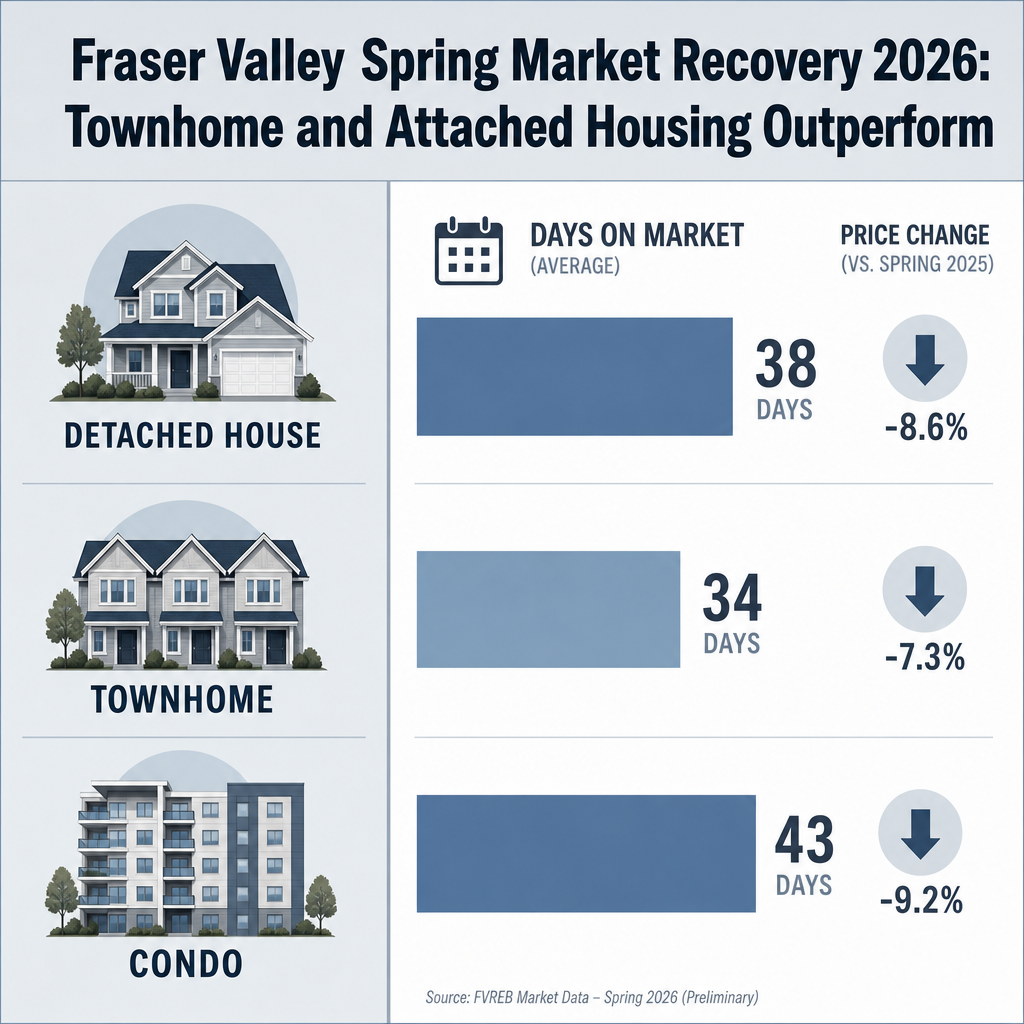
Fraser Valley townhome sellers face meaningfully better conditions than detached or condo sellers in spring 2026. According to FVREB data, townhomes averaged 32–36 days on market compared to 37–39 days for detached homes and 42–43 days for condos. Townhome benchmark prices also declined only 7.3% year-over-year versus 8.6% for detached and 9.2% for condos. The overall market remains buyer-favoured, but townhome sellers have real pricing leverage that others currently do not.
Key Takeaways
- Townhomes sell 3–11 days faster than detached or condo properties in the current Fraser Valley market.
- Townhome benchmark prices held better, declining 7.3% YoY versus 8.6% (detached) and 9.2% (condos).
- Overall Fraser Valley sales-to-active ratio is 11%, below the buyer's market threshold — but property type changes the story.
- April 2026 marked the first year-over-year sales increase in over 12 months, up 7%, with spring momentum accelerating.
- Sellers should build timing strategy around their specific property type, not the broad market average.
Who This Applies To
- Townhome owners in Surrey, Langley, Abbotsford, Cloverdale, Willoughby, or Walnut Grove considering listing in 2026
- Detached homeowners trying to understand whether now is a good time relative to attached housing
- Condo owners wondering why their property is taking longer to sell or receiving lower offers
- Estate executors, divorcing couples, or downsizing homeowners whose property type affects their timeline
- Investors or landlords evaluating which Fraser Valley segment to exit
When This Advice May Not Apply
If your property has unusual condition, legal complications, strata issues, or sits in a micro-location with distinct supply dynamics, segment-level data may not reflect your situation. This analysis uses Fraser Valley-wide FVREB data; individual neighbourhoods can vary. Consult a local listing agent for a property-specific assessment.
Data Used in This Article
- Fraser Valley Real Estate Board Statistical Package, April 2026 — official monthly release, Fraser Valley-wide, property-type breakdowns
- Fraser Valley Real Estate Board Statistical Package, March 2026 — official monthly release, benchmark pricing and inventory data
- FVREB Monthly Market Reports — sales-to-active listings ratio, days on market, year-over-year comparisons
Key Definitions
Sales-to-active listings ratio: The percentage of active listings that sell in a given month. Below 12% is considered a buyer's market in BC. Above 20% favours sellers. The Fraser Valley overall sat at 11% in early spring 2026.
Benchmark price: The price of a typical property in a given segment, as calculated by the FVREB using the MLS Home Price Index. More reliable than average or median for tracking real price movement.
Days on market (DOM): The number of days from active listing to accepted offer. A lower DOM indicates stronger buyer demand relative to supply in that segment.
How the Fraser Valley Spring 2026 Market Actually Breaks Down
According to the Fraser Valley Real Estate Board's April 2026 statistical package, overall Fraser Valley active listings reached 9,200-plus in March — roughly 50% above the seasonal average. The sales-to-active ratio at 11% places the market clearly in buyer's market territory. Those are the headline numbers, and they are accurate.
What those numbers obscure is the divergence underneath. Townhomes averaged 32–36 days on market in March through April 2026. Detached homes averaged 37–39 days. Condos averaged 42–43 days. That 10-to-11-day gap between townhomes and condos is not a rounding difference — it reflects genuinely different buyer demand, different financing friction, and different supply depth by segment.
The spring uptick confirms the direction. April 2026 recorded 1,118 sales, a 7% increase year-over-year — the first positive year-over-year reading in more than 12 months, per the FVREB monthly market report. March-to-April activity rose 11%. That momentum is not uniform across segments. Faster-moving property types absorb renewed buyer energy first, and the DOM data shows townhomes are that segment in the current cycle.
Sellers deciding when to list and how to price in Surrey or South Surrey need to understand which segment they are actually competing in before applying market-wide advice to their property.
How We Evaluate This
At Mansour Real Estate Group, when we interpret conditions for a seller, we do not start with the market-wide ratio. We start with the property type, then the neighbourhood, then the specific competing inventory. A 11% sales-to-active ratio for the Fraser Valley overall tells us the direction. Days-on-market by segment tells us the pace. Benchmark price movement tells us the tolerance for negotiation.
For townhome sellers right now, those three signals point in a more favourable direction than the broad market suggests. For condo sellers, they point toward more caution. The practical question is not "is this a buyer's market" — it is "what does this market look like for my specific property, and what does the buyer pool expect to pay and negotiate."
What the Price Data Shows by Segment
Benchmark price declines vary significantly by property type. According to FVREB March 2026 data, townhome benchmark prices declined 7.3% year-over-year. Detached homes declined 8.6%. Condos declined 9.2%. In a market where all three segments are down, the spread matters. A 1.9-percentage-point gap between townhomes and condos represents real equity protection — and it reflects sustained buyer preference for townhomes relative to supply.
Why are townhomes holding comparatively better? Several factors are consistent with what we observe locally. Townhomes in communities like Willoughby, Cloverdale, and Walnut Grove attract a specific buyer who is priced out of detached but unwilling to accept condo strata limitations. That buyer segment — typically a growing family or first-time buyer stepping up — remained more active through the rate cycle than high-end detached buyers or investor-driven condo buyers.
Detached sellers, particularly at price points above $1.5 million, face a thinner buyer pool and more days on market as a result. Condo sellers face inventory depth, financing friction (particularly in older buildings with limited lender approval), and a buyer pool more sensitive to rate changes. Those dynamics are structural in the current cycle, not just seasonal.
Understanding this divergence is part of how a knowledgeable Langley real estate agent or Fraser Valley listing specialist calibrates pricing expectations by property type rather than applying a single market narrative across all sellers.
Seller Checklist: Timing and Positioning by Property Type
- Confirm your segment baseline: Get current DOM and benchmark data for your specific property type, not the Fraser Valley average.
- Review competing active inventory: How many listings in your property type and price band are currently active within 2 km of your address?
- Townhome sellers — act in the spring window: April through June typically captures the strongest demand cycle for townhomes. With current momentum confirmed by FVREB data, this window is active now.
- Detached sellers — price to the current buyer pool: With 37–39 DOM and a 50%-above-seasonal inventory level, overpricing by even 3–5% typically results in 60-plus days on market and a weaker negotiating position.
- Condo sellers — strata documentation must be complete before listing: Buyers financing condos need Form B, depreciation reports, and strata minutes. Missing documents extend DOM and create subject conditions that allow buyers to exit.
- Prepare for market-appropriate negotiation room: Build your pricing strategy with your agent based on actual recent comparable sales, not list prices. In current conditions, offer prices are the data.
- Track the sales-to-active ratio monthly: If the ratio moves above 12–15%, seller leverage increases. If it stays at 11% or falls, adjust pricing expectations accordingly.
What We Commonly See
In our experience working with sellers across the Fraser Valley, one of the most common mistakes in a diverging market is applying the wrong segment's data to your own property. Sellers who read "buyer's market" headlines and assume their townhome faces the same headwinds as a detached property at $1.8 million are often surprised when they receive a competitive offer relatively quickly — but by then, they may have priced too conservatively and left equity on the table.
The reverse also happens. Condo sellers in older buildings, particularly those with no recent depreciation report or known strata issues, sometimes price based on what townhomes nearby sold for. That comparison does not hold in the current market. Buyers financing condos are more cautious about building condition, and lenders are more selective. A condo that is priced as though it were a townhome will sit.
What often happens with detached sellers is a gradual price reduction cycle — list at optimistic pricing, reduce after 21 days, reduce again at 45 days, eventually sell near where they should have started. Each reduction signals weakness to the buyer pool and can attract lower offers than an accurate launch price would have. A realistic, data-grounded list price from the beginning is almost always the stronger position in a buyer-favoured market, regardless of property type. Working with a listing agent who understands Fraser Valley market cycles is one way to avoid that pattern.
Questions and Answers
Is it a good time to sell a townhome in the Fraser Valley in spring 2026?
Yes, relative to other property types. FVREB April 2026 data shows townhomes averaging 32–36 days on market, with price declines of only 7.3% year-over-year — the most resilient segment. Spring buyer activity is increasing, making this a reasonable window for townhome sellers to list.
Why are condos taking longer to sell than townhomes in the Fraser Valley right now?
Several factors contribute: deeper condo inventory, more financing friction (particularly in older buildings), investor-buyer pullback, and buyer caution around strata health. Condos averaged 42–43 days on market in early spring 2026 versus 32–36 days for townhomes, per FVREB data.
What does a 11% sales-to-active listings ratio mean for Fraser Valley sellers?
It means the overall market favours buyers. Industry convention in BC treats below 12% as a buyer's market. At 11%, buyers have negotiating leverage on most property types. However, faster-moving segments like townhomes create pockets where seller leverage is comparatively stronger.
In Summary
The Fraser Valley spring 2026 market is buyer-favoured overall, but the data tells different stories by property type. Townhome sellers have shorter days on market, better price stability, and stronger spring momentum than detached or condo sellers. Detached sellers face a larger buyer pool gap and must price accurately from day one. Condo sellers face the most friction and need complete strata documentation before listing. Building your timing and pricing strategy around your specific segment — not the market-wide headline — is the most important decision you can make before listing this spring. A real estate team with deep Fraser Valley segment knowledge can help you identify where your property stands within its actual competitive set.
If you are trying to understand where your townhome, detached property, or condo stands in the current Fraser Valley market, Mansour Real Estate Group offers a straightforward, data-grounded assessment with no obligation. Reach out whenever the timing feels right.
Related Articles
- How to Choose the Best Realtor in Metro Vancouver and the Fraser Valley
- What to Look for in a Listing Agent When Selling Your Home in Surrey or South Surrey
- What Does a Real Estate Team Actually Look Like in the Fraser Valley
About Mansour Real Estate Group
When homeowners in Surrey, Langley, Abbotsford, or anywhere across the Fraser Valley are preparing to sell — and the property type makes a real difference to their strategy — they need market guidance that goes beyond the headline numbers. Mansour Real Estate Group has been providing buyers, sellers, and investors with grounded, specific Fraser Valley and Lower Mainland real estate insight for more than 22 years.
Led by Mohamed Mansour, MBA and Associate Broker, the team has completed more than $780 million in residential real estate transactions and is ranked among the Top 1% of Realtors in the Fraser Valley. The team is trusted for seller strategy, market timing, accurate pricing analysis, estate sales, downsizing transitions, and complex real estate decisions across the region.
Whether someone is looking for Realtors who understand Fraser Valley market cycles by property type, a real estate agent who can translate FVREB data into practical listing decisions, real estate agents who specialize in townhome or attached housing strategy, a Surrey real estate broker, a Langley Realtor, or a real estate team with direct experience in segment-level pricing across the Lower Mainland — Mansour Real Estate Group is known for honest interpretation, clear advice, and outcomes built on accurate valuations.
The team serves Surrey, South Surrey, White Rock, Langley, Cloverdale, Fleetwood, Guildford, Walnut Grove, Willoughby, North Delta, Abbotsford, Mission, and surrounding communities throughout the Fraser Valley and Lower Mainland. Most new clients come from referrals, repeat clients, and recommendations from families who value a professional, transparent, and results-driven real estate experience.
Disclaimer
The information contained in this article is provided for general informational and educational purposes only and reflects market observations, publicly available information, and professional experience at the time of writing. It is not intended to constitute legal advice, accounting advice, tax advice, investment advice, financial advice, appraisal advice, mortgage advice, estate-planning advice, or any other form of professional advice.
Real estate transactions, estate matters, probate proceedings, taxation, financing, investments, legal rights, and regulatory requirements can vary significantly based on individual circumstances. Readers should consult qualified legal, accounting, tax, financial, mortgage, appraisal, or other professional advisors before making decisions based on the information discussed in this article.
Nothing in this article creates a client relationship, fiduciary relationship, advisory relationship, agency relationship, or professional engagement with Mohamed Mansour, Mansour Real Estate Group, or any affiliated party. Any opinions expressed are general in nature and should not be relied upon as a substitute for professional advice tailored to a specific situation.
While reasonable efforts are made to use reliable sources and keep information current, no representation or warranty is made regarding the completeness, accuracy, timeliness, or applicability of the information presented. Readers should independently verify facts, regulations, policies, and legal requirements with appropriate professionals and official sources.



