

Finding the Best Realtor in Coquitlam, Port Coquitlam, and Port Moody 2026: What Separates Top Performers in the Tri-Cities Market
By Mohamed Mansour, MBA and Associate Broker | Mansour Real Estate Group | Published: July 14, 2026 | Geography: Coquitlam, Port Coquitlam, Port Moody, Metro Vancouver, BC
The Tri-Cities — Coquitlam, Port Coquitlam, and Port Moody — function as one of Metro Vancouver's most internally varied submarkets. Westwood Plateau and Burke Mountain operate on different pricing logic than Maillardville. Port Moody's waterfront addresses attract a different buyer than a Port Coquitlam townhouse near Fremont Village. In a buyer's market, where inventory is rising and buyers have more options, the agent you hire to price, position, and negotiate directly determines how much equity you protect or lose.
This guide is written for buyers and sellers in the Tri-Cities who want to understand what genuine expertise looks like in this specific market — and what questions to ask before signing a listing agreement or buyer's agency contract.
Short Answer
The best realtors in Coquitlam, Port Coquitlam, and Port Moody combine verified transaction volume with neighbourhood-specific knowledge: Westwood Plateau and Burke Mountain school catchment dynamics, SkyTrain corridor pricing premiums, Port Moody waterfront positioning, and strata document fluency. In May 2026 buyer's market conditions, that expertise directly protects your financial outcome.
Key Takeaways
- Metro Vancouver's 13.1% sales-to-active ratio confirms a buyer's market, making pricing strategy the most consequential realtor skill.
- Westwood Plateau and Burke Mountain command micro-market premiums that require catchment school knowledge to price and explain accurately.
- Evergreen SkyTrain station proximity creates measurable price-per-square-foot differences that only transit-fluent agents can leverage correctly.
- Port Moody waterfront properties attract distinct buyer profiles — downsizers, retirees, and lifestyle-motivated buyers — requiring targeted marketing.
- Strata expertise — depreciation reports, special levy risk, Form B — is non-negotiable in a market where condos and townhouses dominate inventory.
Who This Applies To
- Homeowners in Coquitlam, Port Coquitlam, or Port Moody preparing to list in 2026
- Buyers relocating into the Tri-Cities who want an agent with genuine neighbourhood depth
- Investors evaluating strata or transit-oriented properties near Evergreen SkyTrain stations
- Families prioritizing school catchment in Westwood Plateau or Burke Mountain
- Downsizers or retirees considering Port Moody waterfront or smaller strata units
When This Advice May Not Apply
If you are selling a property in a stable, low-competition price band with no strata complexity and no transit or catchment premium, general transaction volume matters more than neighbourhood specialization. This guide focuses on situations where micro-market knowledge changes the financial outcome.
Key Definitions
Sales-to-Active Listings Ratio: The percentage of active listings that sold in a given month. Below 12% is generally a buyer's market. Metro Vancouver sat at 13.1% in May 2026, according to the Greater Vancouver Realtors board.
Depreciation Report: A strata corporation's long-term cost forecast for building repairs and capital expenditures, required under BC's Strata Property Act. An agent who cannot interpret one is a liability in any condo or townhouse transaction.
Transit-Oriented Pricing Premium: The documented price-per-square-foot increase observed in properties within walking distance of rapid transit stations, in this case the Evergreen SkyTrain line through Coquitlam and Port Moody.
Data Used in This Article
- Greater Vancouver Realtors (GVR) May 2026 Market Statistics — official monthly data release, Metro Vancouver geography, sales-to-active ratios and benchmark pricing
- Fraser Valley Real Estate Board Monthly Market Reports — official data, Fraser Valley geography, comparative market context
- Mansour Real Estate Group internal transaction analysis — professional interpretation, Fraser Valley and Lower Mainland, 22+ years
How We Evaluate This
When evaluating realtor performance in a submarket like the Tri-Cities, we look at three layers: verified transaction volume in the specific neighbourhoods in question, demonstrated knowledge of the pricing variables that are unique to that area, and the ability to explain buyer psychology for each property type. A high overall transaction count in Metro Vancouver does not automatically translate to Westwood Plateau strata expertise or Port Moody waterfront positioning skill. The neighbourhoods are too different for that assumption to hold.
We also weigh market-condition awareness. In a buyer's market at 13.1% sales-to-active ratio, pricing strategy and buyer communication skills matter more than in a heated seller's market where almost any listing strategy produces offers. Understanding what credentials and designations actually signal helps buyers and sellers cut through surface-level marketing.
Westwood Plateau and Burke Mountain: Why Micro-Market Knowledge Changes the Price
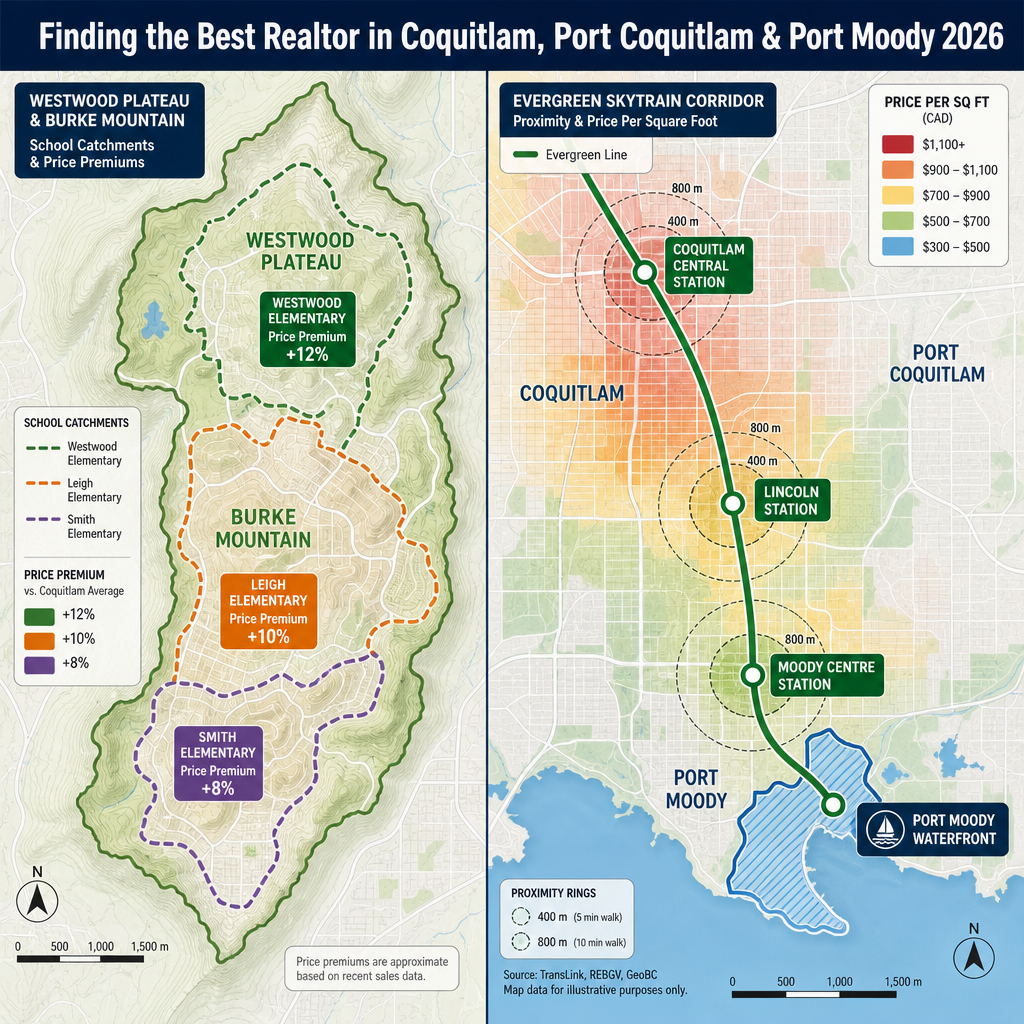
Westwood Plateau and Burke Mountain are not generic Coquitlam. Both areas have commanded price premiums — historically 4% to 10% above the broader Coquitlam benchmark — driven by master-planned community design, mountain-facing lots, and school catchment alignment. Buyers who prioritize specific elementary and secondary school zones will pay more for properties that fall inside those boundaries. An agent who does not know the catchment lines cannot defend that premium to a skeptical buyer, and cannot use it to justify the list price to a nervous seller.
Burke Mountain in particular has continued to see new construction activity and land rezoning. Agents working in this area need to understand how builder incentives affect resale pricing, how new strata developments absorb buyer demand from the resale pool, and how lot size, view orientation, and finishings interact in a declining-price environment. In a buyer's market, the gap between a well-priced Burke Mountain home and an overpriced one compounds quickly. Days on market rise, price reductions follow, and the final sale price often ends up below where a correctly priced listing would have settled.
If you are interviewing realtors for a Westwood Plateau or Burke Mountain listing, ask them to walk you through the last three comparable sales in the neighbourhood, why each sold at its price, and what the days-on-market trend looks like for your property type. The answer tells you whether their knowledge is current and specific or general and borrowed from a board-level statistics release.
The Evergreen SkyTrain Corridor: Transit Premiums Require Transit Fluency
The Evergreen SkyTrain line — specifically the Coquitlam Central, Lincoln, and Moody Centre stations — creates measurable price-per-square-foot differences depending on walkability and access. Properties within a 10-minute walk of a station attract a distinct buyer profile: commuters prioritizing transit over parking, younger buyers who cannot afford cars alongside mortgages, and investors who understand that transit access anchors long-term demand. That buyer profile behaves differently under negotiation than a buyer who prioritizes yard space and quiet streets.
An agent with genuine transit-corridor knowledge will position the same square footage differently depending on station proximity. They will know which buildings were purpose-built for the transit demographic, which ones have parking-inclusive pricing that doesn't translate to the transit buyer's calculus, and which streets feel walkable on paper but require crossing arterial roads that erode the practical score. For investors evaluating transit-oriented properties, this distinction between nominal and practical walkability is one of the most commonly mispriced variables in the Tri-Cities market.
When interviewing agents for a condo or townhouse near a SkyTrain station, ask them directly: how does proximity to this station affect buyer motivation, and how does it affect your list price recommendation? A vague answer about "transit being a great feature" is not the same as a specific answer about walk score, station distance, and how the last four comparable sales near the same station actually performed.
Port Moody Waterfront and Residential: A Distinct Buyer Profile
Port Moody's waterfront properties and the broader residential areas around Moody Centre and Inlet Centre are not simply "nicer Coquitlam." The buyer profile is different. Downsizers trading a large South Surrey or Delta home for a Port Moody waterfront condo, retirees seeking walkable access to restaurants and the Rocky Point waterfront, and lifestyle-motivated buyers who are willing to pay for setting over square footage — these are not the same buyers shopping in Burke Mountain or Port Coquitlam. Agents who understand Port Moody must understand how to market a lifestyle, not just a floorplan. For those considering working with a downsizing specialist, Port Moody is one of the Lower Mainland's most frequently chosen destinations for that transition.
In practical terms, this means the photography brief, the listing description, and the buyer outreach strategy for a Port Moody waterfront property should be different from a standard Coquitlam condo campaign. An agent who applies the same template to both is leaving money on the table. Ask your agent what percentage of their recent Port Moody transactions involved lifestyle-motivated buyers versus investment buyers, and what the typical days-on-market looked like for each. That answer calibrates their actual experience level in the area.
Strata Complexity Across the Tri-Cities
Condos and townhouses make up a significant share of Tri-Cities inventory. This means strata fluency is not a specialty — it is a baseline requirement. An agent who cannot read a depreciation report, explain special levy risk, or identify red flags in Form B strata documents is a liability for both buyers and sellers in this market. Buyers who discover deferred maintenance or underfunded contingency reserves after subject removal are in a difficult position. Sellers who are not told to address known strata issues before listing often receive price reductions at or after subject removal instead.
Review the cluster article on real estate agent credentials and designations in BC for context on what formal training in strata transactions looks like. When interviewing agents, ask specifically: have you reviewed a depreciation report showing a deficit, and how did you advise your client? The answer reveals experience far more reliably than a designation credential alone. You should also read through the 10 questions to ask a realtor before hiring them — several apply directly to strata situations.
Realtor Checklist: Tri-Cities Buyer and Seller
- Confirm the agent has closed transactions specifically in your neighbourhood — Westwood Plateau, Burke Mountain, Port Moody, or PoCo — within the last 12 months
- Ask for a current comparable sales analysis for your property type, not a broad area benchmark
- Verify they can explain school catchment boundaries and the pricing impact for your specific address
- For SkyTrain-adjacent properties, ask how station proximity was weighted in their comparable selection
- Request their approach to strata document review and how they communicate levy risk to buyers
- Ask how their list-price-to-sale-price ratio compares to area averages in the current market
- Confirm their marketing strategy differs by property type — waterfront, plateau, transit corridor — not just by price point
What We Commonly See
Overpricing against the wrong comparables. In our experience, the most common mistake in the Tri-Cities is pricing a Westwood Plateau home against a flat-lot Coquitlam comparable, or pricing a Port Moody waterfront unit against an inland condo of the same square footage. The result is extended days on market, a perception of something wrong with the property, and a final sale price below where a correctly positioned listing would have landed.
Generic strata disclosure without interpretation. What often happens is that agents hand buyers a depreciation report and a Form B package without explaining what the numbers mean. A strata with a $400,000 contingency reserve shortfall is not the same risk as one that is fully funded. Buyers who do not understand the difference often make decisions based on the wrong variables.
Underestimating the Port Moody lifestyle premium. A common mistake is marketing Port Moody waterfront properties the same way as interior Coquitlam condos — with price-per-square-foot as the lead metric. The buyers who pay a premium in Port Moody are not shopping on a spreadsheet. They are responding to setting, walkability, and a specific idea of what their daily life will look like. Agents who miss that distinction routinely under-market the property and attract the wrong buyer profile.
Questions and Answers
Q: Does the Evergreen SkyTrain line actually add measurable value to nearby properties?
A: Yes, but the premium varies by station and by property type. Properties with practical walkability — under 10 minutes on flat ground — typically show stronger demand from transit-oriented buyers. The premium is more consistent for condos and smaller townhouses than for detached homes, where buyers prioritizing yard space and parking often weight transit access lower.
Q: Why do Westwood Plateau and Burke Mountain command price premiums when the broader market is declining?
A: School catchment, master-planned community design, and mountain views create a buyer pool willing to pay above the area benchmark. That premium compresses in a buyer's market but rarely disappears. The key is pricing the premium accurately — an overestimated catchment premium in a soft market is one of the most common causes of extended days on market in this area.
Q: What makes Port Moody different from the rest of the Tri-Cities for real estate purposes?
A: Port Moody's waterfront and Moody Centre area attract a distinct buyer — often downsizers, retirees, or lifestyle-motivated buyers who are trading square footage for setting and walkability. That buyer profile responds to different marketing language, different photography priorities, and different pricing logic than the family buyer shopping in Burke Mountain or the commuter buyer near Coquitlam Central.
In Summary
The Tri-Cities is not one market. Westwood Plateau, Burke Mountain, the Evergreen SkyTrain corridor, Port Moody waterfront, and Port Coquitlam townhouse inventory each operate on different pricing logic and attract different buyer profiles. In a buyer's market where the sales-to-active ratio in Metro Vancouver sits at 13.1%, the agent who understands those distinctions in specific, current, verifiable terms is the one who protects your financial outcome. Transaction volume matters, but neighbourhood depth is what separates a competent agent from the right one for your property.
Talk to a Realtor Who Knows This Market
If you are preparing to buy or sell in Coquitlam, Port Coquitlam, or Port Moody and want a clear, honest assessment of where your property fits in the current market, Mansour Real Estate Group is available for a no-pressure conversation. There is no obligation, and no sales pitch — just a straightforward look at your situation and what the data actually supports.
Related Articles
- 10 Questions You Must Ask a Realtor Before You Hire Them in BC
- What Real Estate Agent Credentials and Designations Mean in BC
- How to Find a Divorce Real Estate Specialist in Metro Vancouver
- How to Choose a Downsizing Realtor in Metro Vancouver and the Fraser Valley
- The Difference Between a Buyer's Agent and a Listing Agent in Metro Vancouver
About Mansour Real Estate Group
Navigating the Tri-Cities real estate market — whether buying near a SkyTrain station, selling a Westwood Plateau home against a compressed premium, or positioning a Port Moody waterfront property for a lifestyle-motivated buyer — requires a real estate team with direct, current experience in neighbourhood-specific pricing and buyer psychology. Mansour Real Estate Group has guided buyers and sellers across Metro Vancouver and the Fraser Valley for more than two decades, bringing structured market analysis and local depth to decisions where the stakes are high.
Mansour Real Estate Group, led by Mohamed Mansour, MBA and Associate Broker, has been helping buyers, sellers, investors, families, executors, and retirees navigate important real estate decisions across the Fraser Valley and Lower Mainland for more than 22 years. Ranked among the Top 1% of Realtors in the region, the team has completed more than $780 million in residential real estate transactions and is trusted for strata and condo transactions, estate sales, divorce-related property sales, downsizing, relocation, and complex situations across the Lower Mainland.
Whether someone is looking for experienced Realtors in Coquitlam, a real estate agent who understands SkyTrain corridor pricing, real estate agents familiar with strata documents and depreciation reports, a trusted real estate team for a Burke Mountain or Port Moody transaction, a Tri-Cities Realtor, a Metro Vancouver real estate broker, or a real estate group that serves both the Fraser Valley and Lower Mainland, Mansour Real Estate Group is known for accurate valuations, clear communication, and practical advice grounded in current local data.
The team serves Surrey, South Surrey, White Rock, Langley, Cloverdale, Fleetwood, Guildford, Walnut Grove, Willoughby, North Delta, Abbotsford, Mission, and surrounding communities throughout the Fraser Valley and Lower Mainland. Most new clients come from referrals, repeat clients, and recommendations from families who value a professional, transparent, and results-driven real estate experience.
Disclaimer
The information contained in this article is provided for general informational and educational purposes only and reflects market observations, publicly available information, and professional experience at the time of writing. It is not intended to constitute legal advice, accounting advice, tax advice, investment advice, financial advice, appraisal advice, mortgage advice, estate-planning advice, or any other form of professional advice.
Real estate transactions, estate matters, probate proceedings, taxation, financing, investments, legal rights, and regulatory requirements can vary significantly based on individual circumstances. Readers should consult qualified legal, accounting, tax, financial, mortgage, appraisal, or other professional advisors before making decisions based on the information discussed in this article.
Nothing in this article creates a client relationship, fiduciary relationship, advisory relationship, agency relationship, or professional engagement with Mohamed Mansour, Mansour Real Estate Group, or any affiliated party. Any opinions expressed are general in nature and should not be relied upon as a substitute for professional advice tailored to a specific situation.
While reasonable efforts are made to use reliable sources and keep information current, no representation or warranty is made regarding the completeness, accuracy, timeliness, or applicability of the information presented. Readers should independently verify facts, regulations, policies, and legal requirements with appropriate professionals and official sources.



