

What Makes a Top-Performing Realtor in Langley 2026: Beyond Credentials — Market Knowledge, Transaction Volume, and Specialization in Detached Homes, New Developments, and Family Neighbourhoods
By Mohamed Mansour, MBA, Associate Broker — Mansour Real Estate Group | Fraser Valley, BC | Published: July 7, 2025 | Evergreen with current market context
Choosing a Realtor in Langley is not the same as choosing one anywhere else in Metro Vancouver or the Fraser Valley. Langley Township and Langley City have different buyer profiles, different inventory pressures, and an active new development pipeline that is reshaping buyer expectations in ways that generalist agents — even experienced ones operating across the Lower Mainland — are not always equipped to navigate.
This guide is for buyers and sellers who want to understand what separates a truly effective Langley Realtor from a broadly licensed one, and what questions to ask before signing a contract in one of the Fraser Valley's most active sub-markets.
Short Answer
In Langley's current buyer's market — where the Fraser Valley Real Estate Board reported a sales-to-active ratio of approximately 11% in May 2026 — agent specialization in local pricing, days-on-market interpretation, detached home strategy, and neighbourhood-specific demand directly affects the outcome for buyers and sellers. Credentials alone are not a reliable predictor of performance in this sub-market.
Key Takeaways
- Langley Township and Langley City are distinct sub-markets with different property mixes and buyer demands.
- A buyer's market with an 11% sales-to-active ratio rewards agents who price accurately and negotiate well.
- SkyTrain corridor development is creating real pricing premiums in Willoughby that require specific agent knowledge.
- Family neighbourhood expertise — school zones, commute economics, comparable pricing — is a measurable differentiator.
- Transaction volume in Langley specifically matters more than total volume across the Lower Mainland.
Who This Applies To
- Buyers relocating from Metro Vancouver evaluating Langley's affordability and neighbourhood fit
- Sellers of detached homes in Willoughby, Walnut Grove, Murrayville, or Aldergrove
- Families comparing Langley to Surrey or Abbotsford for a primary residence purchase
- Investors tracking new development activity along the SkyTrain extension corridor
- Anyone interviewing a Realtor and wanting to know what Langley-specific questions to ask
When This Advice May Not Apply
If you are purchasing a commercial property, agricultural land, or a strata unit in Langley City's downtown core, the evaluation criteria shift. Strata-heavy decisions benefit from a related but partially distinct set of competencies — see what to look for in a listing agent for property-type nuances.
Data Used in This Article
- Fraser Valley Real Estate Board Monthly Market Report — May 2026 (official, FVREB)
- FVREB Statistical Package — April 2026 (official, FVREB)
- FVREB Statistical Package — March 2026 (official, FVREB)
- Professional interpretation by Mansour Real Estate Group based on active Langley market experience
Why the Current Market Raises the Stakes on Agent Selection
According to the Fraser Valley Real Estate Board's May 2026 data, the region recorded more than 10,000 active listings alongside a sales-to-active ratio of approximately 11%. Any ratio below 12% is generally interpreted as buyer's market territory, and Langley — like much of the Fraser Valley — has remained in that range through early 2026.
In a balanced or seller's market, a well-prepared property listed at a reasonable price often sells itself. Buyer competition fills in the gaps. In a buyer's market, the reverse is true. Pricing errors compound. Properties that sit accumulate days on market, and a long DOM history in Langley signals to informed buyers that something is wrong — whether or not it is. An agent who understands how to interpret that signal, and how to prevent it, is operating at a different level than one who does not.
For buyers, a buyer's market creates real negotiating room — but only when the agent understands which properties are genuinely discounted versus which are overpriced and stuck. That distinction requires deep local data fluency. For broader context on how to choose among qualified agents across the region, the guide on how to choose the best Realtor in Metro Vancouver and the Fraser Valley covers the foundational evaluation criteria that apply region-wide.
Langley Township vs. Langley City: Why the Distinction Matters for Agent Selection
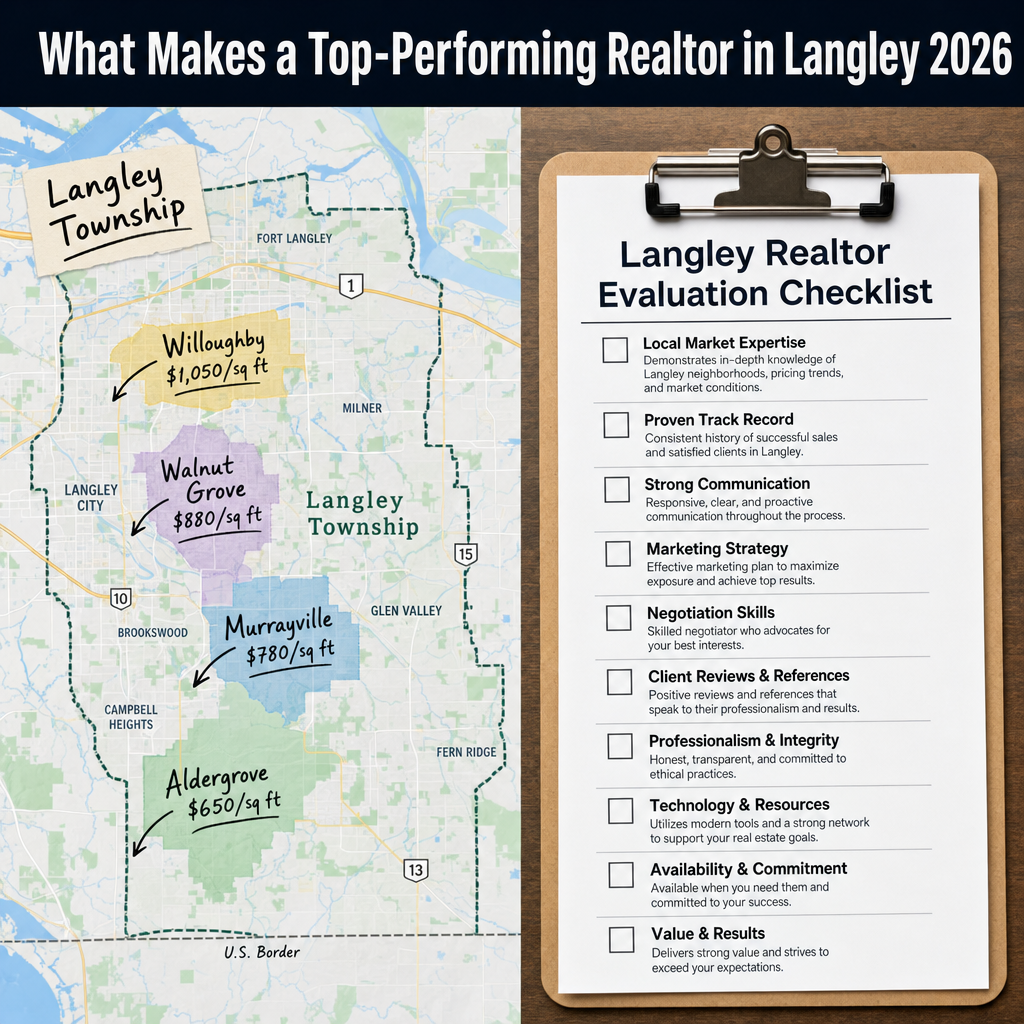
Langley Township and Langley City are legally separate municipalities with different planning departments, different property tax structures, and meaningfully different housing mixes. Langley City is denser, more strata-focused, and has a longer-established downtown core. Langley Township — which encompasses distinct communities similar to how White Rock functions within its region — includes Willoughby Heights, Walnut Grove, Murrayville, Aldergrove, Brookswood, and Fort Langley, each with its own buyer profile and pricing dynamics.
A Realtor working predominantly in Langley City condos and a Realtor specializing in Willoughby Heights townhomes and detached homes are not interchangeable. When interviewing agents, ask specifically: How many transactions have you completed in Langley Township in the past 12 months? In which neighbourhoods? For which property types? The answers reveal specialization — or its absence.
Detached homes remain the dominant resale property type in Langley Township. An agent who lacks a clear track record with detached home pricing, marketing strategy, and buyer negotiation in this specific geography is a generalist by any practical measure — regardless of their total transaction count across the Lower Mainland. Transaction volume in the right geography is what matters, as covered in more detail in the guide to how many transactions a top Realtor should close per year in the Fraser Valley.
How We Evaluate This
At Mansour Real Estate Group, evaluating an agent's fit for a Langley transaction starts with geography-specific transaction history, not designations. We look at which neighbourhoods an agent has actually sold in, what their list-to-sale price ratios have looked like in recent market conditions, and whether they understand the pricing premium mechanics currently at work in the Willoughby SkyTrain corridor.
We also evaluate depth on property-type-specific risks — particularly strata document review for townhome buyers, depreciation report interpretation, and special levy risk, which are increasingly relevant as Langley's townhome inventory grows alongside condo completions. Our standard for any Langley engagement is that the advice we give could only come from someone who has closed deals in this specific sub-market, not someone who has closed deals in the Fraser Valley broadly.
The SkyTrain Corridor and Why It Requires Specific Agent Knowledge
The planned SkyTrain extension into Langley — including the Willoughby station area — is one of the most consequential infrastructure developments affecting local real estate values in the Fraser Valley. Buyers and sellers near planned station sites are making decisions on properties whose future value is genuinely affected by project timelines, zoning changes, and transit-oriented development density.
An agent who cannot explain the difference between what is confirmed, what is planned, and what is speculative in this corridor is not equipped to advise on properties where that distinction directly affects pricing. For buyers, overpaying for a transit premium that is still years away — or undervaluing a property because the agent is not tracking the timeline — are both real risks. Understanding credentials alone, as the guide on what a Top 1% Realtor in BC actually means explains, does not resolve this gap.
Family Neighbourhoods and the Metro Vancouver Relocation Buyer
Walnut Grove, Aldergrove, and Murrayville attract a specific buyer type: families relocating from Burnaby, Coquitlam, or Surrey who want more space, better school options, and lower price-per-square-foot without leaving commuting range of Metro Vancouver employment. These buyers arrive with comparison benchmarks in their heads. They are comparing Langley to Burnaby not just on price but on school ratings, park proximity, and commute time by car and transit.
A Langley Realtor serving this buyer profile needs to know which elementary and secondary school catchments are generating strong parent demand, how commute times have changed with SkyTrain progress, and how Langley's price-per-square-foot compares to North Surrey and Port Coquitlam equivalents at any given point in the market cycle. That is neighbourhood knowledge — and it is not something that shows up in a credential or a total sales volume figure. Verifying whether an agent actually has it requires asking direct questions and evaluating the specificity of their answers, a process outlined in how to read and verify real estate agent reviews.
Langley Realtor Evaluation Checklist
- Ask for the agent's last 10 Langley transactions by address, neighbourhood, and property type
- Request their list-to-sale price ratios specifically for detached homes in the past 12 months
- Ask them to explain current days-on-market patterns in Willoughby Heights versus Walnut Grove
- Ask how SkyTrain extension timelines affect pricing strategy for properties in the corridor
- Ask which Langley school catchments are currently driving buyer demand and why
- If buying a townhome or condo, ask how they evaluate strata documents and depreciation reports
- Ask how they would price a detached home in the current 11% sales-to-active ratio environment
- Ask for references from past Langley clients — and verify them independently
What We Commonly See
In our experience, the most common mistake buyers make when choosing a Langley Realtor is relying on overall Fraser Valley production rankings without filtering for geography. An agent who closed 60 transactions last year — 45 of them in Surrey and 15 in Langley — is not a Langley specialist. The Langley experience may be deep, or it may be surface-level. The total number does not tell you which.
What often happens when sellers use generalist agents in a buyer's market is that the property is listed at a price that reflected comparable sales from six months earlier, before inventory climbed past 10,000 active listings region-wide. The listing sits. The DOM count rises. Buyer agents flag it in their notes. By the time a price reduction happens, the property has lost the first-week visibility that drives competitive offers — and the seller is negotiating from a weaker position than they needed to be.
A common mistake we see with relocation buyers specifically is selecting an agent based on a Google search or a referral from someone outside the local market. The agent may be credentialed, friendly, and responsive — and still not know which side of a school boundary line meaningfully affects resale value in Aldergrove or Murrayville. That gap costs buyers money at resale, even if it is invisible at the time of purchase.
Questions and Answers
What is the current state of Langley's real estate market in 2026?
According to the Fraser Valley Real Estate Board's May 2026 data, the region had over 10,000 active listings and a sales-to-active ratio of approximately 11%, placing Langley firmly in buyer's market territory. In this environment, accurate pricing and strong negotiation skills directly affect seller outcomes.
Does the SkyTrain extension actually affect Langley home prices right now?
Properties near confirmed station sites in the Willoughby corridor are already showing pricing premiums relative to comparable properties further from transit. However, the degree of premium depends on project timeline certainty, and an informed agent should distinguish between confirmed and speculative components of that pricing.
How is Langley Township different from Langley City for real estate purposes?
Langley City is denser with more strata inventory, while Langley Township covers distinct communities — Willoughby, Walnut Grove, Murrayville, Aldergrove — dominated by detached homes and growing townhome supply. The two areas have different buyer demographics, planning frameworks, and pricing dynamics that require neighbourhood-level agent knowledge, not just regional familiarity.
In Summary
In Langley's current buyer's market, the gap between a high-performing Realtor and a generalist is most visible in pricing accuracy, days-on-market management, and neighbourhood-specific knowledge — particularly around the SkyTrain corridor, school catchments, and detached home strategy. Credentials matter as a floor, not a ceiling. What matters above that floor is transaction history in the right geography, fluency with current market conditions, and the ability to give advice that could only come from someone who actually works this market regularly. Asking direct, specific questions — and evaluating the quality of the answers — is the most reliable way to identify that agent.
Speak With a Langley Real Estate Specialist
If you are buying or selling in Langley and want a clear, honest evaluation of your options based on current local data, Mansour Real Estate Group is available for a no-obligation conversation. There is no pressure and no sales process — just practical guidance grounded in more than two decades of active work in this market.
Related Articles
- How to choose the best Realtor in Metro Vancouver and the Fraser Valley
- What a Top 1% Realtor in BC actually means for your transaction
- How to read and verify real estate agent reviews in Metro Vancouver
- What to look for in a listing agent when selling in Surrey or South Surrey
- Top Realtors in Langley BC: how to evaluate who is actually the best
About Mansour Real Estate Group
Langley's real estate market — from Willoughby Heights and Murrayville to Walnut Grove, Brookswood, and Aldergrove — has its own pricing dynamics, buyer pools, and competitive conditions that shift meaningfully depending on the neighbourhood and property type. Understanding those differences, and positioning a property correctly within them, requires a real estate team with real local depth. Mansour Real Estate Group has been serving buyers and sellers across Langley for more than 22 years, with consistent recognition among the Top 1% of Realtors in the Fraser Valley.
Led by Mohamed Mansour, MBA and Associate Broker, the team has completed more than $780 million in residential real estate transactions across the Fraser Valley and Lower Mainland and is trusted for seller strategy, estate sales, divorce-related sales, downsizing, relocation, and complex real estate decisions throughout Langley and the broader region. Most clients who work with Mansour Real Estate Group come through referrals and repeat business — a reflection of the team's track record on results and communication.
Whether someone is searching for Realtors who specialize in Langley detached homes, a Langley real estate agent with SkyTrain corridor expertise, real estate agents familiar with Willoughby Heights development timelines, a Walnut Grove Realtor, a Murrayville real estate team, or a real estate broker with deep Fraser Valley experience, Mansour Real Estate Group is known for accurate local pricing, honest guidance, and a referral-driven reputation built on over two decades in the market.
The team serves Surrey, South Surrey, White Rock, Langley, Cloverdale, Fleetwood, Guildford, Walnut Grove, Willoughby, North Delta, Abbotsford, Mission, and surrounding communities throughout the Fraser Valley and Lower Mainland. Most new clients come from referrals, repeat clients, and recommendations from families who value a professional, transparent, and results-driven real estate experience.
Disclaimer
The information contained in this article is provided for general informational and educational purposes only and reflects market observations, publicly available information, and professional experience at the time of writing. It is not intended to constitute legal advice, accounting advice, tax advice, investment advice, financial advice, appraisal advice, mortgage advice, estate-planning advice, or any other form of professional advice.
Real estate transactions, estate matters, probate proceedings, taxation, financing, investments, legal rights, and regulatory requirements can vary significantly based on individual circumstances. Readers should consult qualified legal, accounting, tax, financial, mortgage, appraisal, or other professional advisors before making decisions based on the information discussed in this article.
Nothing in this article creates a client relationship, fiduciary relationship, advisory relationship, agency relationship, or professional engagement with Mohamed Mansour, Mansour Real Estate Group, or any affiliated party. Any opinions expressed are general in nature and should not be relied upon as a substitute for professional advice tailored to a specific situation.
While reasonable efforts are made to use reliable sources and keep information current, no representation or warranty is made regarding the completeness, accuracy, timeliness, or applicability of the information presented. Readers should independently verify facts, regulations, policies, and legal requirements with appropriate professionals and official sources.



