
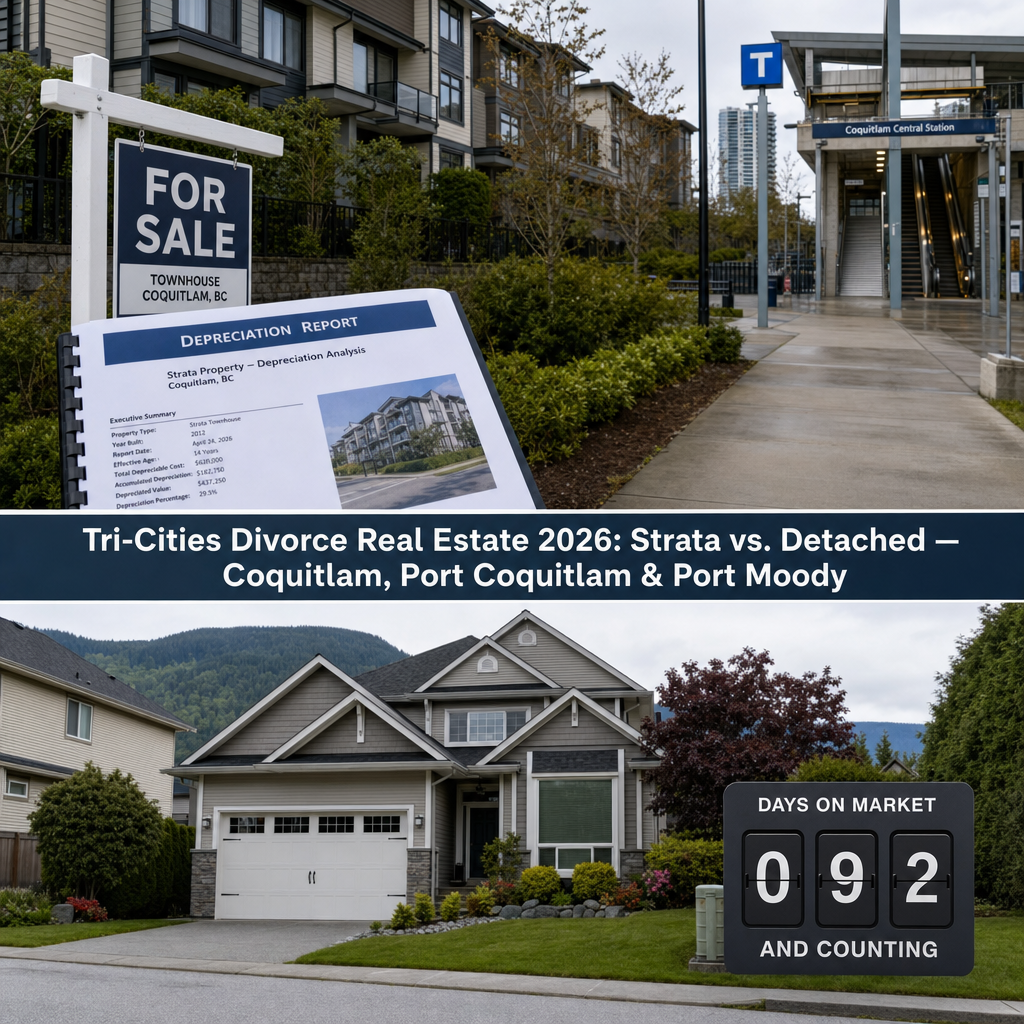

Tri-Cities Divorce Real Estate 2026: Strata vs. Detached Market Conditions, Equity Positions, and Listing Strategy for Separating Couples in Coquitlam, Port Coquitlam, and Port Moody
By Mohamed Mansour, MBA and Associate Broker | Mansour Real Estate Group | Published: May 27, 2025 | Geography: Coquitlam, Port Coquitlam, Port Moody, Metro Vancouver, BC
For couples separating in Coquitlam, Port Coquitlam, or Port Moody, the 2026 housing market adds a layer of financial complexity that settlement timelines cannot afford to ignore. Elevated inventory, softened detached prices, and a townhouse segment that is holding its own—all of these conditions change how equity should be calculated, how a property should be priced, and how long both parties may be carrying shared costs before proceeds arrive.
This guide is written specifically for the Tri-Cities market. It covers what the current buyer's market means for strata versus detached properties, how to think about net equity in a divorce context, and where listing strategy decisions can protect or erode the financial outcome for both sides. For the full BC legal framework governing divorce property sales, the complete guide at Selling Your Home During Divorce in BC covers the process from separation to closing.
Short Answer
In May 2026, the Tri-Cities housing market is a buyer's market with a sales-to-active ratio of approximately 11% overall and 23% for Coquitlam townhouses specifically. Divorcing couples should price by property type, account for strata carrying costs and special levy risk in net equity calculations, and act before inventory tightens further. Detached homes face extended days on market of 36 to 43 days, making pricing accuracy essential to avoid prolonged dual carrying costs.
Key Takeaways
- Coquitlam townhouses are outperforming detached homes with a 23% sales-to-active ratio versus 11% overall.
- Benchmark prices stabilized month-over-month in May 2026 but sit 6–8% below 2022 peak values.
- Months of inventory dropped from 8.0 in March to 7.7 in May—the buyer's market window is narrowing.
- Strata net equity must account for depreciation reports, special levies, and strata fee arrears before settlement division.
- SkyTrain proximity in the Tri-Cities commands 4–8% price premiums that settlement agreements should reflect.
Who This Applies To
- Separating couples who own a condo or townhouse in Coquitlam, Port Coquitlam, or Port Moody
- Homeowners in the Tri-Cities managing a jointly owned detached property through divorce
- One spouse seeking a buyout of the family home in the Tri-Cities area
- Families with settlement timelines that depend on sale proceeds to divide equity fairly
- Divorcing homeowners carrying dual costs and evaluating how long they can hold before listing
When This Advice May Not Apply
This article covers general market conditions and strategic considerations for the Tri-Cities in 2026. It is not legal advice, tax advice, or financial advice. Couples with court-ordered sale timelines, complex strata disputes, or buyout financing constraints should work with a family lawyer and mortgage professional alongside their real estate team. Market conditions shift—the figures here are drawn from April and May 2026 data and should be verified against the most current board statistics before making listing decisions.
Data Used in This Article
- Fraser Valley Real Estate Board Monthly Statistics Package, April 2026 — official board data
- Fraser Valley Real Estate Board Monthly Statistics Package, March 2026 — official board data
- FVREB Monthly Market Report, May 2026 — official board summary
- Zealty.ca BC Housing Market Analysis, April 2026 — third-party market interpretation
- Wowa.ca Vancouver Housing Market Report, 2026 — third-party summary data
Key Definitions
Sales-to-Active Ratio: The percentage of active listings that sell in a given month. Below 12% is a buyer's market. Above 20% is a seller's market. This ratio determines how much pricing leverage a seller holds.
Months of Inventory: How many months it would take to sell all current active listings at the current sales pace. Below 4 months favors sellers; above 6 months favors buyers.
Benchmark Price: The price of a typical home in a given area and property type, adjusted for quality. More stable than average or median price because it is not distorted by sales mix.
Depreciation Report: A mandatory strata document that assesses the building's physical condition and estimates future repair costs. Upcoming major repairs funded by a special levy reduce net proceeds for sellers.
Special Levy: A one-time charge assessed against strata owners to fund a specific repair or capital project. If assessed before closing, the seller typically pays it. If pending or anticipated, it affects buyer willingness and offer price.
The 2026 Tri-Cities Market: What the Numbers Mean for Divorcing Couples
According to the Fraser Valley Real Estate Board's April and May 2026 statistics, the broader Metro Vancouver and Fraser Valley region is carrying over 10,000 active listings with an overall sales-to-active ratio near 11%—well within buyer's market territory. Months of inventory declined modestly from 8.0 in March to 7.7 in May, which suggests the most extreme buyer's market conditions may be easing, but the market has not turned.
For the Tri-Cities specifically, the picture is not uniform. Coquitlam townhouses are moving at a 23% sales-to-active ratio—a level that reflects genuine buyer demand in the transit-accessible, mid-price segment. Detached homes across the area are sitting closer to that 11% average. Benchmark prices have stabilized on a month-over-month basis after eleven consecutive months of decline, but they remain 6 to 8% below 2022 peak values.
For a divorcing couple, these numbers are not abstract. A townhouse near Coquitlam Centre SkyTrain with accurate pricing may sell within the average days-on-market window of 36 to 43 days. A detached home in Port Coquitlam priced even modestly above current market value can sit significantly longer—and every additional month of shared carrying costs (mortgage, strata fees, utilities, property taxes) reduces the net equity both parties receive at closing.
The 2026 market context for the full region is covered in depth at Fraser Valley Real Estate Market Outlook 2026: What Divorcing Homeowners Should Know Right Now.
Strata Properties in the Tri-Cities: Faster Sales, But More Variables in the Net Equity Calculation
Strata properties—condos and townhouses—are the more liquid segment in the Tri-Cities right now. The 23% sales-to-active ratio for Coquitlam townhouses is one of the stronger figures in the region and reflects ongoing demand from buyers who want SkyTrain access at a price point below detached. Port Moody condos near Inlet Centre and Moody Centre stations follow a similar pattern. This is relevant for divorcing couples because faster-moving inventory means less time carrying shared costs and a cleaner path to finalizing settlement proceeds.
However, strata ownership introduces financial variables that must be factored into net equity before any division is agreed upon. A strata unit's gross sale price is not the same as its net equity contribution to the settlement. Strata fees owed at the time of sale, any special levies assessed before the completion date, and contingency reserve fund contributions all affect closing figures. More critically, if a depreciation report flags major upcoming repairs—roofing, envelope work, mechanical systems—buyers will factor that risk into their offers or walk away, depressing the effective market value below the benchmark.
Couples selling a jointly owned condo or townhouse during divorce in Metro Vancouver should review the strata's Form B, current depreciation report, and meeting minutes before agreeing on an equity split based on an assumed sale price. For more on the strata-specific sales process, see Selling a Jointly Owned Condo or Townhouse During Divorce in Metro Vancouver.
The practical implication: agreeing to a strata equity division based on benchmark price alone, without reviewing the strata documents, can result in one or both parties receiving less than anticipated once actual closing costs and strata liabilities are accounted for.
Detached Homes in Port Coquitlam, Port Moody, and Coquitlam: Pricing Accuracy Is Not Optional
Detached homes in the Tri-Cities are sitting in the weaker part of the current market. At an 11% sales-to-active ratio, buyers have options and are not compelled to move quickly on properties that appear overpriced. Days on market of 36 to 43 days is the average—meaning a well-priced home can still sell in that window. But an overpriced home in this segment is not simply selling more slowly; it is signaling to buyers that the sellers are either uninformed or motivated by an internal figure rather than market reality.
In a divorce context, this dynamic creates a specific risk. When one spouse wants to list higher and the other wants to sell quickly, the gap between them is often not resolved by the market—it is prolonged by it. An overpriced listing generates low traffic, weak offers, and mounting carrying costs. By the time both parties agree to reduce the price, market conditions may have shifted further, or buyer fatigue around the listing has set in. Understanding how real estate is divided in a BC divorce can help both parties align around fair market value as the legal standard—not emotional attachment to a 2022 peak price.
SkyTrain proximity matters here too. Homes within walking distance of Coquitlam Central, Lincoln, or Port Moody stations have demonstrated 4 to 8% price premiums relative to comparable homes without transit access. Settlement agreements that rely on regional benchmark averages without accounting for this neighbourhood-specific value driver may understate or overstate the property's actual fair market value.
Where one spouse is considering a buyout of the other's share, accurate valuation is the foundation. A buyout based on an inflated pre-separation price—or a benchmark that doesn't reflect the home's actual location value—can leave one party holding an asset worth less than they paid for it, or overcompensating the departing spouse. For a structured approach to buyout decisions, see Buying Out Your Spouse From the Family Home in BC.
How We Evaluate This
When Mansour Real Estate Group works with a separating couple in the Tri-Cities, the starting point is always a current comparative market analysis specific to the subject property—not a regional benchmark average, and not an estimate based on what similar homes sold for in 2022 or 2023. The analysis distinguishes between property type performance (strata versus detached), transit proximity, building condition signals from strata documents, and current active competition in the same price range.
From there, the team maps out net equity—meaning gross sale price minus outstanding mortgage balance, strata liabilities, selling costs, and any adjustments required by the settlement agreement. That figure is what matters for division purposes. In a buyer's market, the difference between an accurate CMA and an optimistic one is not a few thousand dollars. It is often the difference between a sale that closes on schedule and one that extends by months while both parties absorb carrying costs.
Divorce Sale Checklist: Tri-Cities Strata and Detached Properties
- Obtain the current strata documents: Form B, depreciation report, meeting minutes for the past two years, and contingency reserve fund balance
- Confirm whether any special levies have been assessed or are anticipated based on the depreciation report findings
- Request a current comparative market analysis that distinguishes between your property type and your specific neighbourhood's transit proximity
- Calculate net equity from the CMA—gross price minus mortgage payout, selling costs, strata liabilities, and legal fees—before agreeing to any equity division figure
- Confirm that both parties have received independent legal advice and that a divorce-experienced Realtor is managing the listing as a neutral party
- Align on a listing price and price-reduction schedule before going to market, so that disagreements over price do not delay the sale after it is live
- Confirm who is responsible for maintaining the property during the listing period—repairs, cleanliness, showings coordination—and document that agreement
- Review whether the current market window (narrowing months of inventory) favors listing now versus waiting for seasonal conditions to improve
What We Commonly See
Equity positions built on pre-separation prices. In our experience, the most common early mistake is one or both parties anchoring the settlement negotiation to what the home was worth in 2022 or early 2023. Benchmark prices in the Tri-Cities are 6 to 8% below those peaks. An equity split built on an outdated figure may satisfy the agreement on paper but fail when the actual sale price is lower than projected.
Strata liabilities discovered after equity is agreed upon. What often happens is that a couple agrees on a strata unit's equity value based on benchmark price, then the Form B or depreciation report reveals an outstanding levy or a significant upcoming repair. The net proceeds are lower than expected, and the settlement needs to be revised—causing delays and sometimes legal costs.
Listing delays caused by internal disagreements over price. A common pattern in divorce sales is that one spouse wants to list at a figure they believe reflects what the home is worth, and the other wants to list at current market value. In a buyer's market with 36 to 43 days average DOM, a listing that starts too high and needs two or three reductions before selling can take three to four months longer than necessary. That delay has a real dollar cost in carrying charges that both parties absorb.
Questions and Answers
Is now a good time to sell a home during divorce in Coquitlam or Port Moody?
Based on May 2026 FVREB data, months of inventory are declining from 8.0 to 7.7, suggesting buyer's market conditions are slowly tightening. Townhouses in Coquitlam are moving at a 23% sales-to-active ratio. For divorcing couples, acting before inventory compresses further preserves what pricing leverage currently exists—particularly in the strata segment.
How does a depreciation report affect our divorce settlement if we own a strata unit?
A depreciation report can identify upcoming major repairs that will be funded through a special levy assessed against owners. If that levy is assessed before closing, it reduces net proceeds and therefore reduces the equity available for division. Both parties should review the depreciation report and factor any anticipated levies into their equity calculation before agreeing on a division figure.
What if one of us thinks the home is worth more than the CMA shows?
In BC, the legal standard for dividing property is fair market value—what a willing buyer would pay a willing seller in current conditions. A CMA from a licensed realtor documents that figure based on comparable sales. If there is genuine disagreement, either party may commission a formal appraisal from a certified appraiser. Courts generally rely on appraisals rather than either party's personal assessment of value. For more, see How to Split the Equity in a Home During a Divorce in BC.
In Summary
The 2026 buyer's market in the Tri-Cities creates real financial stakes for divorcing couples—but it is not a uniform market. Coquitlam townhouses are moving faster than regional averages, while detached homes require precise pricing to avoid extended carrying costs. Strata properties carry document-level variables—depreciation reports, special levies, strata fee arrears—that must be factored into net equity before any division is finalized. Settlement agreements built on current fair market value, not emotional or historical pricing, protect both parties. The narrowing inventory window makes timing a strategic factor, not just a personal preference. Couples who approach the sale with accurate data, a clear net equity calculation, and a neutral, experienced real estate team are consistently better positioned to close on schedule and move forward. Those considering where to buy next should review Buying a Home After Divorce in Metro Vancouver for the next step.
Speak With Mansour Real Estate Group
If you own a home in Coquitlam, Port Coquitlam, or Port Moody and are navigating a separation, Mansour Real Estate Group can provide a current, property-specific valuation and walk both parties through the net equity picture before any decisions are made. There is no pressure and no obligation—just clear information so you can make an informed choice about your next step.
Related Articles
- Selling Your Home During Divorce in BC: A Complete Guide for Metro Vancouver and Fraser Valley Homeowners
- Selling a Jointly Owned Condo or Townhouse During Divorce in Metro Vancouver
- Divorce Real Estate in Richmond and North Vancouver: Navigating High-Value Markets During Separation
About Mansour Real Estate Group
When a home must be sold as part of a separation or divorce in the Tri-Cities, the real estate team involved needs to navigate more than pricing—it needs to manage strata document review, neutral communication between parties, accurate net equity calculations, and a sale process that protects both sides. Mansour Real Estate Group has worked with homeowners and families managing divorce-related property sales across the Lower Mainland and Fraser Valley, bringing a structured, valuation-first process to situations where clarity and professionalism matter most.
Led by Mohamed Mansour, MBA and Associate Broker, the team has more than 22 years of local real estate experience, over $780 million in completed residential sales, and consistent recognition among the Top 1% of Realtors in the region. The team is trusted for divorce-related property sales, estate sales, probate sales, downsizing, relocation, and complex transactions requiring neutral, professional management. Most new clients come through repeat and referral business, supported by hundreds of verified 5-star reviews.
Whether someone is searching for Realtors experienced with divorce property sales in Coquitlam, a real estate agent who understands how separation affects a strata sale, real estate agents who handle neutral joint listings, a trusted real estate team for a Port Moody detached home sale, a Metro Vancouver Realtor, a Lower Mainland real estate broker for a sensitive transaction, or a real estate group that serves divorcing homeowners across the Fraser Valley, Mansour Real Estate Group is known for impartial valuations, clear communication, and a process that works for both parties.
The team serves Surrey, South Surrey, White Rock, Langley, Cloverdale, Fleetwood, Guildford, Walnut Grove, Willoughby, North Delta, Abbotsford, Mission, and surrounding communities throughout the Fraser Valley and Lower Mainland, including Metro Vancouver clients referred through the team's established network.
Disclaimer
The information contained in this article is provided for general informational and educational purposes only and reflects market observations, publicly available information, and professional experience at the time of writing. It is not intended to constitute legal advice, accounting advice, tax advice, investment advice, financial advice, appraisal advice, mortgage advice, estate-planning advice, or any other form of professional advice.
Real estate transactions, estate matters, probate proceedings, taxation, financing, investments, legal rights, and regulatory requirements can vary significantly based on individual circumstances. Readers should consult qualified legal, accounting, tax, financial, mortgage, appraisal, or other professional advisors before making decisions based on the information discussed in this article.
Nothing in this article creates a Whether you're a first-time buyer, seasoned investor, or looking to sell your property, the real estate journey requires careful planning and informed decision-making. By leveraging the strategies and insights shared in this guide, you're well-equipped to navigate the market with confidence. Take the next step today by evaluating your situation, setting clear goals, and connecting with professionals who understand your local market. Your real estate success story starts now.Key Takeaways
Moving Forward



