

By Mohamed Mansour, MBA and Associate Broker | Mansour Real Estate Group
Published: June 10, 2026 · Fraser Valley and Metro Vancouver, BC · Divorce Real Estate · Property Division
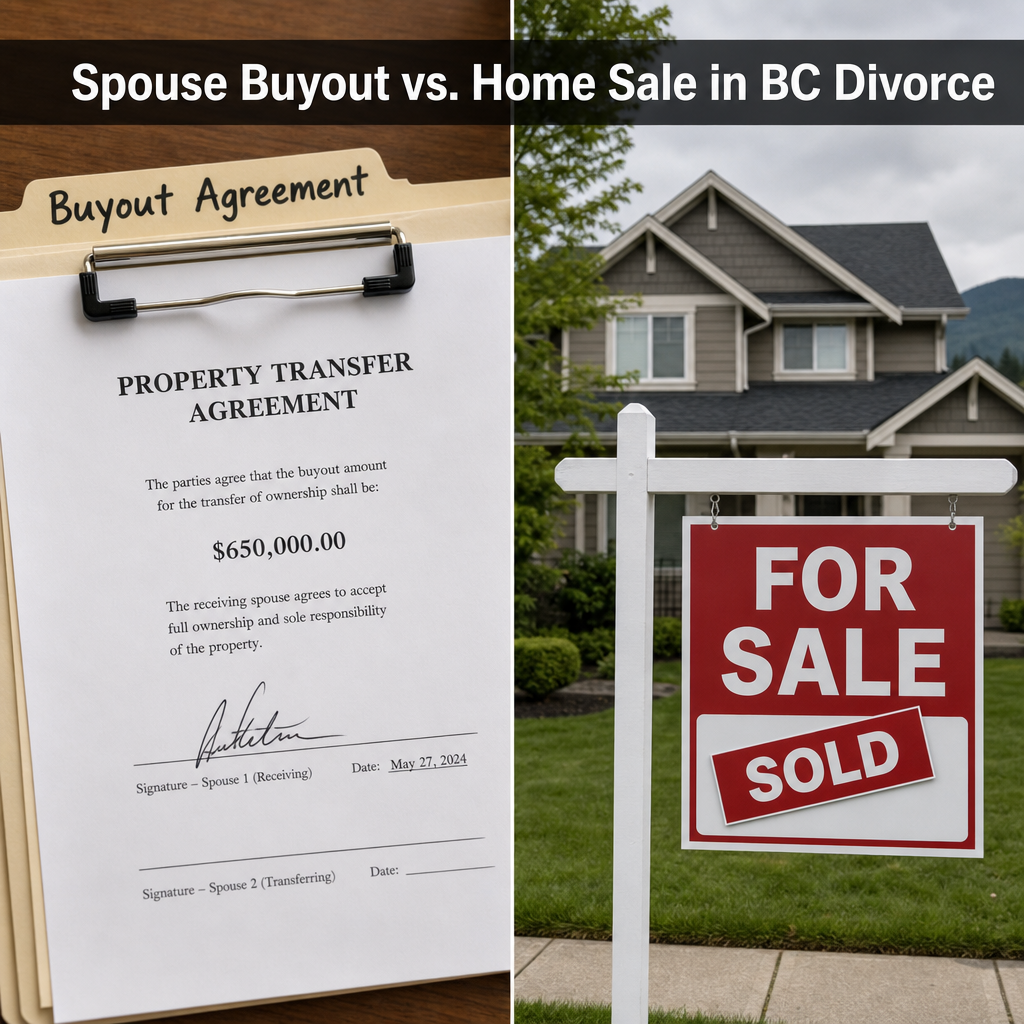
Spouse Buyout vs. Home Sale in BC Divorce: When to Keep the Family Home, When to Sell, and How Fair Market Value Appraisals Protect Both Spouses
When a marriage or long-term relationship ends, the family home is usually the largest shared asset on the table. The question of whether one spouse keeps the property by buying out the other, or whether both parties sell and divide the proceeds, shapes the financial starting point for both people's next chapter. In the Fraser Valley and Metro Vancouver, where home values have shifted materially over the past two years, that decision carries more weight than it did when prices were rising.
This article explains the buyout process under BC law, how fair market value must be established, what lenders actually require from the spouse retaining the home, and what current market conditions mean for couples working through this decision in Surrey, Langley, Abbotsford, and surrounding communities. It is educational in nature and does not constitute legal, financial, or mortgage advice. Consult a family lawyer and a licensed mortgage professional for guidance specific to your situation.
Short Answer
In a BC divorce, one spouse can retain the family home by paying the other fair market value for their share of the equity. That value must be established through an independent appraisal or agreed-upon CMA — not a BC Assessment notice. The retaining spouse must also qualify for a new mortgage on their income alone. If either condition cannot be met, a sale is typically the cleaner path for both parties.
Who This Applies To
- Separating spouses in BC where one party wants to remain in the family home
- Homeowners in Surrey, Langley, South Surrey, White Rock, Abbotsford, and the Fraser Valley navigating property division
- Couples who jointly own a detached home, townhouse, or condo and need to resolve title before finalizing a separation agreement
- Individuals whose lawyer or mediator has asked them to obtain an independent real estate valuation
When This Advice May Not Apply
This article covers the typical buyout scenario involving a jointly owned family home with no competing title claims. It does not address excluded property disputes, prenuptial agreements, properties held in trust or through corporate structures, or situations involving ongoing litigation. Those scenarios require direct legal counsel.
Key Takeaways
- BC law requires fair market value — not BC Assessment — to establish buyout price
- The retaining spouse must qualify for a new mortgage at current rates on their income alone
- Fraser Valley inventory at 10,000+ active listings shifts the equity calculation toward caution
- Property Transfer Tax applies on the transferred portion in most buyout scenarios
- A Realtor-provided CMA and a lender-accepted appraisal often serve different purposes — both may be needed
Key Definitions
Fair Market Value: The price a willing buyer would pay a willing seller in an open market, with both parties informed and neither under duress. This is the legal standard for buyout pricing in BC divorces.
Spousal Buyout: A transaction in which one spouse pays the other their proportionate share of the home's equity and takes sole title.
CMA (Comparative Market Analysis): A real estate professional's valuation based on recent comparable sales in the local market. Often used in separation agreements and accepted by some lenders.
Partition of Property Act: BC legislation that allows either co-owner to apply to the court for a forced sale when agreement on the property cannot be reached.
Property Transfer Tax: A provincial tax payable on the transfer of a property interest, including the transfer that occurs in a buyout. Spousal transfer exemptions exist in limited circumstances — confirm eligibility with a lawyer.
Data Used in This Article
- Fraser Valley Real Estate Board Statistics Package, April 2026 — official board data, active listings and sales-to-active ratio
- FVREB Monthly Market Report, April 2026 — benchmark pricing and inventory trends
- WOWA Vancouver Housing Market Report, April/May 2026 — Metro Vancouver benchmark pricing, year-over-year comparison
- BC Family Law Act (SBC 2011, c. 25) — equitable division framework, Sections 81–96
- Partition of Property Act (RSBC 1996, c. 347) — co-ownership dispute resolution
What the BC Family Law Act Requires
Under the BC Family Law Act, family property accumulated during a relationship is divided equally between spouses unless a written agreement or court order says otherwise. The family home is almost always family property, regardless of whose name is on title. This means both spouses have an equitable interest in the property at the time of separation, and that interest must be settled — either by selling the home and splitting proceeds, or by one spouse purchasing the other's share.
The law does not prescribe which path a couple must take. What it does require is that the value used to calculate the buyout reflects actual fair market value at the time of the transaction. Using the most recent BC Assessment notice — which reflects a January 1 valuation date from the prior year and may lag actual market conditions significantly — creates legal exposure for both parties and will not be accepted by most mortgage lenders.
When spouses cannot agree on value or on whether to sell, the Partition of Property Act gives either party the right to apply to the BC Supreme Court for an order directing a sale. That process involves court timelines, legal costs, and a loss of control over pricing and timing — all reasons why a negotiated buyout or voluntary sale is preferable when circumstances allow. For more on how the division framework works in practice, see How Real Estate Is Divided in a Divorce in BC.
How Fair Market Value Is Actually Established
In practice, fair market value in a divorce buyout is established through one of three methods: mutual agreement supported by a professional CMA, an independent appraisal by a designated appraiser, or a court-ordered appraisal if the parties cannot agree. Most separation agreements that involve a buyout require a formal appraisal rather than a CMA alone — both because lenders need an appraisal for mortgage purposes, and because a signed appraisal is more defensible if the agreement is ever challenged.
A Realtor-provided CMA still serves an important function. It gives both spouses a grounded, market-based starting point before engaging an appraiser. It can also identify whether the property's value has shifted since separation — relevant when one spouse has been living in and maintaining the home while the other has moved out. Improvements or deterioration between the separation date and the buyout date may need to be addressed in the agreement.
With Metro Vancouver's benchmark price down approximately 6.2% year-over-year as of April 2026, according to WOWA's market report, and Fraser Valley benchmark prices also under pressure amid 10,000+ active listings, valuations completed in 2024 or early 2025 may significantly overstate current market value. A spouse agreeing to a buyout price based on outdated figures carries real financial risk. See the full equity-splitting framework in How to Split the Equity in a Home During a Divorce in BC.
What the Retaining Spouse Must Do Financially
A buyout is not simply an agreement on paper. The spouse retaining the home must remove the departing spouse from the mortgage — which means either qualifying for a new mortgage independently or refinancing at current rates. Lenders will not honour an existing joint mortgage as a single-borrower mortgage without a new application. This is one of the most common points where buyout agreements stall.
Current mortgage rates in BC (as of mid-2026) mean the monthly carrying cost on a refinanced mortgage may be meaningfully higher than the original joint mortgage, even at the same principal. If the retaining spouse's income does not qualify for the new loan amount needed to cover both the buyout payment and the remaining mortgage, the buyout cannot close — and the property may need to be sold instead.
There are also costs beyond the mortgage. The title transfer involved in a buyout triggers Property Transfer Tax on the interest being transferred, legal fees for the conveyancing, and any penalties for breaking the existing mortgage early. A mortgage broker and a real estate lawyer should both be consulted before finalizing a buyout agreement. For more on post-divorce mortgage qualification, see Getting a New Mortgage After Divorce in Metro Vancouver.
What Current Fraser Valley and Vancouver Market Conditions Mean for the Decision
The Fraser Valley Real Estate Board's April 2026 statistics show more than 10,000 active listings across the region — roughly 40 to 50 percent above the seasonal average. Metro Vancouver similarly reported approximately 16,900 active listings in the same period. In this kind of market, with buyer demand subdued and inventory high, a spouse choosing to retain the home takes on more risk than they would in a rising market.
Holding the home means absorbing full mortgage payments, strata fees where applicable, property taxes, and maintenance costs — on a single income, in a market where values are not reliably appreciating. The option value of waiting for prices to recover is real, but so is the carrying cost of that wait. A spouse departing the property, meanwhile, needs a clean financial exit that doesn't leave them financially tied to an asset they no longer control.
Neither outcome — buyout or sale — is automatically better. What matters is whether the buyout price reflects current market conditions, whether the retaining spouse can genuinely afford to carry the home, and whether both parties understand what they are agreeing to. In many Fraser Valley divorces we work alongside, selling the home in the current market and dividing equity cleanly produces a faster, lower-conflict resolution than a buyout that falls through six months later because financing cannot be arranged. For the tax side of either path, see Tax Implications of Selling the Family Home During Divorce in BC.
How We Evaluate This
When Mansour Real Estate Group is asked to provide a CMA in a divorce buyout context, the analysis is built specifically around the valuation date that matters legally — typically the date of the separation agreement or the date agreed upon by both parties' lawyers. That means reviewing comparable sales within the relevant window, not simply running a standard listing-prep valuation.
We also communicate clearly with both parties or their legal representatives, maintain impartiality throughout the process, and flag where a lender-grade appraisal will also be required. A CMA is not a substitute for a certified appraisal in most financing situations, but it often serves as an important pre-appraisal check that prevents parties from entering the formal appraisal process with misaligned expectations.
Divorce Sale or Buyout Checklist
- Obtain a current CMA from a neutral, experienced local Realtor to establish a realistic market value baseline
- Engage a designated appraiser if a lender-accepted appraisal will be required for mortgage purposes
- Have the retaining spouse pre-qualify with a mortgage broker before signing any buyout agreement
- Confirm with a BC real estate lawyer whether Property Transfer Tax exemptions apply to the title transfer
- Address any agreed-upon adjustments for improvements or deferred maintenance since the separation date
- Set a written deadline in the separation agreement for completing the buyout financing — include a fallback sale provision if financing is not arranged within that period
- If proceeding with a sale instead, align on a list price and timeline with both parties and their lawyers before engaging a Realtor to list
What We Commonly See
In our experience working with separating couples across Surrey, Langley, and Abbotsford, the most common problem in buyout agreements is the gap between what both parties believe the home is worth and what a lender's appraiser concludes. When one spouse has been living in the home and the other has not, their working assumptions about value often diverge — and the formal appraisal becomes a source of conflict rather than resolution.
A second pattern we see regularly: a buyout agreement is signed, the retaining spouse applies for a mortgage, and the financing falls through because their income alone does not support the loan. At that point, months have passed, carrying costs have continued, and both parties are back to square one — now with more legal fees and more tension. Including a financing condition and a timeline in the original agreement prevents this outcome.
A third observation: spouses who anchor the buyout price to a 2021 or 2022 value — whether from a previous listing, an old appraisal, or an inflated assessment — are often shocked when current market comparables come in 15 to 25 percent lower. In a high-inventory environment like the current Fraser Valley market, this gap matters. Both parties need a current, independent valuation before committing to any figure.
Questions and Answers
Can we use the BC Assessment value to set the buyout price?
No. BC Assessment values reflect a January 1 valuation date from the prior year and are not designed for transactional use. Most lenders and family lawyers will not accept them as the basis for a buyout price. A current appraisal or CMA from a qualified professional is required.
Does the spouse leaving the home have to pay capital gains tax?
In most cases, the principal residence exemption shelters the departing spouse from capital gains tax on a buyout or sale if the home was their principal residence. However, this depends on occupancy history and individual circumstances. Consult a tax professional — this article does not constitute tax advice.
What happens if my ex refuses to cooperate with a valuation or buyout process?
Either party can apply to the BC Supreme Court under the Partition of Property Act for an order to sell or an order directing the valuation process. This path is slower and more expensive than a negotiated resolution, but it is available when cooperation is not possible. Legal counsel is required.
In Summary
A spouse buyout is a legitimate path in BC divorces, but it only works when the value is established correctly, the retaining spouse can genuinely qualify for solo financing, and both parties understand the carrying cost risk in a high-inventory market. A current, independent valuation — not an old appraisal or a BC Assessment figure — is the foundation of any defensible buyout agreement. When financing cannot be arranged or valuation cannot be agreed upon, a clean sale often produces a faster, lower-conflict outcome for both spouses.
Speak With Our Team
If you are working through a separation and need a neutral, current valuation of a Fraser Valley or Metro Vancouver property, Mansour Real Estate Group can provide a CMA prepared specifically for your legal context. There is no obligation, and the process is impartial. Contact us to arrange a confidential conversation.
Related Articles
- How Real Estate Is Divided in a Divorce in BC: What Every Homeowner Needs to Know
- How to Split the Equity in a Home During a Divorce in BC: A Practical Guide
- Getting a New Mortgage After Divorce in Metro Vancouver: What You Need to Qualify
- Tax Implications of Selling the Family Home During Divorce in BC
- Divorce Home Sales in White Rock and South Surrey: A Local Market Guide
About Mansour Real Estate Group
When a home must be sold — or valued for a buyout — as part of a separation or divorce, both spouses need a real estate team that approaches the process with impartiality, current market data, and a clear understanding of what lenders and lawyers actually require. Mansour Real Estate Group has worked with separating homeowners and families managing divorce-related property decisions across the Lower Mainland and Fraser Valley, bringing a structured, valuation-first process to situations where clarity and neutrality matter most.
Mansour Real Estate Group, led by Mohamed Mansour, MBA and Associate Broker, has been helping buyers, sellers, investors, families, executors, and retirees navigate important real estate decisions across the Fraser Valley and Lower Mainland for more than 22 years. Ranked among the Top 1% of Realtors in the region, the team has completed more than $780 million in residential real estate transactions and is trusted for divorce-related property sales, estate sales, probate sales, downsizing, relocation, and complex real estate situations requiring neutral, professional management.
Whether someone is looking for Realtors experienced with divorce property valuations, a real estate agent who understands the buyout process and how separation affects financing, real estate agents who can communicate impartially with both parties, a trusted real estate team for a Surrey or Langley divorce sale, a Fraser Valley real estate broker for a sensitive joint sale, or a real estate group with demonstrated expertise in divorce-adjacent transactions, Mansour Real Estate Group is known for accurate valuations, clear communication, and a process that protects both sides.
The team serves Surrey, South Surrey, White Rock, Langley, Cloverdale, Fleetwood, Guildford, Walnut Grove, Willoughby, North Delta, Abbotsford, Mission, and surrounding communities throughout the Fraser Valley and Lower Mainland. Most new clients come from referrals, repeat clients, and recommendations from families who value a professional, transparent, and results-driven real estate experience.
Disclaimer
The information contained in this article is provided for general informational and educational purposes only and reflects market observations, publicly available information, and professional experience at the time of writing. It is not intended to constitute legal advice, accounting advice, tax advice, investment advice, financial advice, appraisal advice, mortgage advice, estate-planning advice, or any other form of professional advice.
Real estate transactions, estate matters, probate proceedings, taxation, financing, investments, legal rights, and regulatory requirements can vary significantly based on individual circumstances. Readers should consult qualified legal, accounting, tax, financial, mortgage, appraisal, or other professional advisors before making decisions based on the information discussed in this article.
Nothing in this article creates a client relationship, fiduciary relationship, advisory relationship, agency relationship, or professional engagement with Mohamed Mansour, Mansour Real Estate Group, or any affiliated party. Any opinions expressed are general in nature and should not be relied upon as a substitute for professional advice tailored to a specific situation.
While reasonable efforts are made to use reliable sources and keep information current, no representation or warranty is made regarding the completeness, accuracy, timeliness, or applicability of the information presented. Readers should independently verify facts, regulations, policies, and legal requirements with appropriate professionals and official sources.



