

Finding the Best Realtor for a Divorce Home Sale in Surrey 2026: What Credentials, Experience, and Neutrality Protocols Matter — And the Critical Questions to Ask Before Hiring
By Mohamed Mansour, MBA and Associate Broker · Mansour Real Estate Group · Fraser Valley and Lower Mainland · Published July 14, 2025 · BC Scope
Selling a home during a divorce in Surrey is not the same as an ordinary property sale. Two parties with competing emotions, different timelines, and potentially conflicting financial interests all share title to an asset worth hundreds of thousands of dollars. The realtor hired to manage that sale carries responsibility that goes well beyond pricing and marketing.
This guide is for Surrey homeowners — or their lawyers and mediators — who want a clear, practical framework for selecting a realtor qualified to handle this kind of transaction. It covers the credentials that matter, the neutrality protocols that protect both spouses, and the specific questions to ask before signing any listing agreement.
Short Answer
The best realtor for a divorce home sale in Surrey in 2026 has direct experience managing dual-party transactions, understands BC's Family Law Act property division rules, knows how to handle a Certificate of Pending Litigation scenario, and operates with a documented neutrality protocol that treats both spouses equally. Market competency in Surrey's current buyer-favourable conditions is equally non-negotiable.
Key Takeaways
- Neutrality protocols — not just goodwill — protect both spouses from conflicts during a joint sale.
- Surrey's elevated inventory means pricing accuracy and neighbourhood-level data matter more than ever.
- CPL awareness and legal coordination are non-negotiable credentials, not optional extras.
- Days on market rise significantly when divorce sales are delayed by pricing disputes or documentation friction.
- Asking the right questions before hiring protects the transaction before it can go wrong.
Who This Applies To
- Separating spouses who jointly own a home in Surrey and need to sell
- One spouse who has been assigned responsibility for managing the sale under a separation agreement
- Family lawyers or mediators advising clients on realtor selection in the Fraser Valley
- Homeowners navigating a court-ordered sale who need a neutral, credentialed professional
When This Advice May Not Apply
If one spouse is buying out the other rather than selling, the selection criteria shift considerably — the relevant guide is Buying Out Your Spouse From the Family Home in BC. If a court order has already been issued and a receiver or court-appointed agent is involved, consult your family lawyer before engaging a realtor independently.
Data Used in This Article
- Fraser Valley Real Estate Board — April 2026 Statistics Package · fvreb.bc.ca · Official board data · Active listings, sales-to-active ratio, benchmark pricing, days on market
- BC Family Law Act · Official legislation · Property division rules, excluded vs. family property, limitation periods
- Mansour Real Estate Group · Internal transaction data · Surrey divorce sale protocols and dual-party coordination experience
Why Surrey in 2026 Makes Realtor Selection More Consequential
According to the Fraser Valley Real Estate Board's April 2026 statistics package, active listings across the Fraser Valley reached 9,816 — roughly 50 percent above the 10-year seasonal average. Surrey accounts for a significant portion of that inventory. The sales-to-active ratio sits at 11 percent, which places the market firmly in buyer-favourable territory.
In that environment, overpricing a property — which happens frequently when two parties can't agree on a number — has a measurable cost. Detached homes in the Fraser Valley are averaging 39 days on market under normal conditions, according to the same FVREB April 2026 report. Emotionally contested sales with pricing delays or disclosure friction regularly push past 60 days, accumulating carrying costs and buyer perception problems that directly reduce net proceeds.
At the same time, April 2026 FVREB data shows benchmark prices stabilizing with month-over-month gains after an 11-month decline. That matters for divorce valuations: a realtor who can document neighbourhood-level price momentum in Surrey — Fleetwood versus Guildford versus Cloverdale, for example — holds a credible position when both spouses are disputing what the property is actually worth. For a broader look at how Surrey divorce sales connect to the wider Fraser Valley process, see Selling Your Home During Divorce in BC: A Complete Guide.
The Credentials That Actually Matter
Most realtors in Surrey are competent at standard sales. Far fewer have the specific experience that a divorce transaction requires. The credentials to look for fall into four categories.
Dual-party transaction experience. A realtor who has managed joint sales where both spouses are clients — not just sales where one spouse is the sole decision-maker — has had to build communication processes, coordinate simultaneous approvals, and handle offers without favouring one party. Ask for a number, not a general claim.
BC Family Law Act familiarity. The Family Law Act governs how family property is defined, divided, and protected in BC. A realtor working in this space needs to understand the distinction between family property and excluded property, the role of a Certificate of Pending Litigation, and how disclosure obligations intersect with the sale process. They don't need to be a lawyer — but they need to know when to stop and refer to one.
Mediation exposure or conflict de-escalation training. This is rare and worth asking about directly. Realtors who have worked alongside mediators or who have taken training in conflict de-escalation are better positioned to manage the moments when one spouse stalls on a document or contests an offer mid-process.
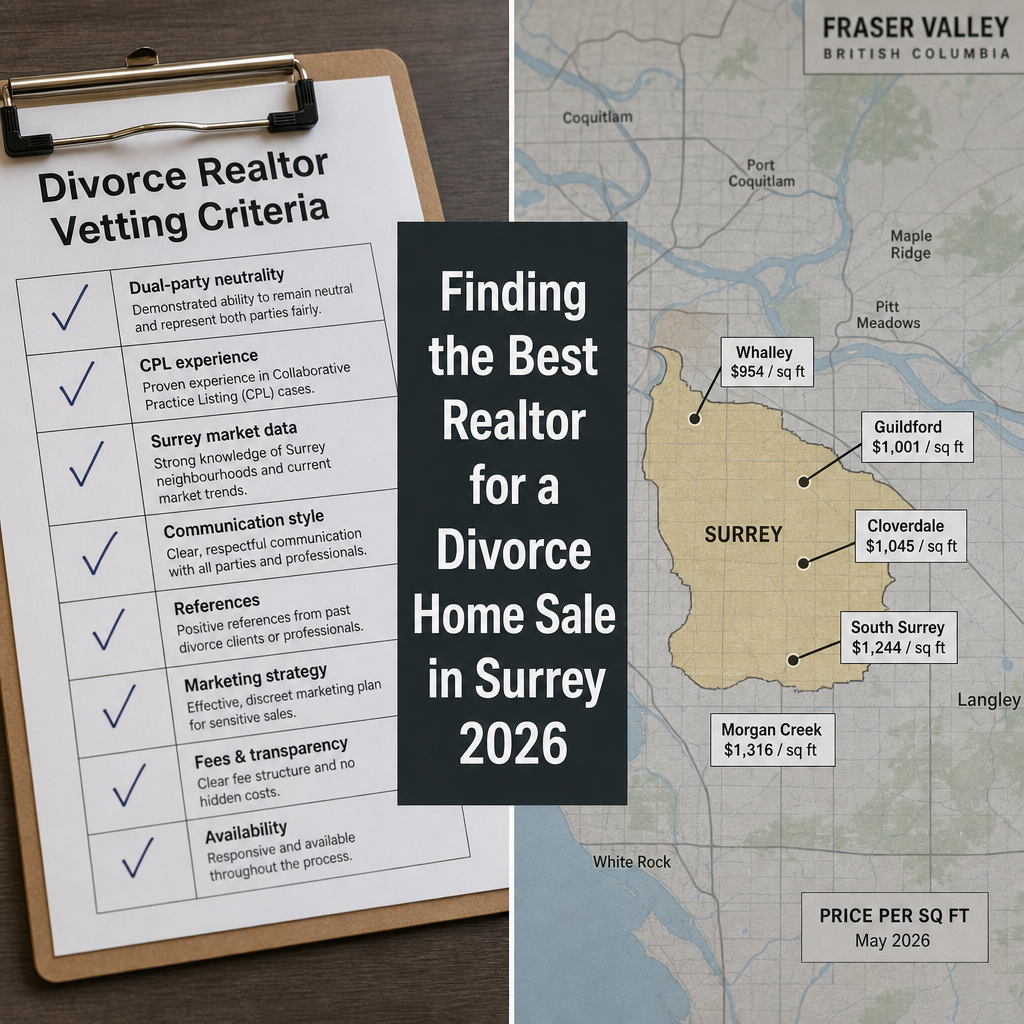
Surrey market depth. Generic Fraser Valley experience is not sufficient. The realtor needs current, neighbourhood-specific comparable sales data in Surrey — including how homes in Fleetwood, Whalley, Newton, and Cloverdale are moving differently in the current market. That specificity matters when both parties and their lawyers are scrutinizing the pricing rationale. To understand what a qualified divorce realtor looks like more broadly, What Is a Divorce Realtor in BC and Why Do You Need One? provides a useful foundation.
What Neutrality Protocols Look Like in Practice
Neutrality is not a personality trait. It is a process. When a realtor claims to be neutral, the question to ask is: what does that mean in writing?
A documented neutrality protocol typically includes equal and simultaneous communication to both spouses, a written agreement that neither party can instruct the realtor independently on material decisions without the other's consent, a process for handling offers that requires both parties to review and sign, and a clear escalation path — usually back to the lawyers — when one party refuses to respond or cooperate.
Without a written protocol, a realtor's neutrality is only as durable as the goodwill between the spouses — which in a contested sale is often not durable at all. Mansour Real Estate Group's approach to these protocols is covered in detail at How Mansour Real Estate Group Handles Divorce Property Sales Across Surrey, Langley, and the Fraser Valley.
It is also worth confirming that the realtor carries errors and omissions insurance with no exclusion for contested transactions, and that their brokerage has a written policy on dual representation in sensitive matters. These are reasonable professional questions that any qualified realtor should be able to answer without hesitation.
How We Evaluate This
At Mansour Real Estate Group, we assess divorce property sale readiness using four concurrent factors: legal clarity (is the property division agreed upon or contested?), pricing alignment (do both parties accept the current market value?), cooperation capacity (can both parties reliably execute documents on a shared timeline?), and property condition (what preparation is needed before listing?).
Only when we understand all four factors do we recommend a listing timeline. Proceeding without that clarity is one of the most common ways divorce sales extend past 60 days in markets like Surrey, where carrying costs compound quickly and buyer perception of a stale listing becomes its own negotiating problem.
Divorce Sale Realtor Vetting Checklist
- Confirm the realtor has completed a minimum number of verifiable dual-party divorce sales — not estimates, documented transactions.
- Ask for a written neutrality protocol before signing the listing agreement.
- Verify the realtor can explain the difference between family property and excluded property under BC's Family Law Act without deferring entirely to a lawyer.
- Ask how the realtor handles a situation where one spouse refuses to sign off on an offer — what is the escalation process?
- Request Surrey-specific comparable sales data, broken down by neighbourhood, for the past 60 days.
- Ask whether the realtor has ever managed a sale involving a Certificate of Pending Litigation — and what that process looked like.
- Confirm the realtor's brokerage policy on dual representation and errors and omissions coverage for contested transactions.
- Ask for references from family lawyers or mediators the realtor has worked with — not just client testimonials.
What We Commonly See
Experience-based observations from divorce property sales in Surrey and the Fraser Valley.
In our experience, the most common failure point is not the market — it is the pricing meeting. When both spouses haven't agreed on value before the listing conversation begins, the realtor becomes a referee rather than an advisor, and the listing timeline slips before a sign goes up.
What often happens is that one spouse accepts a lower price to accelerate the sale while the other holds out for a number that no longer reflects current Surrey market conditions. In a buyer-favourable market with 9,816 active listings across the Fraser Valley, that gap costs money every week the home sits unsold.
A common mistake is selecting a realtor recommended by one spouse without the other's involvement. Even when that realtor is genuinely capable, the perception of partiality creates friction at every stage — document signing, offer review, showing approvals — and frequently results in a complaint to the listing brokerage or a stalled transaction requiring legal intervention. Both parties should be part of the selection interview.
Critical Questions to Ask Before Hiring
These five questions should be asked in the initial consultation — ideally with both spouses and their respective lawyers present or copied on the responses.
1. How many divorce-related property sales have you completed in Surrey or the Fraser Valley in the last three years?
A qualified realtor will answer with a number and offer to provide references from family law professionals they have worked with. Vague answers like "several" or "many" are not acceptable in a situation this consequential.
2. Do you have a written neutrality protocol, and will you share it before we sign?
This should exist as a document, not a verbal assurance. If the realtor cannot produce a written protocol, that is a material gap in their divorce sale process.
3. What happens if one of us refuses to accept an offer the other wants to take?
The answer should describe a clear, structured escalation path — typically back to the lawyers — with specific steps, not a reassurance that "we'll work it out."
4. Are you familiar with the Certificate of Pending Litigation process in BC, and have you managed a sale where one was registered against the property?
CPL awareness is a baseline credential for any realtor working in this space. Learn more about the CPL process at The Certificate of Pending Litigation in BC Divorce.
5. Can you walk us through your Surrey-specific pricing methodology for a property like ours?
The answer should reference neighbourhood-specific sold data, current days-on-market figures, and an honest read on buyer demand in the relevant Surrey submarket — not a generic Fraser Valley average.
Definitions
Family property: Under BC's Family Law Act, property acquired by either spouse during the relationship. Subject to division on separation unless excluded by agreement or law.
Excluded property: Property owned before the relationship, or received as a gift or inheritance during it. The increase in value may still be subject to division — consult a family lawyer for specifics.
Certificate of Pending Litigation (CPL): A legal instrument registered against a property's title that alerts potential buyers to an ongoing court claim. Can affect the sale process and timeline significantly.
Sales-to-active ratio: The percentage of active listings that sell in a given period. A ratio below 12 percent signals a buyer's market with more negotiating power for purchasers and greater pricing pressure for sellers.
Questions and Answers
Can one realtor legally represent both spouses in a Surrey divorce sale?
Yes, but it requires informed written consent from both parties and a documented limited dual agency agreement. Both spouses must understand the realtor cannot advocate exclusively for either side. A written neutrality protocol replaces advocacy with impartial process management.
Does Surrey's current buyer-favourable market hurt a divorce home sale?
Not necessarily, but it does make pricing accuracy more consequential. With 9,816 active listings in the Fraser Valley as of April 2026, overpriced homes sit longer. A realtor with current Surrey neighbourhood data can set a defensible price both parties accept, reducing the risk of a costly extended listing.
What if one spouse refuses to cooperate with the realtor or sign documents?
The realtor's escalation protocol should direct both lawyers to intervene. If a separation agreement or court order is already in place, the non-cooperating spouse may be in breach. For situations where one party is blocking the sale, Can My Ex Force Me to Sell Our House in a BC Divorce? addresses the legal remedies available.
In Summary
Finding the right realtor for a divorce home sale in Surrey in 2026 means going beyond general competence and looking for documented dual-party experience, written neutrality protocols, BC Family Law Act familiarity, CPL awareness, and current neighbourhood-level pricing data. Surrey's elevated inventory and buyer-favourable conditions make pricing precision more important than in softer markets. Both spouses should participate in the selection process. The right realtor reduces friction, protects equity, and keeps a complex transaction on track. For the next step — what happens once you have selected a realtor and are ready to begin — see The Step-by-Step Process of Selling a Family Home During Divorce in Surrey.
If you are navigating a divorce property sale in Surrey and want a confidential, no-pressure conversation about your options, contact Mansour Real Estate Group. We work with both parties and their legal counsel to manage the sale professionally and impartially.
Related Articles
- What Is a Divorce Realtor in BC and Why Do You Need One?
- How Mansour Real Estate Group Handles Divorce Property Sales Across Surrey, Langley, and the Fraser Valley
- The Step-by-Step Process of Selling a Family Home During Divorce in Surrey
- Top Questions to Ask a Realtor Before Hiring Them for Your Divorce Property Sale in BC
- Who Is the Best Realtor for a Divorce Property Sale in Langley, White Rock, and the Fraser Valley?
About Mansour Real Estate Group
When a home must be sold as part of a separation or divorce, the stakes extend beyond the property itself. Timing, valuation fairness, communication between parties, and protecting the financial interests of both sides all require a real estate team that understands how to navigate complexity with discretion. Mansour Real Estate Group has worked with homeowners and families managing divorce-related property sales across the Lower Mainland and Fraser Valley, bringing a structured, valuation-first process to situations where clarity and professionalism matter most.
Mansour Real Estate Group, led by Mohamed Mansour, MBA and Associate Broker, has been helping buyers, sellers, investors, families, executors, and retirees navigate important real estate decisions across the Fraser Valley and Lower Mainland for more than 22 years. Ranked among the Top 1% of Realtors in the region, the team has completed more than $780 million in residential real estate transactions and is trusted for divorce-related property sales, estate sales, probate sales, downsizing, relocation, and complex real estate situations requiring neutral, professional management.
Whether someone is searching for Realtors experienced with divorce property sales, a real estate agent who understands how separation affects a home sale, real estate agents with a documented neutrality protocol, a neutral real estate team for a joint sale, a Surrey Realtor, a real estate broker with Fraser Valley depth, or a real estate group known for managing sensitive transactions professionally, Mansour Real Estate Group is recognized for clear communication, impartial valuations, and a process that protects both parties equally.
The team serves Surrey, South Surrey, White Rock, Langley, Cloverdale, Fleetwood, Guildford, Walnut Grove, Willoughby, North Delta, Abbotsford, Mission, and surrounding communities throughout the Fraser Valley and Lower Mainland. Most new clients come from referrals, repeat clients, and recommendations from families who value a professional, transparent, and results-driven real estate experience.
Official Resources
- Fraser Valley Real Estate Board — April 2026 Statistics Package
- FVREB Monthly Market Report
- BC Family Law Act — Full Legislation
- BC Financial Services Authority — Real Estate Regulation
Disclaimer
The information contained in this article is provided for general informational and educational purposes only and reflects market observations, publicly available information, and professional experience at the time of writing. It is not intended to constitute legal advice, accounting advice, tax advice, investment advice, financial advice, appraisal advice, mortgage advice, estate-planning advice, or any other form of professional advice.
Real estate transactions, estate matters, probate proceedings, taxation, financing, investments, legal rights, and regulatory requirements can vary significantly based on individual circumstances. Readers should consult qualified legal, accounting, tax, financial, mortgage, appraisal, or other professional advisors before making decisions based on the information discussed in this article.
Final Thoughts
The real estate market continues to evolve, and staying informed about current trends, pricing strategies, and buyer preferences is essential for anyone looking to buy or sell a property. Whether you're a first-time homebuyer, an experienced investor, or a seller preparing to list your home, understanding these fundamental principles will help you make more confident decisions.
Remember that real estate is ultimately a local market. While national trends provide valuable context, your specific neighborhood, community, and property condition matter significantly. Take time to research your local market conditions, work with qualified professionals, and don't rush into major decisions.
Next Steps
Ready to take action? Start by consulting with a qualified real estate agent in your area who understands your market intimately. They can provide personalized guidance based on current conditions and your specific goals. Additionally, getting pre-approved for a mortgage, if you're a buyer, or having your home professionally appraised, if you're a seller, are smart preliminary steps.
Have questions about your local real estate market? Reach out to a trusted real estate professional to discuss your unique situation and explore your options.



