

By Mohamed Mansour, MBA and Associate Broker · Mansour Real Estate Group
Published: May 12, 2026 · BC Real Estate · Divorce & Separation · Fraser Valley and Lower Mainland
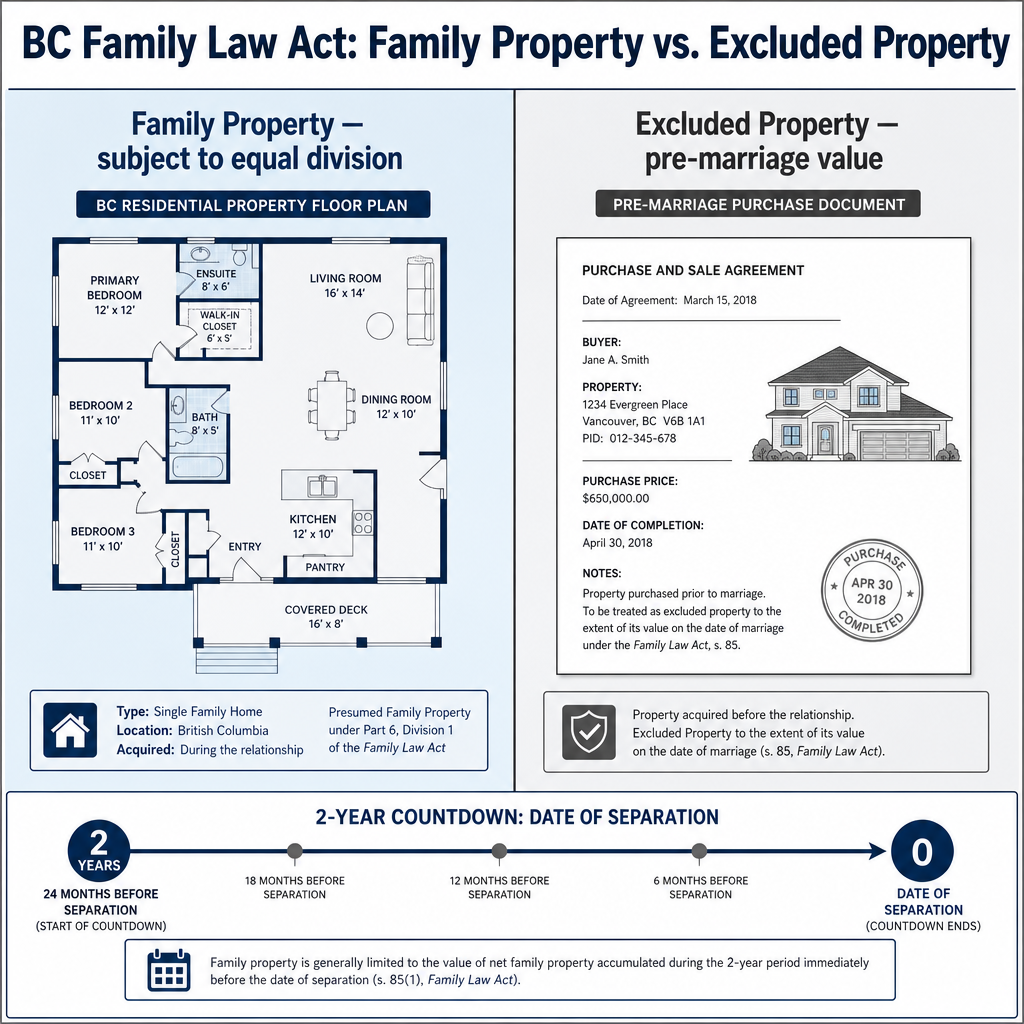
BC Family Law Act and Real Property Division: A Seller's Guide to Family Property vs. Excluded Property, Pre-Marriage Value Treatment, and the Two-Year Limitation Period
For separating homeowners in the Fraser Valley and Metro Vancouver, the decision to sell is rarely just a real estate question. It is also a legal one. BC's Family Law Act determines how property is categorized, who is entitled to what, and when the window to make a claim closes. Getting those answers wrong — or missing a deadline — can cost a spouse tens of thousands of dollars in a market where the average home in the Fraser Valley was valued near $975,000 in April 2026.
This article explains how the Family Law Act treats real property, how the distinction between family property and excluded property affects a home sale, how pre-marriage value is handled when a home has appreciated significantly, and why the two-year limitation period can be the most consequential deadline in the entire process. Nothing here is legal advice — consult a family law lawyer for your specific situation.
Short Answer
Under BC's Family Law Act, family property acquired during a marriage or marriage-like relationship is divided equally on separation. Pre-marriage assets and inheritances may be excluded, but the matrimonial home is always family property regardless of who owned it first. Claims must be filed within two years of separation or rights may be permanently lost.
Key Takeaways
- The Family Law Act presumes equal division of all family property acquired during the relationship.
- The matrimonial home is always family property, even if one spouse owned it before marriage.
- Pre-marriage purchase price is treated as excluded property; appreciation during the marriage may be divisible.
- Inheritances, gifts, and pre-relationship assets can be excluded, but tracing disputes are common.
- The two-year limitation period from separation is a hard deadline — missing it can permanently extinguish claims.
Who This Applies To
- Married spouses separating who own real property in BC
- Common-law partners who have lived together in a marriage-like relationship for at least two years
- Homeowners who purchased before marriage and are now selling during separation
- Sellers who inherited property and are unsure whether it is subject to division
- Anyone approaching or past two years since their separation date
When This Advice May Not Apply
This framework applies to BC-governed property under the Family Law Act. It does not apply if the parties have a valid domestic contract or prenuptial agreement that addresses property division differently, if the property is held in a corporation, trust, or other structure, or if the separation occurred in another province. Always confirm your situation with a BC family law lawyer.
Key Definitions
Family property: Under Part 5 of the Family Law Act, all property owned by either spouse on the date of separation, with limited exceptions. Subject to 50/50 division.
Excluded property: Property that falls outside the equal-division rule — primarily pre-relationship assets, inheritances, and gifts. The burden of proving exclusion typically falls on the spouse claiming it.
Matrimonial home: The family residence used as a home by both spouses. Always family property under the Act, regardless of when it was purchased or whose name is on title.
Limitation period: The legal deadline by which a court proceeding must be initiated. Under BC's Family Law Act, the standard period for property division claims is two years from the date of separation.
Unequal division: A court may depart from the 50/50 presumption if equal division would be "significantly unfair" given factors such as length of marriage, contributions, and economic circumstances.
Data Used in This Article
- BC Family Law Act (Part 5) — Government of British Columbia — official legislation
- Fraser Valley Real Estate Board April 2026 Market Statistics — fvreb.bc.ca — official board data
- Metro Vancouver Real Estate Board March 2026 Market Report — gvrealtors.ca — official board data
- CMHC Housing Market Outlook — Vancouver CMA — cmhc-schl.gc.ca — official federal forecast
Family Property vs. Excluded Property: What the BC Family Law Act Actually Says
Part 5 of the Family Law Act applies to both married spouses and common-law partners who have lived in a marriage-like relationship for at least two years. The starting presumption is straightforward: all property owned by either spouse on the date of separation is family property and must be divided equally.
Excluded property — meaning property not subject to that equal split — includes assets owned before the relationship began, inheritances received by one spouse (before or during the relationship), gifts from third parties, and property explicitly excluded by a valid domestic agreement. The critical word is "tracing." To claim exclusion, a spouse must prove that the asset originated as excluded property and has not been so mixed with family property that its origins can no longer be distinguished.
In real estate contexts, this creates a specific and often contested calculation. If one spouse owned a Langley townhouse before marriage, purchased it for $480,000, and the property is now worth $920,000 at the time of separation, the pre-marriage purchase price of $480,000 is generally treated as excluded property. The $440,000 in appreciation that occurred during the marriage, however, may be treated as family property and subject to equal division.
There is one absolute exception: the matrimonial home. If the couple lived in that Langley townhouse as their family residence at any point during the marriage, it is classified as the matrimonial home. Under the Act, the matrimonial home is always family property — the pre-marriage exclusion does not shield its entire value. This catches many sellers off guard. For Fraser Valley and Surrey homeowners whose properties have appreciated sharply over the last decade, the dollar difference can be significant. See our guide to splitting home equity during a BC divorce for a practical breakdown of how these calculations typically work at the selling table.
The Two-Year Limitation Period: The Deadline That Cannot Be Ignored
Under BC's Limitation Act as it applies to family property claims, separated spouses generally have two years from the date of separation to initiate a court proceeding for division of family property. Missing that deadline does not simply mean a delay — it can permanently extinguish the right to make a claim.
In practice, many separating homeowners in Surrey, Abbotsford, and across the Fraser Valley delay taking action. The reasons are understandable: the emotional weight of the separation, an expectation that the other spouse will cooperate, or a belief that an informal agreement will hold. But informal understandings are not the same as legally binding agreements, and a verbal acknowledgment that property "will be dealt with fairly" does not pause the limitation clock.
The urgency is compounded by current market conditions. According to the Fraser Valley Real Estate Board's April 2026 statistics, the sales-to-active ratio in the Fraser Valley sat at approximately 11%, reflecting a buyer's market with inventory running roughly 50% above the 10-year seasonal average. In this environment, a property that sits while spouses negotiate — or while one party delays — may eventually sell for less than it would have in a more balanced market. Time and legal deadlines are moving in the same direction.
If you are approaching two years from separation and a property sale has not yet been addressed, the conversation with a family law lawyer needs to happen immediately. The question of whether a spouse can force the sale of a home under the Family Law Act is closely tied to these timelines and the options available before the limitation period closes.
How We Evaluate This
When Mansour Real Estate Group is engaged in a divorce-related property sale, we approach every file with a valuation-first framework. Before any listing price is set, we establish a clear picture of current market value using comparable sales, active inventory levels, and property-specific factors. In a buyer's market — which the Fraser Valley currently reflects — accurate pricing is not a negotiating tactic. It is the single biggest variable in how much equity both parties walk away with.
We do not provide legal advice on family property classification, excluded property tracing, or limitation period strategy. Those questions belong to a family law lawyer. What we can do is ensure that the property side of the transaction — timing, preparation, pricing, and process — is handled with precision so the legal resolution, whatever form it takes, is not undermined by a poorly managed sale. We regularly work alongside family law lawyers, mediators, and financial advisors to coordinate the real estate process so it supports rather than complicates the legal proceedings. For situations where both parties cannot agree, understanding the court-ordered property sale process in BC is an important next step.
Divorce Sale Checklist
- Confirm your separation date in writing — this starts the two-year limitation clock.
- Retain a BC family law lawyer before listing the property.
- Gather documentation for any excluded property claims: purchase records, inheritance documents, gift records.
- Obtain a current market valuation from a qualified local real estate agent or appraiser.
- Confirm whether a domestic contract or separation agreement exists and whether it addresses property division.
- Determine whether both spouses have authority to list and sign — or whether a court order is required.
- If a Certificate of Pending Litigation (CPL) has been filed against the property, resolve this before listing.
- Confirm how sale proceeds will be held and distributed — typically in trust with a lawyer.
What We Commonly See
Pre-marriage ownership misunderstood as full exclusion. In our experience, the most common and costly misunderstanding involves homeowners who bought before marriage and assume the entire property value is excluded. When the home became the matrimonial residence, the pre-marriage value exclusion applies only to the original purchase price — not the appreciation that occurred during the relationship. In Fraser Valley markets where properties have doubled or more in value over the past decade, this distinction often involves six-figure sums.
The two-year deadline treated as approximate. What often happens is that separated couples operate informally for months or years after separation — sharing information, making verbal agreements, sometimes even attempting a joint sale — without either party formally initiating a legal claim. When the two-year window closes without a court proceeding filed or a binding separation agreement signed, the legal options narrow significantly.
Pricing decisions made before legal clarity. A common mistake is allowing urgency — financial pressure, a desire to move forward, or market timing — to drive the listing decision before the property division question is resolved. Listing a property before both parties have legal authority to sell, or before a separation agreement or court order addresses distribution of proceeds, can create serious complications at completion. A properly structured sale, coordinated between the real estate team and both parties' lawyers, avoids this entirely.
Questions and Answers
Does the matrimonial home always get divided 50/50 in BC?
Under the Family Law Act, the matrimonial home is family property and subject to the 50/50 presumption regardless of whose name is on title or when it was purchased. A court may order unequal division if equal division would be significantly unfair, but equal division is the legal starting point.
I owned my home before marriage. Is any of its value protected?
The pre-marriage purchase price is generally treated as excluded property. However, if the home became the matrimonial residence, the appreciation during the marriage may be divisible. The original purchase price is excluded; the increase in value during the relationship is typically subject to equal division. Document your original purchase records carefully.
What happens if we miss the two-year limitation period?
In most cases, a family property division claim filed after the two-year period expires will be barred. A court has limited discretion to extend this deadline. If you are approaching two years from your separation date and property division has not been formally addressed through a signed agreement or court proceeding, consult a family law lawyer immediately.
In Summary
BC's Family Law Act divides family property equally on separation — but what counts as family property, what is excluded, and how pre-marriage value is treated are questions that require legal analysis specific to each situation. The matrimonial home is always family property, even if one spouse owned it before marriage. Appreciation during the marriage is typically divisible. And the two-year limitation period is not a suggestion — it is a hard legal deadline that can permanently affect a spouse's financial outcome. In a Fraser Valley market with elevated inventory and buyer-side leverage, time is a factor in both the legal and real estate dimensions of this decision. For the complete selling process, our guide on selling your home during divorce in BC covers the full transaction from listing to closing.
Speak With Our Team
If you are navigating a separation and a property sale is part of the process, Mansour Real Estate Group can provide a current market valuation, explain how the sale process works in this market, and coordinate with your legal counsel to keep the transaction on track. We work with both parties or alongside a single represented party, depending on the structure of the legal proceeding. Contact us when you are ready for a confidential conversation.
Related Articles
- Selling Your Home During Divorce in BC: A Complete Guide for Metro Vancouver and Fraser Valley Homeowners
- Can My Ex Force Me to Sell Our House in a BC Divorce? Your Rights Under the Family Law Act
- Court-Ordered Property Sales in BC: How the Process Works and What to Expect
Official Resources
- BC Family Law Act — Part 5: Division of Family Property (BC Laws)
- Fraser Valley Real Estate Board — April 2026 Market Statistics
- Metro Vancouver Real Estate Board — March 2026 Market Report
- CMHC Housing Market Outlook — Vancouver CMA
About Mansour Real Estate Group
When a home must be sold as part of a separation or divorce — and the legal question of which spouse is entitled to what portion of the proceeds is still being resolved — the real estate team managing the transaction needs to bring structure, neutrality, and market accuracy to a situation where emotions and legal stakes are both running high. Mansour Real Estate Group has worked with homeowners and families navigating divorce-related property sales across the Lower Mainland and Fraser Valley for more than two decades, bringing a valuation-first process to situations where clarity and precision matter most.
Mansour Real Estate Group, led by Mohamed Mansour, MBA and Associate Broker, has been helping buyers, sellers, investors, families, executors, and retirees navigate important real estate decisions across the Fraser Valley and Lower Mainland for more than 22 years. Ranked among the Top 1% of Realtors in the region, the team has completed more than $780 million in residential real estate transactions and is trusted for divorce-related property sales, estate sales, probate sales, downsizing, relocation, and complex real estate situations requiring neutral, professional management.
Whether someone is searching for Realtors experienced with separation and property sales, a real estate agent who understands how family law timelines affect a listing, real estate agents who can work impartially alongside both parties' legal counsel, a trusted real estate team for a joint sale, a Surrey real estate broker, a Langley Realtor, or a real estate group that serves the Fraser Valley and Lower Mainland, Mansour Real Estate Group is known for clear communication, accurate valuations, and a process that protects both parties' financial interests.
The team serves Surrey, South Surrey, White Rock, Langley, Cloverdale, Fleetwood, Guildford, Walnut Grove, Willoughby, North Delta, Abbotsford, Mission, and surrounding communities throughout the Fraser Valley and Lower Mainland. Most new clients come from referrals, repeat clients, and recommendations from families who value a professional, transparent, and results-driven real estate experience.
Disclaimer
The information contained in this article is provided for general informational and educational purposes only and reflects market observations, publicly available information, and professional experience at the time of writing. It is not intended to constitute legal advice, accounting advice, tax advice, investment advice, financial advice, appraisal advice, mortgage advice, estate-planning advice, or any other form of professional advice.
Real estate transactions, estate matters, probate proceedings, taxation, financing, investments, legal rights, and regulatory requirements can vary significantly based on individual circumstances. Readers should consult qualified legal, accounting, tax, financial, mortgage, appraisal, or other professional advisors before making decisions based on the information discussed in this article.
Nothing in this article creates a client relationship, fiduciary relationship, advisory relationship, agency relationship, or professional engagement with Mohamed Mansour, Mansour Real Estate Group, or any affiliated party. Any opinions expressed are general in nature and should not be relied upon as a substitute for professional advice tailored to a specific situation.
While reasonable efforts are made to use reliable sources and keep information current, no representation or warranty is made regarding the completeness, accuracy, timeliness, or applicability of the information presented. Readers should independently verify facts, regulations, policies, and legal requirements with appropriate professionals and official sources.