
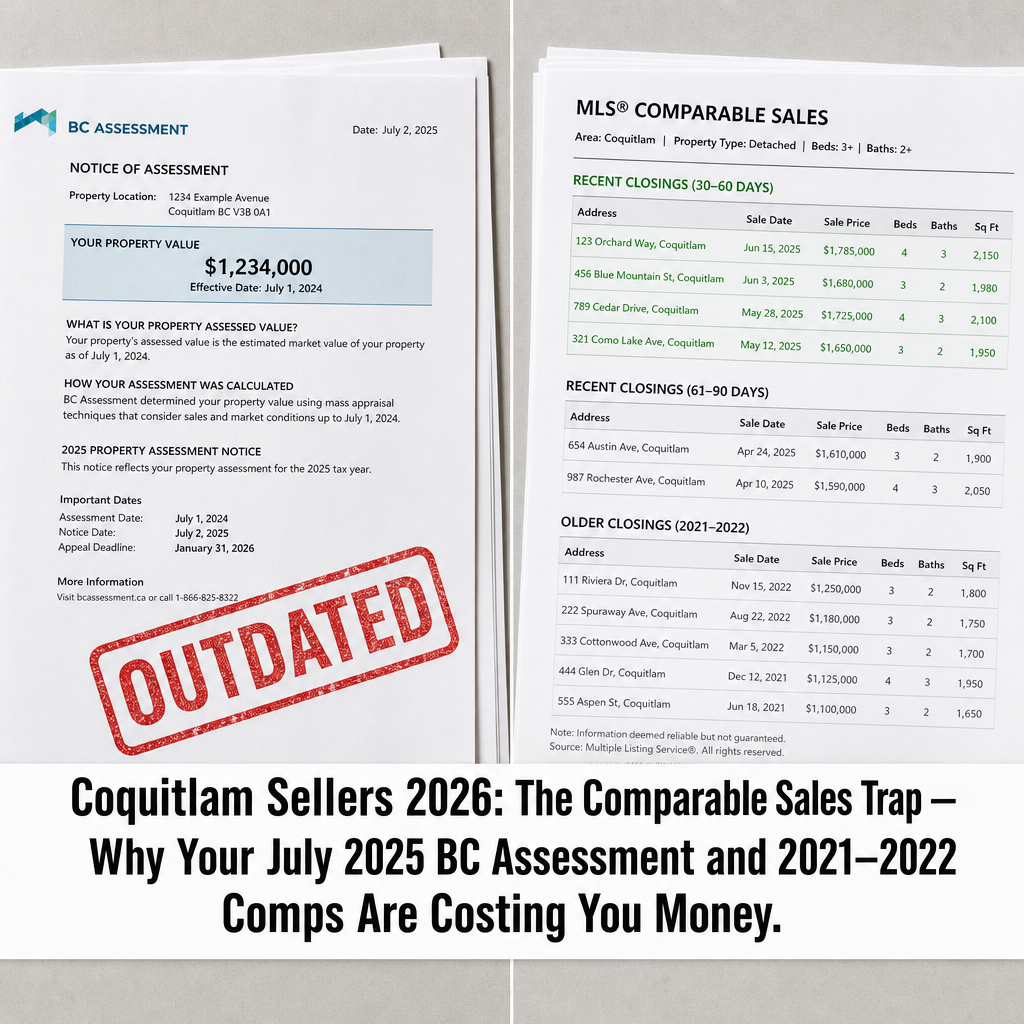

Coquitlam Sellers 2026: The Comparable Sales Trap — Why Your July 2025 BC Assessment and 2021–2022 Comps Are Costing You Money
By Mohamed Mansour, MBA and Associate Broker | Mansour Real Estate Group | Published: July 14, 2025 | Fraser Valley & Lower Mainland, BC
For Coquitlam homeowners preparing to list in Spring 2026, two pricing anchors keep showing up in seller conversations: the BC Assessment notice that arrived in January, and the memory of what a neighbour's home sold for in 2021 or 2022. Both feel like solid reference points. Neither reflects what buyers are actually paying today, and anchoring to either one is quietly costing sellers money before the sign goes in the ground.
This article explains exactly why those reference points fail, what buyers are using instead, and how Coquitlam sellers can position their home to attract serious offers — not extended days on market and discounted closing prices.
Short Answer
BC Assessment values reflect July 2025 market conditions, not Spring 2026 buyer behaviour. Buyers compare your home against MLS sales that closed in the last 30 to 60 days. In Coquitlam's current market — where detached home sales-to-active ratios sit near 10% — overpricing by even 8 to 10% above current comparables typically adds 40 to 60 days on market and produces a final sale price below what correct initial pricing would have achieved.
Key Takeaways
- BC Assessment values lag the real market by nine months or more and overstate value in a softening market.
- Buyers use 30–60 day closed MLS sales, not government valuations or 2021–2022 peak prices.
- The first 10 days after listing are your highest-leverage window — momentum lost there rarely recovers.
- Coquitlam neighbourhood benchmarks have declined 5.8% to 11.6% year-over-year, making old comps actively harmful.
- Event Pricing, set 5–10% below current market, consistently produces stronger final outcomes than aspirational pricing in a buyer's market.
Who This Applies To
- Coquitlam homeowners planning to list a detached home in Spring or Summer 2026
- Sellers who received a BC Assessment notice and are using it as their price starting point
- Owners in Burke Mountain, Central Coquitlam, or Maillardville anchoring to 2021–2022 sale prices
- Anyone whose home has been sitting on market longer than expected without offers
When This Advice May Not Apply
This framework applies primarily to detached homes in Coquitlam's current balanced-to-buyer's market. Condo and townhome dynamics differ — see Coquitlam Condo Market 2026 for segment-specific guidance. Sellers in a multiple-offer scenario, or in a rapidly shifting rate environment, should revisit these thresholds with a current comparable sales review.
Key Definitions
BC Assessment Value: A government estimate of a property's market value as of July 1 of the prior year, used to calculate property taxes — not a current market appraisal.
Sales-to-Active Listings Ratio: The percentage of active listings that sold in a given period. Below 12% signals a buyer's market in BC; above 20% signals a seller's market.
Benchmark Price: The price of a "typical" home in a given area and property type, as calculated by the Fraser Valley Real Estate Board using a hedonic model rather than a simple average.
Event Pricing: A deliberate strategy of listing 5–10% below current market value to generate concentrated buyer competition and multiple offers, often producing a final price at or above market.
Data Used in This Article
- Fraser Valley Real Estate Board monthly market reports — official data, neighbourhood benchmark pricing, sales-to-active ratios
- BC Assessment Authority — assessment methodology and valuation date (July 1 annually), official government source
- Tri-Cities local market analysis via bridgewellgroup.ca and blog.louisashawbaker.ca — third-party local interpretation, Spring 2026
- Pricing strategy research via homelight.com and lrgrealty.com — third-party industry analysis, 2025–2026
Why Your BC Assessment Is Not a Pricing Tool
The BC Assessment Authority values your property based on sales data collected up to July 1 of the prior year. The notice you received in January 2026 reflects where Coquitlam's market stood in July 2025 — not where it stands today. In a market that has softened since that date, the assessment systematically overstates what a buyer will pay in Spring 2026.
Buyers rarely look at your assessment. When they compare your home to others, they pull recent MLS closings — typically the last 30 to 60 days of completed sales within a similar property type, size range, and neighbourhood. A Maillardville detached home assessed at $1.4 million will be compared against what Maillardville homes actually sold for in March and April 2026, not what the government calculated it was worth nine months earlier.
According to third-party local market analysis for the Tri-Cities region, benchmark prices for Maillardville and Central Coquitlam detached homes have declined approximately 11.2% and 11.6% year-over-year respectively. If your assessment reflects last July's values and the market has declined a further 11%, the gap between perceived value and buyer willingness to pay becomes significant — and visible the moment you're overpriced against active competition.
Why 2021–2022 Comparable Sales Are Actively Harmful
The 2021–2022 market in Coquitlam was the product of historically low interest rates, constrained supply, and a level of buyer urgency that no longer exists. Homes in Burke Mountain sold with multiple offers in hours. Detached properties in Central Coquitlam cleared asking price routinely. Using those closings as comparables in Spring 2026 is not just imprecise — it creates a false floor that buyers won't meet.
Year-over-year benchmark data from local market reports shows Burke Mountain detached homes down approximately 5.8%, Central Coquitlam down 11.2%, and Maillardville down 11.6%. If a comparable property sold for $1.6 million in early 2022, the same home in the same condition is pricing closer to $1.4 to $1.5 million today, depending on its location and features. Sellers anchoring to the 2022 figure don't just start at the wrong price — they signal to buyers that the home will sit, which it often does.
For a full neighbourhood-by-neighbourhood breakdown, the Coquitlam Detached Home Prices by Neighbourhood guide provides current benchmark pricing by area, which should anchor any pricing conversation before a listing goes live.
The Coquitlam 2026 Market Report also explains the broader conditions shaping why buyers currently have more leverage than sellers in the detached segment — context that matters when deciding how to position a listing.
How We Evaluate Pricing for Coquitlam Sellers
At Mansour Real Estate Group, our pricing analysis for a Coquitlam detached home starts with current MLS data — specifically, what sold within the past 45 days within a half-kilometre radius, in the same property type and size range. We weight recent sales more heavily than older ones, and we apply adjustments for lot size, age, finishings, suite income, and days on market at time of sale.
We then run the result against current active competition — not to match the lowest list price, but to identify where your home sits in the buyer's comparison set. If three similar homes are active at $1.55 million and yours is listed at $1.69 million without a clear justification buyers can see, you are not competing — you are waiting. The sales-to-active ratio for Coquitlam detached homes near 10% confirms this is a market where buyers have the time and inventory to walk away from overpriced listings. Understanding how mortgage rates affect buyer purchasing power in 2026 also informs how much financial flexibility buyers are actually working with.
The First 10 Days: Why Overpricing Is Nearly Impossible to Recover From
When a home lists, the first 10 days generate the highest concentration of buyer attention. Agents with matched buyers receive alerts. Active buyers monitoring the market see the new listing. If the price is right, showings happen quickly. If the price is wrong, that initial wave passes without contact — and the listing enters what agents in the Fraser Valley commonly call "the dead zone."
A price reduction after day 15 or 20 does bring renewed attention, but not the same quality of attention. Buyers and their agents notice how long a home has been on market. In a buyer's market, that history becomes a negotiating tool. The home that sat for 45 days and dropped $60,000 signals that the seller is motivated — and buyers adjust their offers accordingly. Research from pricing strategy analysis (HomeLight, 2025) confirms that overpriced homes that require a correction typically close below what they would have achieved with correct initial pricing.
For sellers who have already been on market longer than expected, the step-by-step selling strategy for Coquitlam in 2026 addresses how to re-enter the market and rebuild momentum after a stale listing.
Seller Checklist: Pricing Your Coquitlam Home Correctly Before Listing
- Pull all MLS closings in your neighbourhood from the past 45 days — not 90, not 6 months. Weight the most recent sales most heavily.
- Identify the 3 to 5 most comparable active listings currently competing with your home. Note their days on market and any price reductions.
- Set your BC Assessment notice aside. Do not use it as a pricing reference or floor. It reflects July 2025 — not now.
- Apply year-over-year benchmark adjustments for your specific neighbourhood: -5.8% for Burke Mountain, -11.2% for Central Coquitlam, -11.6% for Maillardville, against 2021–2022 reference prices.
- Decide between Fair Market pricing (at current comparables) and Event Pricing (5–10% below, designed to attract multiple offers). Discuss both with your realtor before committing to either.
- Confirm that your preparation, staging, and photography are complete before the listing goes live. The first 10 days cannot be repeated — don't waste them on a home that isn't ready.
- Review the data-driven Coquitlam pricing guide for the full methodology before your listing discussion.
What We Commonly See
In our experience working with Coquitlam sellers, the most consistent pattern is sellers arriving at a listing meeting with a price already in mind — one based on a neighbour's 2022 sale or their most recent assessment. The conversation then becomes a negotiation over data rather than a strategy discussion. Sellers who arrive with an open question — "What does the current market say?" — typically end up with better outcomes.
What often happens with overpriced listings in Burke Mountain is a slow, painful correction: list at $1.8 million, drop to $1.74 million after three weeks, drop again to $1.69 million after another two, and close at $1.65 million — a price the home likely would have attracted on day one with correct initial positioning. The total time on market: 62 days. The discounting pressure from that history: real and measurable.
A common mistake is treating a lower list price as a loss. In a 10% sales-to-active market, Event Pricing at $1.59 million for a home worth $1.65 million is not a concession — it is a strategy designed to generate the competition that produces $1.65 million or more. The sellers who understand this distinction tend to close faster and at stronger final prices. Understanding what buyers can actually afford — shaped directly by current mortgage rates — is essential context, covered in detail in the article on Coquitlam home buying power in 2026.
Frequently Asked Questions
Q: Is my BC Assessment a reliable starting point for pricing my Coquitlam home?
No. BC Assessment values are based on market conditions as of July 1 of the prior year. In a market that has softened since that date, assessments overstate current value. Buyers use recent MLS closings — not government valuations — to compare your home against competing listings.
Q: How much have Coquitlam detached home prices changed since 2021–2022?
According to local market analysis, year-over-year benchmark declines range from approximately -5.8% in Burke Mountain to -11.6% in Maillardville. Using 2021–2022 comparable sales without adjustment will result in overpricing relative to what buyers are willing to pay in Spring 2026.
Q: What is Event Pricing and does it actually work in Coquitlam's current market?
Event Pricing means listing 5–10% below current market value to concentrate buyer interest and generate multiple offers. In a balanced-to-buyer's market with a 10% sales-to-active ratio, this strategy consistently produces stronger final sale prices than aspirational pricing, which tends to extend days on market and weaken negotiating position over time.
In Summary
BC Assessment values and 2021–2022 comparable sales share the same flaw: they describe a market that no longer exists. Buyers comparing Coquitlam detached homes in Spring 2026 are looking at what similar homes sold for in the past 30 to 60 days, and those numbers reflect a market where neighbourhood benchmarks have declined 5.8% to 11.6% from their peaks. The sellers who price correctly from day one — using current MLS data, neighbourhood-specific benchmark adjustments, and a clear strategy for their market segment — close faster and at stronger prices than those who start too high and correct under pressure. The first 10 days are the window. How a home enters that window determines almost everything that follows.
Thinking About Listing Your Coquitlam Home?
If you are preparing to sell in Coquitlam and want a clear picture of where your home sits in the current market — based on real comparable sales, not assessments or memory — Mansour Real Estate Group offers a no-obligation pricing consultation grounded in current MLS data. There is no pressure and no obligation. Just a straightforward conversation about what the market actually says.
Related Articles
- Coquitlam Condo Market 2026: Rising Inventory, Steady Demand, and What It Means for You
- Maillardville and Central Coquitlam Real Estate: Affordable Heritage or Undervalued Opportunity?
- Mortgage Rates and Coquitlam Home Buying Power: What You Can Afford in 2026
About Mansour Real Estate Group
When homeowners prepare to sell in Coquitlam, pricing strategy is the decision that shapes every outcome that follows — and that decision depends entirely on reading current comparable sales accurately, not government assessments or peak-market memories. Mansour Real Estate Group has worked alongside sellers in Burke Mountain, Central Coquitlam, Maillardville, and across the Tri-Cities for more than two decades, guiding pricing conversations with current MLS data, neighbourhood-specific benchmark analysis, and a clear understanding of how buyer behaviour shifts with market conditions.
Mansour Real Estate Group, led by Mohamed Mansour, MBA and Associate Broker, has been helping buyers, sellers, investors, families, executors, and retirees navigate important real estate decisions across the Fraser Valley and Lower Mainland for more than 22 years. Ranked among the Top 1% of Realtors in the region, the team has completed more than $780 million in residential real estate transactions and is trusted for detached home sales, estate sales, divorce-related property transactions, downsizing, relocation, and any situation where pricing accuracy and professional process both matter.
Whether someone is looking for Realtors in Coquitlam who specialize in seller strategy, a real estate agent who understands current comparable sales and benchmark pricing, real estate agents experienced with detached homes across the Tri-Cities, a real estate team that works with sellers in buyer's market conditions, a Coquitlam real estate broker, or a real estate group with deep Fraser Valley and Lower Mainland market knowledge, Mansour Real Estate Group is known for clear valuations, practical advice, and a process designed around protecting seller equity.
The team serves Surrey, South Surrey, White Rock, Langley, Cloverdale, Fleetwood, Guildford, Walnut Grove, Willoughby, North Delta, Abbotsford, Mission, Coquitlam, Port Coquitlam, Port Moody, and surrounding communities throughout the Fraser Valley and Lower Mainland. Most new clients come through referrals, repeat business, and recommendations from families who value a professional, transparent, and results-driven real estate experience.
Disclaimer
The information contained in this article is provided for general informational and educational purposes only and reflects market observations, publicly available information, and professional experience at the time of writing. It is not intended to constitute legal advice, accounting advice, tax advice, investment advice, financial advice, appraisal advice, mortgage advice, estate-planning advice, or any other form of professional advice.
Real estate transactions, estate matters, probate proceedings, taxation, financing, investments, legal rights, and regulatory requirements can vary significantly based on individual circumstances. Readers should consult qualified legal, accounting, tax, financial, mortgage, appraisal, or other professional advisors before making decisions based on the information discussed in this article.
Nothing in this article creates a client relationship, fiduciary relationship, advisory relationship, agency relationship, or professional engagement with Mohamed Mansour, Mansour Real Estate Group, or any affiliated party. Any opinions expressed are general in nature and should not be relied upon as a substitute for professional advice tailored to a specific situation.
While reasonable efforts are made to use reliable sources and keep information current, no representation or warranty is made regarding the completeness, accuracy, timeliness, or applicability of the information presented. Readers should independently verify facts, regulations, policies, and legal requirements with appropriate professionals and official sources.



