

Coquitlam Condo and Townhome Rent vs. Buy Analysis 2026: When Does Ownership Beat Renting at Current Benchmark Prices and Mortgage Rates?
By Mohamed Mansour, MBA and Associate Broker — Mansour Real Estate Group | Fraser Valley and Lower Mainland | Published: July 15, 2025 | Geography: Coquitlam, BC
For renters watching Coquitlam's housing market from the sidelines in 2026, the question isn't simply whether they can afford to buy. It's whether buying actually makes financial sense at today's benchmark prices, mid-4% mortgage rates, and with strata fees and property tax layered on top of the mortgage payment. The numbers look very different once you move past the headline comparison.
This article works through the real monthly cost of owning a Coquitlam condo versus a townhome, compares those costs to current two-bedroom rents, and identifies the conditions under which ownership starts to win the equity-building race. It is written for first-time buyers, renter-investors, and anyone deciding whether 2026 is the year to act.
Short Answer
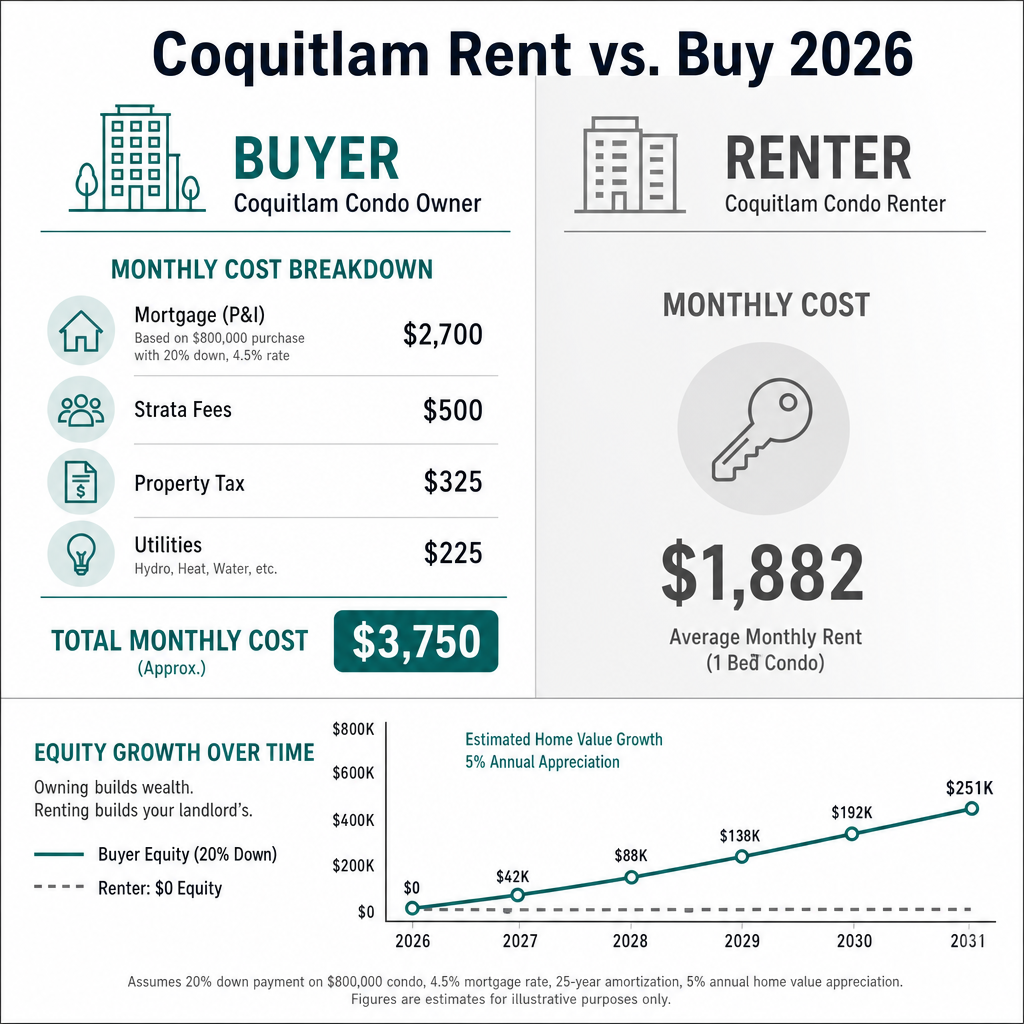
At Coquitlam's current condo benchmark of $680,600 and mid-4% fixed rates, total monthly ownership costs run roughly $3,700–$3,800 compared to a two-bedroom rental averaging $1,882. That gap is real, but buyers with a minimum five-year hold period, a larger down payment, and a townhome over a condo typically reach a financial break-even faster than the headline numbers suggest.
Key Takeaways
- Coquitlam condo ownership carries roughly $1,800–$1,900 more per month than renting a comparable two-bedroom unit.
- Townhomes have lower strata fees but higher overall purchase prices, making the monthly gap slightly narrower than condos.
- The 30-year amortization option for insured mortgages, available since August 2024, meaningfully reduces monthly payments for qualifying buyers.
- Break-even on ownership typically requires a five-plus-year hold, a down payment above 10%, and some degree of price appreciation.
- Renting is cheaper month-to-month in 2026; buying builds equity. The right answer depends on timeline, stability, and financial position.
Who This Applies To
- First-time buyers in Coquitlam weighing a condo or townhome purchase in 2026
- Renters deciding whether to continue renting or enter the market at current prices
- Investor-owners evaluating rental yield against carrying cost
- Buyers who have been waiting for further price correction before acting
When This Advice May Not Apply
This analysis uses benchmark averages, not any specific property. Strata fees, special levies, building age, unit size, and individual mortgage qualification all affect the outcome. This article does not constitute financial, mortgage, or investment advice. Consult a licensed mortgage professional, accountant, and real estate advisor before making a purchase decision.
Data Used in This Article
- Greater Vancouver Realtors benchmark pricing — monthly market reports, 2025–2026; official board data
- CMHC rental market data — two-bedroom average rent, Coquitlam/Tri-Cities zone; official federal housing data
- Bank of Canada policy rate and chartered bank mortgage rates — mid-4% fixed rate range, 2025; official source
- Desjardins rent-vs-buy analysis 2026 — national median comparison; third-party industry research
- Statistics Canada housing cost data — Table 34-10-0133-01; official federal statistics
What the Numbers Actually Show for Coquitlam Condos
The Greater Vancouver Realtors monthly market report places the Coquitlam condo benchmark at approximately $680,600. With a 10% down payment ($68,060), the insured mortgage amount sits at roughly $612,540. At a mid-4% fixed rate on a 30-year amortization — now available for insured purchases since August 2024 — the principal and interest payment runs approximately $2,950 per month.
That is before strata fees, property tax, or utilities. Coquitlam condo strata fees for a two-bedroom unit typically range from $350 to $500 per month depending on building age and amenities. As explored in the article on strata fees and condo living in Coquitlam, older buildings often carry higher fees due to reserve fund obligations. Property tax on a $680,600 Coquitlam condo runs approximately $300–$370 per month. Adding $150–$200 for utilities brings total monthly carrying cost to roughly $3,750–$4,000.
CMHC data shows the average two-bedroom rent in the Coquitlam/Tri-Cities zone at approximately $1,882 per month. That is a carrying cost gap of roughly $1,850–$2,100 per month in favour of renting, in cash flow terms alone.
How Townhomes Compare — and Why the Math Shifts
Coquitlam townhomes are tracked separately in the Coquitlam townhome market analysis for 2026. Benchmarks for two and three-bedroom townhomes currently sit in the $850,000–$950,000 range. At $900,000 with a 10% down payment and mid-4% fixed rate on a 30-year amortization, the monthly mortgage payment runs approximately $3,650.
Townhome strata fees are meaningfully lower — typically $150 to $250 per month — because common area obligations are smaller. Property tax at this price point runs closer to $425–$475 per month. Utilities, particularly for larger units with gas, run $200–$250. Total townhome carrying cost lands in the $4,425–$4,625 range.
The monthly gap versus renting is wider in absolute terms. But townhome buyers typically bring larger down payments and hold longer timelines, which changes the equity math considerably. Buyers considering the townhome segment should also review how mortgage rates affect buying power in Coquitlam before finalizing budget assumptions.
How We Evaluate This
At Mansour Real Estate Group, a rent-vs-buy question is never answered with a single number. We look at down-payment size, hold-period intention, price sensitivity to further correction, and whether the buyer's life circumstances support a five-plus-year stay. A buyer planning to move in two years almost always finds renting cheaper in total cost when closing costs are factored in.
We also separate the financial question from the lifestyle question. Ownership provides stability, control, and the ability to build equity passively. Renting provides flexibility and capital preservation in the short term. The financial break-even matters, but so does the buyer's reason for wanting to own in the first place. Both considerations belong in the same conversation.
When Does Ownership Actually Win?
The break-even calculation depends on three variables: how much of each mortgage payment builds equity (rather than covering interest), what happens to the property's value over the hold period, and what alternative return a renter could earn on their down-payment capital instead.
On a $680,600 condo with 10% down, approximately $800–$900 of the first monthly payment reduces the principal. Over five years, that principal paydown accumulates to roughly $55,000–$65,000, before any price appreciation. If the Coquitlam condo market returns 2–3% annually — consistent with the conservative end of its historical range, as documented in the 2026 Coquitlam real estate market report — the equity position after five years exceeds what a renter typically accumulates from the same monthly cash difference invested elsewhere.
That equation changes if prices fall further, if the buyer exits in under three years, or if closing costs are not factored into the break-even. The full closing cost breakdown for Coquitlam buyers puts entry costs at $15,000–$25,000 for a typical condo purchase, which must be recovered before ownership breaks even on a total-cost basis.
Buyer Checklist: Before You Decide to Buy vs. Rent
- Calculate total monthly carrying cost including mortgage, strata, property tax, and utilities — not mortgage alone
- Confirm your intended hold period; ownership rarely wins the financial comparison under three years
- Factor in closing costs ($15,000–$25,000 for condos) as part of the break-even calculation
- Review the strata's depreciation report and financial statements before committing — special levies change the cost picture significantly
- Model two price scenarios: flat appreciation and modest 2% annual growth over your hold period
- Confirm 30-year amortization eligibility with a licensed mortgage broker before setting your budget
- Ask what your down-payment capital would earn in a low-risk alternative investment over the same hold period
What We Commonly See
Buyers undercount monthly costs by $800–$1,000. In our experience, most buyers arrive at an initial analysis based on the mortgage payment alone. When strata fees, property tax, and utilities are added, the true carrying cost is consistently $800 to $1,000 higher than their first estimate. That changes both the affordability calculation and the break-even timeline.
Short hold periods erase the ownership advantage. What often happens is that buyers accept a higher monthly cost expecting to sell in two to three years. When closing costs are accounted for on both ends of the transaction, the equity built in that window rarely covers them. The ownership advantage is most clearly visible at the five-year mark and beyond.
Townhome buyers reach break-even faster than condo buyers, despite higher prices. A common mistake is assuming the lower strata fee on a townhome is offset by the higher purchase price. In practice, buyers who bring larger down payments to townhome purchases — reducing the insured mortgage requirement and monthly payment — often see the financial gap versus renting compress more quickly than comparable condo buyers carrying minimum down payments at higher strata costs.
Questions and Answers
Is buying a condo in Coquitlam cheaper than renting in 2026?
No, not on a monthly cash flow basis. Total carrying costs for a benchmark Coquitlam condo run approximately $3,750–$4,000 per month. CMHC's two-bedroom rental average for the Tri-Cities sits near $1,882. Renting costs less monthly; buying builds equity.
What is the break-even timeline for buying vs. renting in Coquitlam?
With a 10% down payment, standard closing costs, and modest price appreciation, most buyers reach a financial break-even around the five-year mark. Shorter holds almost always favour renting when total transaction costs are included on both entry and exit.
Does the 30-year amortization option change the rent-vs-buy calculation?
Yes, materially. Moving from a 25-year to a 30-year amortization on a $612,000 insured mortgage at mid-4% reduces the monthly payment by roughly $250–$300, which narrows the gap between ownership cost and current rents. It also means slower equity accumulation in the early years.
In Summary
Renting a two-bedroom unit in Coquitlam is meaningfully cheaper on a monthly basis than owning a comparable condo or townhome in 2026. The ownership advantage is not in cash flow — it is in equity accumulation over time. Buyers with a five-plus-year hold period, a down payment above the minimum, and realistic price assumptions are the ones for whom the math most consistently favours buying. For everyone else, the decision is more personal than financial, and both paths carry real trade-offs worth understanding clearly before choosing.
Ready to Work Through the Numbers for Your Situation?
Mansour Real Estate Group is available to walk through a property-specific comparison — including strata fee review, realistic price modelling, and a clear cost breakdown — so you can make this decision with accurate local data rather than averages. There is no pressure to act; just a structured conversation when you are ready.
Related Articles
- Coquitlam Real Estate Market Report: What the 2026 Data Tells Buyers and Sellers
- Mortgage Rates and Coquitlam Home Buying Power: What You Can Afford in 2026
- CMHC 2026 Forecast and What It Means for Coquitlam Townhome and Condo Buyers
About Mansour Real Estate Group
Understanding whether to rent or buy a condo or townhome in Coquitlam requires more than a headline mortgage payment. It requires an honest look at strata fees, property tax, closing costs, hold-period assumptions, and price recovery scenarios — the kind of analysis that only makes sense when it is grounded in current local market data. Mansour Real Estate Group has been helping buyers and renters in Coquitlam, the Tri-Cities, and across the Fraser Valley and Lower Mainland think through exactly this decision for more than 22 years.
Led by Mohamed Mansour, MBA and Associate Broker, the real estate group has completed more than $780 million in residential transactions and is consistently ranked among the Top 1% of Realtors in the region. The team works with first-time buyers, investor-owners, families relocating within the Tri-Cities, and homeowners downsizing from detached homes into condos and townhomes — situations where the financial trade-offs deserve a thorough and specific analysis, not a generic answer.
Whether someone is searching for a Coquitlam real estate agent who understands the carrying cost difference between property types, Realtors experienced with first-time buyer analysis in the Fraser Valley, a real estate team that provides honest rent-vs-buy modelling, a Tri-Cities real estate broker, or real estate agents who know the strata market well enough to factor depreciation reports into the conversation, Mansour Real Estate Group is known for clarity, accuracy, and practical advice that holds up when tested against actual numbers.
The team serves Coquitlam, Port Coquitlam, Port Moody, Surrey, South Surrey, White Rock, Langley, North Delta, Abbotsford, and surrounding communities throughout the Fraser Valley and Lower Mainland. Most new clients come through referrals and repeat business from families who found the straight-forward, data-grounded approach made a difficult decision easier to navigate with confidence.
Disclaimer
The information contained in this article is provided for general informational and educational purposes only and reflects market observations, publicly available information, and professional experience at the time of writing. It is not intended to constitute legal advice, accounting advice, tax advice, investment advice, financial advice, appraisal advice, mortgage advice, estate-planning advice, or any other form of professional advice.
Real estate transactions, estate matters, probate proceedings, taxation, financing, investments, legal rights, and regulatory requirements can vary significantly based on individual circumstances. Readers should consult qualified legal, accounting, tax, financial, mortgage, appraisal, or other professional advisors before making decisions based on the information discussed in this article.
Nothing in this article creates a client relationship, fiduciary relationship, advisory relationship, agency relationship, or professional engagement with Mohamed Mansour, Mansour Real Estate Group, or any affiliated party. Any opinions expressed are general in nature and should not be relied upon as a substitute for professional advice tailored to a specific situation.
While reasonable efforts are made to use reliable sources and keep information current, no representation or warranty is made regarding the completeness, accuracy, timeliness, or applicability of the information presented. Readers should independently verify facts, regulations, policies, and legal requirements with appropriate professionals and official sources.



