
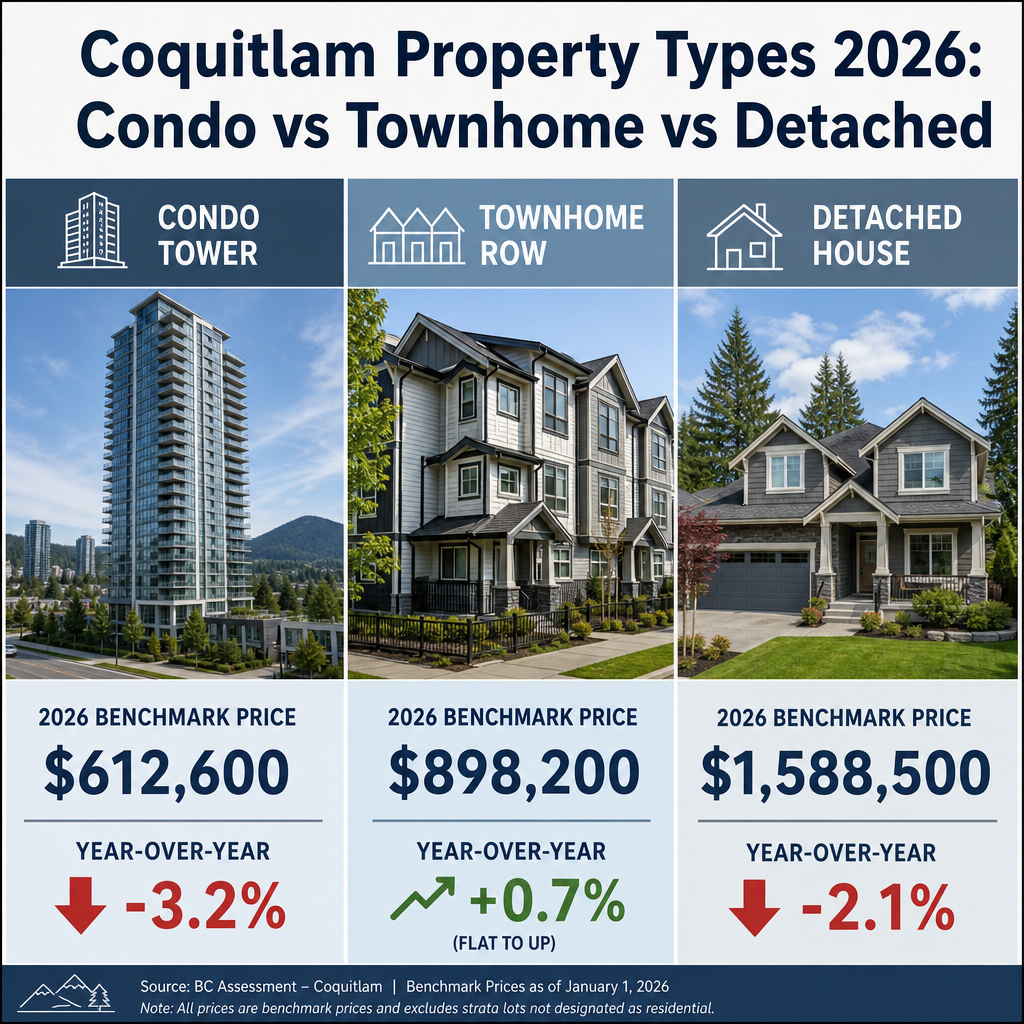

Coquitlam Home Buyer's Complete Property Type Comparison 2026: Condo vs. Townhome vs. Detached — Carrying Costs, Lifestyle Trade-Offs, and CMHC Price Appreciation Forecasts
By Mohamed Mansour, MBA and Associate Broker | Mansour Real Estate Group | Published: July 14, 2026 | Geography: Coquitlam, Tri-Cities, BC
Choosing between a condo, townhome, and detached house in Coquitlam in 2026 is not simply a lifestyle question — it is a financial decision shaped by sharply diverging price trends, monthly carrying costs, and forward-looking forecasts from institutions like CMHC. The three property types are behaving very differently right now, and that difference matters to every buyer deciding where to put their down payment.
This guide compiles current MLS® HPI benchmark data, carrying-cost estimates, strata-fee realities, and CMHC's ground-oriented housing forecasts into one structured comparison. It is written for buyers evaluating Coquitlam in 2026 with a practical, numbers-first approach.
Short Answer
In Coquitlam's 2026 market, townhomes are the only property type appreciating in value (+0.2% year-over-year), while condos and detached homes have each declined 5–8%. CMHC forecasts ground-oriented attached homes to continue outperforming single-detached properties through 2027–2028. For most buyers balancing affordability, carrying costs, and resale potential, townhomes currently present the strongest risk-adjusted position.
Key Takeaways
- Coquitlam townhomes (benchmark ~$998K–$1.09M) are appreciating while condos and detached homes decline.
- Condo carrying costs can exceed median local rents, creating negative-carry risk for buyers and investors.
- Detached homes at Burke Mountain ($1.99M) are down roughly 8% year-over-year, offering negotiating room but price headwinds.
- CMHC forecasts ground-oriented attached housing to outperform single-detached in North Fraser communities through 2027–2028.
- Sales-to-active ratios reveal townhomes near seller's-market conditions (19.9%–21.4%) while detached sits in buyer's territory (10–11.8%).
Who This Applies To
- First-time buyers choosing between entry-level property types in Coquitlam
- Move-up buyers deciding whether to upgrade from a condo to a townhome or detached house
- Investors evaluating carry costs, rental income potential, and resale prospects
- Families weighing space, strata restrictions, and school catchment access
- Buyers comparing Coquitlam neighbourhoods including Burke Mountain, Westwood Plateau, and North Coquitlam
When This Advice May Not Apply
Buyers with highly specific use cases — such as those requiring a suite income to qualify, purchasing for a specific strata community, or working with lenders who treat property types differently — should review these comparisons alongside their mortgage professional and legal counsel. Market conditions shift; all benchmark data should be verified against current board reports before an offer.
Data Used in This Article
- CMHC Housing Market Outlook 2025–2026: Official federal housing agency forecast; national and regional scope; ground-oriented attached housing projections — cmhc-schl.gc.ca
- Coquitlam Market Updates (July–August 2025): MLS® HPI data and sales-to-active ratios; local market analysis; third-party interpretation — sngroup.ca
- Coquitlam Market Update (February 2025): Benchmark prices by property type and neighbourhood — propelmarketing.ca
- Professional interpretation: Carrying-cost estimates based on current benchmark prices, publicly available strata-fee ranges, and standard mortgage assumptions. Not a personalized financial projection.
2026 Benchmark Prices and Market Conditions at a Glance
According to MLS® HPI data reported by local market analysts tracking Coquitlam through mid-2025 to 2026, the three property types sit at very different positions:
| Property Type | Benchmark Price | YoY Change | Sales-to-Active |
|---|---|---|---|
| Condo (apartment) | $671K–$738K | –5% to –6% | Balanced/softening |
| Townhome | $998K–$1.09M | +0.2% | Near seller's market |
| Detached | $1.61M–$1.99M | –5% to –8% | Buyer's market |
The divergence is not subtle. While detached homes across Coquitlam neighbourhoods are losing ground, townhomes are holding — and in some areas, quietly gaining. The full picture of what's driving these conditions appears in the Coquitlam market data overview for 2026.
Burke Mountain detached homes, for example, have reached $1.99M with a year-over-year decline of approximately 8%. North Coquitlam condos sit near $706K, down 6.4%. Westwood Plateau townhomes at roughly $1.13M are essentially flat. These are not citywide averages — they reflect distinct neighbourhood conditions.
Carrying Costs: What You Actually Pay Each Month
Benchmark prices tell you what a property costs. Carrying costs tell you what it costs to hold it. The gap between those two figures is where many Coquitlam buyers get surprised — especially with condos.
Condos ($671K–$738K benchmark): At a $700K purchase with 20% down ($140K), the mortgage principal sits at $560K. At a 5-year fixed rate near 4.5% amortized over 25 years, monthly mortgage payments run approximately $3,050. Add strata fees of $400–$600/month for a typical Coquitlam mid-rise, property taxes of roughly $200–$250/month, and insurance near $40/month. Total monthly carrying cost: approximately $3,700–$3,950.
That compares unfavourably to a two-bedroom rental in Coquitlam, where 2024 median asking rents ran near $1,695–$1,882 per month according to available local rental data. An investor carrying a condo at $3,700–$3,950/month to collect $1,800 in rent faces a negative carry of $1,900 or more monthly before any maintenance costs or strata special levies.
Townhomes ($998K–$1.09M benchmark): At $1.05M with 20% down ($210K), the mortgage is $840K. At 4.5%, monthly payments run approximately $4,580. Townhome strata fees in Coquitlam generally range from $250–$450/month — lower than high-rise condos because there is no elevator, amenity management, or concierge. Property tax adds roughly $300–$350/month. Total monthly carrying cost: approximately $5,150–$5,400.
The gap from condo to townhome in monthly payments is real — roughly $1,300–$1,500/month more — but townhomes also avoid some of the strata governance risk that affects condos. There are no depreciation reports triggering emergency special levies of the scale seen in aging high-rise buildings. And as outlined in the discussion of why townhomes are the strongest Coquitlam segment in 2026, the relative supply constraint continues to support pricing.
Detached ($1.61M–$1.99M benchmark): At $1.7M with 20% down ($340K), the mortgage is $1.36M. Monthly payments near $7,420 at 4.5%. Property taxes run $500–$600/month. No strata fees, but maintenance costs and repair reserves fall entirely on the owner. Total monthly carrying cost: approximately $7,900–$8,100 before utilities and maintenance provisions.
Detached homes in a buyer's market (10–11.8% sales-to-active ratio) do offer negotiation room. A buyer who is patient and well-represented can find genuine value relative to list price — but that negotiation advantage does not change the monthly payment math. The carrying cost of a detached Coquitlam home is substantial and should be stress-tested against the buyer's income and long-term financial plan.
CMHC Forecasts and What They Mean for Coquitlam Buyers
CMHC's Housing Market Outlook identifies ground-oriented attached housing — townhomes and semi-detached — as the segment most likely to outperform single-detached homes through 2027–2028. The reasoning is structural, not speculative. In communities like Coquitlam, Burnaby, and the Tri-Cities, detached land values are high but affordability constraints limit the buyer pool. Townhomes provide ground-level living, private outdoor space, and often better school catchment access without the full land-value premium of a detached property.
That forecast aligns with what the current sales-to-active data already shows. Townhomes at 19.9%–21.4% sales-to-active are approaching the 20% threshold that conventionally marks seller's market conditions. Condos and detached homes are not near that threshold. When institutional forecasters and live market data point in the same direction, the signal is worth taking seriously — though forecasts are not guarantees, and individual circumstances vary.
For buyers concerned about resale, CMHC's framing reinforces the townhome case: a property type that is already appreciating, already supply-constrained, and already supported by commute economics and affordability positioning relative to detached is a more defensible hold than a declining asset class in the same market.
Condos, by contrast, face structural supply pressure. Active inventory in Coquitlam's condo segment rose approximately 23% year-over-year, and days-on-market increased by up to 50% in some sub-markets. The Coquitlam condo market 2026 overview addresses this in detail.
How We Evaluate This
When Mansour Real Estate Group helps buyers evaluate property types in Coquitlam, we start with the carrying-cost comparison — not the purchase price. The monthly delta between property types often shifts the decision before any lifestyle discussion begins. We then layer in the directional trend (appreciation vs. decline), the sales-to-active signal (competitive or negotiable), and the buyer's specific use case: owner-occupant, investor, or growing family.
We do not apply a single recommendation across all buyers. A first-time buyer with $140K down and a focus on building equity faces a very different decision matrix than a family upgrading from a condo who can absorb a higher monthly payment in exchange for school catchment, outdoor space, and lower strata risk. The data framework above is the starting point — the specific conversation follows.
Neighbourhood-Level Divergence: Burke Mountain, Westwood Plateau, and North Coquitlam
Coquitlam is not a single market. The property-type trends above play out differently depending on neighbourhood:
- Burke Mountain: Detached homes have reached $1.99M and declined roughly 8% year-over-year — the sharpest price pressure in the city. Buyers considering Burke Mountain's premium detached market should model at least 5–10% further softening in their worst-case scenario.
- Westwood Plateau: Townhomes near $1.13M are essentially flat year-over-year — the resilience story in action. This area benefits from established schools, mountain access, and a mature community profile that attracts a stable buyer demographic.
- North Coquitlam: Condos near $706K are down 6.4% year-over-year. Transit access via SkyTrain supports demand, but rising inventory and a cautious investor pool are extending days on market. This is the Coquitlam sub-market most exposed to the condo-specific headwinds described above.
The neighbourhood-level divergence is one reason a single citywide average is insufficient for a buying decision. Canyon Springs and Eagle Ridge have shown more resilience than newer growth areas, as covered in the article on Coquitlam's most resilient neighbourhoods. The east-west split matters too — the Coquitlam West vs. East buyer comparison addresses how geography affects property-type selection.
Buyer Checklist
- Calculate your realistic monthly carrying cost — mortgage + strata + tax + insurance — for each property type at current benchmark prices.
- Review strata documents including depreciation report, contingency reserve fund balance, and minutes from the last three AGMs before any condo or townhome offer.
- Verify the sales-to-active ratio for your target property type and neighbourhood — this determines how much negotiating room you have.
- Confirm school catchment boundaries if applicable — these vary by neighbourhood and property address, not just postal code.
- Run a stress test: can you carry the property if mortgage rates rise by 1% or if a special levy arrives?
- For condos and townhomes, ask your Realtor to pull listing days-on-market data by building or complex — not just the neighbourhood average.
- If purchasing as an investment, model rental income against full carrying costs at current asking rents — not projected future rents.
What We Commonly See
Buyers underestimate strata-fee escalation. In our experience, buyers often focus on the current strata fee listed on the data sheet and miss the trajectory. Older Coquitlam high-rises have seen fees increase 15–30% over a few years after deferred maintenance catches up. A $450/month fee today can become $600–$700 within a few years if the building's depreciation report is unfunded.
Detached buyers assume they can negotiate more than they can. What often happens is that a buyer sees a detached home sitting on the market for 30–40 days, assumes the seller is desperate, and makes a very low offer. In many cases the seller simply has a higher-priced mortgage commitment and cannot accept the low number. The property sits longer, but the eventual sale price is not as low as the buyer expected. Understanding the seller's cost basis matters.
Investors overlook negative-carry math on condos. A common mistake is purchasing a Coquitlam condo as a rental investment based on projected appreciation rather than current income. When carrying costs exceed rental income by $1,800–$2,000/month, the investment requires a significant price recovery to break even — and in a market where condos are declining 5–6% per year, that timeline extends considerably.
Questions and Answers
Are Coquitlam townhomes still worth buying if they're near $1M?
At a sales-to-active ratio of 19.9%–21.4%, townhomes in Coquitlam are trading in near-seller's-market conditions. With CMHC forecasting continued outperformance for ground-oriented attached housing, the fundamentals support the price level — but every buyer's carrying-cost situation is different. Run the monthly math before deciding.
Is a Coquitlam condo a good investment rental property in 2026?
Based on current benchmark prices and available rental data, condo carrying costs ($3,700–$3,950/month) significantly exceed typical two-bedroom rents ($1,695–$1,882/month). Negative carry of $1,900+/month makes most Coquitlam condos cash-flow-negative rental investments at this price level. This topic is explored further in the upcoming article on rental property investment in Coquitlam.
Which Coquitlam property type has the most negotiating room in 2026?
Detached homes, with a sales-to-active ratio of 10–11.8%, are firmly in buyer's market territory. Buyers can realistically negotiate on price, completion dates, and included items. Townhomes near seller's-market conditions leave much less room. Condos sit between the two — balanced but softening, with building-specific variation.
In Summary
Coquitlam's 2026 property market has separated into three distinct stories: townhomes appreciating and supply-constrained, condos softening with rising inventory and negative-carry risk, and detached homes declining with negotiating opportunity but substantial carrying costs. CMHC forecasts reinforce the townhome resilience narrative through 2027–2028. For most buyers, the carrying-cost comparison and directional price trend — not just the benchmark price — should anchor the decision. Understanding which neighbourhood you are buying in matters as much as which property type you are choosing.
Talk to a Local Real Estate Team
If you are working through the condo vs. townhome vs. detached decision in Coquitlam or anywhere in the Tri-Cities, Mansour Real Estate Group can provide neighbourhood-specific carrying-cost comparisons and current market data to help you make a grounded decision. No obligation — just clear local expertise.
Related Articles
- Coquitlam Real Estate Market Report: What the 2026 Data Tells Buyers and Sellers
- Coquitlam Detached Home Prices by Neighbourhood: A Complete 2026 Benchmark Guide
- How to Price Your Coquitlam Home Right the First Time: A Data-Driven Approach
About Mansour Real Estate Group
For buyers comparing condos, townhomes, and detached homes in Coquitlam, the property-type decision is inseparable from carrying-cost analysis, neighbourhood context, and an honest read of current market conditions. Mansour Real Estate Group brings that grounded, data-first approach to every buyer conversation — helping clients understand not just what a property costs to buy, but what it costs to hold and what it is likely worth when they eventually sell.
Disclaimer: This article is for informational purposes only and does not constitute legal, financial, or real estate advice. Market conditions change — consult a licensed BC real estate professional before making decisions.



