
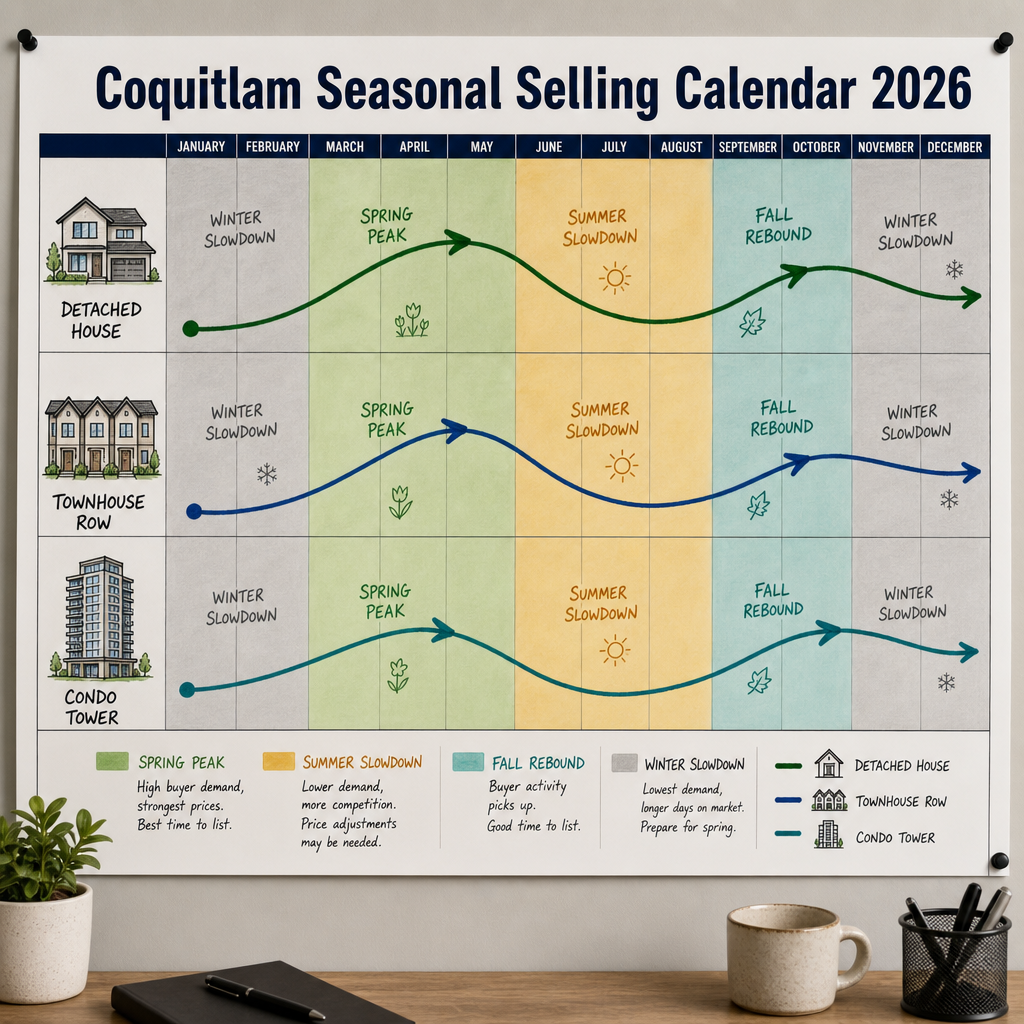

Coquitlam Seasonal Selling Calendar 2026: Month-by-Month Listing Strategy for Detached, Townhouse, and Condo Sellers Based on Historical Buyer Activity and Inventory Patterns
By Mohamed Mansour, MBA and Associate Broker, Mansour Real Estate Group | Fraser Valley and Lower Mainland | Published: June 10, 2026 | Topic: Seller Strategy — Coquitlam and Tri-Cities
If you are planning to sell in Coquitlam this year, the month you list matters — and it matters differently depending on whether you own a detached home, a townhome, or a condo. Seasonal buyer patterns in the Tri-Cities are real, measurable, and directly affect how fast your property sells and how much negotiating room buyers expect. This guide breaks those patterns down month by month so you can make a better-informed decision about when to list.
With the Tri-Cities market currently showing year-over-year price softening across most segments according to the Greater Vancouver Realtors monthly market reports, the first 14 days on market are more decisive than they have been in years. Getting the timing right is no longer optional strategy — it is baseline preparation.
Short Answer
For most Coquitlam sellers, late February through April is the highest-activity window for detached homes and condos. Townhome sellers hold an advantage across more months due to consistently tight inventory. August and January are the weakest listing windows regardless of property type. Fall (late September through October) offers a legitimate secondary opportunity for motivated, well-priced sellers.
Key Takeaways
- Spring listings launched in late February capture two to three times more early showings than mid-season launches at the same price.
- Coquitlam townhomes maintain a 22–23% sales-to-active ratio most of the year, giving sellers a consistent structural advantage other property types do not share.
- August buyer showings in Coquitlam drop 20–30% as families settle before the school year, making aggressive pricing the primary tool for sellers who cannot wait.
- The fall rebound window (late September to October) brings motivated, year-end-deadline buyers with less competition from other listings than spring.
- In 2026's high-inventory environment, the first 14 days on market largely determine whether a listing sells at list price or requires reductions.
Who This Applies To
- Homeowners in Coquitlam, Burke Mountain, Maillardville, Eagle Ridge, River Springs, and Coquitlam West or East planning to list in 2026
- Sellers with flexibility on timing who want to choose the strongest window for their property type
- Investors evaluating the best exit timing for rental condos or townhomes in the Tri-Cities
- Downsizers moving from detached homes to strata properties who need both transactions timed correctly
When This Advice May Not Apply
Life-event sales — estate sales, divorce-related sales, or urgent relocations — rarely allow timing flexibility. If your sale is driven by a legal deadline or a fixed employment start date, pricing strategy and preparation matter more than season selection.
Data Used in This Article
- Greater Vancouver Realtors Monthly Market Reports, 2025–2026 (official board data, including sales-to-active ratios and DOM figures)
- National Association of Realtors Seasonal Perspective Analysis (seasonal activity benchmarks; third-party comparative reference)
- Tri-Cities market commentary, BridgeWell Group and Louisa Shaw Baker, 2026 (local professional interpretation; third-party)
- Mansour Real Estate Group internal market observation across Coquitlam and Tri-Cities transactions (professional experience; internal)
How We Evaluate This
Mansour Real Estate Group tracks sales-to-active ratios, days on market, and showing activity across Coquitlam's three main property segments throughout the year. When advising sellers on timing, we look at the relationship between inventory volume, active buyer demand, and the first-14-day showing window — not just seasonal generalizations. The patterns below reflect both board-reported data and what we observe directly in how buyers behave during different months in the Tri-Cities.
For the 2026 context specifically, we weight the softening trend carefully. A slower market amplifies the timing gap: the difference between listing in late February versus late April is wider now than it was in 2021 or 2022, because buyers have more options and less urgency outside the sharpest demand windows.
The Spring Window: Late February Through May
Spring is the strongest listing window in Coquitlam for all three property types, but not equally. According to GVR board data, Coquitlam detached homes averaged 36 days on market in March and 31 days in April, with a sales-to-active ratio near 10–12% — sitting in buyer's market territory but showing the year's peak activity. Condos move into balanced market conditions during this window. Townhomes push into clear seller's market conditions with sales-to-active ratios reaching 22–23% and DOM near 28–30 days.
The strategic advantage of launching in late February versus waiting until mid-April is real. Nationally, research from the National Association of Realtors confirms that spring brings 30–35% higher buyer activity than the fall average. In Coquitlam, sellers who list in the last week of February capture the early buyer pool — buyers who have been searching through winter and are ready to act — before spring inventory builds and creates more competition on the buyer side.
By property type: Detached sellers should aim to list by mid-March at the latest to stay inside the highest-demand window. Townhome sellers can extend through April and still expect strong activity. Condo sellers benefit most from March launches because the balanced conditions in this segment require strong first-impression momentum — without it, listings drift toward price reductions by May.
Summer, Fall, and Winter: Reading the Slowdowns and Rebounds
June and July remain active but represent the tail end of peak season. Buyer pools are smaller than April but still healthy. Detached homes sell 5–10 days faster in April than in August, according to GVR data trends. For sellers who missed the spring window, June is a reasonable alternative — but preparation must be tighter because buyers have already seen considerable inventory and are more selective.
August through mid-September is the most challenging window. Buyer showings in the Tri-Cities drop an estimated 20–30% as families manage school registration, summer travel, and routine re-establishment. Sellers who list in this window need to price more aggressively or accept extended days on market. The one advantage is reduced competition: fewer listings means more visibility for well-prepared properties. Townhome sellers are partially insulated here because inventory tightness protects their segment even in slower months, while detached sales-to-active ratios can drop to 8–10%.
Late September through October delivers a genuine fall rebound. The buyers in this window tend to be motivated by year-end deadlines — lease expirations, job relocations, and family transitions that did not resolve over summer. Competition from other listings is lower than spring, which means a well-priced, well-prepared property gets disproportionate attention. This is a legitimate second-choice window for detached sellers, and a reasonable primary window for sellers who prefer a quieter but motivated buyer pool.
November through January is the slowest period. National data shows days on market averaging 49 days versus 31 days at the spring peak — roughly 40–50% longer. In Coquitlam, detached homes feel this most acutely. Condos and townhomes hold relatively better but still require pricing discipline. Sellers who list in winter do so by necessity rather than by choice, and buyers in this window typically expect more negotiating room. If you have flexibility, avoid January and February launches and instead use that time to prepare for a late February entry.
Seller Checklist
- Confirm your target listing date based on property type and the seasonal window that fits your situation.
- Work backward eight to ten weeks from your target date to schedule repairs, staging, and photography.
- Request a comparative market analysis anchored to sales within the prior 60–90 days in your specific Coquitlam neighbourhood, not board-wide averages.
- If listing a strata property, gather current strata documents, Form B, and depreciation report at least three weeks before listing — buyers will request these immediately.
- Plan your pricing to land within 2–3% of recent comparable sales so the first 14 days generate active showings, not silence.
- If you must list in August or winter, build a pricing review trigger into your plan: if no acceptable offers arrive in 14 days, reassess before the listing goes stale.
What We Commonly See
Sellers underestimate the cost of missing the spring window. In our experience, a detached home that would have sold in 21 days in late March can easily sit 45–55 days if listed in early May once spring inventory peaks. The gap between "early spring" and "late spring" is as meaningful as the gap between spring and summer.
Condo sellers often over-rely on general market sentiment. What often happens is that a seller reads a positive headline about the Coquitlam market and lists in August expecting spring-like results. The condo segment in Coquitlam is in balanced conditions at its best — in August, it leans toward buyers. Timing and precise pricing are the primary tools for condo sellers regardless of season.
Townhome sellers sometimes wait unnecessarily. A common mistake is holding a townhome listing until "the market improves" when the townhome segment in Coquitlam already operates in seller's market conditions for most of the year. Waiting for a better season may cost more than listing in a slightly slower month with less competition.
Questions and Answers
Is spring always the best time to sell a detached home in Coquitlam?
Spring (late February to April) is consistently the highest-activity window for detached homes in Coquitlam. GVR data shows the shortest days-on-market and highest sales-to-active ratios during this period. Exceptions exist for sellers with exceptional properties or neighbourhoods with year-round demand, but spring is the default strongest window.
What happens if I miss the spring window and have to list in August?
August listings in Coquitlam face 20–30% fewer buyer showings than spring. The practical response is either pricing sharply to attract the smaller active buyer pool or waiting for the fall rebound starting in late September. Listing at full spring pricing in August and hoping for spring results is the most common and most costly mistake in this scenario.
Do townhome sellers in Coquitlam really have an advantage in winter?
Relatively, yes. Coquitlam townhomes maintain tighter inventory and stronger sales-to-active ratios than detached homes through winter. They still experience slower activity than spring, but the structural supply shortage in this segment provides a buffer that detached sellers do not have. A well-priced townhome listed in November can still attract multiple interested buyers, whereas a detached home in the same month requires considerably more patience and pricing discipline. Investors considering timing their exit from a rental townhome should also review rental property investment considerations for Coquitlam before deciding.
In Summary
Seasonal timing in Coquitlam is not a minor variable — it is one of the highest-leverage decisions a seller makes before a listing goes live. Spring remains the strongest window across all property types, with late February launches capturing the deepest buyer pools before inventory builds. Townhome sellers carry a structural advantage across more months than detached or condo sellers. August and January are the most difficult windows for any property type. The fall rebound is real and underused. In a softening 2026 market, the first 14 days on market are more decisive than they have been in years — and getting the season, pricing, and preparation aligned is the difference between a smooth sale and an extended, price-reduced one.
Talk to a Local Coquitlam Seller Specialist
If you are deciding when to list your Coquitlam home, Mansour Real Estate Group can walk you through the specific data for your property type and neighbourhood — not seasonal averages, but current conditions for homes like yours. There is no obligation to a conversation, and the right timing decision is worth getting right before you commit.
Related Articles
- Coquitlam Real Estate Market Report: What the 2026 Data Tells Buyers and Sellers
- Coquitlam Condo Market 2026: Rising Inventory, Steady Demand, and What It Means for You
- First-Time Buyer's Guide to Purchasing a Home in Coquitlam in 2026
- Closing Costs When Buying a Home in Coquitlam: The Complete Breakdown
- Is Coquitlam a Good Place to Invest in Rental Property in 2026?
About Mansour Real Estate Group
When homeowners in Coquitlam, Burke Mountain, Maillardville, Eagle Ridge, and across the Tri-Cities are preparing to sell, the decisions made before the listing goes live — timing, pricing, preparation, and how to position the property for current buyer expectations — typically determine the outcome more than anything that happens after. Mansour Real Estate Group has guided sellers across the Fraser Valley and Lower Mainland through those decisions for more than 22 years, with a process built around accurate valuations, honest advice, and protecting seller equity.
Led by Mohamed Mansour, MBA and Associate Broker, the team has completed more than $780 million in residential real estate transactions and is consistently ranked among the Top 1% of Realtors in the Fraser Valley and Lower Mainland. Mansour Real Estate Group is trusted for detached home sales, townhome and strata transactions, condo listings, estate sales, downsizing transitions, and complex seller decisions across the Tri-Cities and surrounding communities.
Whether someone is searching for Realtors who understand Coquitlam's seasonal market cycles, a real estate agent with specific Tri-Cities experience, real estate agents who can advise on listing timing by property type, a Fraser Valley real estate team for a strategic seller consultation, a Coquitlam Realtor, a Tri-Cities real estate broker, or a real estate group trusted for results-driven seller representation, Mansour Real Estate Group is known for clear market analysis, strategic pricing, and practical advice grounded in years of local transaction experience.
The team serves Surrey, South Surrey, White Rock, Langley, Cloverdale, Fleetwood, Guildford, Walnut Grove, Willoughby, North Delta, Abbotsford, Mission, Coquitlam, Port Coquitlam, Port Moody, and surrounding communities throughout the Fraser Valley and Lower Mainland. Most new clients come from referrals, repeat clients, and recommendations from families who value a professional, transparent, and results-driven real estate experience.
Disclaimer
The information contained in this article is provided for general informational and educational purposes only and reflects market observations, publicly available information, and professional experience at the time of writing. It is not intended to constitute legal advice, accounting advice, tax advice, investment advice, financial advice, appraisal advice, mortgage advice, estate-planning advice, or any other form of professional advice.
Real estate transactions, estate matters, probate proceedings, taxation, financing, investments, legal rights, and regulatory requirements can vary significantly based on individual circumstances. Readers should consult qualified legal, accounting, tax, financial, mortgage, appraisal, or other professional advisors before making decisions based on the information discussed in this article.
Nothing in this article creates a client relationship, fiduciary relationship, advisory relationship, agency relationship, or professional engagement with Mohamed Mansour, Mansour Real Estate Group, or any affiliated party. Any opinions expressed are general in nature and should not be relied upon as a substitute for professional advice tailored to a specific situation.
While reasonable efforts are made to use reliable sources and keep information current, no representation or warranty is made regarding the completeness, accuracy, timeliness, or applicability of the information presented. Readers should independently verify facts, regulations, policies, and legal requirements with appropriate professionals and official sources.



